Florida Lead Based Paint Disclosure For Rental Transaction
Description
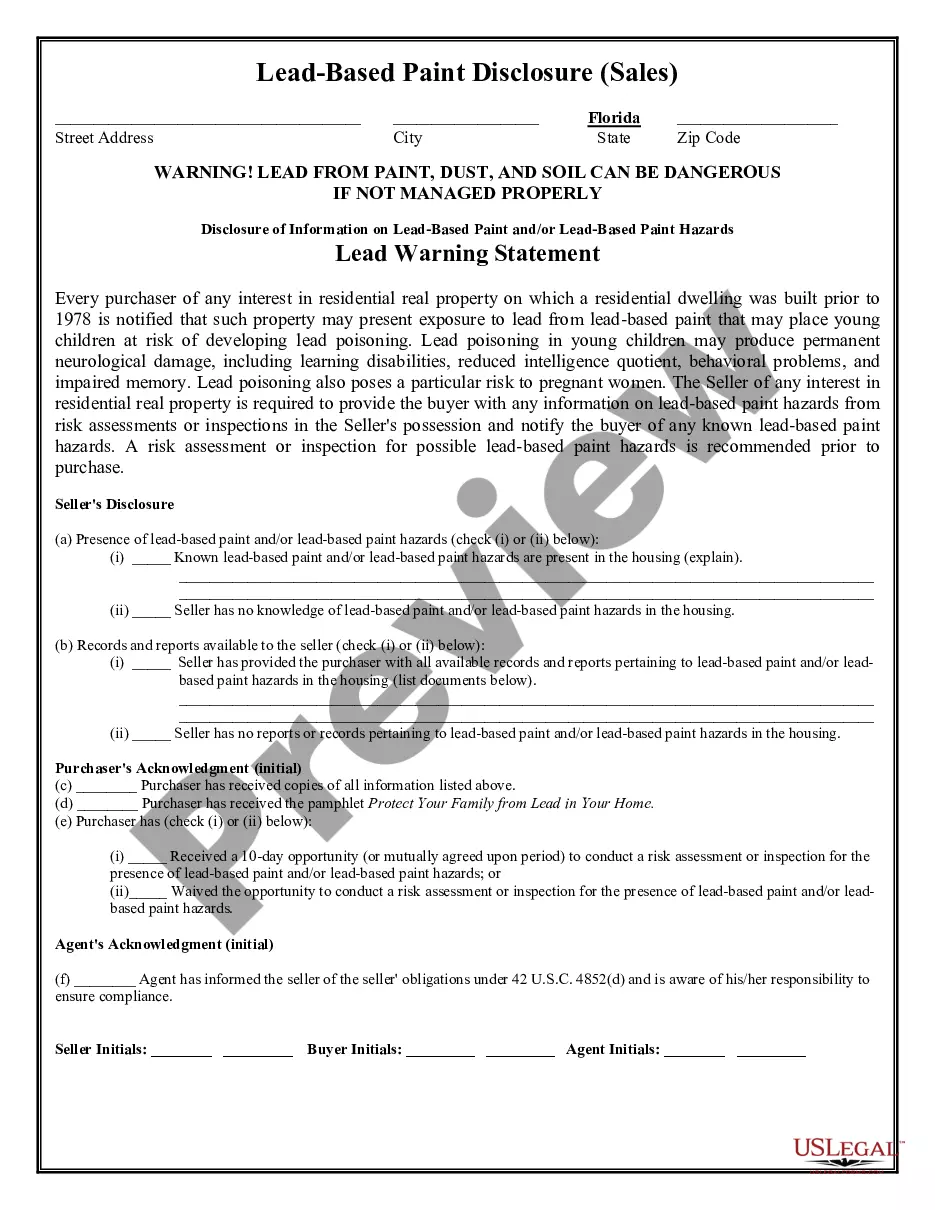

Get your form ready online
Our built-in tools help you complete, sign, share, and store your documents in one place.
Make edits, fill in missing information, and update formatting in US Legal Forms—just like you would in MS Word.
Download a copy, print it, send it by email, or mail it via USPS—whatever works best for your next step.
Sign and collect signatures with our SignNow integration. Send to multiple recipients, set reminders, and more. Go Premium to unlock E-Sign.
If this form requires notarization, complete it online through a secure video call—no need to meet a notary in person or wait for an appointment.
We protect your documents and personal data by following strict security and privacy standards.

Make edits, fill in missing information, and update formatting in US Legal Forms—just like you would in MS Word.

Download a copy, print it, send it by email, or mail it via USPS—whatever works best for your next step.

Sign and collect signatures with our SignNow integration. Send to multiple recipients, set reminders, and more. Go Premium to unlock E-Sign.

If this form requires notarization, complete it online through a secure video call—no need to meet a notary in person or wait for an appointment.

We protect your documents and personal data by following strict security and privacy standards.
Looking for another form?







How to fill out Florida Lead Based Paint Disclosure For Sales Transaction?
Regardless of whether for professional needs or personal issues, everyone must deal with legal circumstances at some stage in their lifetime.
Filling out legal documents requires meticulous care, beginning with choosing the right form template.
Once it is saved, you can fill out the form using editing tools or print it and complete it manually. With a vast library of US Legal Forms available, you don't have to waste time searching for the right sample online. Utilize the library's easy navigation to find the right template for any situation.
- For example, if you choose an incorrect version of the Florida Lead Based Paint Disclosure For Rental Transaction, it will be denied upon submission.
- Thus, it is crucial to find a reliable source of legal forms like US Legal Forms.
- If you need to acquire a Florida Lead Based Paint Disclosure For Rental Transaction template, follow these simple steps.
- Locate the sample you require using the search bar or catalog browsing.
- Review the description of the form to ensure it fits your situation, state, and county.
- Click on the preview of the form to examine it.
- If it is the wrong form, return to the search feature to locate the Florida Lead Based Paint Disclosure For Rental Transaction sample you need.
- Download the template once it fulfills your requirements.
- If you have a US Legal Forms account, click Log in to access previously stored documents in My documents.
- If you do not have an account yet, you can obtain the form by clicking Buy now.
- Select the appropriate pricing option.
- Complete the profile registration form.
- Choose your payment method: use a credit card or PayPal account.
- Select your desired file format and download the Florida Lead Based Paint Disclosure For Rental Transaction.
Form popularity
FAQ
Costs and Timeframes Once you file your completed paperwork, it usually takes about 30 days for the court to decide if they will grant guardianship. Lawyer and court costs are generally $2,000 to $5,000, depending on where you live in Texas and how hard it is to get the guardianship completed.
A guardianship must be created by the court through a formal appointment process. In larger counties, the proceedings will be initiated in the Probate Court. For smaller counties that do not have a probate court, the County Court or County Court at Law will be the appropriate court.
You must hire an attorney. You have a right to represent yourself in court, but you do not have the right to represent another person. Only a licensed attorney may represent the interests of the proposed ward. The Process: Your attorney will file an application for guardianship with the county court.
Guardianship is not an easy, quick or inexpensive process. It requires the services of a licensed attorney because it involves a legal action against the person in question, which may result in a loss of their rights.
Once you file your completed paperwork, it usually takes about 30 days for the court to decide if they will grant guardianship. Lawyer and court costs are generally $2,000 to $5,000, depending on where you live in Texas and how hard it is to get the guardianship completed.
If Appointed Guardian: Within 20 days of appointment, you must sign under oath that you will perform the duties of a legal guardian and post a bond with the court. After you post the bond, the clerk will issue ?Letters of Guardianship? to prove that you are the guardian. The letters expire after 16 months.
Guardianship of the Person: When a Texas court awards guardianship of the person, this means that the legal guardian is responsible for providing supervision, care, food, clothing, shelter, and medical treatment for the ward.
In Texas, the process to appoint a guardian includes: Filing an application with a court. Having a hearing before a judge. Having a judge appoint a guardian, if one is needed.