Notice To Owner/notice To Contractor Florida
Description
Get your form ready online
Our built-in tools help you complete, sign, share, and store your documents in one place.
Make edits, fill in missing information, and update formatting in US Legal Forms—just like you would in MS Word.
Download a copy, print it, send it by email, or mail it via USPS—whatever works best for your next step.
Sign and collect signatures with our SignNow integration. Send to multiple recipients, set reminders, and more. Go Premium to unlock E-Sign.
If this form requires notarization, complete it online through a secure video call—no need to meet a notary in person or wait for an appointment.
We protect your documents and personal data by following strict security and privacy standards.

Make edits, fill in missing information, and update formatting in US Legal Forms—just like you would in MS Word.

Download a copy, print it, send it by email, or mail it via USPS—whatever works best for your next step.

Sign and collect signatures with our SignNow integration. Send to multiple recipients, set reminders, and more. Go Premium to unlock E-Sign.

If this form requires notarization, complete it online through a secure video call—no need to meet a notary in person or wait for an appointment.

We protect your documents and personal data by following strict security and privacy standards.
Looking for another form?
How to fill out Florida Notice To Owner Form - Construction - Mechanic Liens - Corporation?
- If you’re already a user, log into your account at US Legal Forms and locate the 'Notice to Owner/Notice to Contractor Florida' template to download it directly.
- For first-time users, start by browsing the comprehensive library. Use the preview function to check the specifics of the template ensuring it meets your legal needs.
- If the current selection isn’t right, utilize the search feature to find an alternative form that fits your requirements.
- Select the desired document and proceed by clicking the 'Buy Now' button. Choose a subscription plan that suits you best and create an account to gain full access to the forms.
- Complete your purchase by entering your payment details, either through credit card or PayPal.
- Once processed, download the form to your device for quick access. You can always revisit your forms in the 'My Forms' section of your profile.
In conclusion, US Legal Forms streamlines the process of obtaining legal documentation, ensuring that you have all the necessary tools at your fingertips. With over 85,000 forms available, you can rest assured you have what you need.
Don't hesitate to enhance your legal processes - visit US Legal Forms today and empower your documentation experience!
Form popularity
FAQ
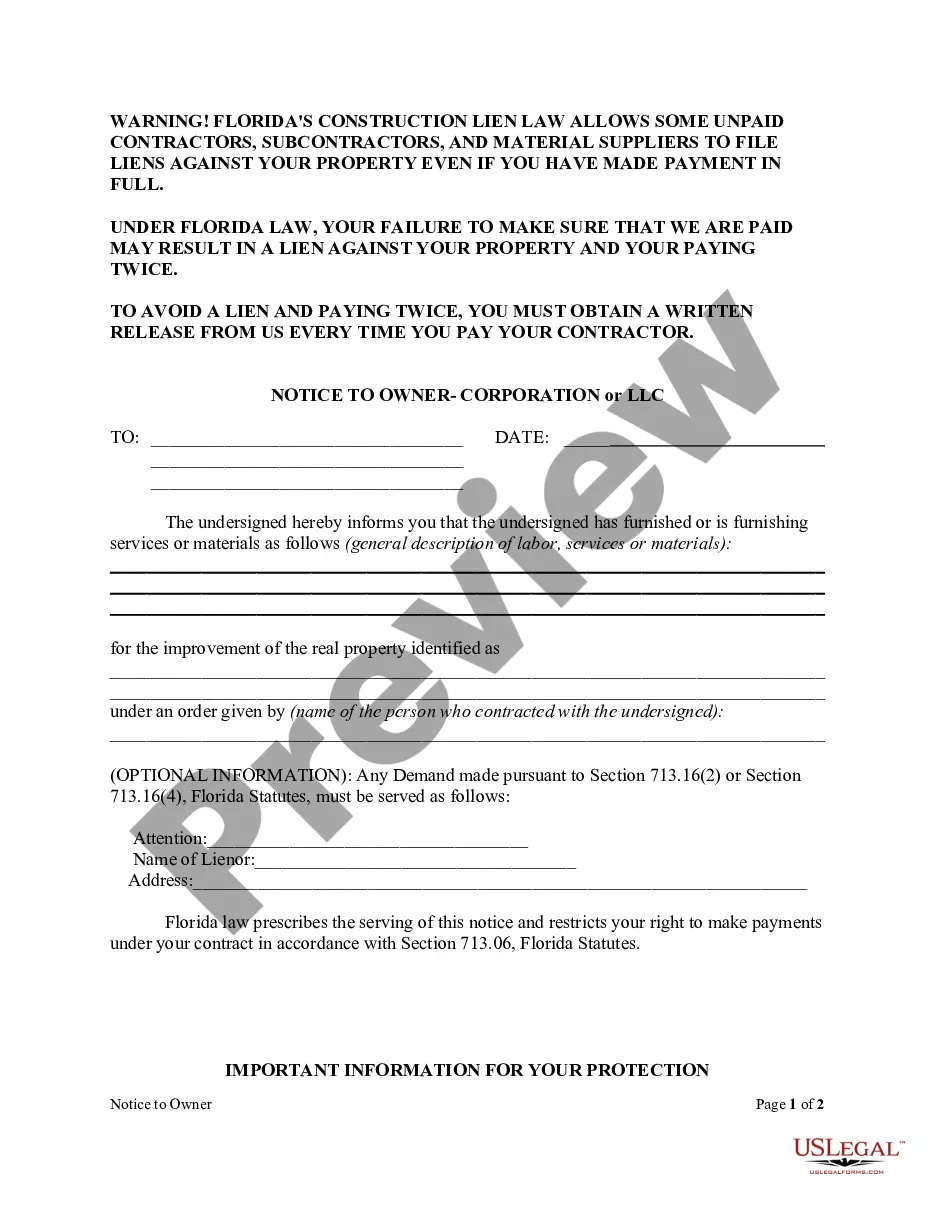
Filing a Notice to Owner in Florida involves several straightforward steps. First, you must gather all relevant information about the property, the contractor, and the work performed. Next, prepare the notice document, ensuring it includes accurate details to comply with Florida laws. Finally, serve the notice to the property owner and the contractor, keeping a copy for your records. For a smooth process, consider using the US Legal Forms platform, where you can find templates and guidance for filing a Notice to Owner/Notice to Contractor Florida.
A Notice to Owner is not the same as a Notice of Commencement in Florida. The Notice to Owner informs the property owner of participants in the construction project, while the Notice of Commencement formally declares the start of construction. Understanding the differences between these two notices is crucial for compliance and protecting your rights within the construction framework.
In Florida, filing a lien without first providing a Notice to Owner may limit your rights. Typically, you must send this notice to preserve your lien rights effectively. Failing to provide the notice can result in losing the ability to file a lien, potentially jeopardizing your payment for services rendered or materials supplied on the project.
In Florida, the duration for a contractor to complete a job typically depends on the terms outlined in the contract. While there is no specific legal timeframe mandated statewide, contractors must adhere to agreed timelines to ensure customer satisfaction and legal compliance. Understanding this timeframe is beneficial for both parties, enhancing communication and project management.
To file a Notice to Owner in Florida, you can use a template that outlines the essential components required by the law. Visit the US Legal Forms platform, which offers customizable templates to assist you in drafting an accurate and legally compliant notice. Once completed, the notice should be delivered to the property owner via certified mail to ensure proper record-keeping and documentation.
In Florida, an owner must file a Notice of Completion within 90 days of the substantial completion of a project. This document notifies interested parties of the project's completion status. Filing this notice is essential, as it serves as a final step in the construction process and helps limit the time frame for contractors to file any lien claims.
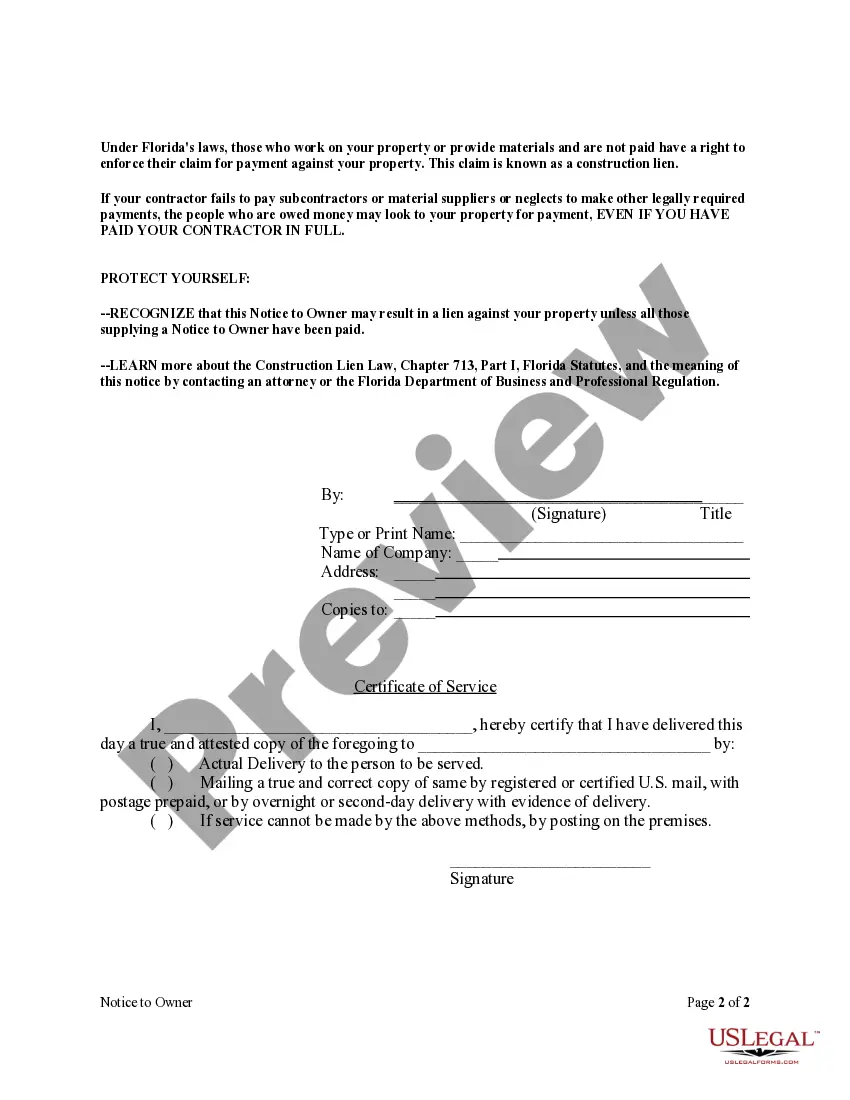
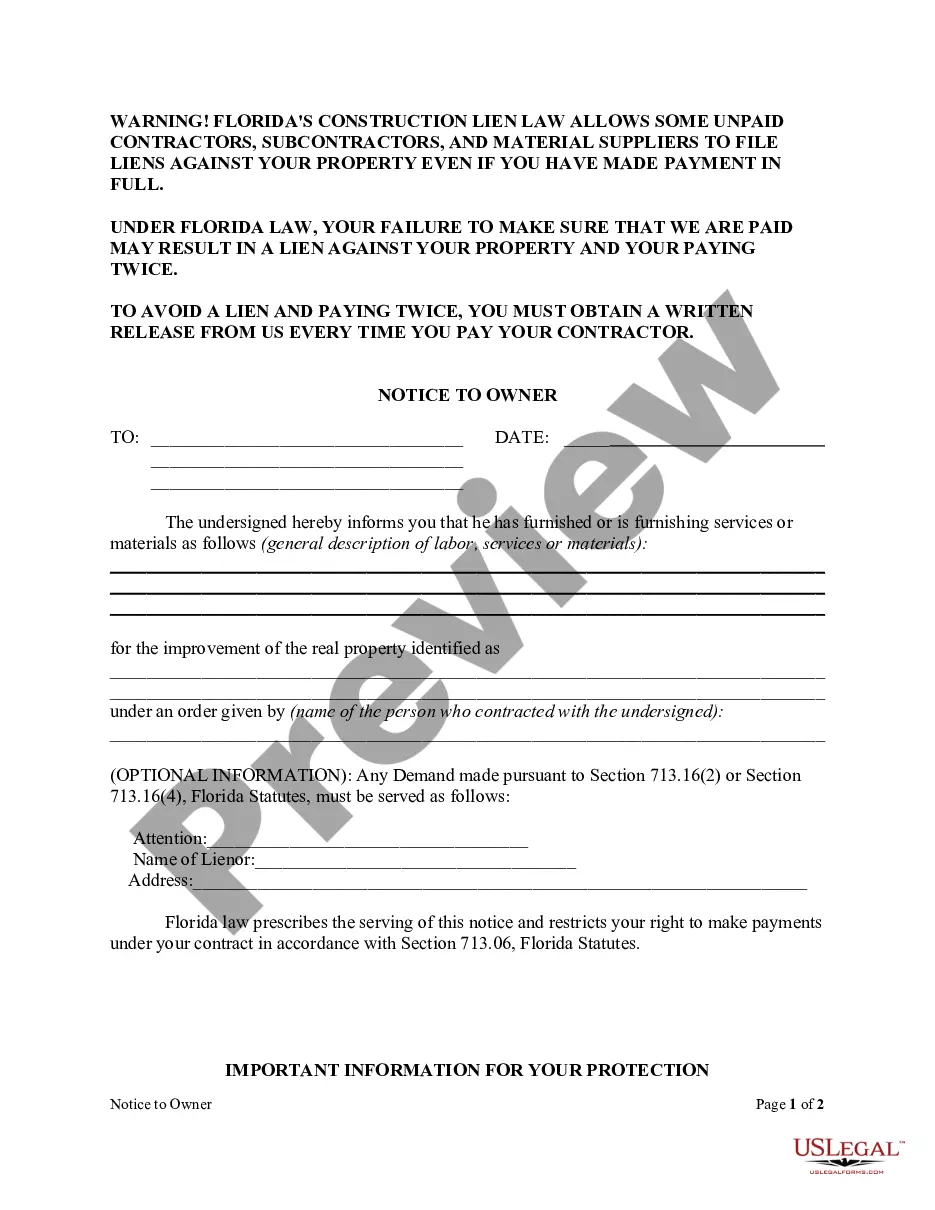
A Notice to Owner, also referred to as a notice to contractor in Florida, serves as a formal notification from subcontractors or suppliers to the property owner. This document notifies the owner of individuals or companies providing labor or materials for a project. By sending this notice, subcontractors protect their rights to file a lien if necessary, reinforcing their claims for payment in the event of default.
In Florida, a Notice to Owner must be in writing and provide specific details about the project. You need to include the property address, the date of the notice, and the name of the contractor. Additionally, it is important to deliver this notice to the owner or their authorized agent within 45 days of starting work on the project. This process ensures your right to file a lien later, making it a crucial step in the construction process.
A notice of commencement is a document that signals the start of construction work, while a Notice to Owner informs property owners and contractors of a potential lien claim. They serve different purposes in the construction process. Understanding their distinct roles is essential for protecting your rights and ensuring a smooth project flow. Platforms like USLegalForms can help clarify these differences.
In Florida, a Notice to Owner does not need to be notarized. However, it must be in writing and delivered to the appropriate parties within the required timeframe. Ensuring accurate completion of the form is vital for the notice to be effective. For simplicity and efficiency, using services like USLegalForms can help ensure proper documentation.