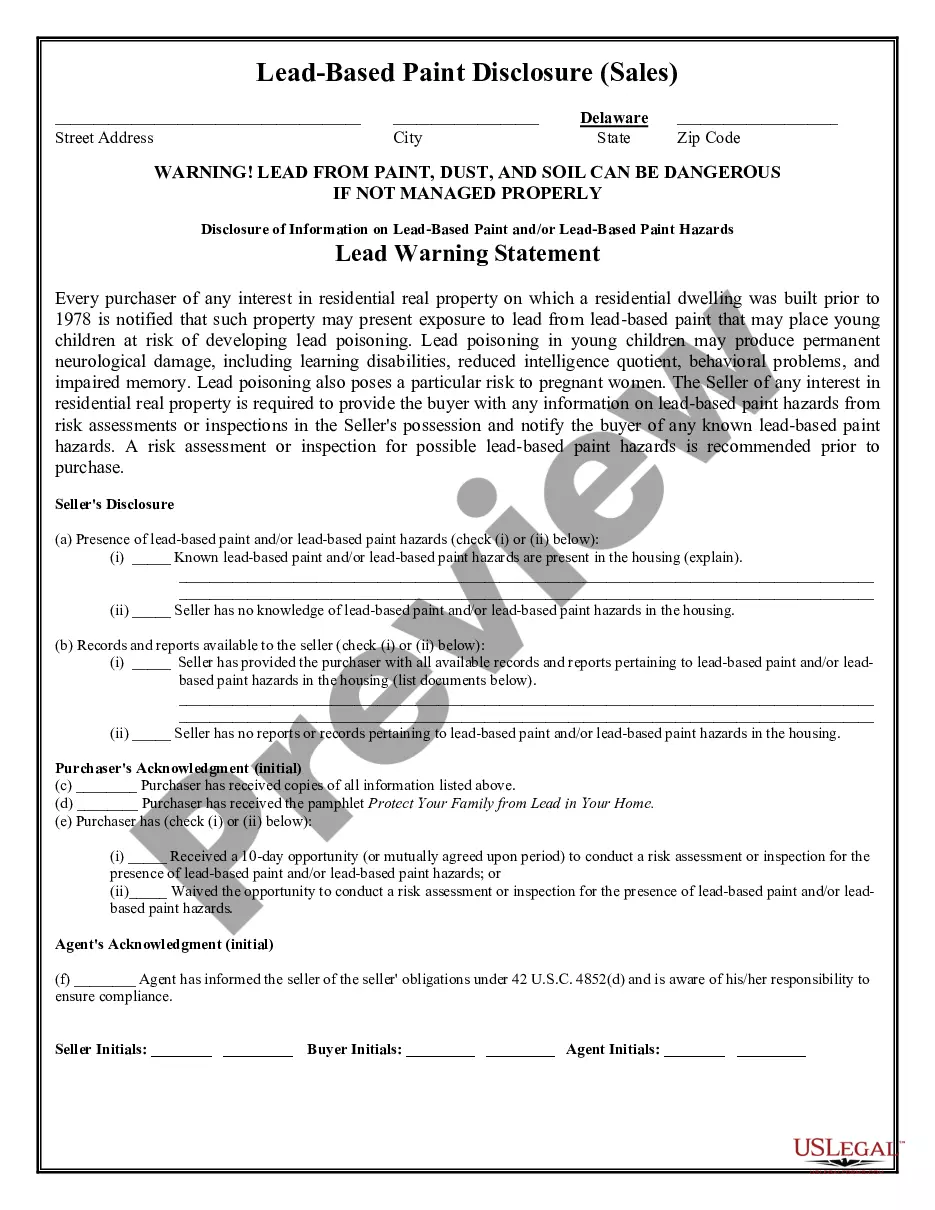
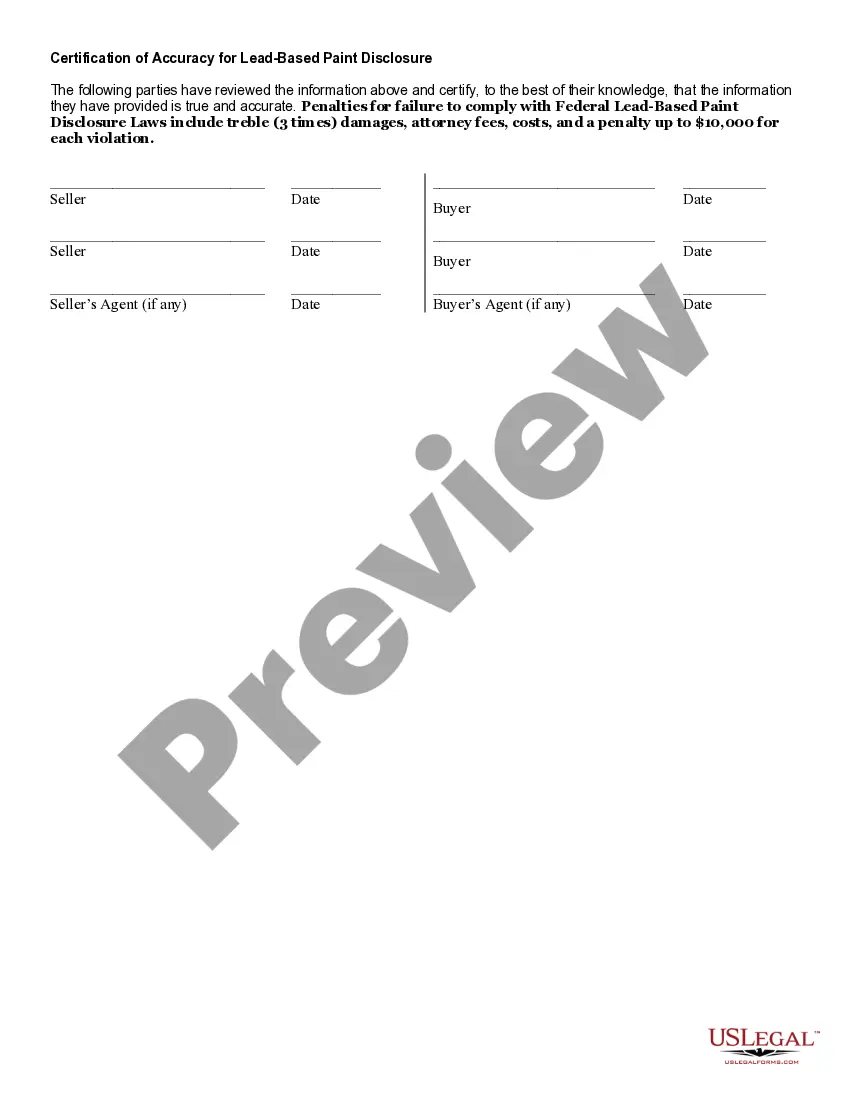
Lead Paint Disclosure For Tenants
Description
Get your form ready online
Our built-in tools help you complete, sign, share, and store your documents in one place.
Make edits, fill in missing information, and update formatting in US Legal Forms—just like you would in MS Word.
Download a copy, print it, send it by email, or mail it via USPS—whatever works best for your next step.
Sign and collect signatures with our SignNow integration. Send to multiple recipients, set reminders, and more. Go Premium to unlock E-Sign.
If this form requires notarization, complete it online through a secure video call—no need to meet a notary in person or wait for an appointment.
We protect your documents and personal data by following strict security and privacy standards.

Make edits, fill in missing information, and update formatting in US Legal Forms—just like you would in MS Word.

Download a copy, print it, send it by email, or mail it via USPS—whatever works best for your next step.

Sign and collect signatures with our SignNow integration. Send to multiple recipients, set reminders, and more. Go Premium to unlock E-Sign.

If this form requires notarization, complete it online through a secure video call—no need to meet a notary in person or wait for an appointment.

We protect your documents and personal data by following strict security and privacy standards.
Looking for another form?








How to fill out Delaware Lead Based Paint Disclosure For Sales Transaction?
Identifying a reliable source for the most up-to-date and suitable legal templates is a significant part of navigating bureaucracy.
Selecting the appropriate legal documents demands accuracy and meticulousness, which underscores the importance of obtaining samples of Lead Paint Disclosure For Tenants solely from credible sources, such as US Legal Forms. An incorrect template can squander your time and delay your current situation.
Eliminate the hassle associated with your legal paperwork. Discover the extensive US Legal Forms collection where you can locate legal templates, verify their applicability to your case, and download them instantly.
- Utilize the library navigation or search bar to find your template.
- Review the form’s information to ensure it aligns with the regulations of your state and locality.
- Check the form preview, if available, to confirm that it is the template you need.
- Return to the search to locate an alternative document if the Lead Paint Disclosure For Tenants does not meet your requirements.
- Once you are certain of the form’s relevance, download it.
- If you are a registered user, click Log in to verify and access your selected templates in My documents.
- If you have not created an account yet, click Buy now to purchase the form.
- Select the pricing plan that meets your needs.
- Proceed with registration to finalize your order.
- Complete your transaction by selecting a payment method (credit card or PayPal).
- Choose the document format for downloading Lead Paint Disclosure For Tenants.
- Once you have the form on your device, you can modify it using the editor or print it for manual completion.
Form popularity
FAQ
Preparation for a lead paint inspection involves tidying the premises, making spaces accessible, and evaluating potential lead paint issues. Remove objects that could obstruct access to painted surfaces. Ensure you have your lead paint disclosure for tenants handy, as it offers crucial information regarding any known lead paint presence in your residence. Being well-prepared leads to a more effective inspection.
Homeowners can face significant fines for failing to comply with lead paint disclosure for tenants. The maximum penalty can reach up to $10,000 per violation, depending on the severity and number of offenses. This financial consequence serves as an important reminder for landlords to disclose lead hazards proactively. Taking these steps not only avoids fines but also contributes to tenant health and safety.
The preferred written instrument to convey a legal interest in land is a deed. There are two basic categories of deed used in Vermont to convey fee title and/or easements in land: the warranty deed; and the quit-claim deed.
The following should be in a contract for deed: Purchase price. Interest rate. Down payment. Number of monthly installments. Buyer and seller information. Party responsibilities. Legal remedies in the event of default.
Attorney Involvement If a legal opinion of title is provided, it is executed by a Vermont Attorney. Vermont does not have an unauthorized practice of law statute, however there is Vermont Case Law indicating that deed preparation constitutes the practice of law.
To properly convey a deed the deed must be signed in front of a notary and recorded in the county clerks office. If a survey is referenced in the deed, that survey should also be recorded. If a deed divides a parcel a survey should be recorded with the deed.
(a) Deeds and other conveyances of lands, or of an estate or interest therein, shall be signed by the party granting the same and acknowledged by the grantor before a notary public and recorded at length in the clerk's office of the town in which such lands lie.
In Vermont, all land records are recorded and preserved at the local level, primarily in the office of the clerk of the town where the property is located.
To properly convey a deed the deed must be signed in front of a notary and recorded in the county clerks office. If a survey is referenced in the deed, that survey should also be recorded. If a deed divides a parcel a survey should be recorded with the deed.