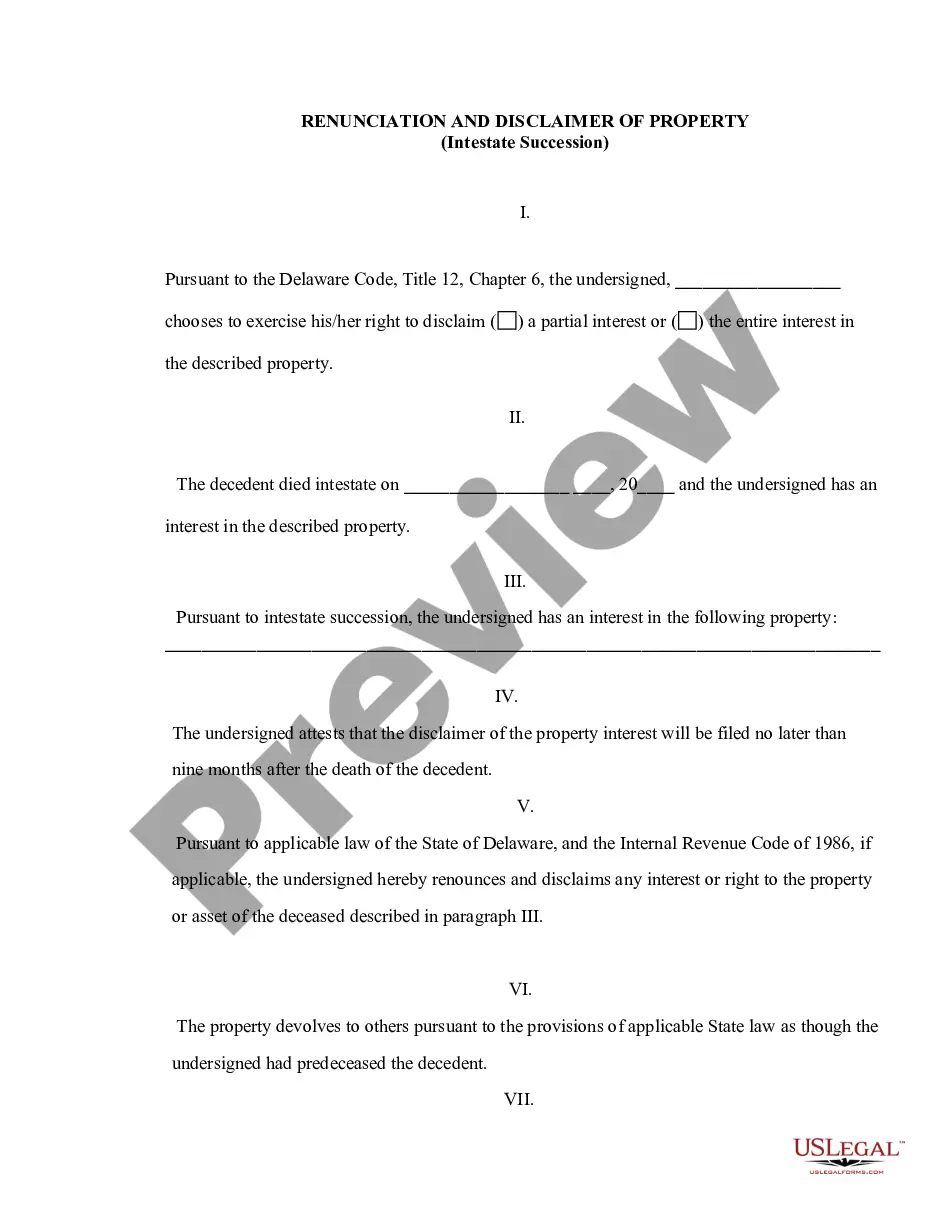
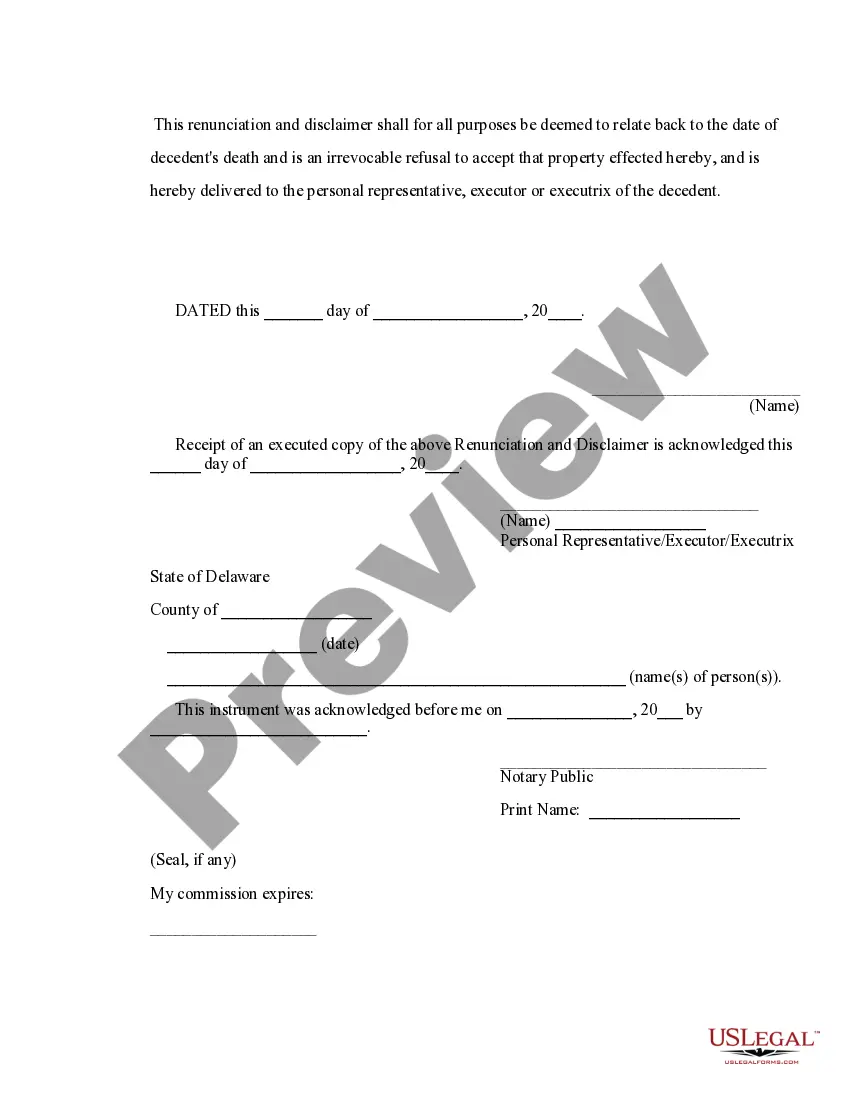
Delaware Renunciation And Disclaimer of Property received by Intestate Succession
Delaware Code
TITLE 12 Decedents' Estates and Fiduciary Relations
PART III Descent and Distribution; Escheat
CHAPTER 6. DISCLAIMER
Right to disclaim interest in property.
A person, or the representative of a deceased, incapacitated or
protected person, who is a grantee, donee, heir, next of kin, devisee,
legatee, person succeeding to a disclaimed or relinquished interest, surviving
joint tenant, beneficiary under a testamentary or nontestamentary instrument
or contract, donee of a power of appointment or appointee under an exercised
power of appointment, to whom property or an interest in or with respect
to property devolves by whatever means may disclaim it, in whole or in
part, by delivering a written disclaimer in the manner provided in this
chapter. The right to disclaim exists notwithstanding any limitation on
the interest of the disclaimant in the nature of a spendthrift provision
or similar restriction. A disclaimer may be of a fractional share, or any
limited interest or estate, or of any lesser included interest or estate,
including a lesser included interest or estate having a specific monetary
value. Title 12, Part III, Chap. 6, §601.
Time for receipt.
(a) Except as provided in subsection (c), (d) or (e) of
this section, if the property or interest has devolved to the disclaimant
under a testamentary instrument, by the laws of intestacy or as a result
of the death of a joint tenant, the disclaimer must be received, if of
a present interest, not later than 9 months after the death of the deceased
transferor, the deceased donee of a power of appointment or the deceased
joint tenant, as the case may be, and, if of a future interest, not later
than 9 months after the event determining that the taker of the property
or interest has become finally ascertained and the interest indefeasibly
vested. The disclaimer, to be effective, must be received within the above
time limits by the legal representative of the transferor of the property
or interest or the holder of the legal title to which the interest relates.
A copy of the disclaimer may be delivered to the person or persons entitled
to the property or interest in the event of disclaimer, but the failure
to make such delivery shall not affect the validity of the disclaimer.
A copy of the disclaimer may be filed with the Register of Wills for the
county in which proceedings for the administration of the estate of a deceased
transferor of the property or interest, a deceased donee of the power or
a deceased joint tenant have been commenced, but the failure to so file
the disclaimer shall not affect its validity.
(b) Except as provided in subsection (c), (d) or (e) of this section,
if the property or interest has devolved to the disclaimant under a nontestamentary
instrument or contract (other than as the result of the death of a joint
tenant), the disclaimer must be received, if of a present interest, not
later than 9 months after the effective date of the nontestamentary instrument
or contract, and, if of a future interest, not later than 9 months after
the event determining that the taker of the property or interest has become
finally ascertained and the interest indefeasibly vested. If the person
entitled to disclaim does not have actual knowledge of the existence of
the interest, the disclaimer must be received not later than 9 months after
the disclaimant acquires actual knowledge of the existence of the interest.
The effective date of a revocable instrument or contract is the date on
which the maker no longer has the power to revoke it or to transfer to
oneself or another the entire legal and equitable ownership of the interest.
The disclaimer, to be effective, must be received within the above time
limits by the transferor of the property or interest, the transferor legal
representative or the holder of the legal title to which the interest relates.
A copy of the disclaimer may be delivered to the person or persons entitled
to the property or interest in the event of disclaimer, but the failure
to make such delivery shall not affect the validity of the disclaimer.
(c) If the person desiring to disclaim is under age 21 at the commencement
of the applicable 9-month limit under subsection (a) or (b) of this section,
the disclaimer, to be effective, must be received not later than the date
that is 9 months after the day on which the disclaimant attains age 21.
(d) If the person desiring to disclaim is, by reason of mental illness
or mental infirmity, unable properly to manage and care for the property
at the commencement of the applicable 9-month limit under subsection (a),
(b) or (c) of this section, the disclaimer, to be effective, must be received
not later than the date that is 9 months after the earlier of:
(1) The date of the Court's order appointing a trustee
for such mentally ill person or appointing a guardian of the property of
such mentally infirm person; or
(2) The date of termination of such person's mental illness or mental
infirmity.
(e) The Court of Chancery, upon petition of the person desiring to
disclaim, or the person's representative, filed within the applicable time
limit under subsection (a), (b), (c) or (d) of this section, may extend
the time limit for making a disclaimer under this chapter.
(f) A joint tenant who did not join in the creation of the joint
tenancy may disclaim during the joint tenant's life all or any part of
the joint tenant's interest in the property which is the subject of the
joint tenancy by delivering a disclaimer to the other joint tenant or joint
tenants. A surviving joint tenant may disclaim as a separate interest any
property or interest therein devolving to the surviving joint tenant by
right of survivorship. A surviving joint tenant may disclaim the entire
interest in any property or interest therein that is the subject of a joint
tenancy devolving to the surviving joint tenant, if the joint tenancy was
created by the act of a deceased joint tenant and the survivor did not
join in creating the joint tenancy. For purposes of this chapter, the term
"joint tenant" includes a tenant by the entireties, and the term "joint
tenancy" includes a tenancy by the entireties.
(g) For purposes of this chapter, the donee of a power of appointment
with respect to property shall be treated as having an interest in such
property and the donor of a power of appointment shall be considered a
transferor of an interest in the property subject to the power. A disclaimer
by the donee of a power of appointment may be with respect to the whole
or any part of the property subject to such power, and the disclaimer may
be in such manner as to reduce or limit the person or objects, or classes
of persons or objects, in whose favor such power would otherwise be exercisable.
(h) If real property or an interest therein is disclaimed, a copy
of the disclaimer may be recorded in the Office of the Recorder of Deeds
in and for the county in which the property or interest disclaimed is located.
Title 12, Part III, Chap. 6, §602.
Form.
The disclaimer shall be in writing and shall:
(1) Be an irrevocable and unqualified refusal by the disclaimant
to accept property or an interest therein;
(2) Describe the property or interest disclaimed;
(3) Declare the disclaimer and extent thereof; and
(4) Be signed by the disclaimant. Title 12, Part III, Chap. 6, §603.
(63 Del. Laws, c. 448, § 1.)
Effect.
(a) Except as otherwise provided in subsection (c) of this
section, if the property or interest devolved to a disclaimant under a
testamentary instrument, under the laws of intestacy or as a result of
the death of a joint tenant, and if the deceased transferor or deceased
joint tenant has not provided for another disposition, a present interest
devolves as if the disclaimant had predeceased the decedent, and any future
interest that takes effect in possession or enjoyment at or after the termination
of the estate or interest disclaimed takes effect as if the disclaimant
had died before the event determining that the taker of the property or
interest had become finally ascertained and the interest indefeasibly vested.
If a disclaimer relates only to a particular property or interest, the
disclaimant shall not be considered to have predeceased with respect to
any other property or interest not effectively disclaimed. A disclaimer
relates back, for all purposes, to the date of death of the transferor
or joint tenant, or to the date of the determinative event, as the case
may be.
(b) Except as otherwise provided in subsection (c) of this section,
if the property or interest devolved to a disclaimant under a nontestamentary
instrument or contract (other than as the result of the death of a joint
tenant) and the instrument or contract does not provide for another disposition:
(1) A present interest devolves as if the disclaimant had died before the
effective date of the instrument or contract; and (2) a future interest
that takes effect in possession or enjoyment at or after the termination
of the disclaimed interest takes effect as if the disclaimant had died
before the event determining that the taker of the property or interest
had become finally ascertained and the interest indefeasibly vested. If
a disclaimer relates only to a particular property or interest, the disclaimant
shall not be considered to have predeceased with respect to any other property
or interest not effectively disclaimed. A disclaimer relates back, for
all purposes, to the effective date of the instrument or contract or to
the date of the determinative event, as the case may be.
(c) Notwithstanding subsections (a) and (b) of this section, if
the disclaimant was designated to take under an exercised power of appointment,
the property or interest disclaimed devolves as if the disclaimant had
died before the effective date of the exercise.
(d) The disclaimer, or the written waiver of the right to disclaim,
is binding upon the disclaimant or person waiving and all persons claiming
through or under the disclaimant or person waiving. Title 12, Part III,
Chap. 6, §604.
Bar.
The right to disclaim property or an interest therein is barred
by:
(1) An assignment, conveyance, encumbrance, pledge or transfer
of the property or interest, or a contract therefor;
(2) A written waiver of the right to disclaim;
(3) An acceptance of the property or interest or any of its benefits;
or
(4) A sale of the property or interest under judicial sale made
before the disclaimer is effected. Title 12, Part III, Chap. 6, §605.
Chapter not exclusive.
This chapter does not abridge the right of a person to waive, release,
disclaim or renounce property or an interest therein under any other law.
Title 12, Part III, Chap. 6, §606.
Application of chapter.
(a) A present interest in property that exists on the effective
date of this chapter and as to which the time for making a disclaimer under
this chapter has not expired may be disclaimed within 9 months after the
effective date of this chapter.
(b) A future interest that exists on the effective date of this
chapter which has not become indefeasibly vested or with respect to which
the taker has not been finally ascertained may be disclaimed within the
applicable time limit provided in § 602 of this title. Title 12, Part
III, Chap. 6, §607.
Short title.
This chapter may be cited as the "Delaware Disclaimer of Property
Interests Act." Title 12, Part III, Chap. 6, §608.