Tenant Landlord Shut For Florida
Description


Get your form ready online
Our built-in tools help you complete, sign, share, and store your documents in one place.
Make edits, fill in missing information, and update formatting in US Legal Forms—just like you would in MS Word.
Download a copy, print it, send it by email, or mail it via USPS—whatever works best for your next step.
Sign and collect signatures with our SignNow integration. Send to multiple recipients, set reminders, and more. Go Premium to unlock E-Sign.
If this form requires notarization, complete it online through a secure video call—no need to meet a notary in person or wait for an appointment.
We protect your documents and personal data by following strict security and privacy standards.

Make edits, fill in missing information, and update formatting in US Legal Forms—just like you would in MS Word.

Download a copy, print it, send it by email, or mail it via USPS—whatever works best for your next step.

Sign and collect signatures with our SignNow integration. Send to multiple recipients, set reminders, and more. Go Premium to unlock E-Sign.

If this form requires notarization, complete it online through a secure video call—no need to meet a notary in person or wait for an appointment.

We protect your documents and personal data by following strict security and privacy standards.
Looking for another form?








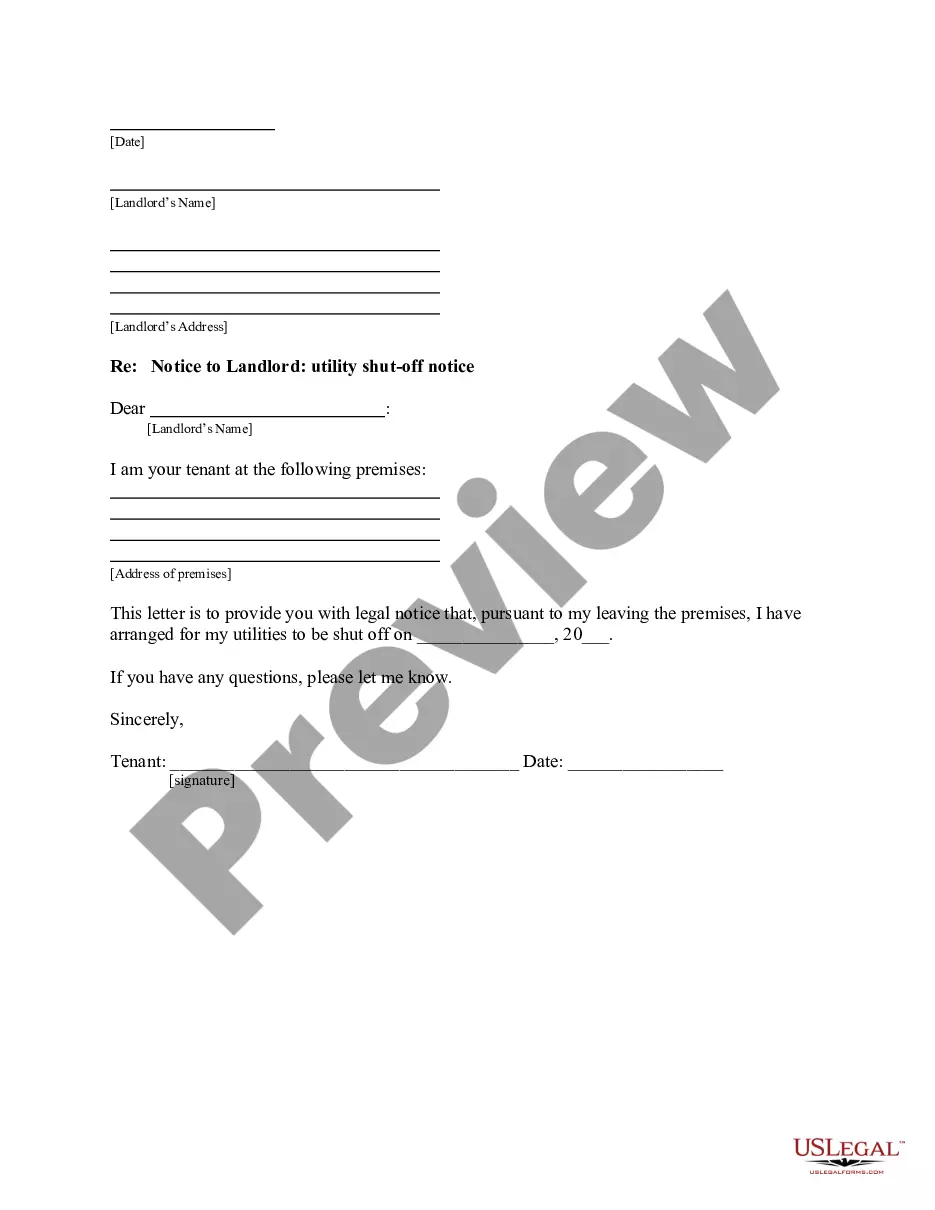
How to fill out Connecticut Letter From Tenant To Landlord - Utility Shut Off Notice To Landlord Due To Tenant Vacating Premises?
- Log in to your existing US Legal Forms account to access previously downloaded templates. Ensure your subscription is active; renew it if necessary.
- If you're new to US Legal Forms, start by searching for the desired form in the preview mode, ensuring it fits your needs and adheres to local jurisdiction rules.
- In case of any discrepancies, utilize the search function to find an appropriate template.
- Once you've found the correct document, click 'Buy Now' and select your preferred subscription plan. If you're a first-time user, create an account.
- Proceed with your purchase by entering your payment details via credit card or PayPal.
- After completing your transaction, download the form directly to your device, and access it anytime from the 'My Forms' section in your profile.
By utilizing US Legal Forms, users gain access to over 85,000 fillable legal documents, ensuring they find the exact forms needed. Each document can be easily customized and reviewed by expert professionals for accuracy.
In conclusion, US Legal Forms is an invaluable resource for landlords and tenants alike. Start your journey to legally sound documentation today and ensure peace of mind.
Form popularity
FAQ
If you need to report a landlord in Florida, start by documenting any issues, such as unsafe living conditions or illegal practices. You can file a complaint with the Florida Department of Agriculture and Consumer Services or your local housing authority. Providing clear details and evidence will strengthen your case. If you are facing significant challenges, consider using resources like USLegalForms to understand your rights and options when dealing with the tenant landlord shut for Florida.
Recent legislation in Florida has introduced several new rules affecting landlords. These rules often focus on enhancing tenant protections, including notice requirements for rent increases and better procedures for evictions. Additionally, new regulations may specify proper communication methods between landlords and tenants. It is essential to stay updated on these changes to navigate the tenant landlord shut for Florida effectively.
In Florida, a landlord cannot unlawfully evict a tenant without following proper legal channels. They are prohibited from entering a tenant's property without notice and must respect tenants' rights to privacy. Landlords cannot discriminate against tenants based on race, religion, gender, or other protected characteristics. Understanding these restrictions is crucial for both parties to maintain a fair tenant-landlord relationship and to manage a tenant landlord shut for Florida.
If a tenant refuses to leave Florida, landlords cannot force them out without following legal eviction procedures. It is essential to provide proper notice and potentially file an eviction lawsuit if necessary. Attempting to remove a tenant without the proper legal process can lead to further complications. Utilizing resources that explain tenant landlord shut for Florida can clarify the steps needed in these situations.
To evict a tenant in Florida, landlords must follow specific legal procedures, including providing notice of the eviction. If the tenant does not comply with these requirements, the landlord can file an eviction lawsuit in court. Understanding the proper legal process is crucial to avoid complications. For help navigating these rules surrounding tenant landlord shut for Florida, consider using platforms like uslegalforms.
If your landlord shuts off power in Florida without proper notice or justification, first communicate with them to resolve the issue. If the problem persists, document everything and seek legal advice or assistance from local tenant rights groups. You have the right to a livable space with functional utilities. Exploring resources on tenant landlord shut for Florida can provide guidance on necessary steps.
If you encounter issues with your landlord in Florida, you can report them to your local housing authority or the Florida Department of Business and Professional Regulation. These organizations can assist with complaints related to unsafe living conditions or illegal eviction practices. Gathering documentation of any issues will strengthen your case. Understanding tenant landlord shut for Florida can empower you when addressing concerns.
If the power goes out due to issues outside the landlord's control, such as a utility failure, they are generally not responsible. However, if the landlord's negligence led to the power outage, they may be held accountable. Tenants should document any issues and communicate with their landlord to resolve the situation. Familiarizing oneself with tenant landlord shut for Florida can provide valuable insights into rights and responsibilities.
In Florida, a landlord can turn off electricity for maintenance or repairs. However, it is illegal for a landlord to shut off utilities to force a tenant out or retaliate against them. Tenants facing such issues should understand their rights and may contact local authorities for assistance. This highlights the importance of knowing tenant landlord shut for Florida regulations to avoid potential disputes.
A landlord in Florida can shut off power for repairs, but they must provide notice to the tenant. Generally, it is reasonable to expect this downtime to last no longer than necessary for the repairs. It's essential that the landlord communicates effectively with the tenant to ensure understanding of the situation. For issues involving extended outages, tenants may seek guidance on tenant landlord shut for Florida laws to protect their rights.