Attorney For Child Care
Description

Get your form ready online
Our built-in tools help you complete, sign, share, and store your documents in one place.
Make edits, fill in missing information, and update formatting in US Legal Forms—just like you would in MS Word.
Download a copy, print it, send it by email, or mail it via USPS—whatever works best for your next step.
Sign and collect signatures with our SignNow integration. Send to multiple recipients, set reminders, and more. Go Premium to unlock E-Sign.
If this form requires notarization, complete it online through a secure video call—no need to meet a notary in person or wait for an appointment.
We protect your documents and personal data by following strict security and privacy standards.

Make edits, fill in missing information, and update formatting in US Legal Forms—just like you would in MS Word.

Download a copy, print it, send it by email, or mail it via USPS—whatever works best for your next step.

Sign and collect signatures with our SignNow integration. Send to multiple recipients, set reminders, and more. Go Premium to unlock E-Sign.

If this form requires notarization, complete it online through a secure video call—no need to meet a notary in person or wait for an appointment.

We protect your documents and personal data by following strict security and privacy standards.
Looking for another form?










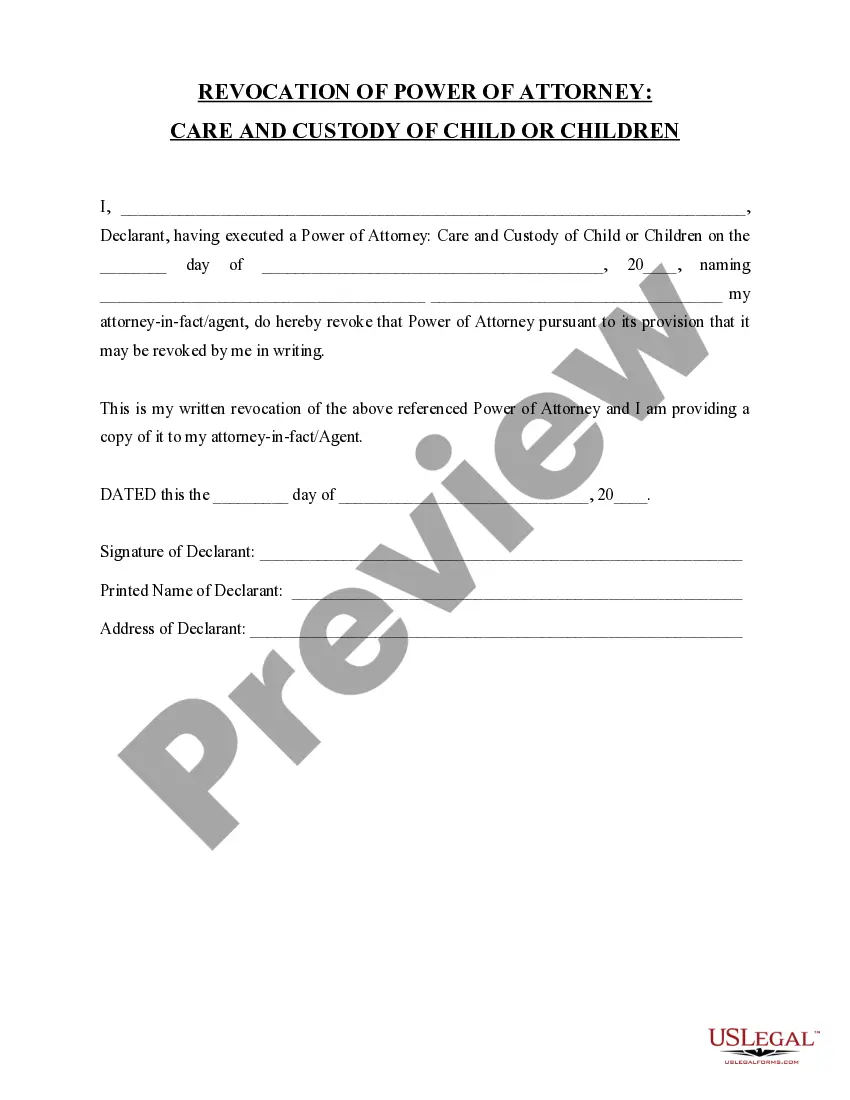
How to fill out Colorado Revocation Of Power Of Attorney For Care Of Child Or Children?
- Start by checking the Preview mode and form description to verify you’ve selected the right document that aligns with your local jurisdiction.
- If you require a different template, utilize the Search tab at the top to find one that meets your exact requirements.
- Purchase the document by clicking the Buy Now button and selecting the subscription plan that works for you. Registration is necessary to access the legal library.
- Make the payment by entering your credit card information or using your PayPal account to process your subscription.
- Download the form for completion. You can always find it later in the My Forms section of your account.
Utilizing US Legal Forms means you access an extensive collection of forms—over 85,000—more than most competitors offer, ensuring you find the right legal documents at an affordable cost.
Take the first step towards securing your child care legal documents today by visiting US Legal Forms. Empower yourself with the right tools for success!
Form popularity
FAQ
A legal power of attorney cannot make decisions regarding the person's own divorce, modify their will, or create or revoke a trust. These decisions generally require direct consent or specific legal procedures. Consulting with an attorney for child care can help you identify the limitations of your power of attorney and ensure that you make informed decisions that fall within legal boundaries.
Being a power of attorney comes with significant responsibilities and potential downsides. You may face legal liability if you fail to act in the best interest of the person you represent. An attorney for child care can help clarify your duties and ensure you understand the legal implications of your decisions, reducing the risk of personal liability.
A power of attorney cannot be used to make decisions that violate the law, such as deciding to commit illegal acts on behalf of another person. Furthermore, an attorney for child care cannot use this authority to override an individual's personal beliefs or values in decision-making related to a child's welfare. Understanding these limitations will help you use power of attorney responsibly and effectively.
While it is possible to file a parenting plan without an attorney, having one can significantly ease the process. An attorney for child care can provide you with the necessary guidance to ensure your parenting plan addresses all required elements. Additionally, they can help you navigate the complexities of custody arrangements, ensuring your plan is comprehensive and legally sound.
A power of attorney gives you the authority to make decisions on behalf of another person regarding their personal affairs, such as health care and financial matters. In the context of child care, an attorney for child care can help you understand how to manage a child's legal and financial decisions. This legal document ensures that your wishes are followed, and it can be crucial in situations where a child needs care due to unforeseen circumstances.
To address child support issues, you typically need a family law attorney. An attorney for child care can guide you through the process of establishing, modifying, or enforcing child support orders. Their expertise will help you navigate the complexities of the legal system and advocate effectively for your child's needs.
Yes, non-lawyers can represent individuals in certain legal settings, like small claims court. However, in more complex situations, having a qualified attorney for child care is advisable, as they possess legal knowledge and skills that can make a significant difference in the outcome.
Guardianship gives a person full authority to make decisions for a child, while a power of attorney allows you to delegate specific powers without granting overall custody. If you're looking to handle particular situations, like temporary medical decisions, a power of attorney for child care might be more suitable for your needs.
Yes, there is a slight difference between a lawyer and an attorney. A lawyer is someone who has attended law school, while an attorney has passed the bar exam and is authorized to practice law. For matters involving a child, an attorney for child care can offer you legal representation tailored to your child's needs.
The choice between guardianship and power of attorney depends on your situation. Guardianship grants more extensive control, often covering medical and education decisions for minors. Conversely, a power of attorney for child care allows for specific tasks to be managed, making it a less comprehensive but often simpler option.