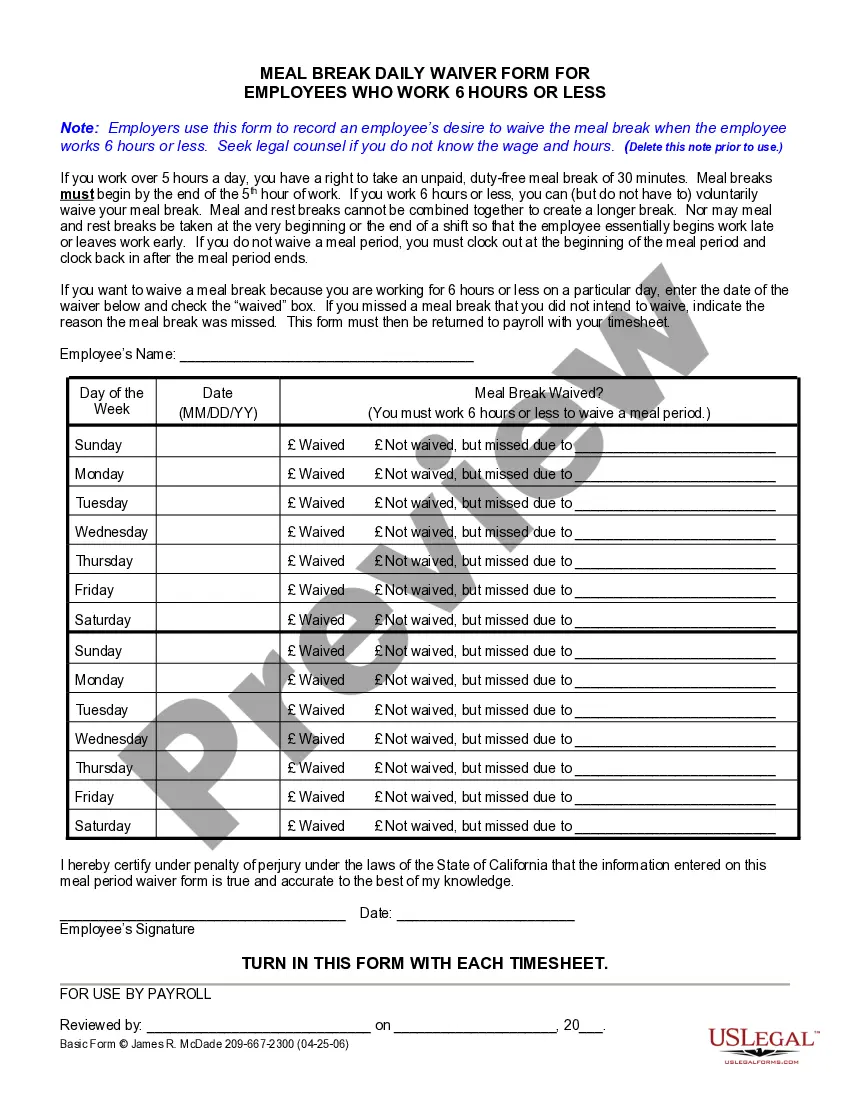
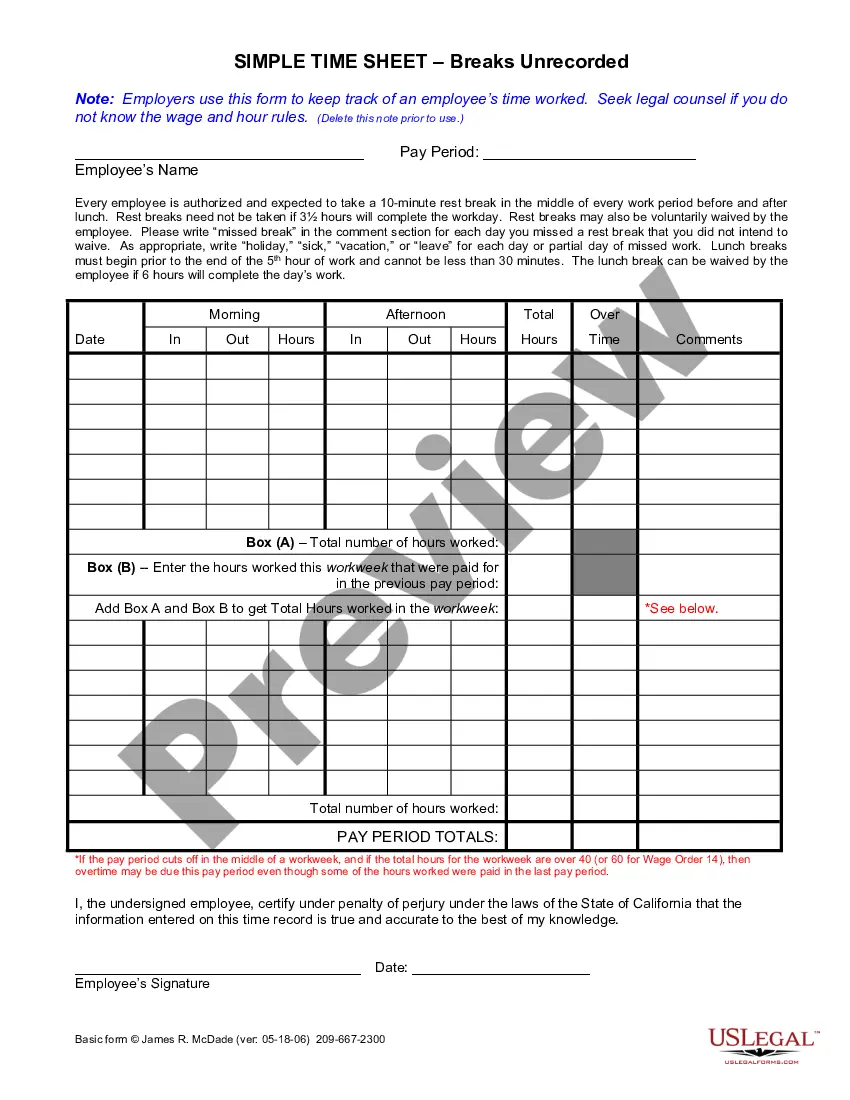
California Employee Break Requirements
Description
Get your form ready online
Our built-in tools help you complete, sign, share, and store your documents in one place.
Make edits, fill in missing information, and update formatting in US Legal Forms—just like you would in MS Word.
Download a copy, print it, send it by email, or mail it via USPS—whatever works best for your next step.
Sign and collect signatures with our SignNow integration. Send to multiple recipients, set reminders, and more. Go Premium to unlock E-Sign.
If this form requires notarization, complete it online through a secure video call—no need to meet a notary in person or wait for an appointment.
We protect your documents and personal data by following strict security and privacy standards.

Make edits, fill in missing information, and update formatting in US Legal Forms—just like you would in MS Word.

Download a copy, print it, send it by email, or mail it via USPS—whatever works best for your next step.

Sign and collect signatures with our SignNow integration. Send to multiple recipients, set reminders, and more. Go Premium to unlock E-Sign.

If this form requires notarization, complete it online through a secure video call—no need to meet a notary in person or wait for an appointment.

We protect your documents and personal data by following strict security and privacy standards.
Looking for another form?



How to fill out California Meal Break Daily Waiver For 6 Hour Employees?
Managing legal papers and processes can be a lengthy addition to your whole day.
California Employee Break Requirements and similar forms frequently necessitate that you search for them and comprehend how to fill them out properly.
As a result, if you are handling financial, legal, or personal affairs, utilizing a thorough and user-friendly online directory of forms at your fingertips will greatly help.
US Legal Forms is the premier online service for legal templates, featuring over 85,000 state-specific forms and a variety of resources to aid you in swiftly completing your documents.
Is it your first time using US Legal Forms? Sign up and create an account in a matter of minutes, and you will gain access to the form directory and California Employee Break Requirements. Then, follow the steps below to fill out your form.
- Browse the collection of pertinent documents available to you with a single click.
- US Legal Forms offers state- and county-specific forms available for download at any time.
- Safeguard your document management methods by utilizing a top-notch service that allows you to prepare any form in minutes without any extra or concealed fees.
- Simply Log In to your profile, locate California Employee Break Requirements, and retrieve it immediately from the My documents section.
- You can also access previously downloaded forms.
Form popularity
FAQ
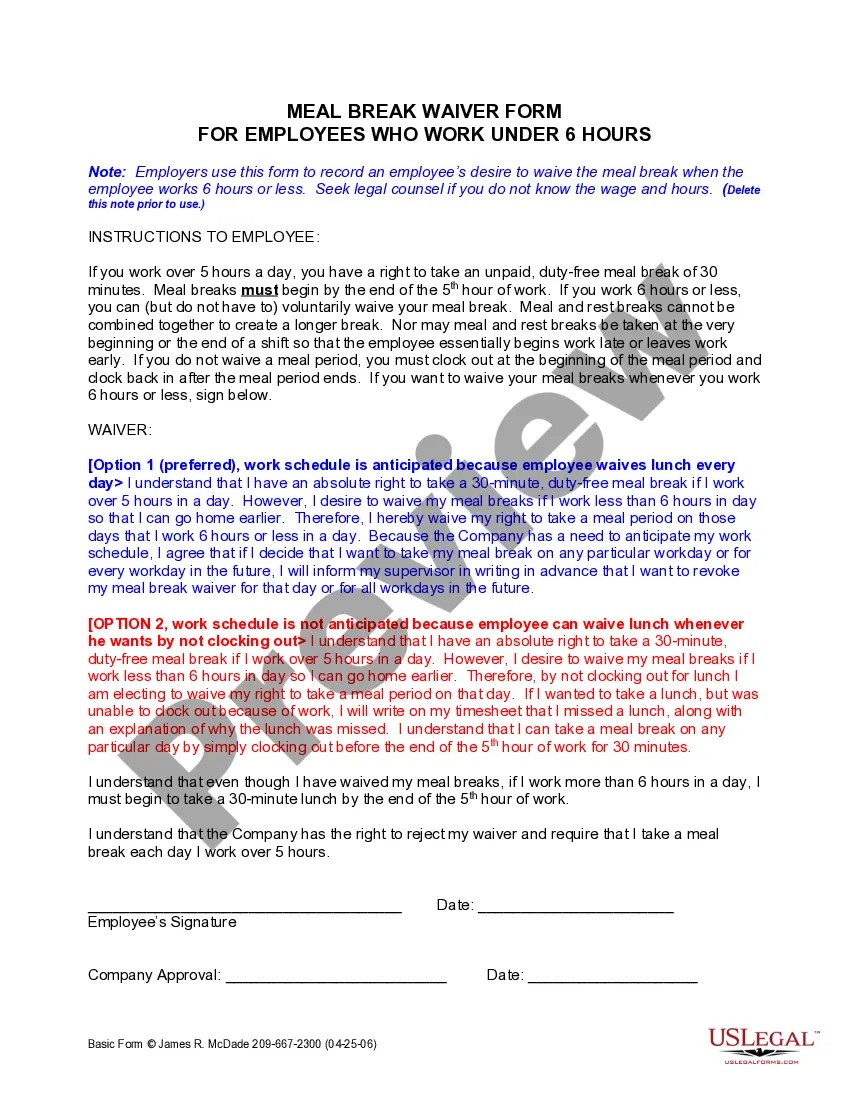
Nonexempt California employees must be given a meal or lunch break for a minimum of 30 minutes for shifts longer than five hours. This break is unpaid, uninterrupted, and must begin before the end of your fifth hour of work. This break can be waived if your work day isn't longer than 6 hours.
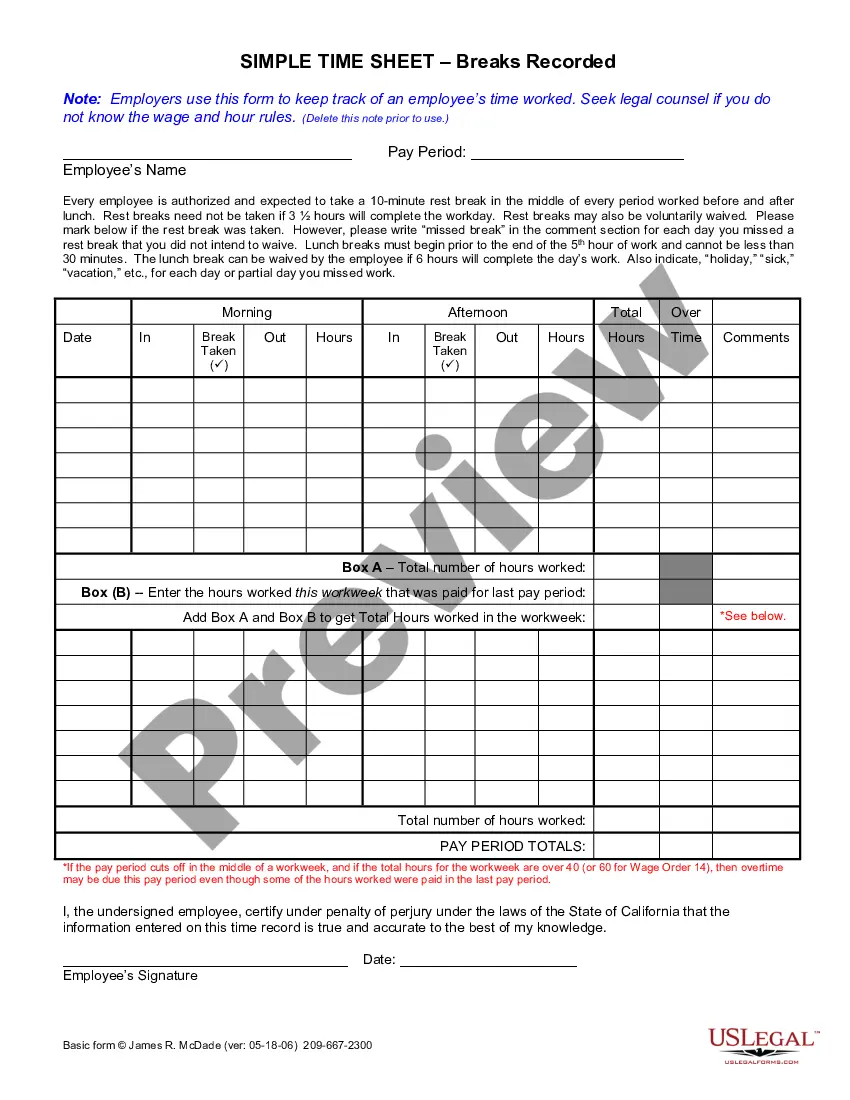
California employment law requires employers to give non-exempt employees (which means ?hourly? employees) one 10-minute rest break for every four hours of work. This break is paid and must be ?uninterrupted? ? meaning the boss can't ask the employee to do any work during the break.
Under California law, non-exempt employees are entitled to one unpaid 30-minute meal break, and two paid 10-minute rest breaks, during a typical 8-hour shift. Employees must receive their off-duty meal breaks before the end of the fifth hour of work.
What are the basic requirements for rest periods under California law? A. Employers of California employees covered by the rest period provisions of the Industrial Welfare Commission Wage Orders must authorize and permit a net 10-minute paid rest period for every four hours worked or major fraction thereof.
Rest breaks are counted as hours worked, and thus, employees are not required to record their rest breaks on their timecards or in the company's timekeeping system. It is company policy to relieve employees of all duty during their rest breaks, so that employees are free to use their rest break time as they wish.