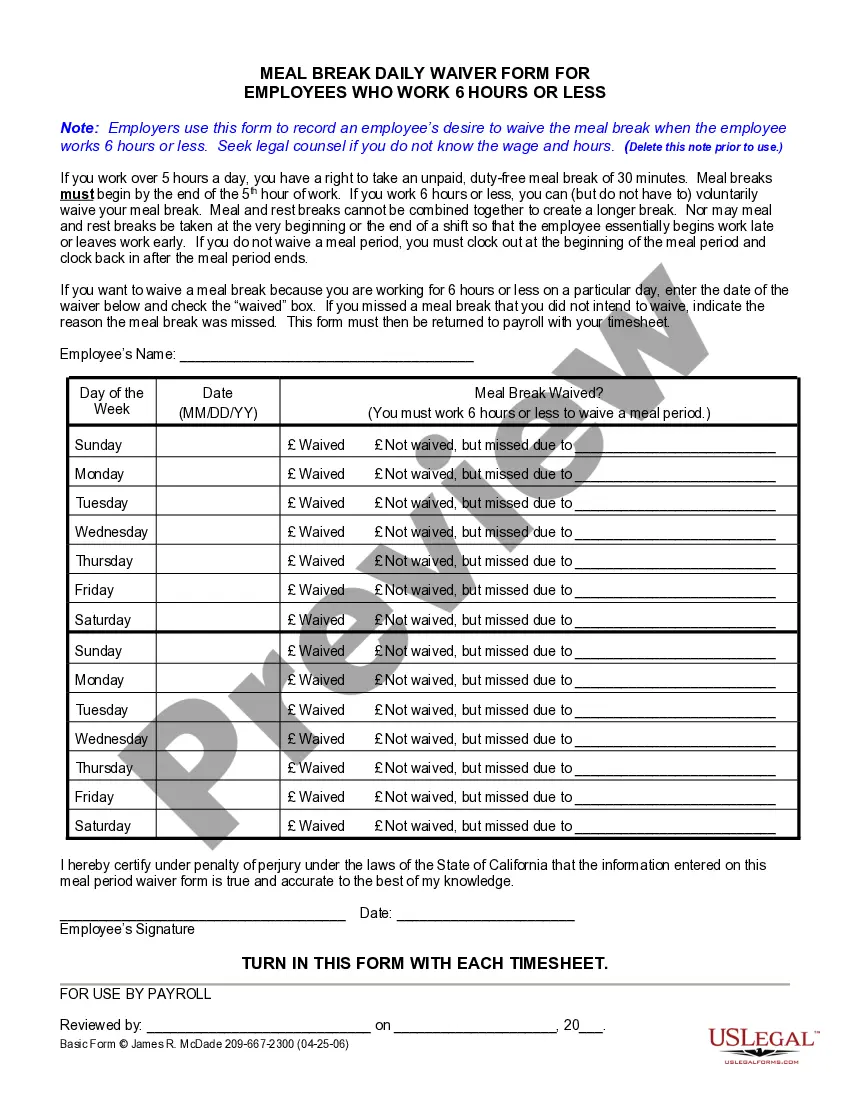
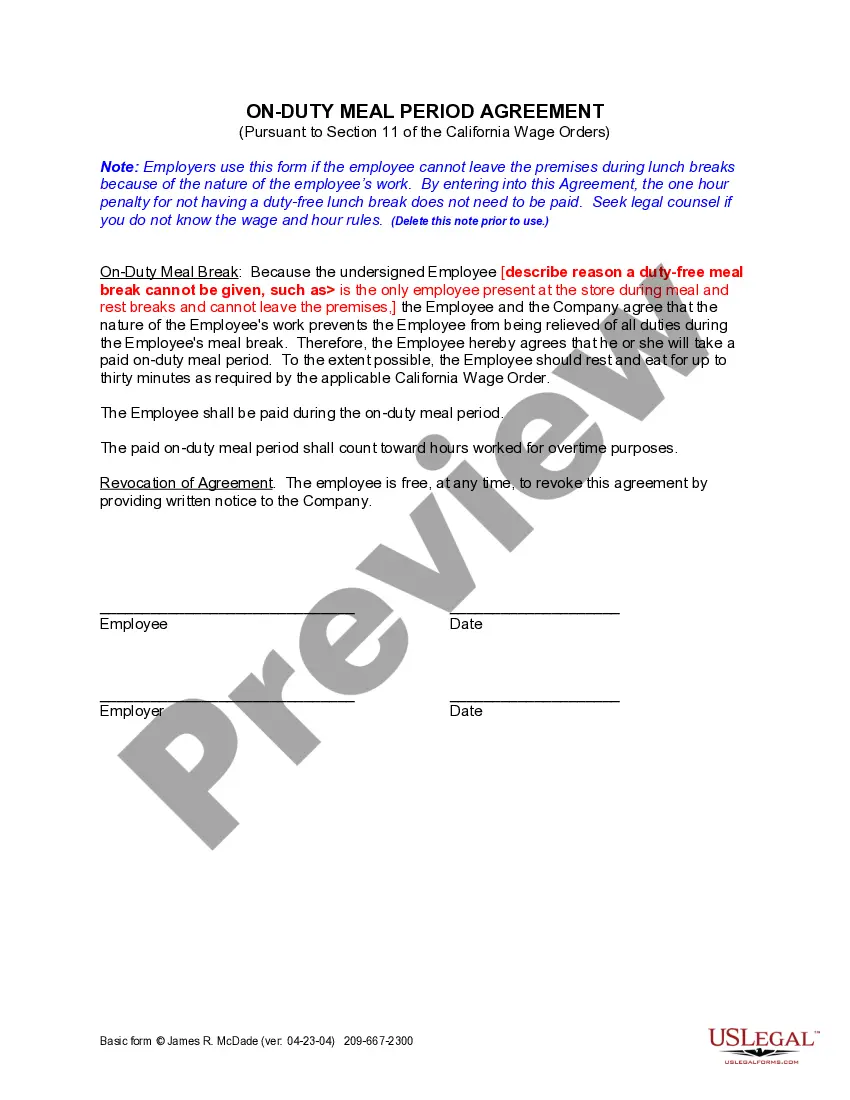
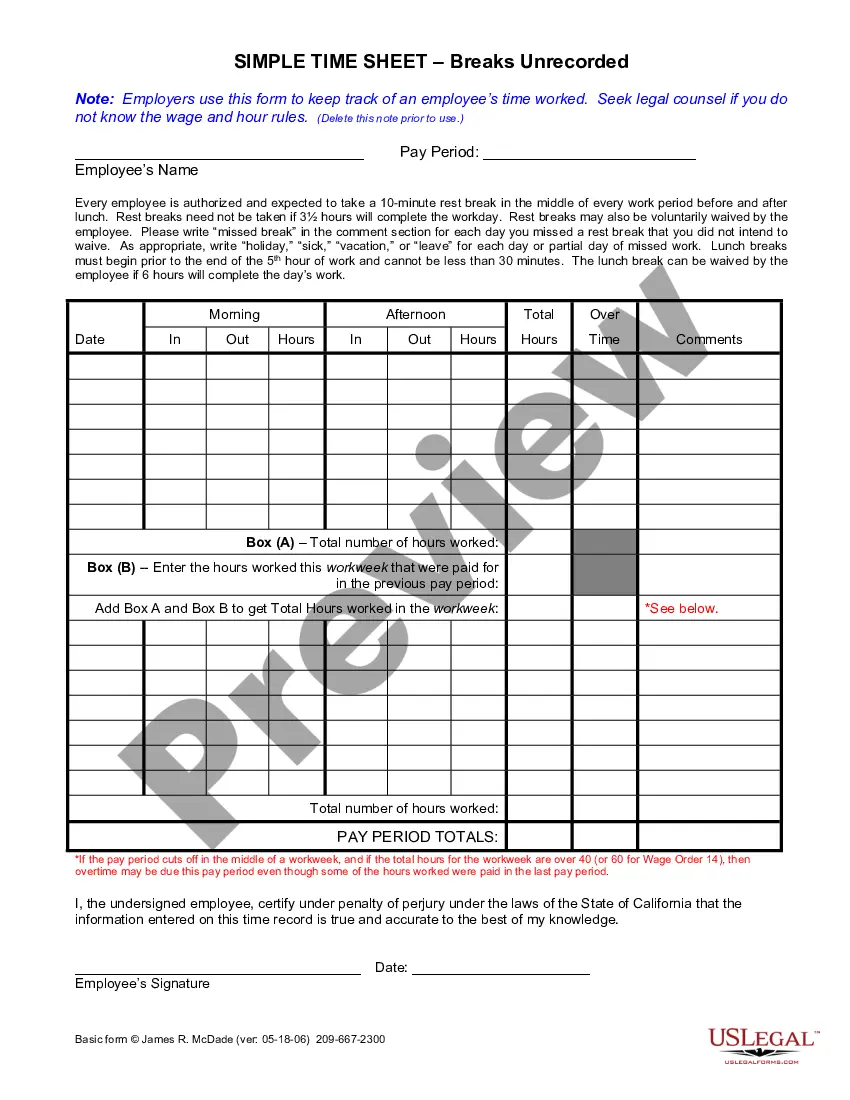
California Employee Break Policy
Description
Get your form ready online
Our built-in tools help you complete, sign, share, and store your documents in one place.
Make edits, fill in missing information, and update formatting in US Legal Forms—just like you would in MS Word.
Download a copy, print it, send it by email, or mail it via USPS—whatever works best for your next step.
Sign and collect signatures with our SignNow integration. Send to multiple recipients, set reminders, and more. Go Premium to unlock E-Sign.
If this form requires notarization, complete it online through a secure video call—no need to meet a notary in person or wait for an appointment.
We protect your documents and personal data by following strict security and privacy standards.

Make edits, fill in missing information, and update formatting in US Legal Forms—just like you would in MS Word.

Download a copy, print it, send it by email, or mail it via USPS—whatever works best for your next step.

Sign and collect signatures with our SignNow integration. Send to multiple recipients, set reminders, and more. Go Premium to unlock E-Sign.

If this form requires notarization, complete it online through a secure video call—no need to meet a notary in person or wait for an appointment.

We protect your documents and personal data by following strict security and privacy standards.
Looking for another form?


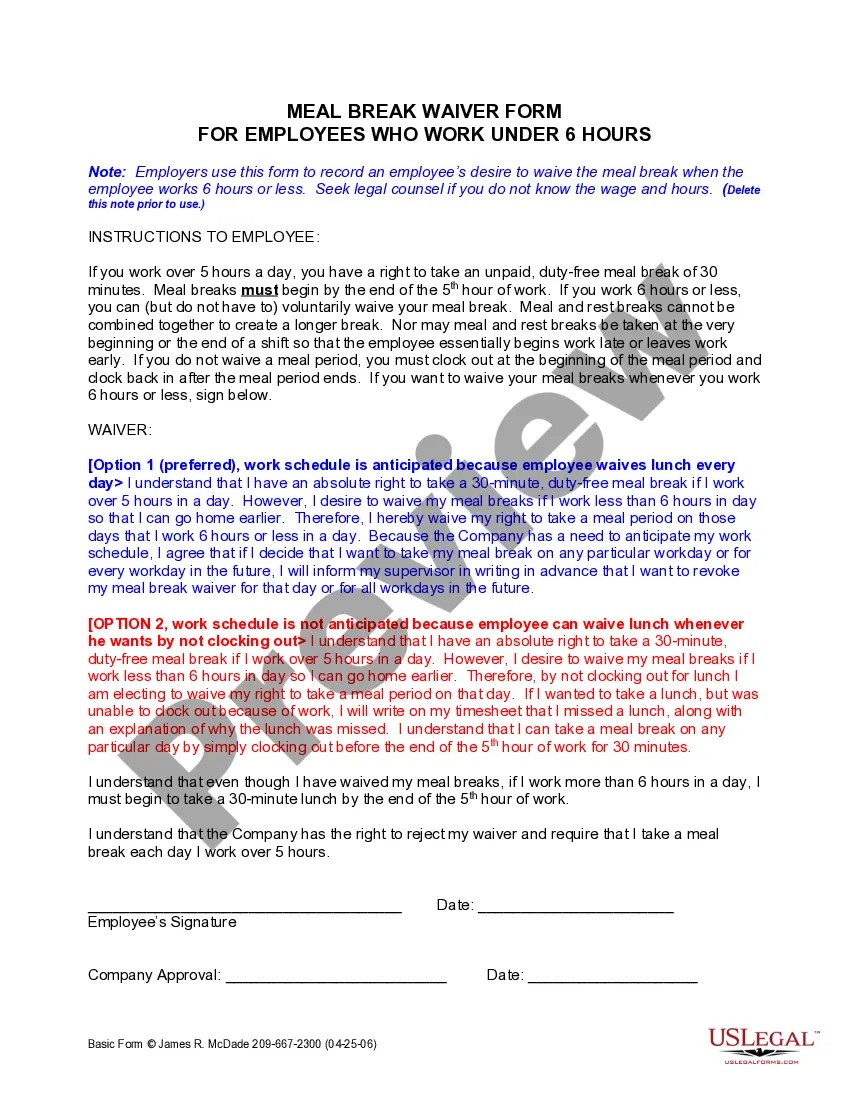
How to fill out California Meal Break Daily Waiver For 6 Hour Employees?
The California Employee Break Policy displayed on this site is a versatile official template crafted by experienced attorneys in accordance with federal and state laws and guidelines.
For over 25 years, US Legal Forms has offered individuals, companies, and legal practitioners with more than 85,000 validated, state-specific documents for any business and personal event. It’s the quickest, easiest, and most reliable method to acquire the papers you require, as the service assures the utmost level of data protection and anti-malware security.
Select the format you prefer for your California Employee Break Policy (PDF, DOCX, RTF) and download the sample onto your device.
- Search for the document you require and review it.
- Examine the sample you looked for and preview it or check the form description to confirm it meets your requirements. If it doesn't, use the search bar to locate the appropriate one. Click Buy Now once you have located the template you need.
- Register and Log In.
- Choose the pricing option that works for you and create an account. Use PayPal or a credit card to process a quick payment. If you already have an account, Log In and verify your subscription to advance.
- Retrieve the fillable template.
Form popularity
FAQ
California employers must provide non-exempt employees with meals and rest breaks during their shifts. An employer should provide a 30-minute unpaid meal break for every five hours worked and an additional 30-minute meal break for employees who work more than ten hours in a shift.
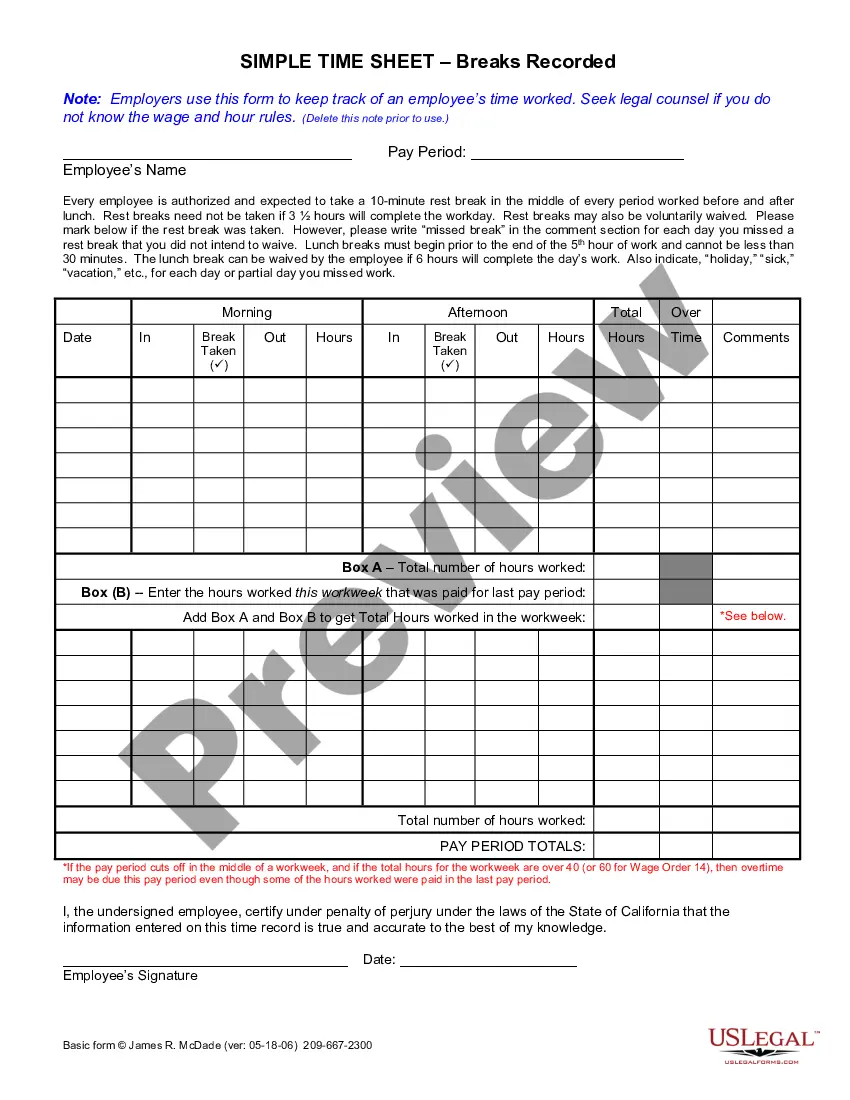
Rest breaks are counted as hours worked, and thus, employees are not required to record their rest breaks on their timecards or in the company's timekeeping system. It is company policy to relieve employees of all duty during their rest breaks, so that employees are free to use their rest break time as they wish.
California employment law requires employers to give non-exempt employees (which means ?hourly? employees) one 10-minute rest break for every four hours of work. This break is paid and must be ?uninterrupted? ? meaning the boss can't ask the employee to do any work during the break.
The California Wage Orders give employees the right to periodic (10) minute, paid rest periods. Unlike statutory meal periods, paid rest periods do not need to be recorded on timekeeping documents (e.g. time clock, timesheets).
Most California workers must receive the following breaks: An uninterrupted 30-minute unpaid meal break when working more than five hours in a day. An additional 30-minute unpaid meal break when working more than 12 hours in a day. A paid 10-minute rest period for every four hours worked.