Homestead Exemption For Persons With Disabilities
Description
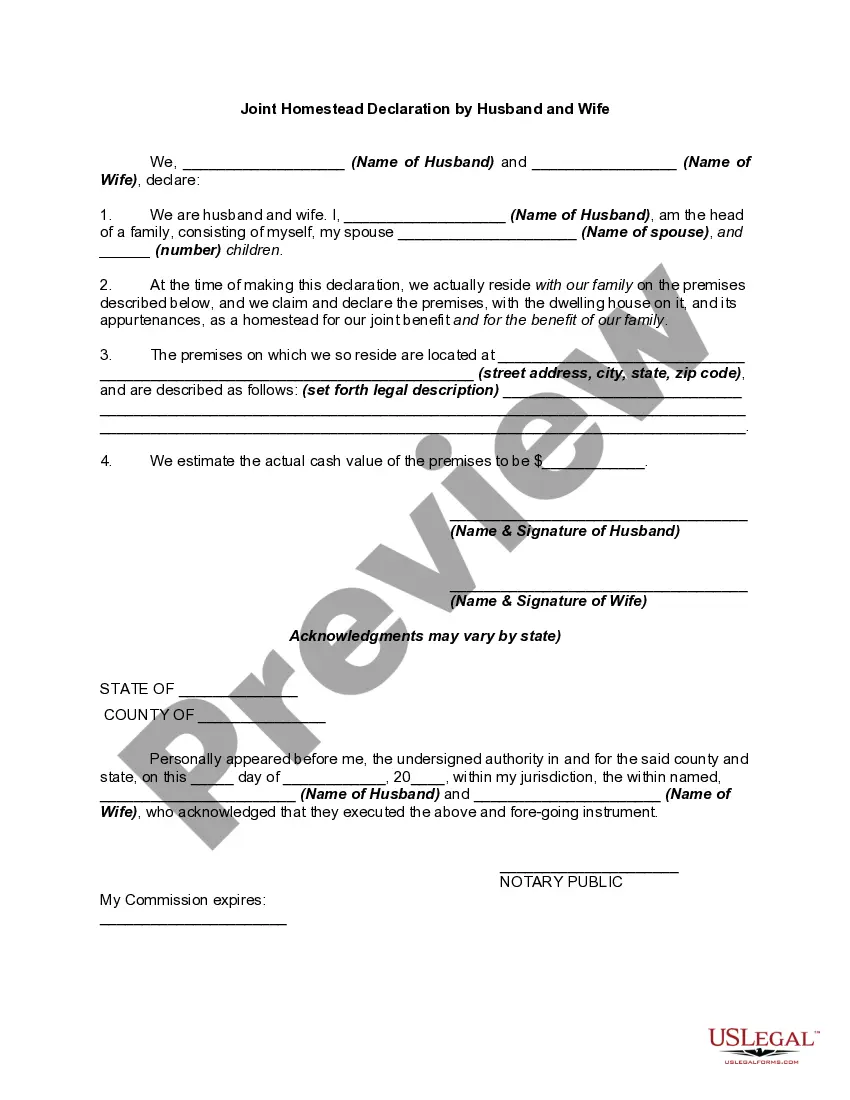
Get your form ready online
Our built-in tools help you complete, sign, share, and store your documents in one place.
Make edits, fill in missing information, and update formatting in US Legal Forms—just like you would in MS Word.
Download a copy, print it, send it by email, or mail it via USPS—whatever works best for your next step.
Sign and collect signatures with our SignNow integration. Send to multiple recipients, set reminders, and more. Go Premium to unlock E-Sign.
If this form requires notarization, complete it online through a secure video call—no need to meet a notary in person or wait for an appointment.
We protect your documents and personal data by following strict security and privacy standards.

Make edits, fill in missing information, and update formatting in US Legal Forms—just like you would in MS Word.

Download a copy, print it, send it by email, or mail it via USPS—whatever works best for your next step.

Sign and collect signatures with our SignNow integration. Send to multiple recipients, set reminders, and more. Go Premium to unlock E-Sign.

If this form requires notarization, complete it online through a secure video call—no need to meet a notary in person or wait for an appointment.

We protect your documents and personal data by following strict security and privacy standards.
Looking for another form?









How to fill out California Homestead Declaration For Single Person?
Creating legal documents from the ground up can at times be intimidating.
Certain situations may require extensive research and significant financial investment.
If you’re seeking a simpler and more economical method for preparing Homestead Exemption For Persons With Disabilities or other forms without the hassle, US Legal Forms is readily available.
Our online collection of over 85,000 current legal forms encompasses nearly every aspect of your financial, legal, and personal matters.
Review the form preview and descriptions to confirm that you are on the document you seek. Verify that the template you choose complies with the rules and regulations of your state and county. Select the appropriate subscription plan to purchase the Homestead Exemption For Persons With Disabilities. Download the form, then complete, validate, and print it out. US Legal Forms has an impeccable reputation and over 25 years of expertise. Join us today and simplify the document signing process!
- With just a few clicks, you can swiftly access state- and county-compliant forms carefully crafted for you by our legal professionals.
- Utilize our platform whenever you require dependable services to easily find and download the Homestead Exemption For Persons With Disabilities.
- If you’re familiar with our site and have created an account previously, simply Log In, find the form, and download it or re-download it at any time in the My documents section.
- Not registered yet? No problem. It only takes a few minutes to sign up and browse the library.
- However, before rushing to download the Homestead Exemption For Persons With Disabilities, consider these suggestions.
Form popularity
FAQ
Homestead Exemption for Persons with Disabilities This exemption is an annual $2,000 reduction in the EAV of the primary residence that is owned and occupied by a person with a disability who is liable for the payment of property taxes.
How do I claim the exemption? To claim the exemption, you must file an application with the appraisal district. The application must include documentation of your disability. The application form is entitled ?Application for Residential Homestead Exemption.
In Texas, a disabled adult has a right to a special homestead exemption. If you qualify, this exemption can reduce your taxes substantially. If you qualify, you will receive this exemption in addition to the general homestead exemption. However, you cannot receive both a disability exemption and an over-65 exemption.
You may apply to the appraisal district the year you become age 65 or qualify for disability. If your application is approved, you will receive the exemption for the entire year in which you become age 65 or disabled and for subsequent years as long as you own a qualified residence homestead.
However, you're usually considered disabled for tax purposes if either of these applies: You're unable to engage in any gainful activity due to physical or mental impairment. Your impairment is expected to result in death or last for a long or indefinite period.