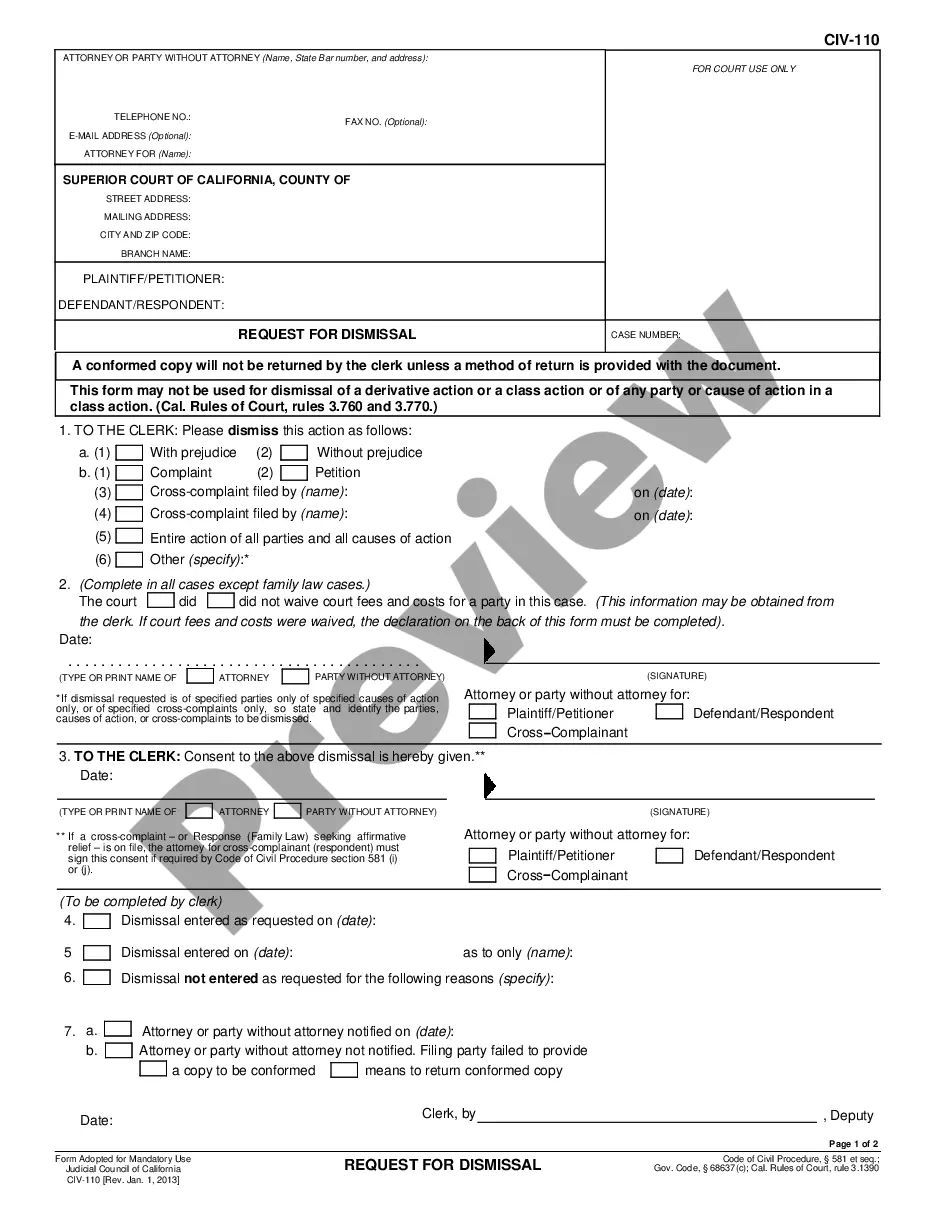
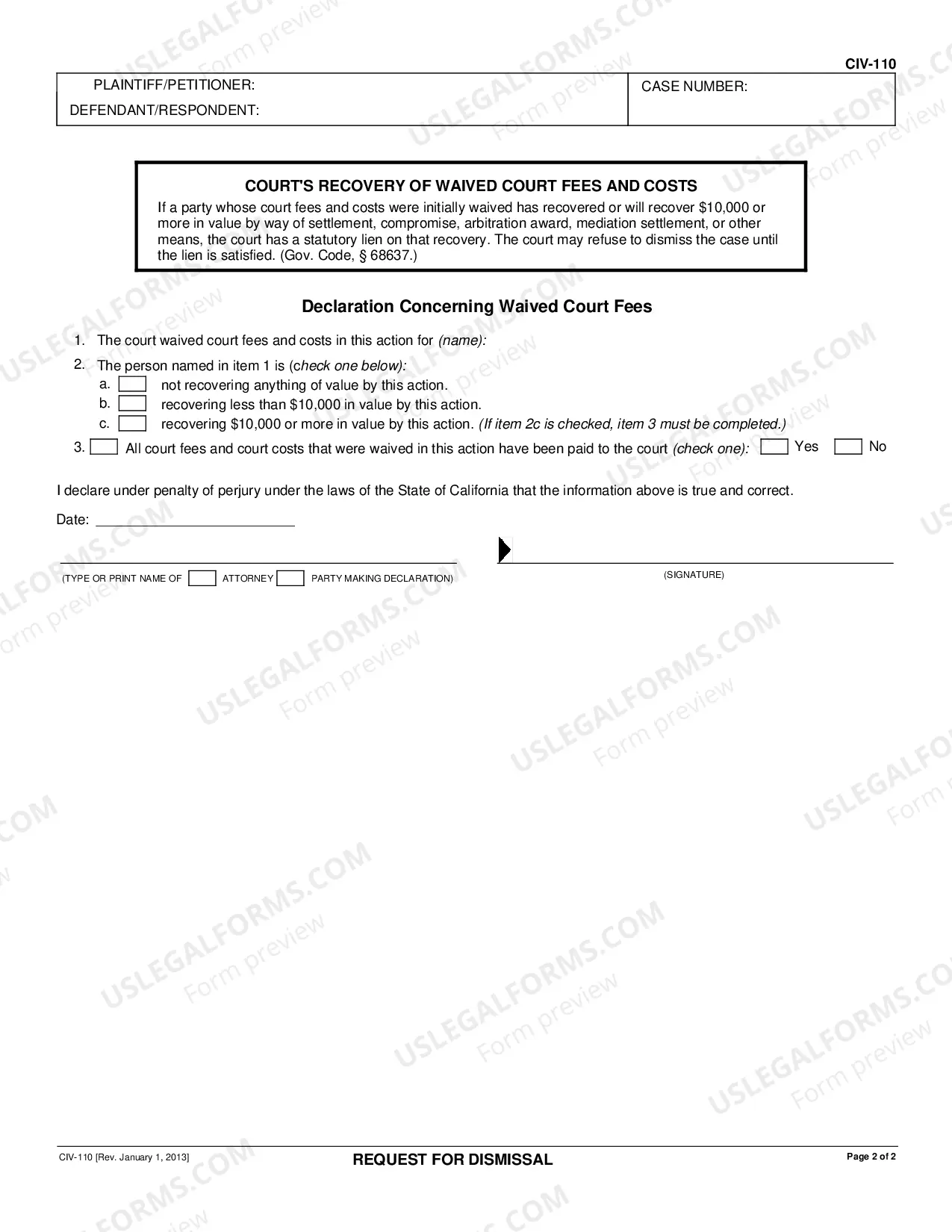
Request For Dismissal With Prejudice Meaning
Description
Get your form ready online
Our built-in tools help you complete, sign, share, and store your documents in one place.
Make edits, fill in missing information, and update formatting in US Legal Forms—just like you would in MS Word.
Download a copy, print it, send it by email, or mail it via USPS—whatever works best for your next step.
Sign and collect signatures with our SignNow integration. Send to multiple recipients, set reminders, and more. Go Premium to unlock E-Sign.
If this form requires notarization, complete it online through a secure video call—no need to meet a notary in person or wait for an appointment.
We protect your documents and personal data by following strict security and privacy standards.

Make edits, fill in missing information, and update formatting in US Legal Forms—just like you would in MS Word.

Download a copy, print it, send it by email, or mail it via USPS—whatever works best for your next step.

Sign and collect signatures with our SignNow integration. Send to multiple recipients, set reminders, and more. Go Premium to unlock E-Sign.

If this form requires notarization, complete it online through a secure video call—no need to meet a notary in person or wait for an appointment.

We protect your documents and personal data by following strict security and privacy standards.
Looking for another form?


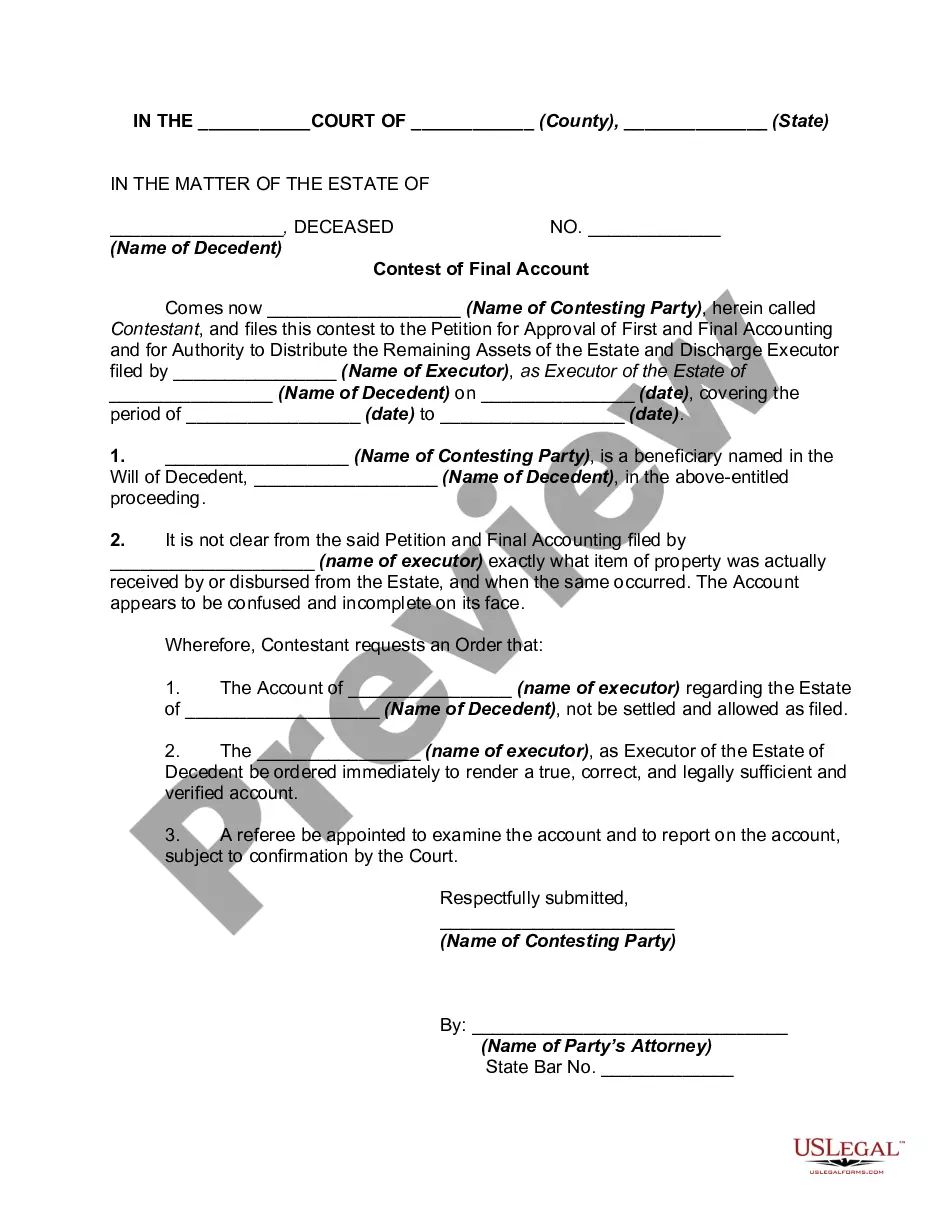






How to fill out California Request For Dismissal?
Whether for corporate intents or for individual issues, all individuals must confront legal circumstances at some point in their lives.
Completing legal documents requires meticulous focus, beginning with picking the suitable template sample.
With an extensive US Legal Forms collection available, you will never have to waste time searching for the correct sample online. Utilize the library’s easy navigation to discover the suitable template for any circumstance.
- Locate the template you require through the search feature or directory navigation.
- Review the document’s specifics to confirm it aligns with your circumstances, state, and locality.
- Press on the document’s preview to examine it.
- If it is the wrong form, revert to the search tool to find the Request For Dismissal With Prejudice Meaning sample you need.
- Obtain the template if it fulfills your specifications.
- If you already possess a US Legal Forms account, click Log in to retrieve previously stored documents in My documents.
- If you do not have an account yet, you can download the document by clicking Buy now.
- Choose the appropriate pricing option.
- Complete the profile registration form.
- Select your payment method: you may use a credit card or PayPal account.
- Choose the file format you prefer and download the Request For Dismissal With Prejudice Meaning.
- After it is downloaded, you can fill out the form using editing software or print it and complete it by hand.
Form popularity
FAQ
The traditional meaning of 'without prejudice' it is to allow communications between parties without worrying that those communications, like letters or emails, will be used in court against the writer. However, it's a term often misused by lawyers. It should be used to preface settlement discussions.
For example, an arrest without probable cause, violation of the right to a speedy trial, or an illegal search can lead to a case being dismissed with prejudice. Other errors in a case also may lead a court to dismiss a case with prejudice.
Whereas a case that is dismissed ?with prejudice? is dismissed permanently, a case that is dismissed ?without prejudice? is only dismissed temporarily. This temporary dismissal means that the plaintiff is allowed to re-file charges, alter the claim, or bring the case to another court.
?With prejudice? means the decision is final. ?Without prejudice? means it's not final and subject to future inquiry. If the judge announces a case is dismissed with prejudice, that means it's permanently dismissed and can't be retried.
If your criminal charges are dismissed without prejudice, it means your case is not moving forward, and you're no longer charged with a crime?but it also leaves the door open for the prosecution to refile the same charges against you if they see fit.