Ca Rent Control For Toronto
Description

Get your form ready online
Our built-in tools help you complete, sign, share, and store your documents in one place.
Make edits, fill in missing information, and update formatting in US Legal Forms—just like you would in MS Word.
Download a copy, print it, send it by email, or mail it via USPS—whatever works best for your next step.
Sign and collect signatures with our SignNow integration. Send to multiple recipients, set reminders, and more. Go Premium to unlock E-Sign.
If this form requires notarization, complete it online through a secure video call—no need to meet a notary in person or wait for an appointment.
We protect your documents and personal data by following strict security and privacy standards.

Make edits, fill in missing information, and update formatting in US Legal Forms—just like you would in MS Word.

Download a copy, print it, send it by email, or mail it via USPS—whatever works best for your next step.

Sign and collect signatures with our SignNow integration. Send to multiple recipients, set reminders, and more. Go Premium to unlock E-Sign.

If this form requires notarization, complete it online through a secure video call—no need to meet a notary in person or wait for an appointment.

We protect your documents and personal data by following strict security and privacy standards.
Looking for another form?










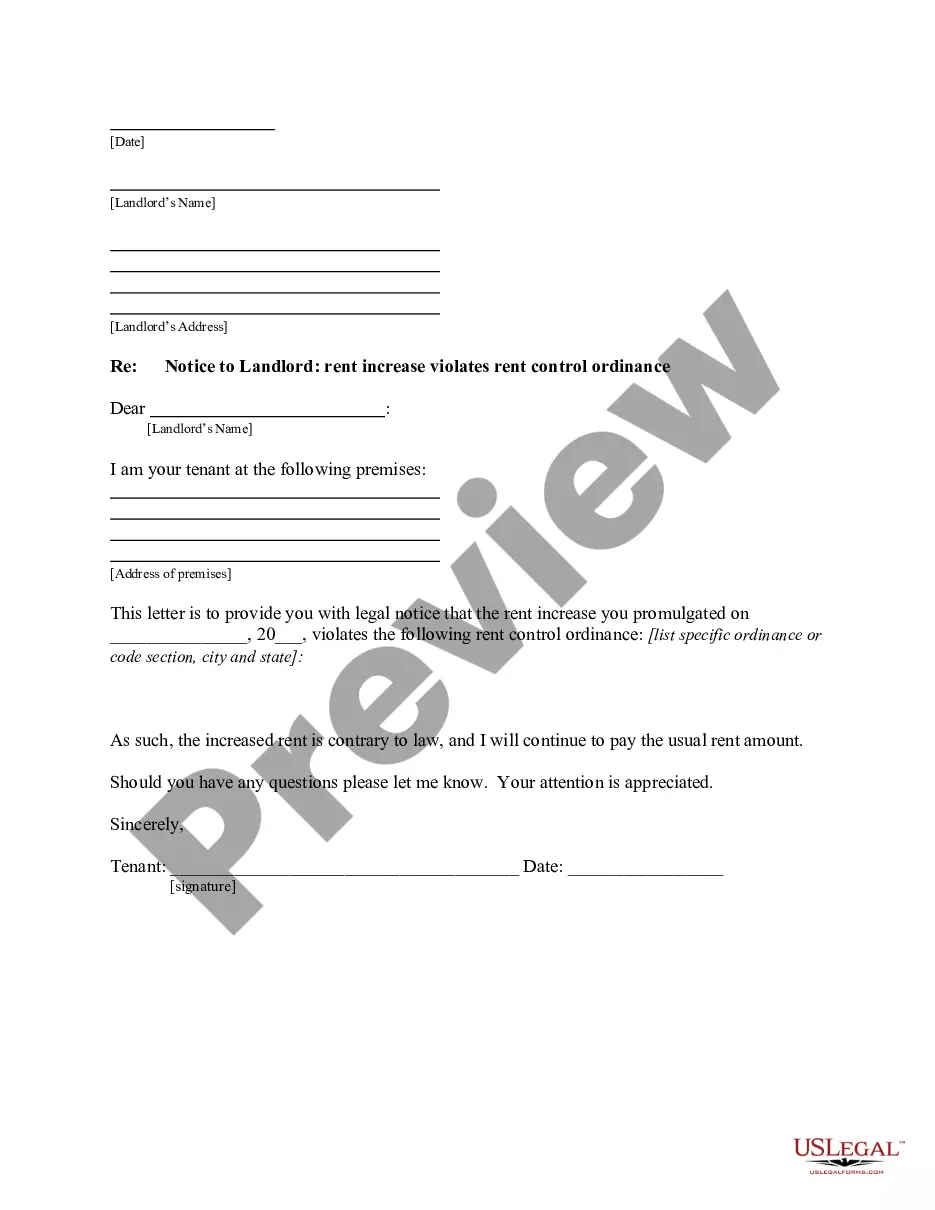
How to fill out California Letter From Tenant To Landlord Containing Notice To Landlord To Withdraw Improper Rent Increase Due To Violation Of Rent Control Ordinance?
The Ca Rent Regulation For Toronto you view on this page is a versatile legal blueprint created by expert attorneys following federal and state statutes and guidelines.
For over 25 years, US Legal Forms has supplied individuals, businesses, and legal practitioners with more than 85,000 validated, state-specific documents for any corporate and personal scenarios. It’s the fastest, simplest, and most dependable method to acquire the documentation you require, as the service ensures the utmost level of data protection and anti-virus safeguarding.
Subscribe to US Legal Forms to have authenticated legal templates for all of life’s situations at your fingertips.
- Search for the document you require and review it.
- Browse the template you sought and preview it or review the form description to confirm it meets your needs. If it doesn't, use the search feature to find the correct one. Click Buy Now once you've found the template you require.
- Register and sign in.
- Choose the pricing option that fits your needs and create an account. Utilize PayPal or a credit card for rapid payment. If you already possess an account, Log In and check your subscription to continue.
- Obtain the editable template.
- Choose the format you desire for your Ca Rent Regulation For Toronto (PDF, Word, RTF) and save the document on your device.
- Fill out and sign the documentation.
- Print the template to complete it manually. Alternatively, use an online multifunctional PDF editor to swiftly and accurately fill out and sign your form with an electronic signature.
- Retrieve your documentation again.
- Utilize the same document again as required. Access the My documents tab in your profile to redownload any forms you have previously downloaded.
Form popularity
FAQ
The rent increase guideline for 2023 is 2.5%. The guideline is based on the Ontario Consumer Price Index, a measure of inflation calculated monthly by Statistics Canada that reflects economic conditions over a 12-month period (June to May).
Any apartment, house, condo, basement or mobile home that someone has lived in since before Nov. 15, 2018 is covered by rent control. That doesn't mean rent can't go up. It means that rent can be increased once a year and the provincial government decides by how much.
The rent increase guideline in Ontario for 2023 is at that maximum of 2.5 per cent for rent-controlled units. Rent control only applies to units first occupied by anyone, not just the current renter, before Nov. 15, 2018.
Keep in mind that certain properties are exempt from California rent control law. These types of properties include: Condos and single family-homes not owned by a real estate investment trust (REIT), corporation, or corporation-owned LLC. Mobile homes.
Most Ontario landlords will be able to increase rent by up to 2.5 per cent next year. Municipal Affairs and Housing Minister Steve Clark says the rent increase guideline for 2024 is set at the same rate as for this year, and he notes that it is below the average inflation rate of 5.9 per cent.