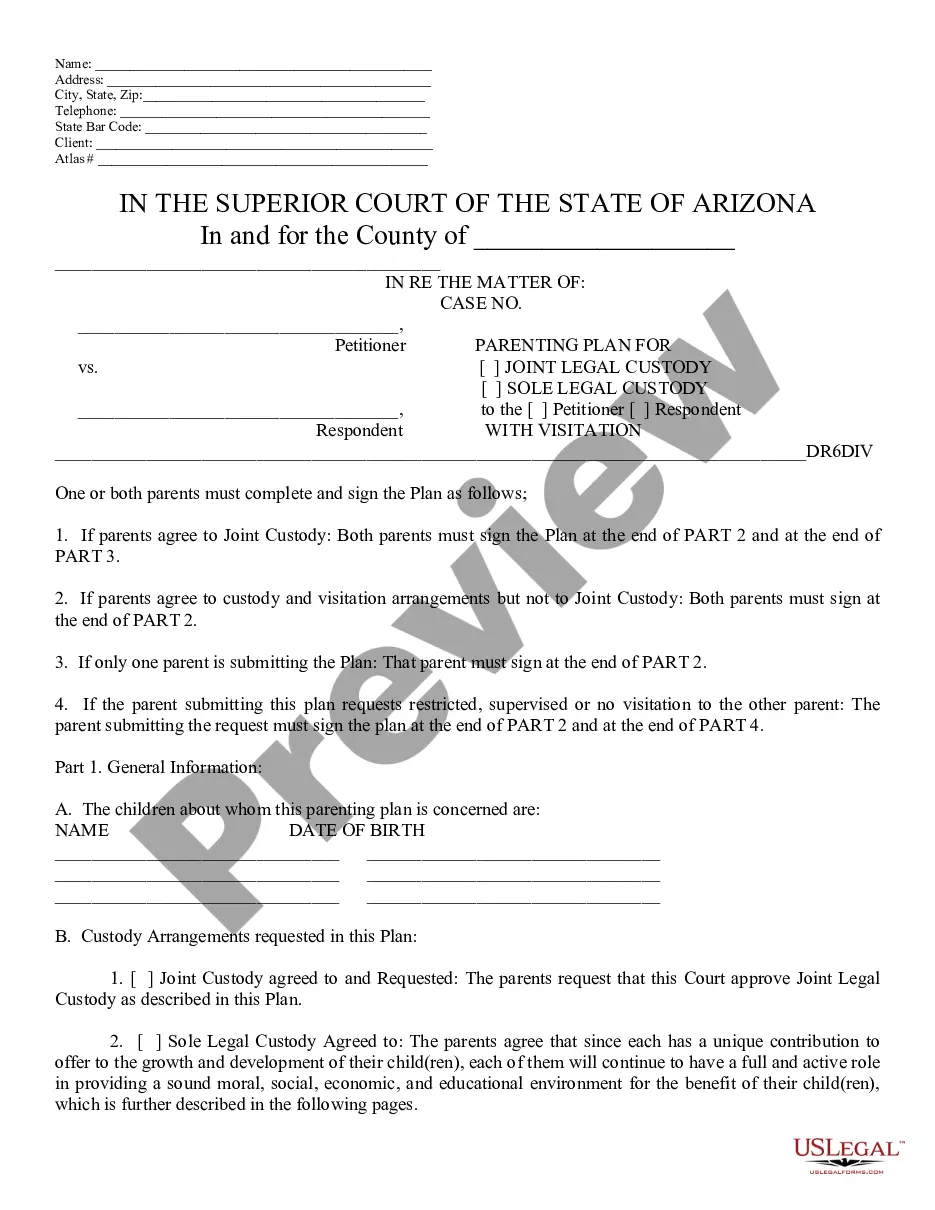
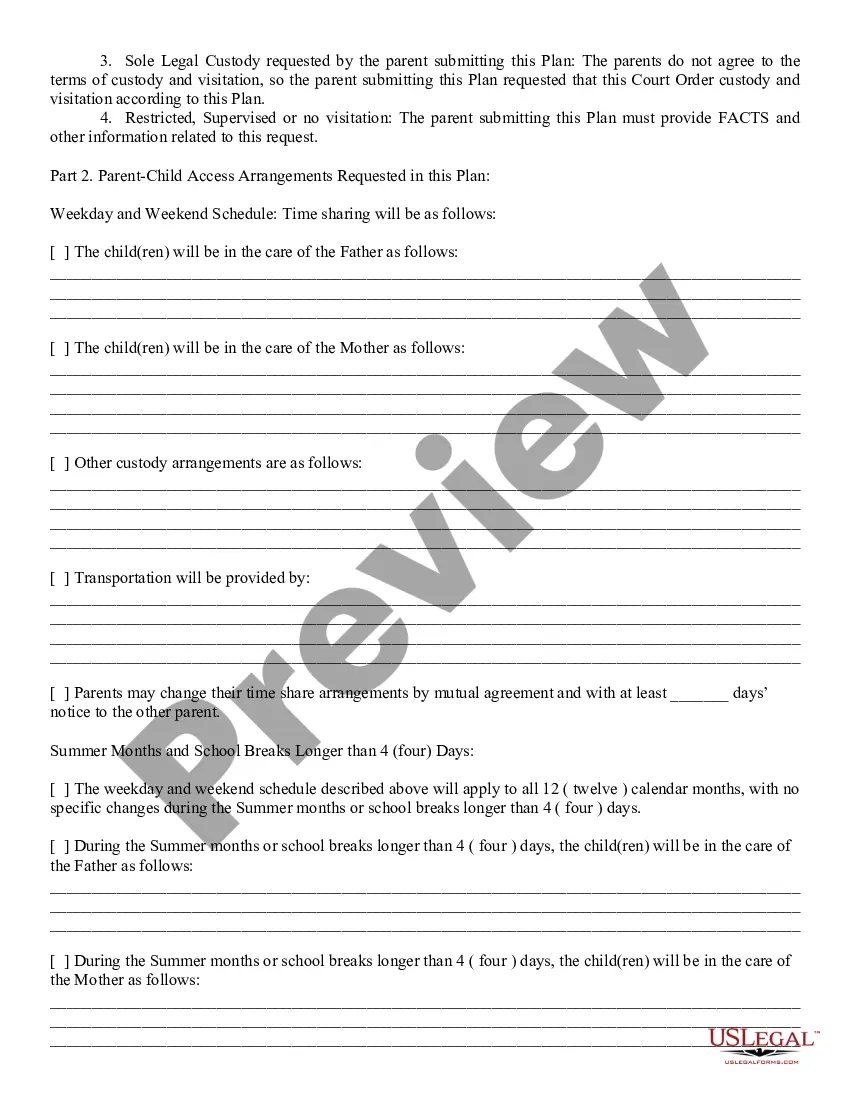
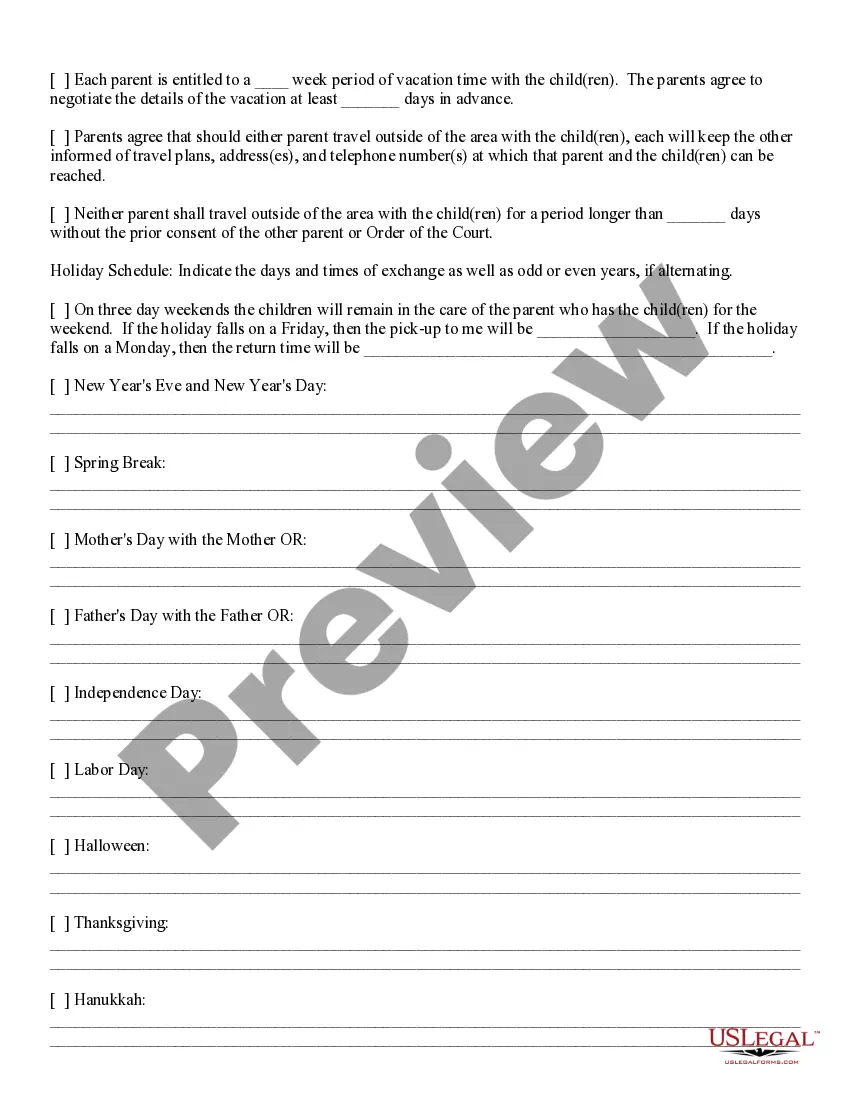
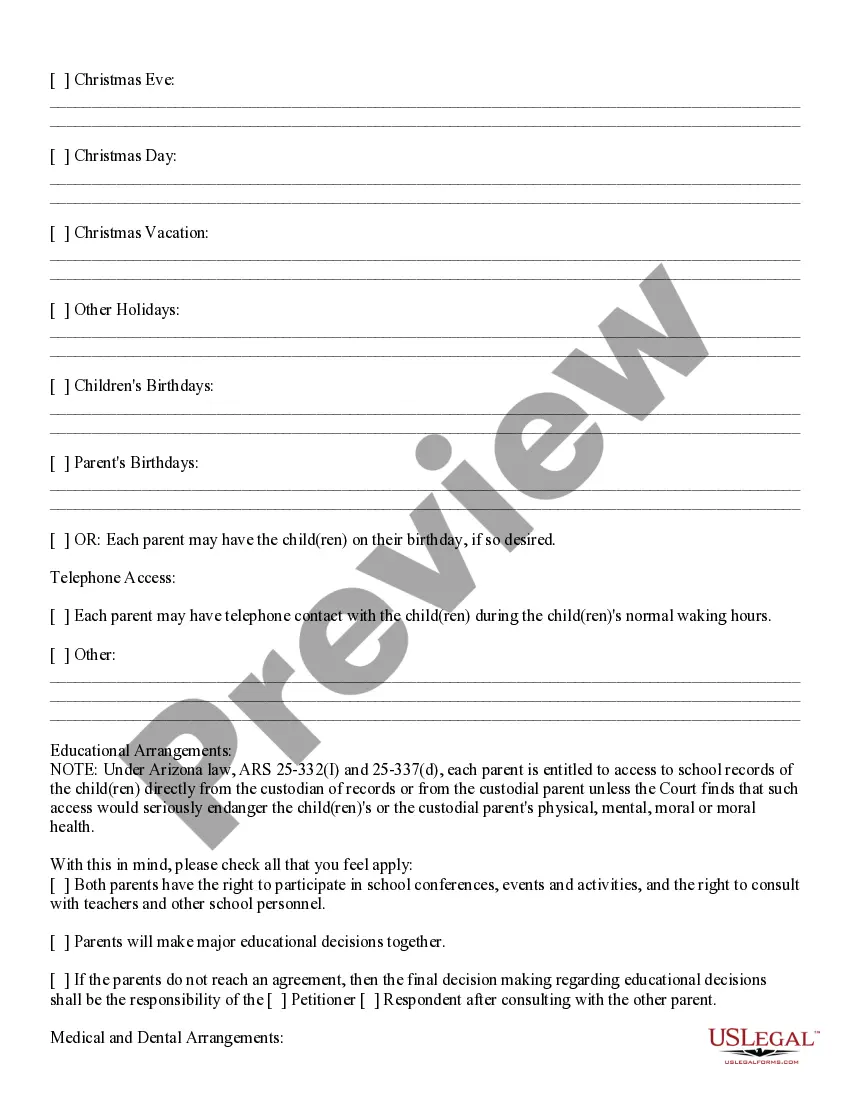
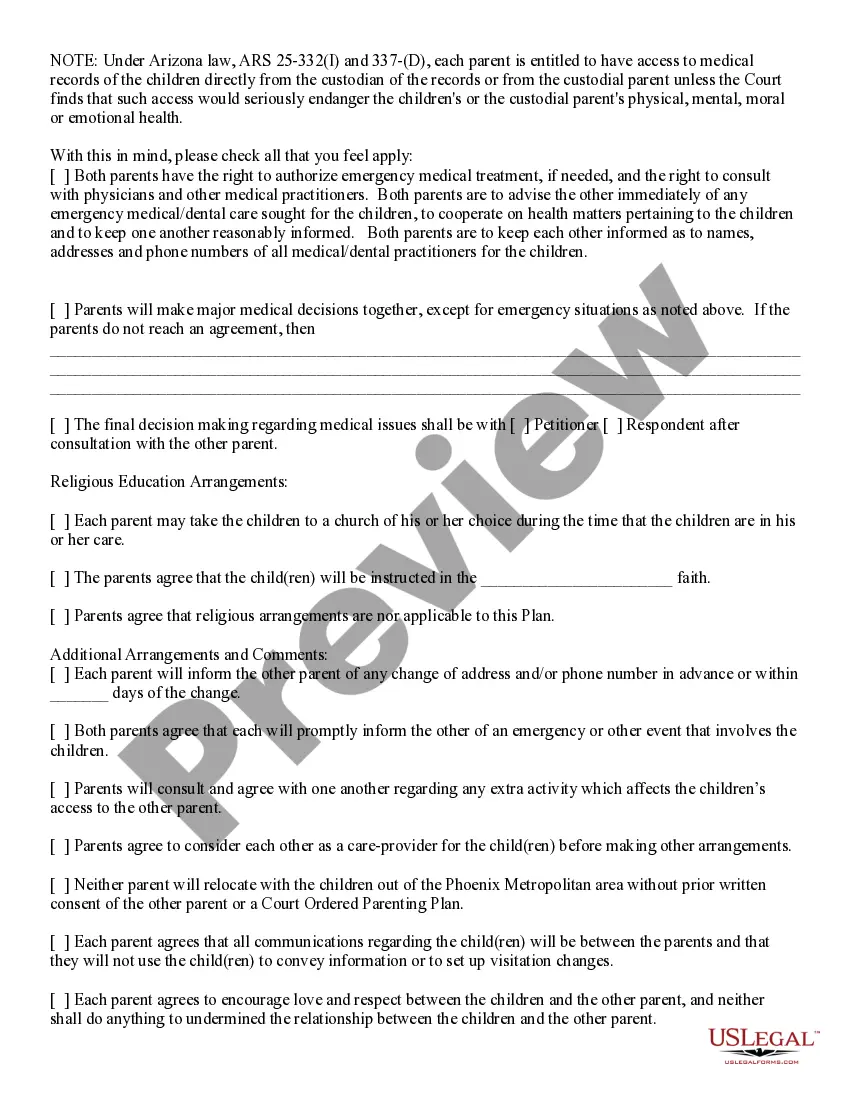
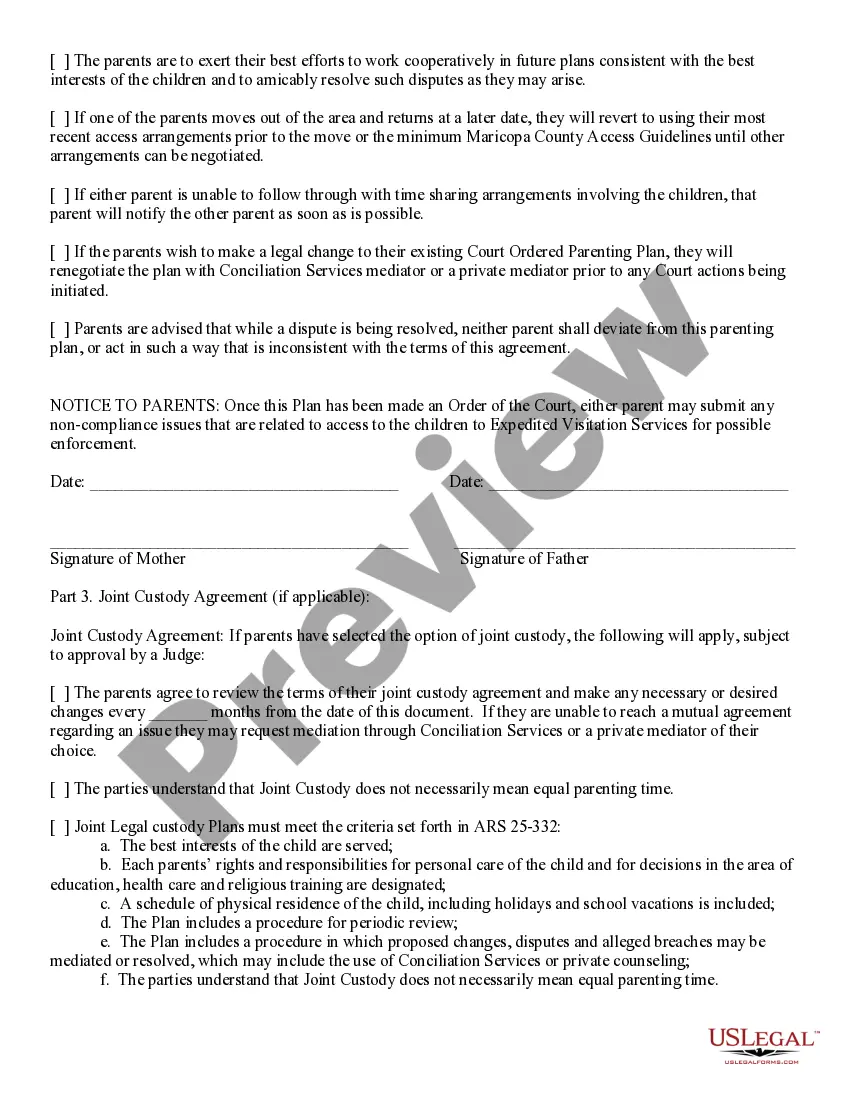
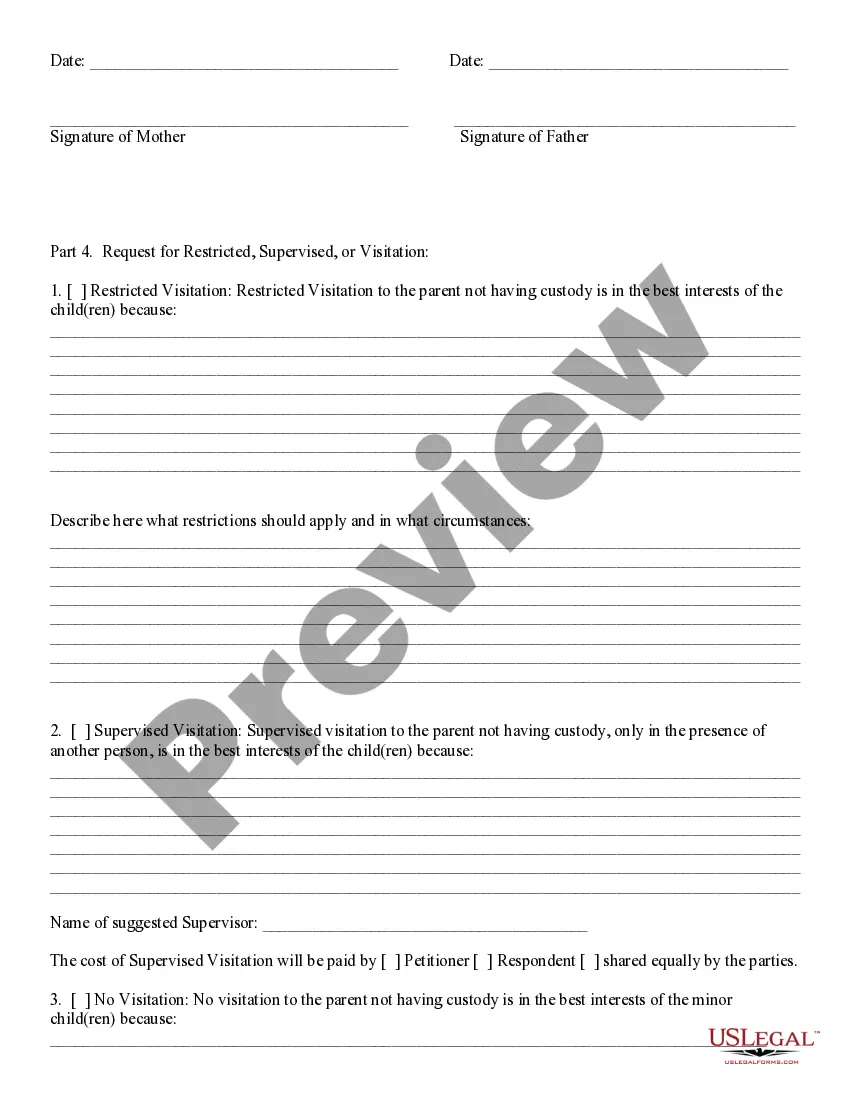
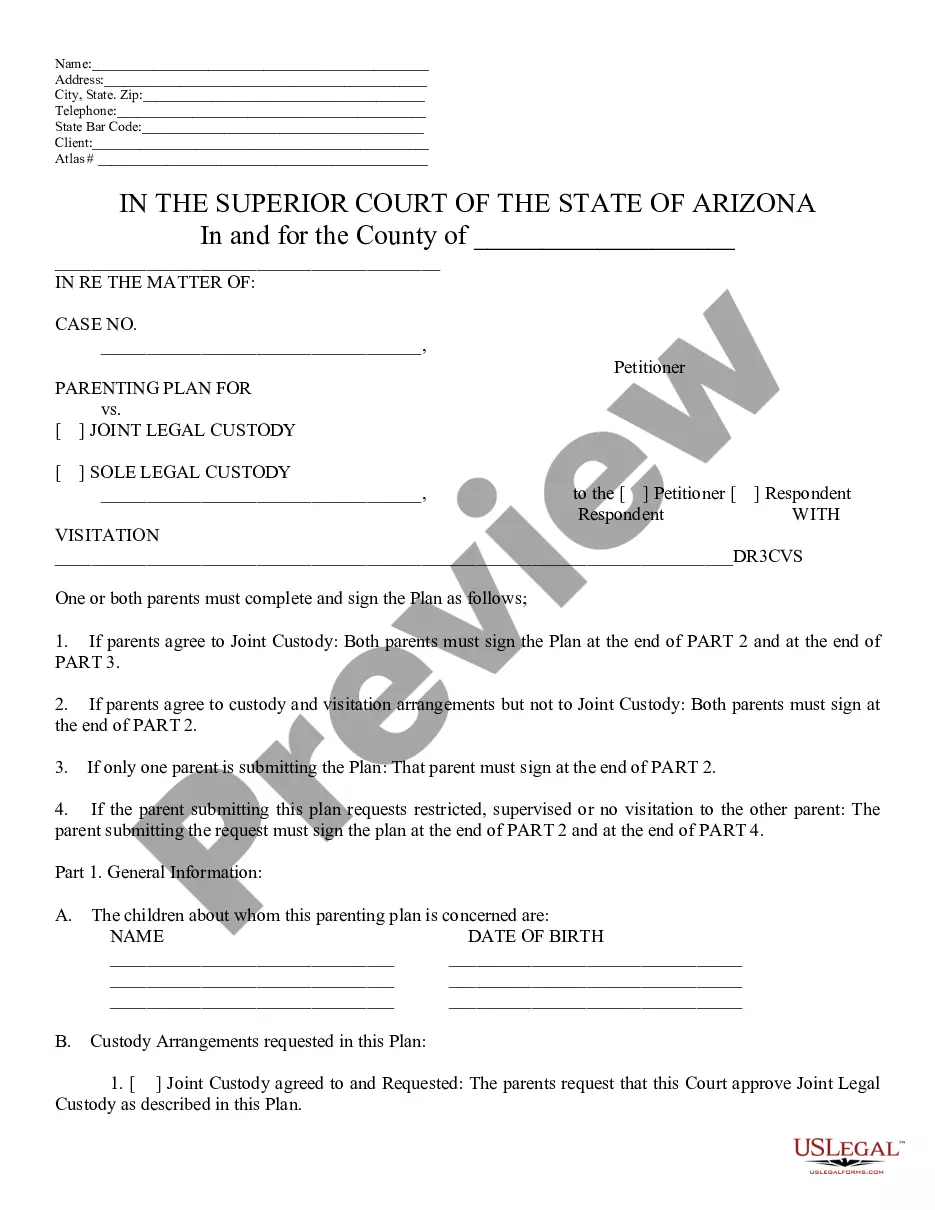
Arizona Parenting Plan Guidelines With No Custody
Description

Get your form ready online
Our built-in tools help you complete, sign, share, and store your documents in one place.
Make edits, fill in missing information, and update formatting in US Legal Forms—just like you would in MS Word.
Download a copy, print it, send it by email, or mail it via USPS—whatever works best for your next step.
Sign and collect signatures with our SignNow integration. Send to multiple recipients, set reminders, and more. Go Premium to unlock E-Sign.
If this form requires notarization, complete it online through a secure video call—no need to meet a notary in person or wait for an appointment.
We protect your documents and personal data by following strict security and privacy standards.

Make edits, fill in missing information, and update formatting in US Legal Forms—just like you would in MS Word.

Download a copy, print it, send it by email, or mail it via USPS—whatever works best for your next step.

Sign and collect signatures with our SignNow integration. Send to multiple recipients, set reminders, and more. Go Premium to unlock E-Sign.

If this form requires notarization, complete it online through a secure video call—no need to meet a notary in person or wait for an appointment.

We protect your documents and personal data by following strict security and privacy standards.
Looking for another form?


How to fill out Arizona Parenting Plan And Guidelines?
Legal administration can be daunting, even for the most experienced experts.
When you are looking for Arizona Parenting Plan Guidelines With No Custody and lack the time to dedicate to finding the correct and current version, the processes can be arduous.
US Legal Forms addresses all your requirements, from personal to business paperwork, all in one location.
Utilize sophisticated tools to fill out and manage your Arizona Parenting Plan Guidelines With No Custody.
Here are the steps to follow after obtaining the form you need: Confirm it is the correct document by previewing it and reviewing its details. Verify that the template is valid in your state or county. Select Buy Now when you are ready. Choose a monthly subscription option. Select the format you require, and Download, fill out, sign, print, and submit your documents. Take advantage of the US Legal Forms online catalog, supported by 25 years of experience and dependability. Transform your daily document management into a simple and user-friendly experience today.
- Access a repository of articles, guides, and materials pertinent to your situation and needs.
- Save time and effort in finding the documents you require, and use US Legal Forms’ advanced search and Preview tool to locate Arizona Parenting Plan Guidelines With No Custody and obtain it.
- If you hold a monthly subscription, Log In to your US Legal Forms account, search for the form, and acquire it.
- Check your My documents section to review the documents you have previously saved and manage your folders as needed.
- If this is your first experience with US Legal Forms, create an account and gain unlimited access to all the resources of the library.
- A comprehensive online form directory could be transformative for anyone aiming to handle these matters effectively.
- US Legal Forms stands as a frontrunner in online legal documents, offering over 85,000 state-specific legal forms accessible at any time.
- With US Legal Forms, you can access localized legal and business documents.
Form popularity
FAQ
Yes. Parents who are able to compromise on their custody arrangements, without turning the decision-making over to the judge, are strongly encouraged to do so. So long as your agreement is in the best interests of the children, you and the other parent may settle custody and access issues by private agreement.
If a married couple separates but does not file for legal separation or divorce, both parents would still share physical and legal custody. Each parent would have just as much right to take the child as they did before the separation.
Commonly referred to as ?sole custody,? sole legal decision-making gives one parent exclusive authority to make all legal decisions for his or her children. Sole decision-making is usually reserved for cases involving domestic violence between the parties or substance abuse by a parent.
Arizona law states that the child must be ?of suitable age and maturity,? but it doesn't specify a particular age (ARS 25-403). In that sense, a child cannot outright refuse visitation with a parent until the child turns 18.