Beneficiary Transfer Death With Ira
Description




Get your form ready online
Our built-in tools help you complete, sign, share, and store your documents in one place.
Make edits, fill in missing information, and update formatting in US Legal Forms—just like you would in MS Word.
Download a copy, print it, send it by email, or mail it via USPS—whatever works best for your next step.
Sign and collect signatures with our SignNow integration. Send to multiple recipients, set reminders, and more. Go Premium to unlock E-Sign.
If this form requires notarization, complete it online through a secure video call—no need to meet a notary in person or wait for an appointment.
We protect your documents and personal data by following strict security and privacy standards.

Make edits, fill in missing information, and update formatting in US Legal Forms—just like you would in MS Word.

Download a copy, print it, send it by email, or mail it via USPS—whatever works best for your next step.

Sign and collect signatures with our SignNow integration. Send to multiple recipients, set reminders, and more. Go Premium to unlock E-Sign.

If this form requires notarization, complete it online through a secure video call—no need to meet a notary in person or wait for an appointment.

We protect your documents and personal data by following strict security and privacy standards.
Looking for another form?








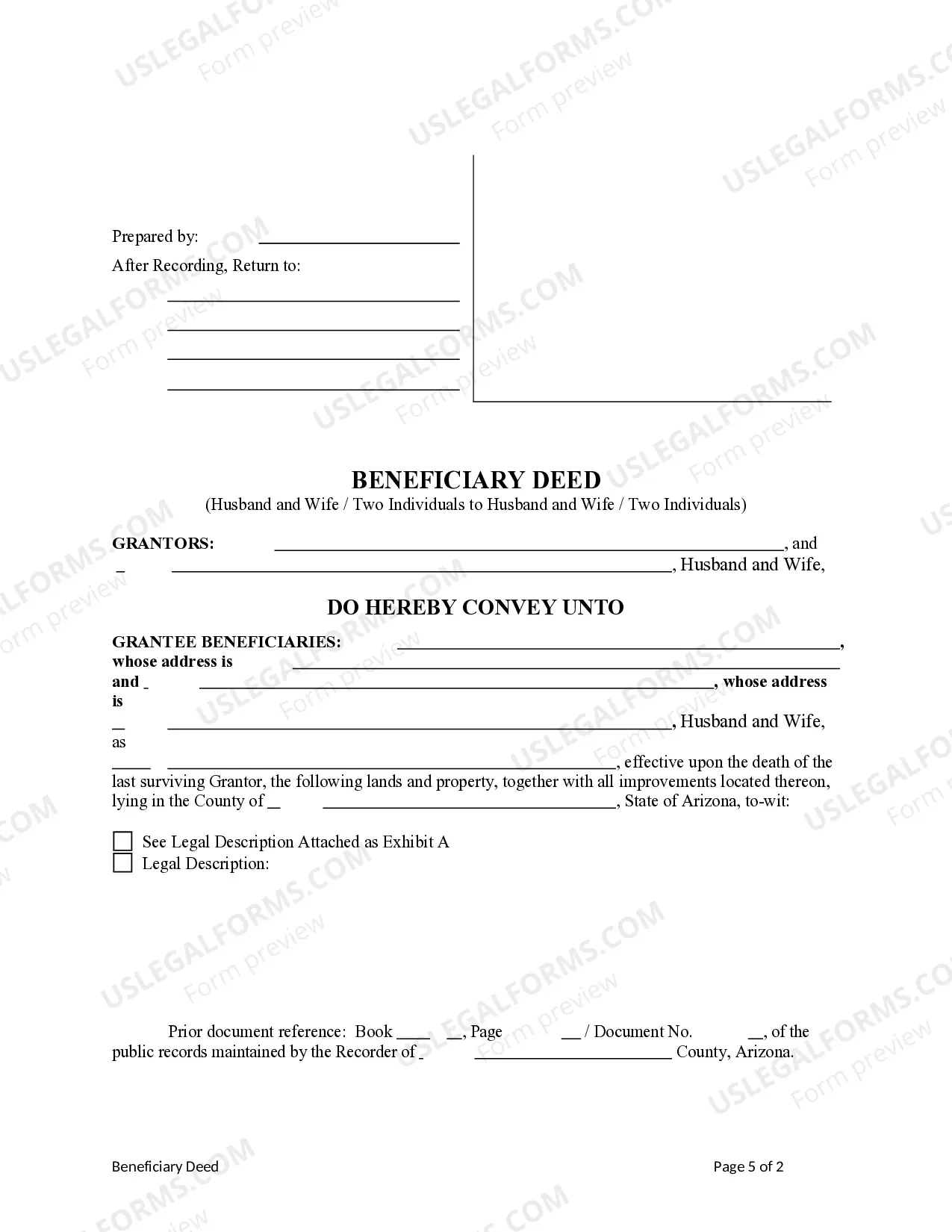
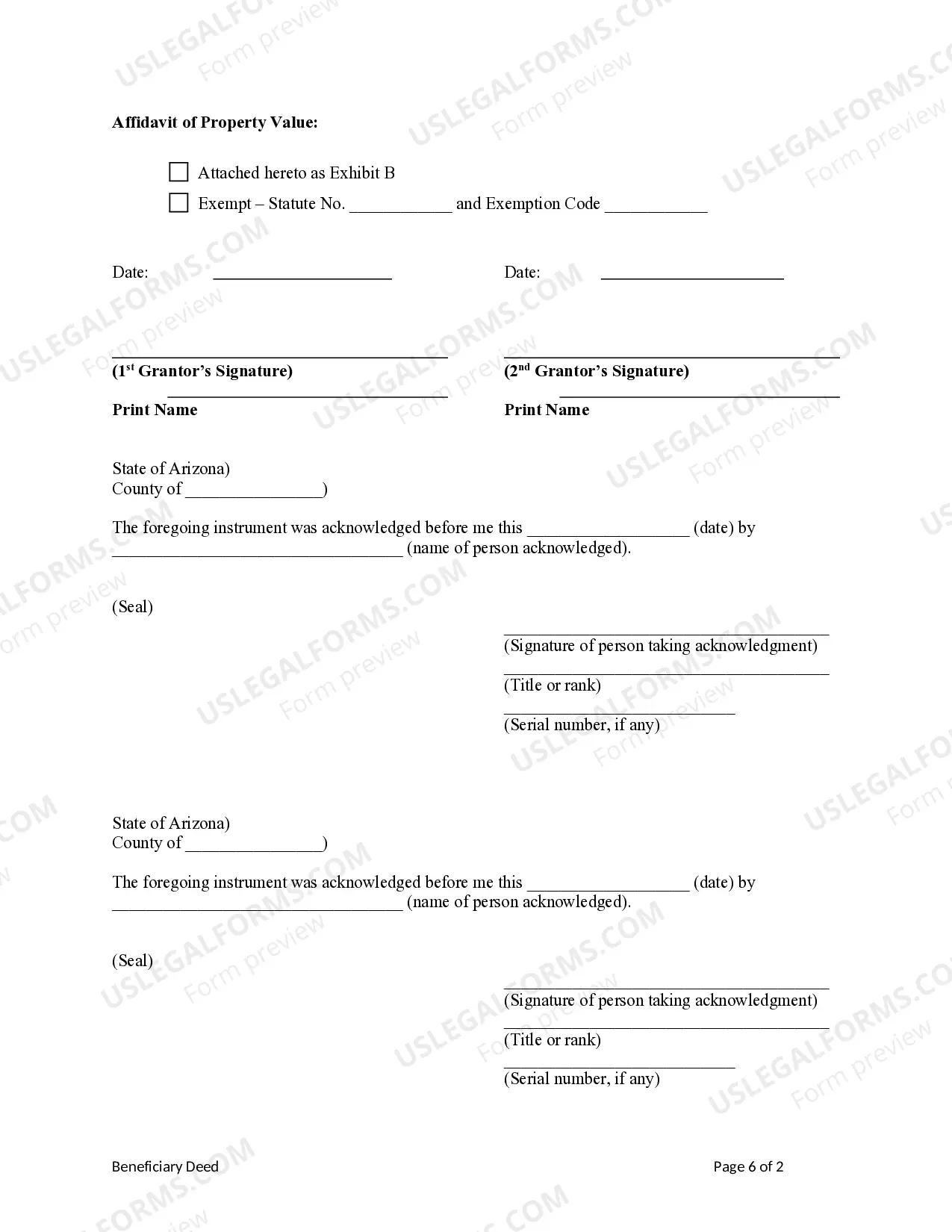
How to fill out Arizona Beneficiary Or Transfer Of Death (TOD) Deed - Husband And Wife / Two Individuals To Husband And Wife / Two Individuals?
- If you are already a user of US Legal Forms, log in to your account and download the necessary form template by clicking the Download button. Ensure your subscription is active, and renew it if required.
- For first-time users, begin by checking the Preview mode and form description. Verify that you have selected the correct template that aligns with your local jurisdiction needs.
- If you notice any inconsistencies, use the Search tab to find the correct form. Once you have found the right document, proceed to the next step.
- Purchase the document by clicking the Buy Now button and selecting your preferred subscription plan. You will need to register an account to access the complete library.
- Complete your purchase by providing your credit card information or selecting your PayPal account for payment.
- Download the form to your device and save it for future completion. You can always revisit it later in the My Forms section of your profile.
US Legal Forms stands out by empowering individuals and attorneys to efficiently execute legal documents. With over 85,000 easily editable templates, we are committed to providing a robust collection at a competitive price.
Get started today to ensure your beneficiary transfer is handled correctly and efficiently. Explore our resources now and take the next step in securing your legal documentation.
Form popularity
FAQ
After the death of an IRA owner, beneficiaries usually need to complete the transfer within specific timeframes set by the IRS. Under typical circumstances, the funds should be distributed within a year to avoid complications with tax liabilities. However, partial distributions may occur based on the beneficiary type and circumstances. For clarity and compliance, consider seeking professional assistance, such as services offered by US Legal Forms.
The rules for IRA death distribution require that funds are distributed according to the beneficiary's designation. If you designated a beneficiary transfer death with IRA, those funds pass directly to them, potentially avoiding probate. Additionally, dependent on the beneficiary's relationship to the IRA owner, different tax implications may apply. It’s essential to review your beneficiary choices regularly to stay compliant with IRS regulations.
If a beneficiary of an IRA passes away, the distribution process can become complicated. Typically, the IRA owner should update the beneficiary designation to reflect any changes. If no contingent beneficiary exists, the IRA may go through probate, delaying access to funds. To navigate these challenges effectively, consider using resources like US Legal Forms to manage your beneficiary transfer death with IRA.
A major downside of a Transfer on Death (TOD) is that it may not provide the same tax advantages as a beneficiary transfer death with IRA. While the asset can be transferred outside probate, its tax implications can vary. Additionally, not all institutions support TODs, causing headaches in asset distribution. Therefore, it’s crucial to consult with an expert to determine if a TOD fits your financial goals.
Choosing between Transfer on Death (TOD) and designating a beneficiary for your IRA involves understanding the nuances of each option. With a beneficiary transfer death with IRA, assets directly pass to the designated person, offering smoother estate management. In contrast, a TOD may not be recognized by all financial institutions, potentially leading to complexities. Ultimately, your choice should be aligned with your estate plan and the needs of your heirs.
The individual named as the beneficiary on the IRA inherits the account after the account holder's death. If there is no named beneficiary, the account may go to the estate, potentially complicating the transfer. Beneficiaries should keep updated records of their accounts to make sure the transfer occurs smoothly. For guidance on managing the beneficiary transfer death with IRA, consider resources from US Legal Forms to simplify your estate planning.
An IRA may stay in a deceased person's name until the estate is settled, but this typically should not last long. Once the beneficiary is identified, they need to act on the account promptly to avoid any unnecessary complications. Generally, beneficiaries must take action within a specific time frame to avoid tax penalties. Understanding the implications of beneficiary transfer death with IRA can guide the next steps effectively.
When someone dies with a designated beneficiary for their IRA, the assets typically transfer directly to that beneficiary. This transfer bypasses probate, which can make the process easier and faster. However, it's essential for beneficiaries to understand their options and any tax implications that may follow. Engaging with platforms like US Legal Forms can help clarify these processes and ensure proper management of the beneficiary transfer death with IRA.
An inherited IRA does not have to be cashed out immediately. Depending on the relationship of the beneficiary to the original account holder, there are often options to stretch the distributions over time. This flexibility can allow the beneficiary to maximize the tax benefits associated with the inherited IRA. Understanding how to manage this can simplify the beneficiary transfer death with IRA.
If the beneficiary of an IRA passes away, the account’s ownership may revert back to the estate unless a new beneficiary is designated. The tax implications can vary based on the circumstances surrounding the estate and the original account holder. In such cases, consulting with a financial advisor can help navigate the complexities of beneficiary transfer death with IRA scenarios.