Arizona Quitclaim Deed from Individual to Individual
Overview of this form
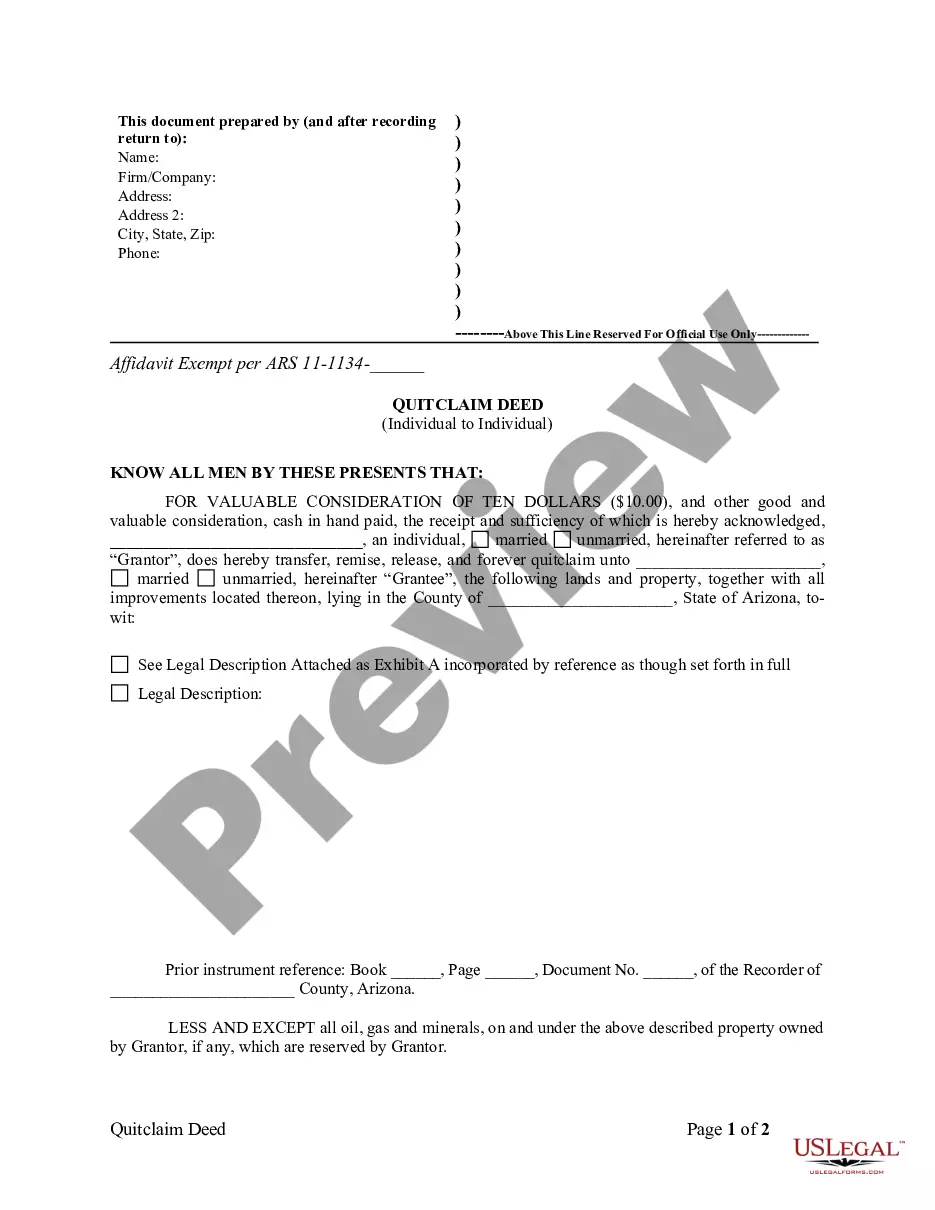
This Quitclaim Deed from Individual to Individual is a legal document that allows a property owner (the Grantor) to transfer their ownership interest in real estate to another individual (the Grantee) without any warranties. It is often used to clear up property titles, but unlike other deeds, it does not guarantee that the Grantor holds a valid title. In this context, the Quitclaim Deed primarily conveys the property while reserving the rights to any oil, gas, and minerals beneath it, distinguishing it from warranty deeds that provide more assurance of title quality.
Main sections of this form
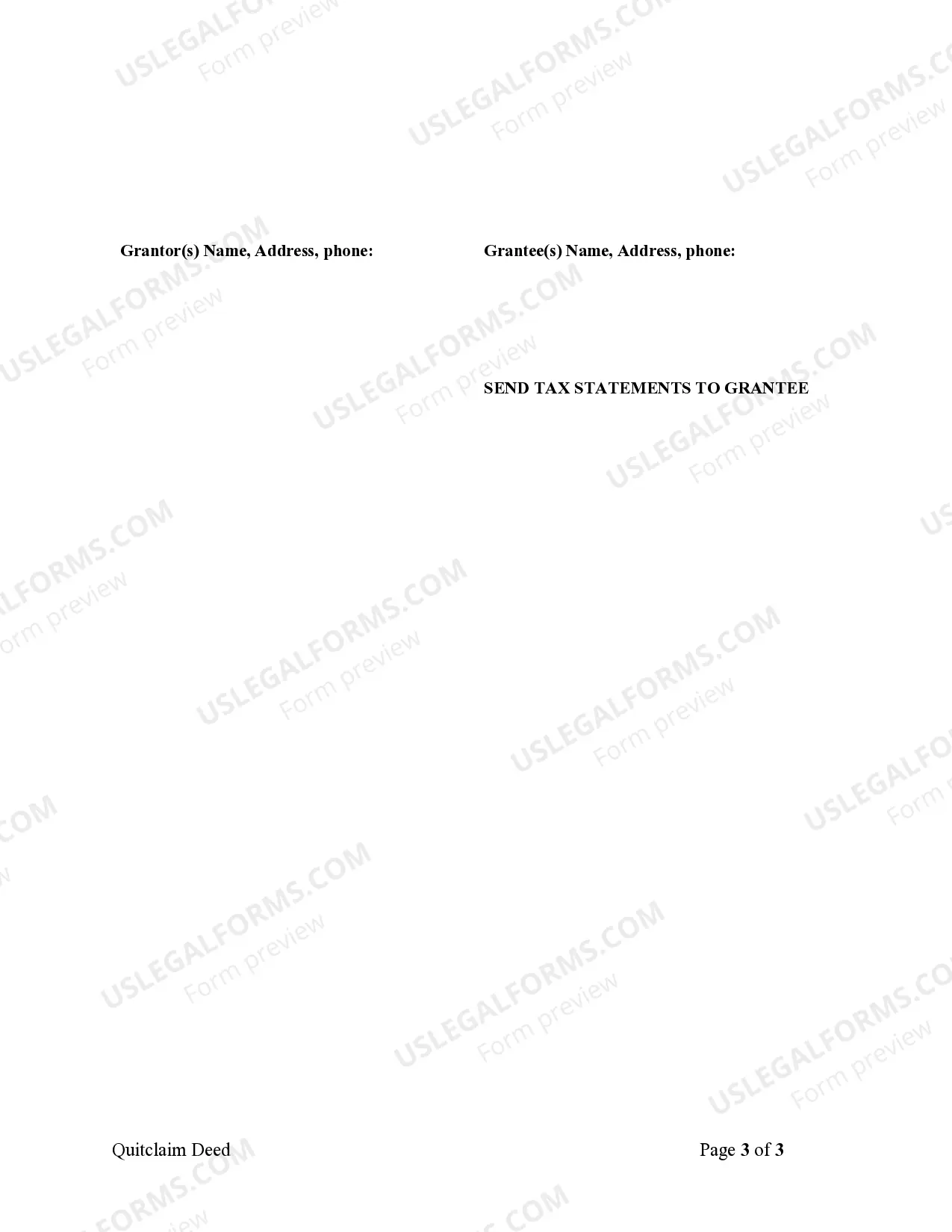
- Identification of the Grantor and Grantee, including names and addresses.
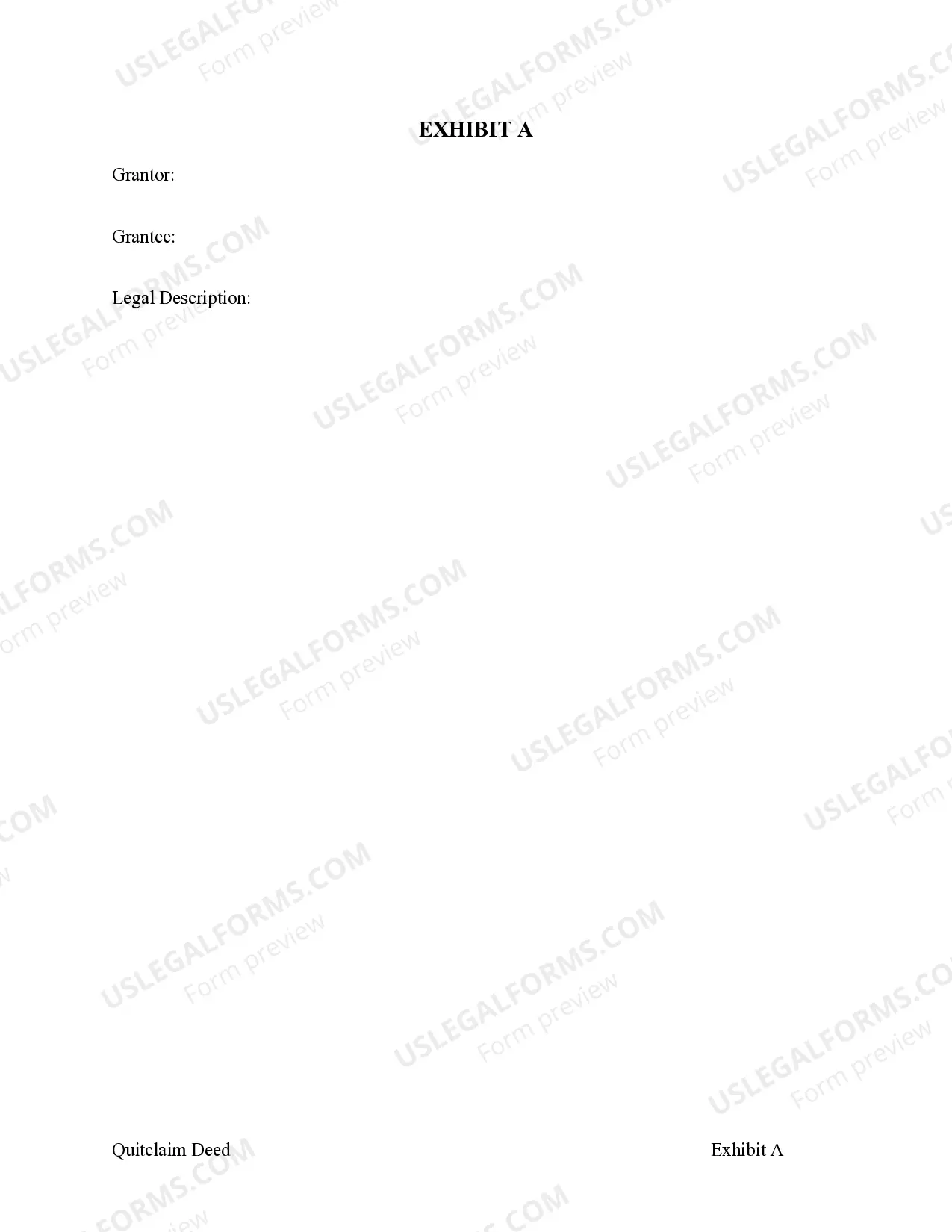
- A legal description of the property being conveyed.
- Reservation of rights to oil, gas, and minerals by the Grantor.
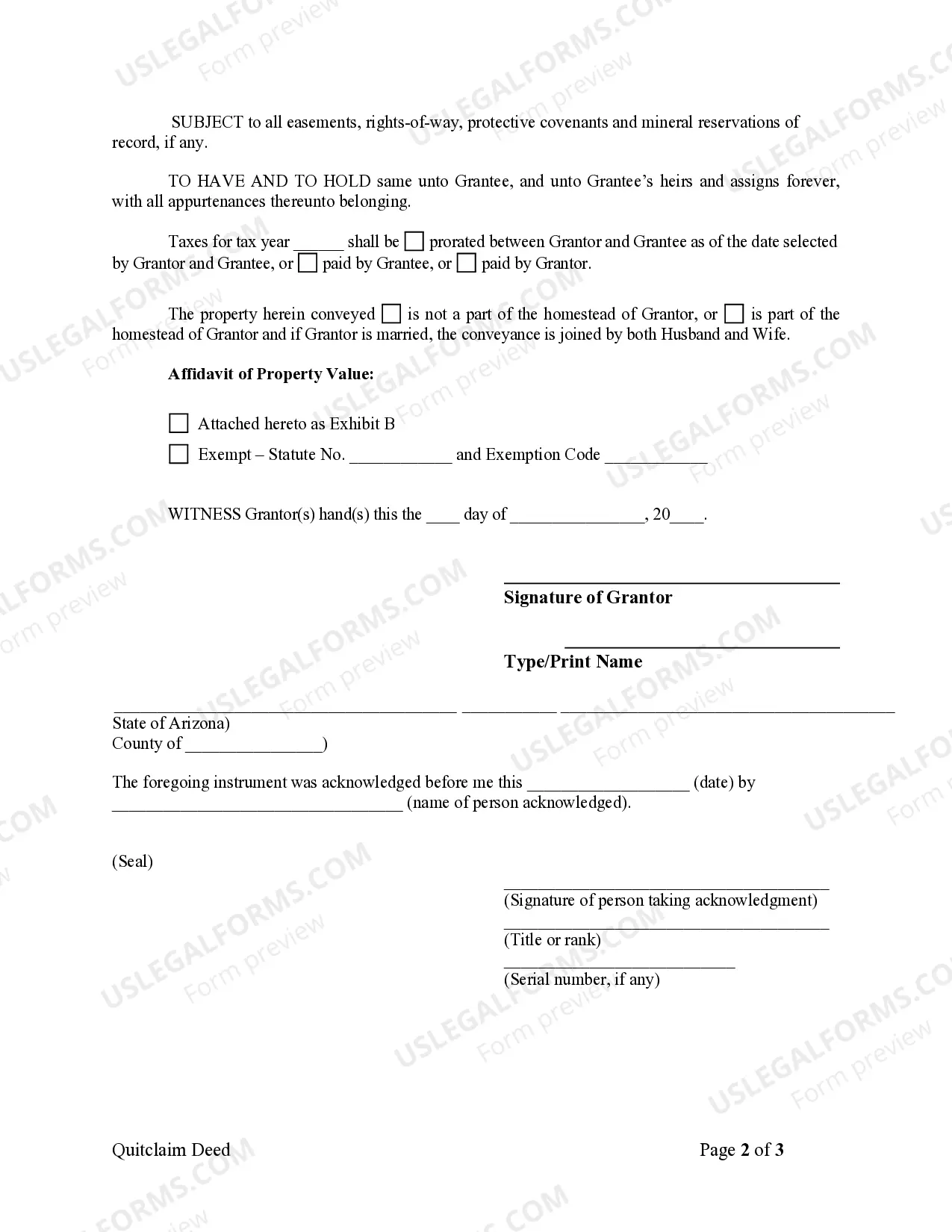
- Provisions regarding tax proration for the year.
- Indication of whether the property is part of the Grantor's homestead.
- Signatures of the Grantor and a Notary Public for validation.




Situations where this form applies
This form is commonly used in situations where an individual wants to transfer property ownership without the complexities associated with a warranty deed. It may be used among family members, during divorce settlements, or when transferring property to a trust. Individuals may also use this deed when selling or gifting property without the need for title guarantees, making it a straightforward option for transferring interests between private parties.
Who should use this form
This Quitclaim Deed is suitable for:
- Individuals who wish to transfer property to another individual.
- Property owners looking to convey interests in real estate without providing warranties.
- People involved in family transactions, such as gifts or inheritances.
- Parties in legal agreements who need a simple method for property transfer.
Instructions for completing this form
- Identify the parties involved by entering the full names and addresses of the Grantor and Grantee.
- Provide a detailed legal description of the property being conveyed.
- Specify any reserved rights, such as oil, gas, and mineral rights, that the Grantor retains.
- Indicate the method of tax payment or prorating for the tax year.
- Ensure signatures of the Grantor are included, along with a Notary Public's acknowledgment.
Is notarization required?
This form must be notarized to be legally valid. US Legal Forms provides secure online notarization powered by Notarize, allowing you to complete the process through a verified video call.
Get your form ready online
Our built-in tools help you complete, sign, share, and store your documents in one place.
Make edits, fill in missing information, and update formatting in US Legal Forms—just like you would in MS Word.
Download a copy, print it, send it by email, or mail it via USPS—whatever works best for your next step.
Sign and collect signatures with our SignNow integration. Send to multiple recipients, set reminders, and more. Go Premium to unlock E-Sign.
If this form requires notarization, complete it online through a secure video call—no need to meet a notary in person or wait for an appointment.
We protect your documents and personal data by following strict security and privacy standards.

Make edits, fill in missing information, and update formatting in US Legal Forms—just like you would in MS Word.

Download a copy, print it, send it by email, or mail it via USPS—whatever works best for your next step.

Sign and collect signatures with our SignNow integration. Send to multiple recipients, set reminders, and more. Go Premium to unlock E-Sign.

If this form requires notarization, complete it online through a secure video call—no need to meet a notary in person or wait for an appointment.

We protect your documents and personal data by following strict security and privacy standards.
Typical mistakes to avoid
- Failing to provide a complete legal description of the property.
- Not including the notary's signature, which may render the deed invalid.
- Incorrectly stating tax obligations, leading to disputes post-transfer.
- Inaccurately identifying the relationship or status of parties involved.
Benefits of using this form online
- The ability to download and complete the form at your convenience.
- Access to templates that are legally compliant and drafted by licensed attorneys.
- Easy editing tools for customization to fit your specific situation.
- Secure and reliable, providing peace of mind for your legal needs.
Looking for another form?
Form popularity
FAQ
To create a valid Arizona Quitclaim Deed from Individual to Individual, you need to meet several essential requirements. The deed should clearly state the names of the individuals involved, provide a precise legal description of the property, and include the grantor's signature. Additionally, notarization is necessary, and in some cases, you may need to include a witness signature. By following these guidelines, you ensure that your property transfer is recognized legally and fully effective.
An Arizona Quitclaim Deed from Individual to Individual must include specific elements to be valid. Key requirements are the names and addresses of both the grantor and grantee, a legal description of the property, and the signature of the grantor. It is also essential to have the deed notarized to verify the authenticity of the signatures. Properly completing these requirements ensures a smooth transfer of property ownership.
Transferring property title to a family member in Arizona can be efficiently done using an Arizona Quitclaim Deed from Individual to Individual. To initiate the process, the current property owner must fill out the quitclaim deed form and provide essential details, such as the names and addresses of both parties involved. After signing the deed in front of a notary, you can file it with the county recorder's office. Utilizing platforms like US Legal Forms can simplify this process by offering user-friendly templates.
To fill out a Quit Claim Deed for the Arizona Quitclaim Deed from Individual to Individual, start by providing the names and addresses of the grantor (the person transferring the property) and the grantee (the person receiving the property). Next, include a legal description of the property, which can be found on the current deed or property tax statement. After that, both parties should sign the document in the presence of a notary public. Finally, record the completed Quit Claim Deed with the County Recorder's Office to make the transfer official.
A quitclaim deed in Arizona allows an individual to transfer their interest in a property to another person without guaranteeing that the title is clear. This means the grantor does not assert any ownership claims beyond their interest in the property. When using an Arizona Quitclaim Deed from Individual to Individual, it's crucial to understand that the recipient receives whatever interest the grantor holds, which can be beneficial in specific situations. Make sure to consult resources like US Legal Forms to ensure the process is handled correctly.
Removing someone from a deed in AZ involves drafting a new deed, like an Arizona Quitclaim Deed from Individual to Individual. This deed allows you to transfer ownership and remove the individual in question. Once properly signed and notarized, ensure you record it at your local county recorder's office to finalize the process and protect your ownership rights.
To remove someone from a deed in Arizona, you typically need to execute a new deed, such as an Arizona Quitclaim Deed from Individual to Individual. This new deed should transfer ownership to the remaining parties or yourself and should clearly state the intention to remove the other party. After signing and notarizing the deed, it must be recorded with the appropriate county office to be effective.
To revoke a beneficiary deed in Arizona, you must complete a new document that explicitly states your intention to revoke the prior deed. This document must be signed, notarized, and recorded with the county recorder's office where the property is located. By doing this, you eliminate the effect of the earlier beneficiary deed. Utilizing platforms like US Legal Forms can streamline this process, helping you create and file the necessary documents correctly.