- US Legal Forms
- Forms Catalog
- Landlord Tenant
-
North Carolina Residential Rental Lease Agreement
North Carolina Residential Rental Lease Agreement
-
No results found.
-
North Carolina
-
Alabama
-
Alaska
-
Arizona
-
Arkansas
-
California
-
Colorado
-
Connecticut
-
Delaware
-
District of Columbia
-
Florida
-
Georgia
-
Hawaii
-
Idaho
-
Illinois
-
Indiana
-
Iowa
-
Kansas
-
Kentucky
-
Louisiana
-
Maine
-
Maryland
-
Massachusetts
-
Michigan
-
Minnesota
-
Mississippi
-
Missouri
-
Montana
-
Multi-State
-
Nebraska
-
Nevada
-
New Hampshire
-
New Jersey
-
New Mexico
-
New York
-
North Dakota
-
Ohio
-
Oklahoma
-
Oregon
-
Pennsylvania
-
Rhode Island
-
South Carolina
-
South Dakota
-
Tennessee
-
Texas
-
Utah
-
Vermont
-
Virginia
-
Washington
-
West Virginia
-
Wisconsin
-
Wyoming

This form is part of a form package!
Get all related documents in one bundle, so you don’t have to search separately.
Understanding this form
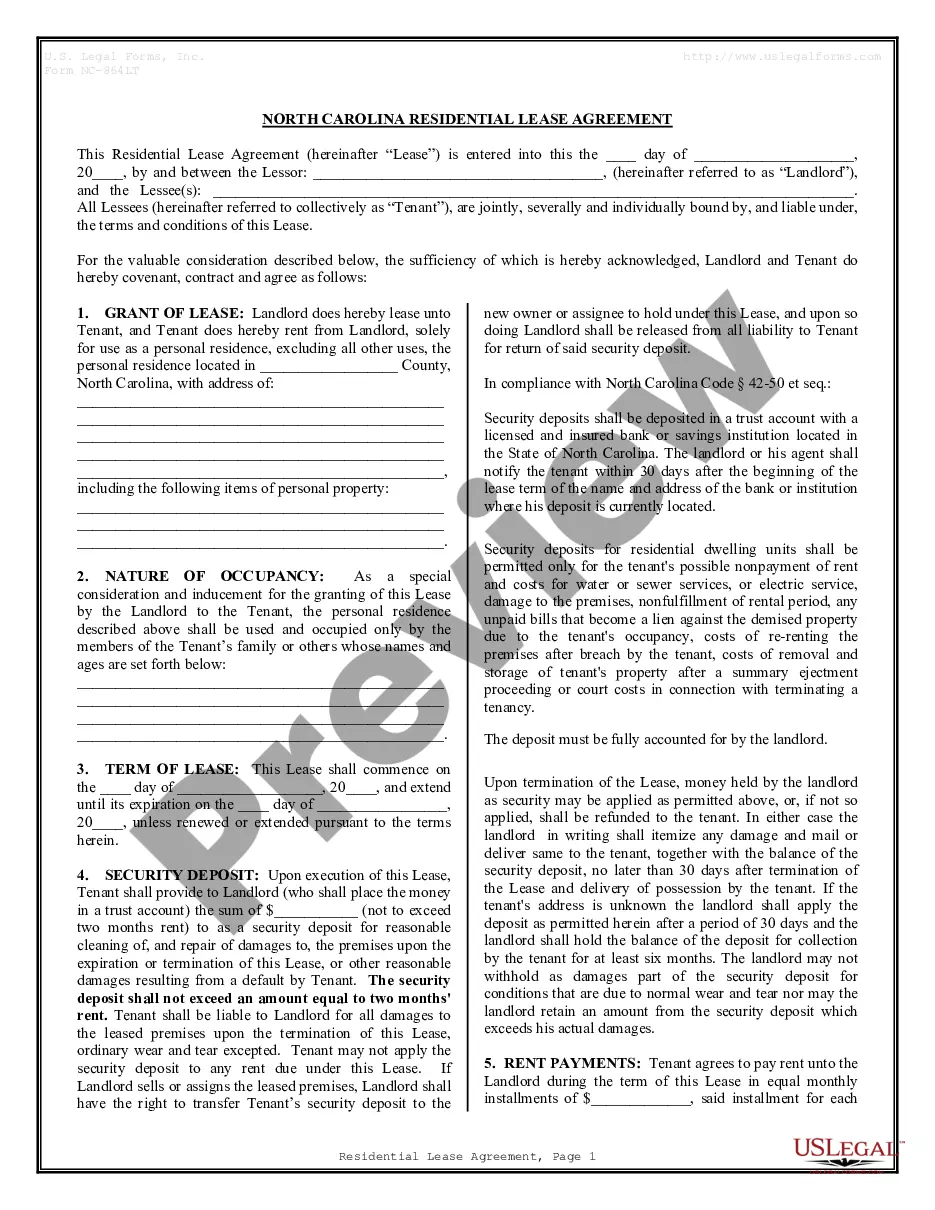
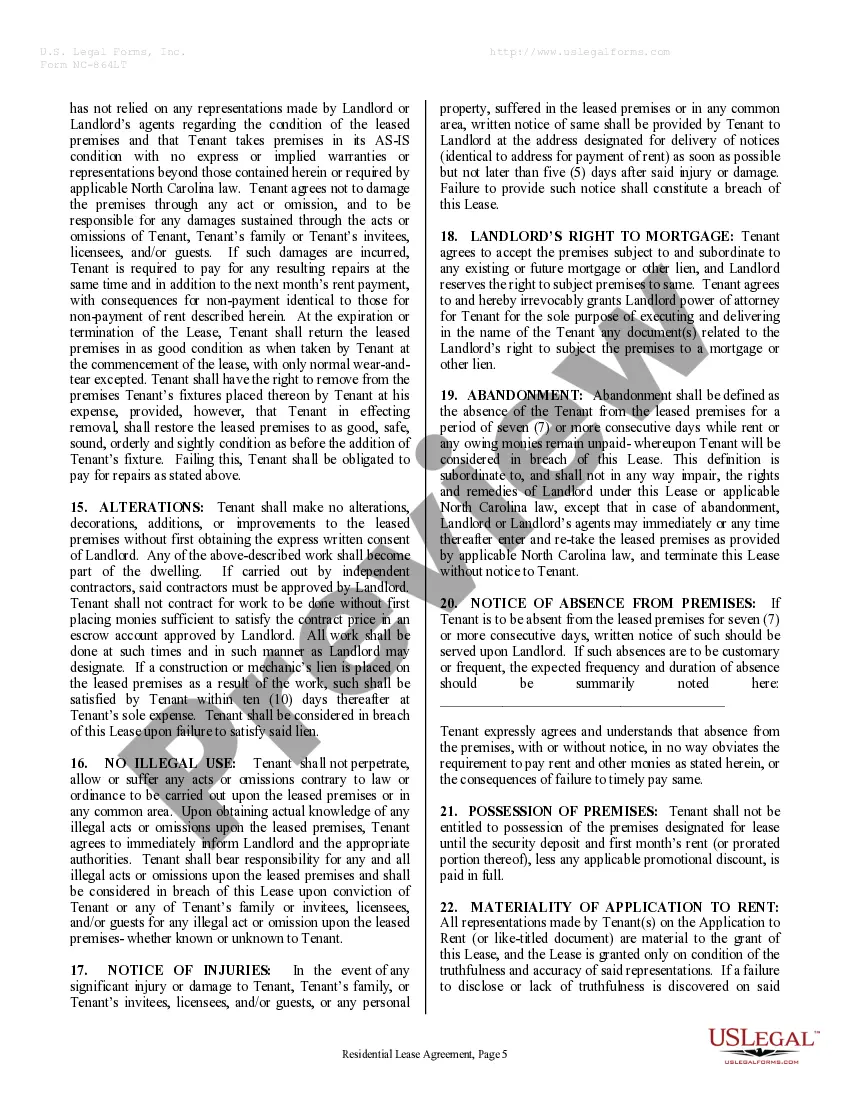
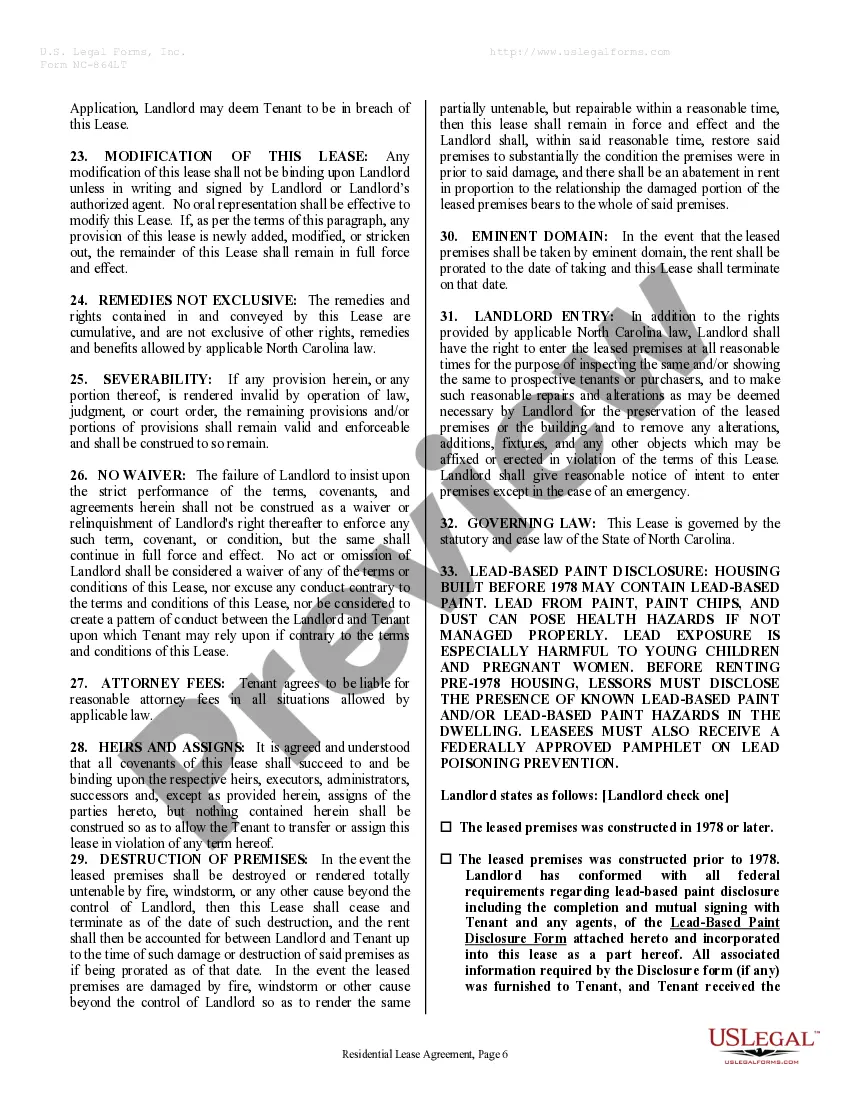
The Residential Rental Lease Agreement is a legal document that outlines the terms and conditions for renting a residential property. This form serves as a binding contract between a landlord and a tenant, specifying mutual obligations, rental amounts, lease duration, and other essential details. Unlike similar agreements, this lease is tailored to a specific term and includes provisions that can be adjusted according to the needs of the parties involved.
Key components of this form
- Grant of lease: Details the leased property and intended use.
- Nature of occupancy: Specifies who may occupy the property.
- Security deposit: Outlines the deposit amount and conditions for its return.
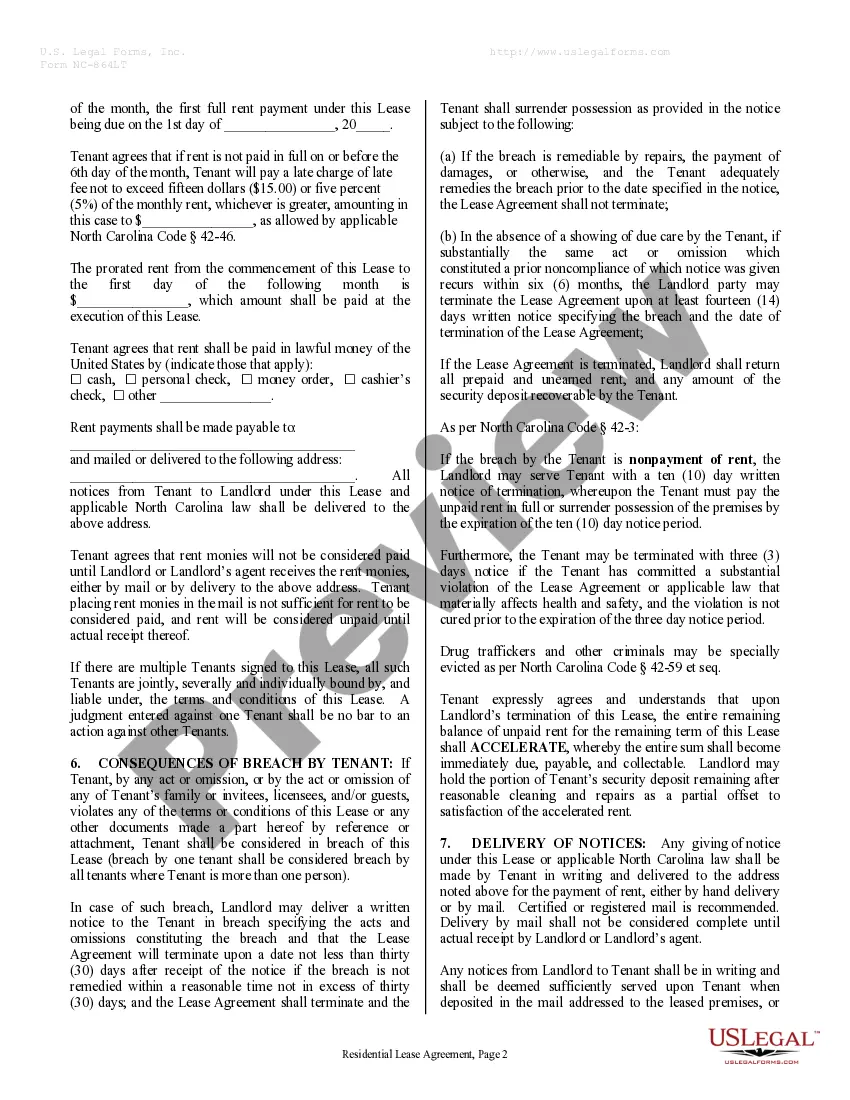
- Rent payments: Describes the rent amount, payment due dates, and late fees.
- Consequences of breach: Explains the repercussions if either party violates the lease terms.
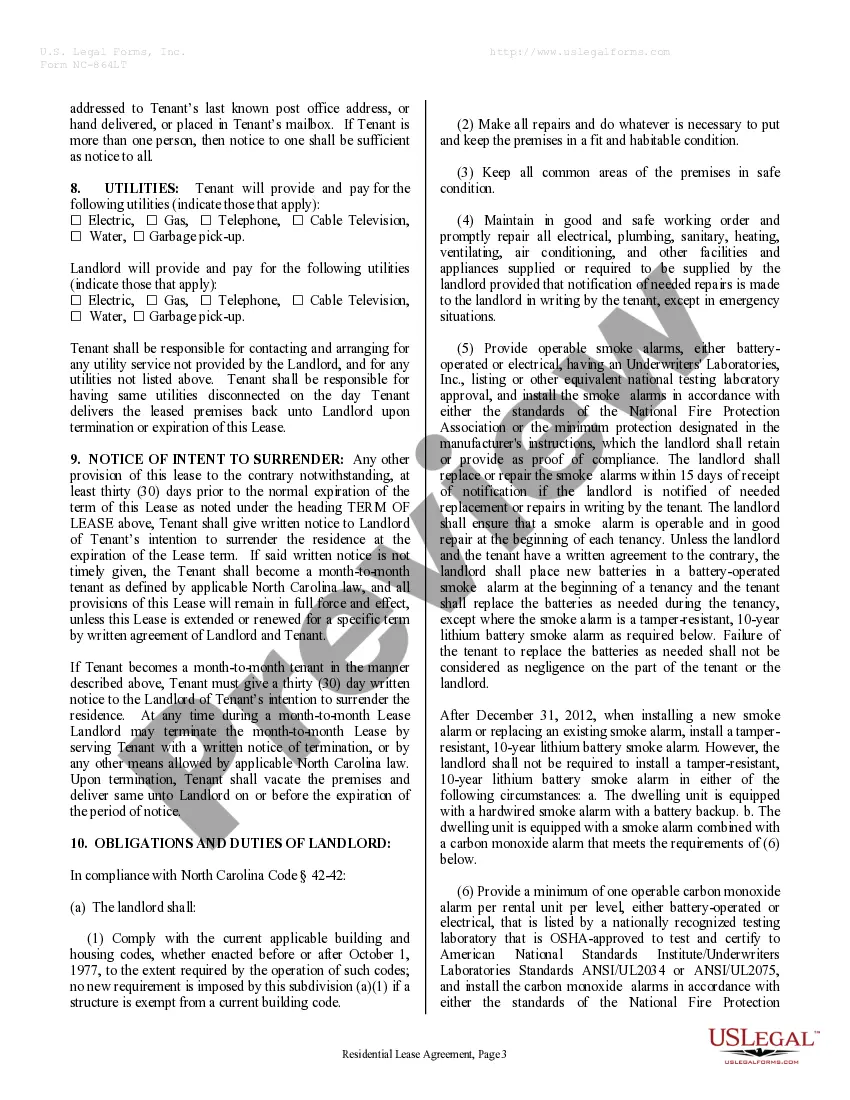
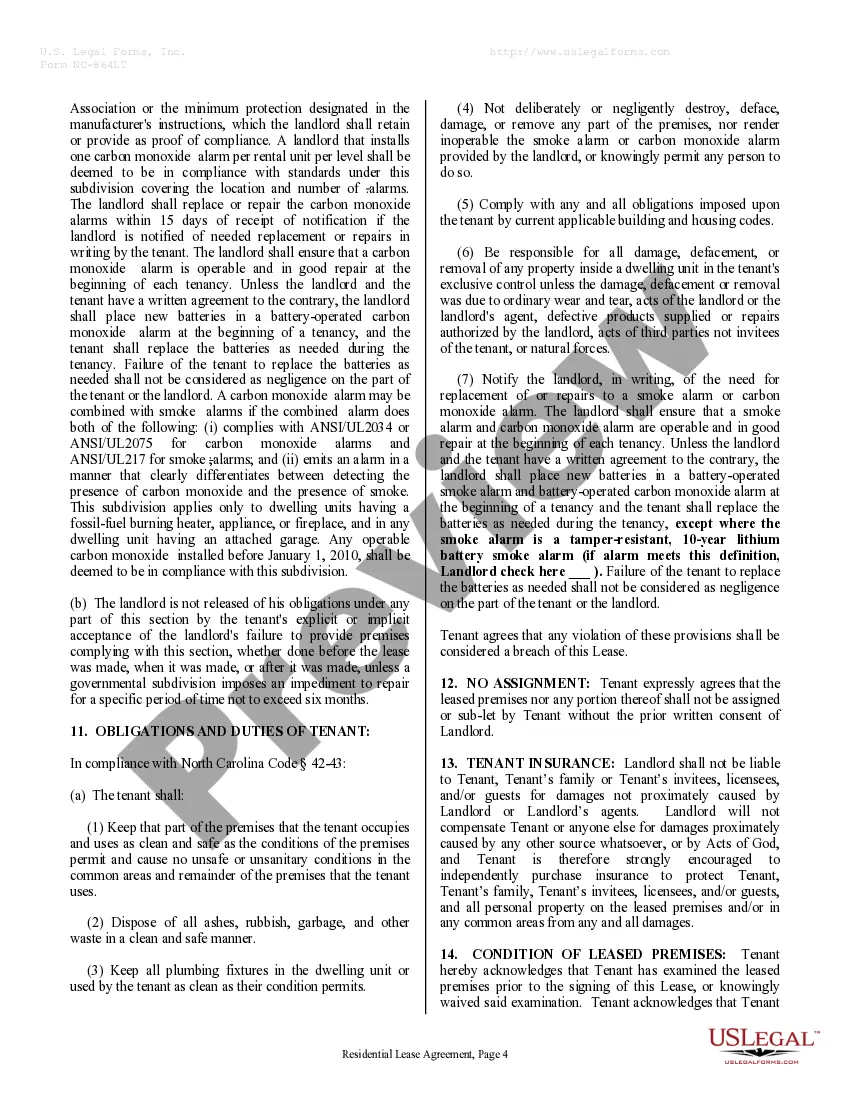
- Obligations and duties of landlord and tenant: Enumerates responsibilities of both parties during the tenancy.

Related forms
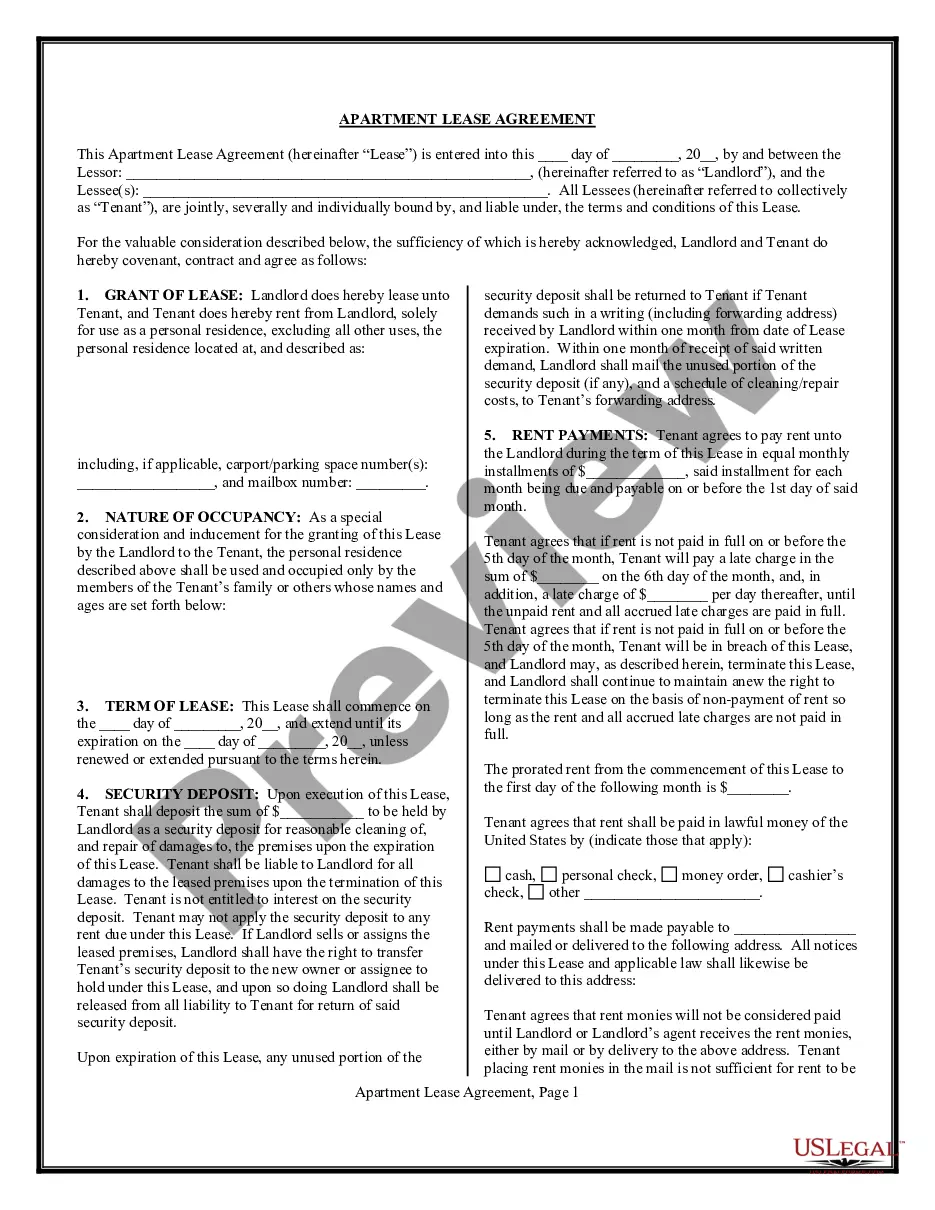
Apartment Lease Agreement
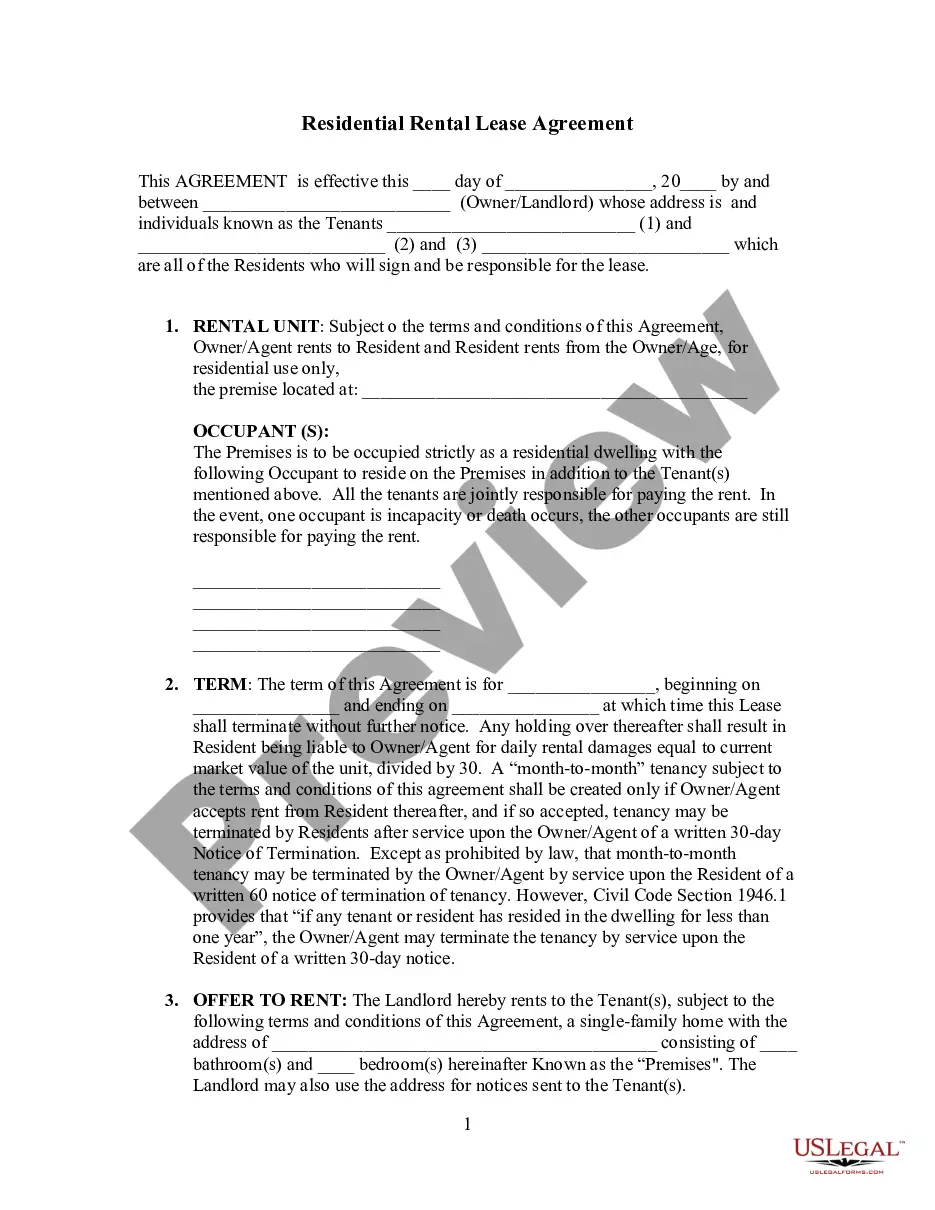
Residential Lease Agreement
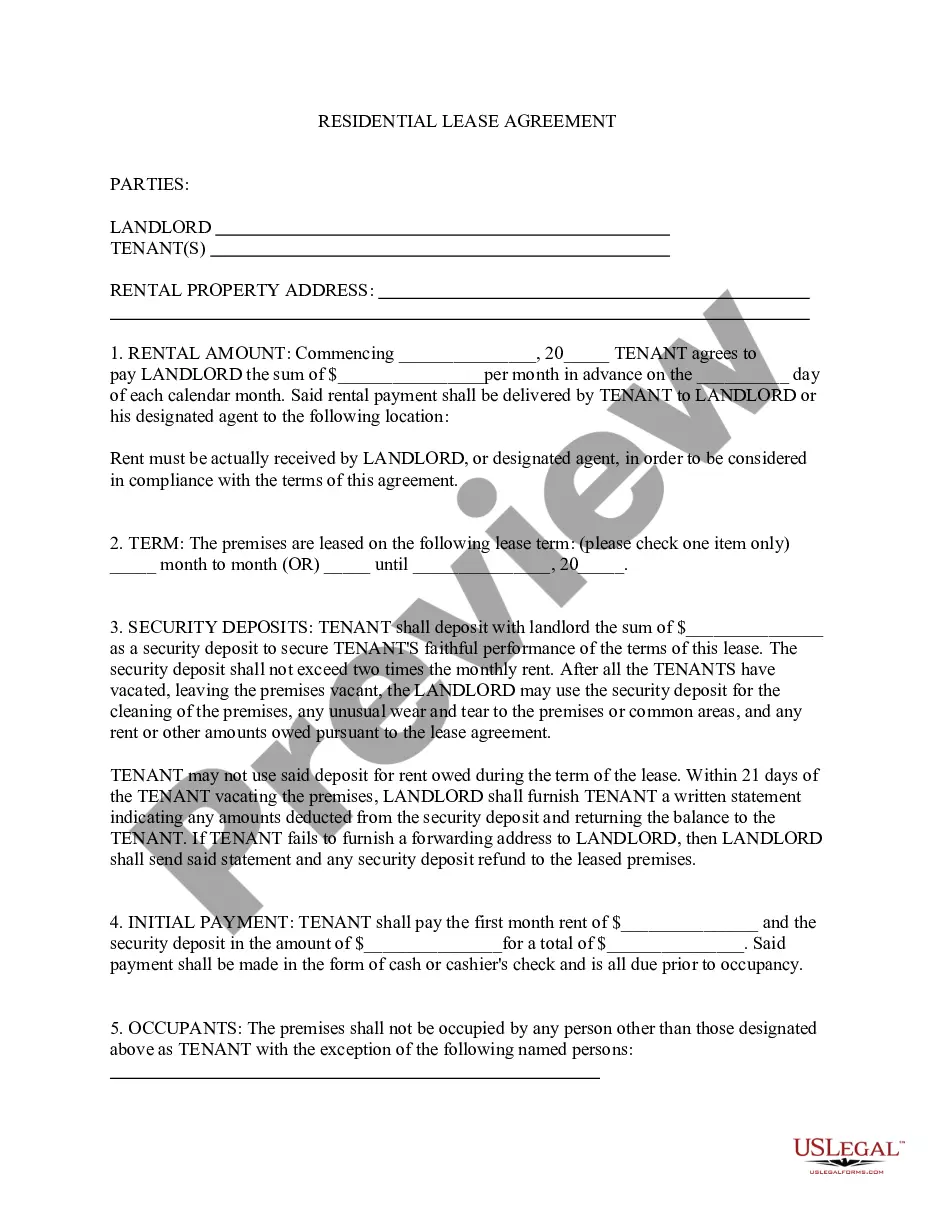
Residential Lease Agreement
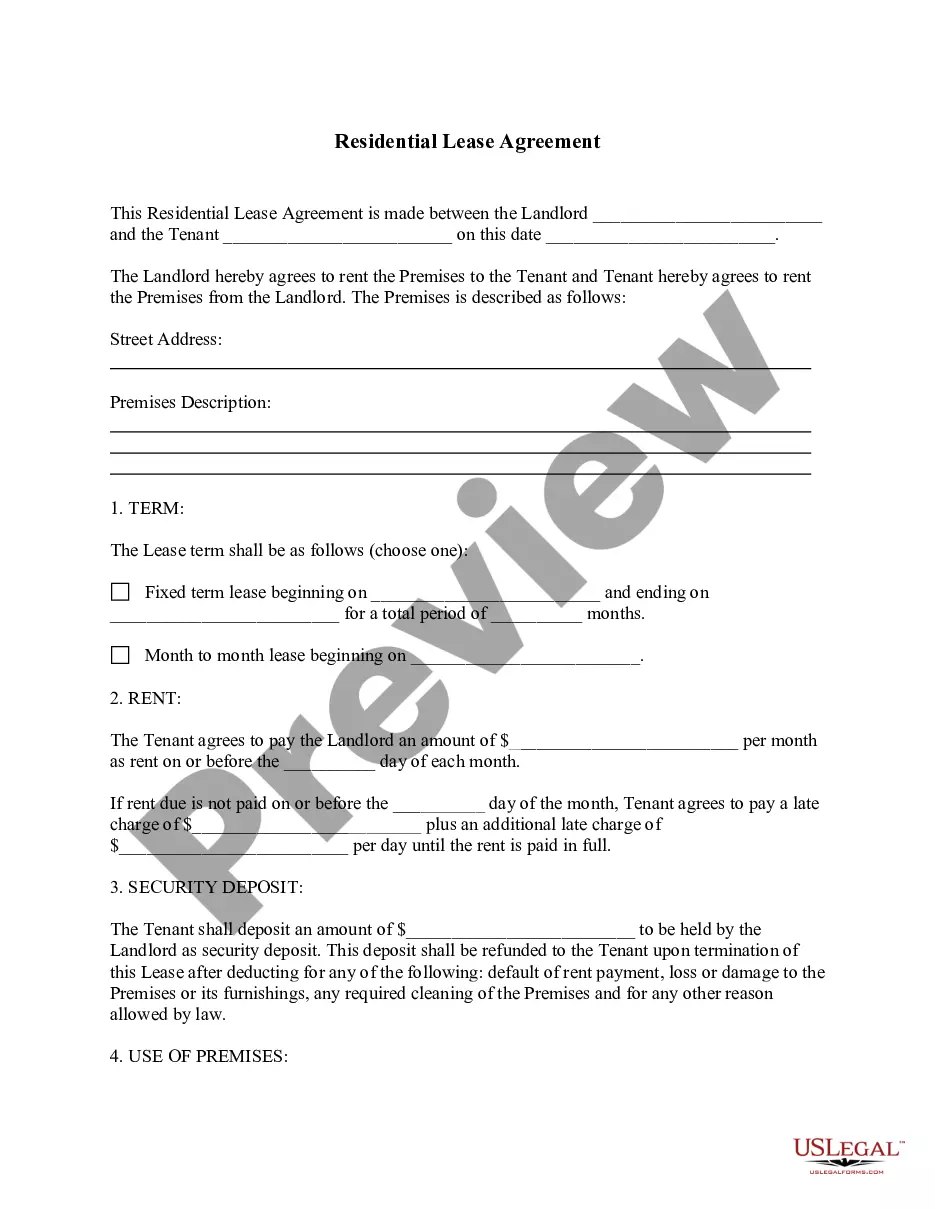
Basic Residential Lease Agreement
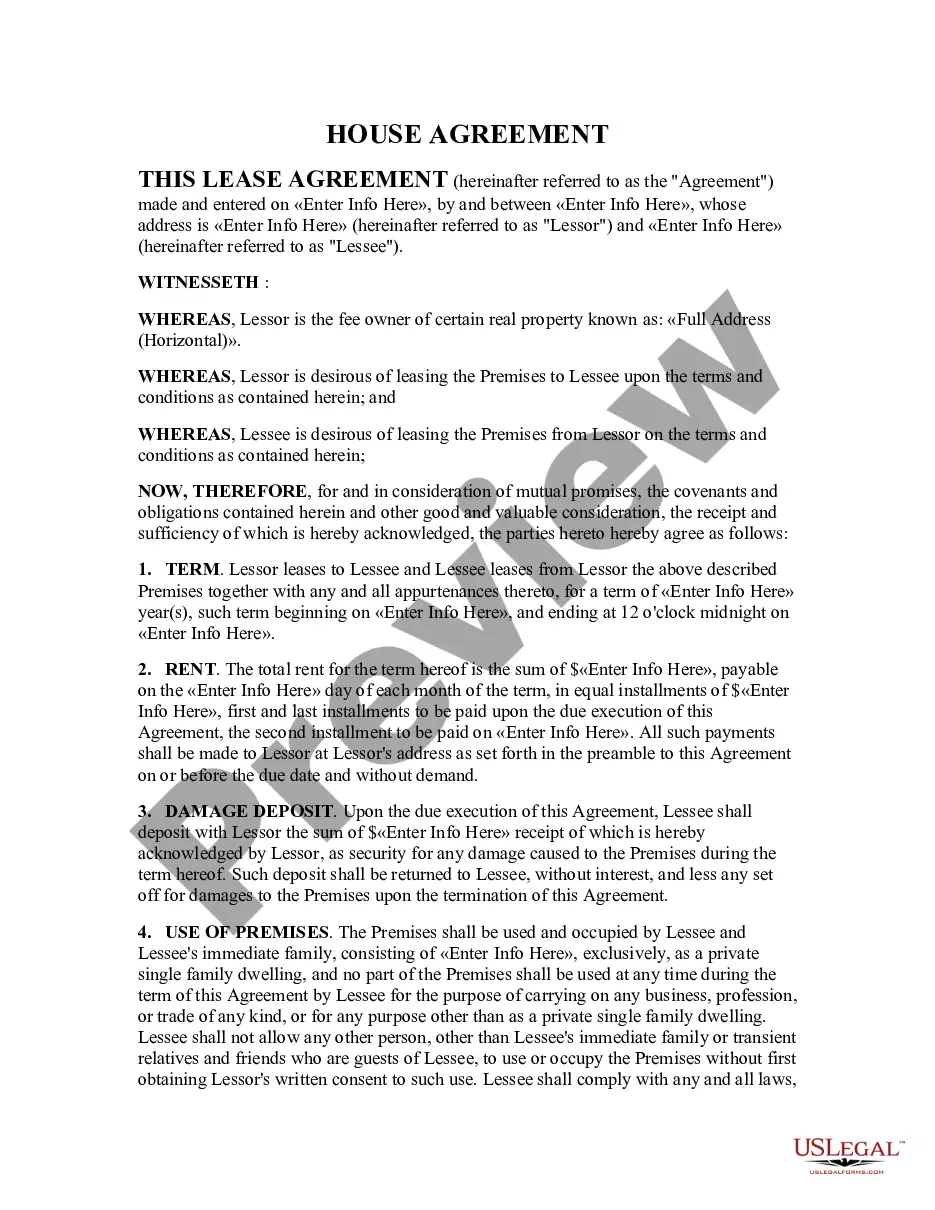
House Lease Agreement
Common use cases
This Residential Rental Lease Agreement should be used when entering into a rental arrangement for residential properties, whether for a single-family home, apartment, or other dwelling. It is suitable when both landlord and tenant agree on the lease terms, such as the rental amount, duration, and specific rules governing the tenancy.
Who can use this document
- Landlords who wish to rent out residential properties.
- Tenants seeking a formal agreement for leasing a residence.
- Property managers or real estate professionals facilitating rental agreements between landlords and tenants.
Completing this form step by step
- Identify the parties: Clearly state the names of the landlord and tenant(s).
- Specify the property: Include the full address and any personal property provided in the rental.
- Enter lease dates: Indicate the lease start and end dates.
- Detail the security deposit: Specify the amount and conditions for its return.
- Outline rent terms: Include the monthly rent amount, due dates, and payment methods.
Notarization requirements for this form
Notarization is generally not required for this form. However, certain states or situations might demand it. You can complete notarization online through US Legal Forms, powered by Notarize, using a verified video call available anytime.
Get your form ready online
Our built-in tools help you complete, sign, share, and store your documents in one place.
Make edits, fill in missing information, and update formatting in US Legal Forms—just like you would in MS Word.
Download a copy, print it, send it by email, or mail it via USPS—whatever works best for your next step.
Sign and collect signatures with our SignNow integration. Send to multiple recipients, set reminders, and more. Go Premium to unlock E-Sign.
If this form requires notarization, complete it online through a secure video call—no need to meet a notary in person or wait for an appointment.
We protect your documents and personal data by following strict security and privacy standards.

Make edits, fill in missing information, and update formatting in US Legal Forms—just like you would in MS Word.

Download a copy, print it, send it by email, or mail it via USPS—whatever works best for your next step.

Sign and collect signatures with our SignNow integration. Send to multiple recipients, set reminders, and more. Go Premium to unlock E-Sign.

If this form requires notarization, complete it online through a secure video call—no need to meet a notary in person or wait for an appointment.

We protect your documents and personal data by following strict security and privacy standards.
Mistakes to watch out for
- Failing to specify all terms related to rent payment and security deposits.
- Not documenting the names of all tenants, leading to potential issues with responsibility.
- Omitting provisions for breach of contract or consequences for non-payment.
- Not checking state-specific requirements before finalizing the lease.
Why complete this form online
- Convenience: Easily download and complete the form from anywhere.
- Editability: Customize the lease to meet specific needs and terms.
- Reliability: The form is legally vetted by licensed attorneys to ensure compliance with state laws.
Legal use & context
- The Residential Rental Lease Agreement is enforceable under North Carolina law.
- Both landlord and tenant must comply with the terms set forth in the lease for it to be valid.
- The form protects the rights of both parties and outlines remedies in case of breaches.
Quick recap
- A Residential Rental Lease Agreement is essential for defining the landlord-tenant relationship.
- Specific clauses can be tailored to address individual circumstances and needs.
- This form ensures compliance with North Carolina's rental laws, safeguarding both parties' rights.
Looking for another form?
-
Alabama
-
Alaska
-
Arizona
-
Arkansas
-
California
-
Colorado
-
Connecticut
-
Delaware
-
District of Columbia
-
Florida
-
Georgia
-
Guam
-
Hawaii
-
Idaho
-
Illinois
-
Indiana
-
Iowa
-
Kansas
-
Kentucky
-
Louisiana
-
Maine
-
Maryland
-
Massachusetts
-
Michigan
-
Minnesota
-
Mississippi
-
Missouri
-
Montana
-
Nebraska
-
Nevada
-
New Hampshire
-
New Jersey
-
New Mexico
-
New York
-
North Carolina
-
North Dakota
-
Ohio
-
Oklahoma
-
Oregon
-
Pennsylvania
-
Puerto Rico
-
Rhode Island
-
South Carolina
-
South Dakota
-
Tennessee
-
Texas
-
Utah
-
Vermont
-
Virgin Islands
-
Virginia
-
Washington
-
West Virginia
-
Wisconsin
-
Wyoming
Viewed forms
Death To Do List - Checklist
60 Day Notice of Termination - Residential Month-to-Month Tenancy
Assumed Name Certificate
Smoking Policy
Deductions from Royalty
Sample Letter for Character Reference from a Friend
Royalty Payments
Irrevocable Letter of Credit

Deed of Trust - Assignment
Form popularity
FAQ
It is a binding written contract between a landlord and tenant that sets the terms for renting a residential property in North Carolina. This standard lease outlines the leased property (grant of lease), who may occupy it (nature of occupancy), the security deposit, rent amount and due dates, the lease duration, and the duties of both parties, plus the consequences of breach. It’s used for a fixed-term tenancy.
Not usually. In North Carolina, a residential lease can be legally binding with the signatures of the landlord and tenant on this written agreement, without notarization. Notarization may be used to verify signatures, but it is not a requirement to enforce the lease.
A standard NC lease is a written contract that sets rent, term, and duties for a residential tenancy. It typically includes the property description, occupancy rules, security deposit terms, rent payments, and breach consequences. This North Carolina Residential Rental Lease Agreement is designed as a standard template to fit a fixed-term tenancy.
In North Carolina, residential rental agreements are governed by state law that outlines the basic rights and responsibilities of landlords and tenants. This form is designed to align with that framework, including typical provisions like rent, security deposits, occupancy, and breach consequences, to create a compliant, enforceable lease.
Red flags include vague property details, unclear rent amount or due dates, inconsistent security deposit terms, ambiguous occupancy rules, and unclear consequences for breach. This North Carolina Residential Rental Lease Agreement lists these terms to help ensure clear obligations before signing.
This is a standard, fixed-term lease tailored to North Carolina, with adjustable provisions to fit the parties’ needs. It covers the grant of lease, nature of occupancy, security deposit, rent payments, consequences of breach, and mutual obligations, setting it apart from more generic or multi-term forms.
Explore more forms
Judgment Regarding Matrimonial Regime of Separation of Property
Matrimonial Regime
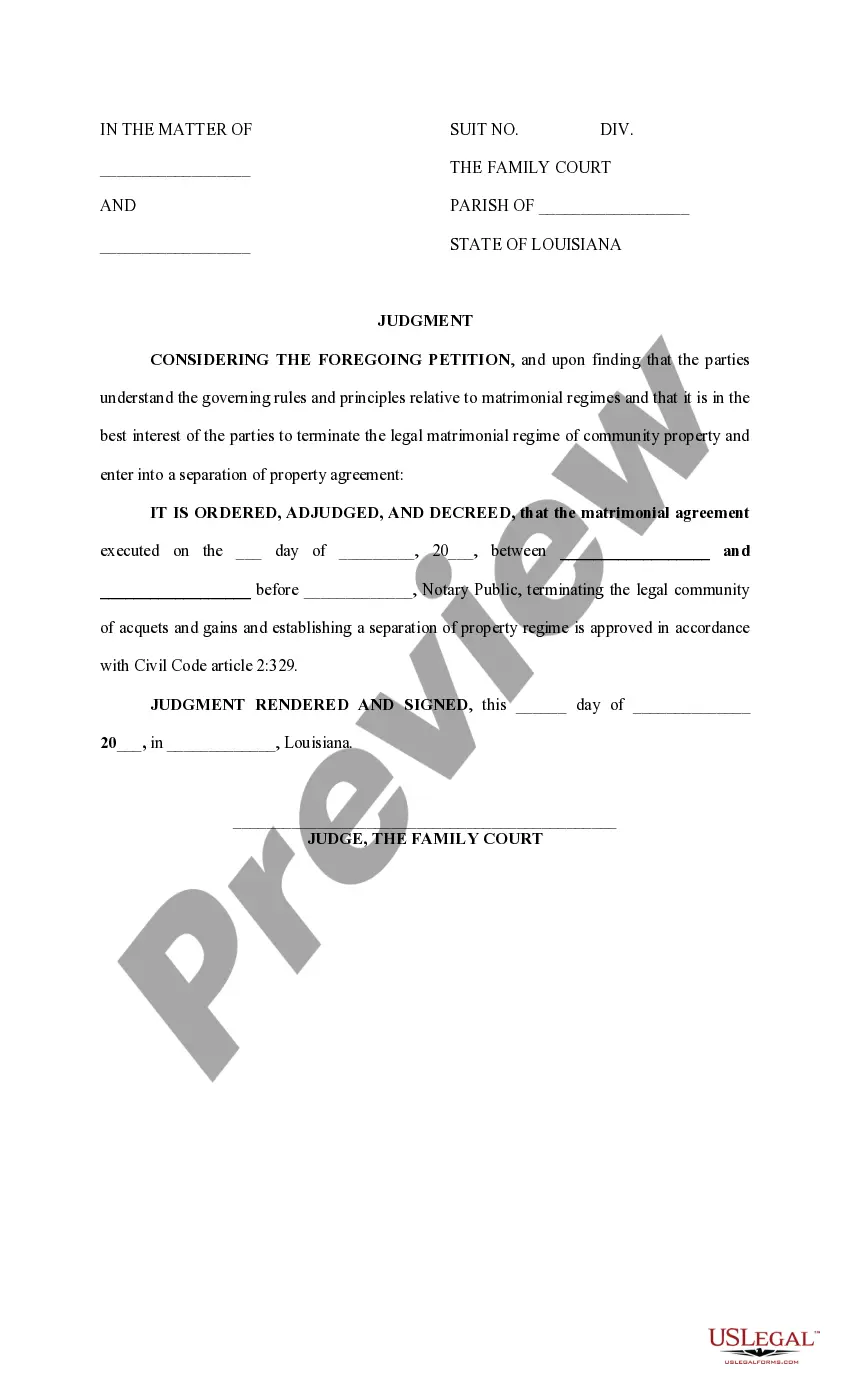
Judgment Establishing a Separation of Property Regime
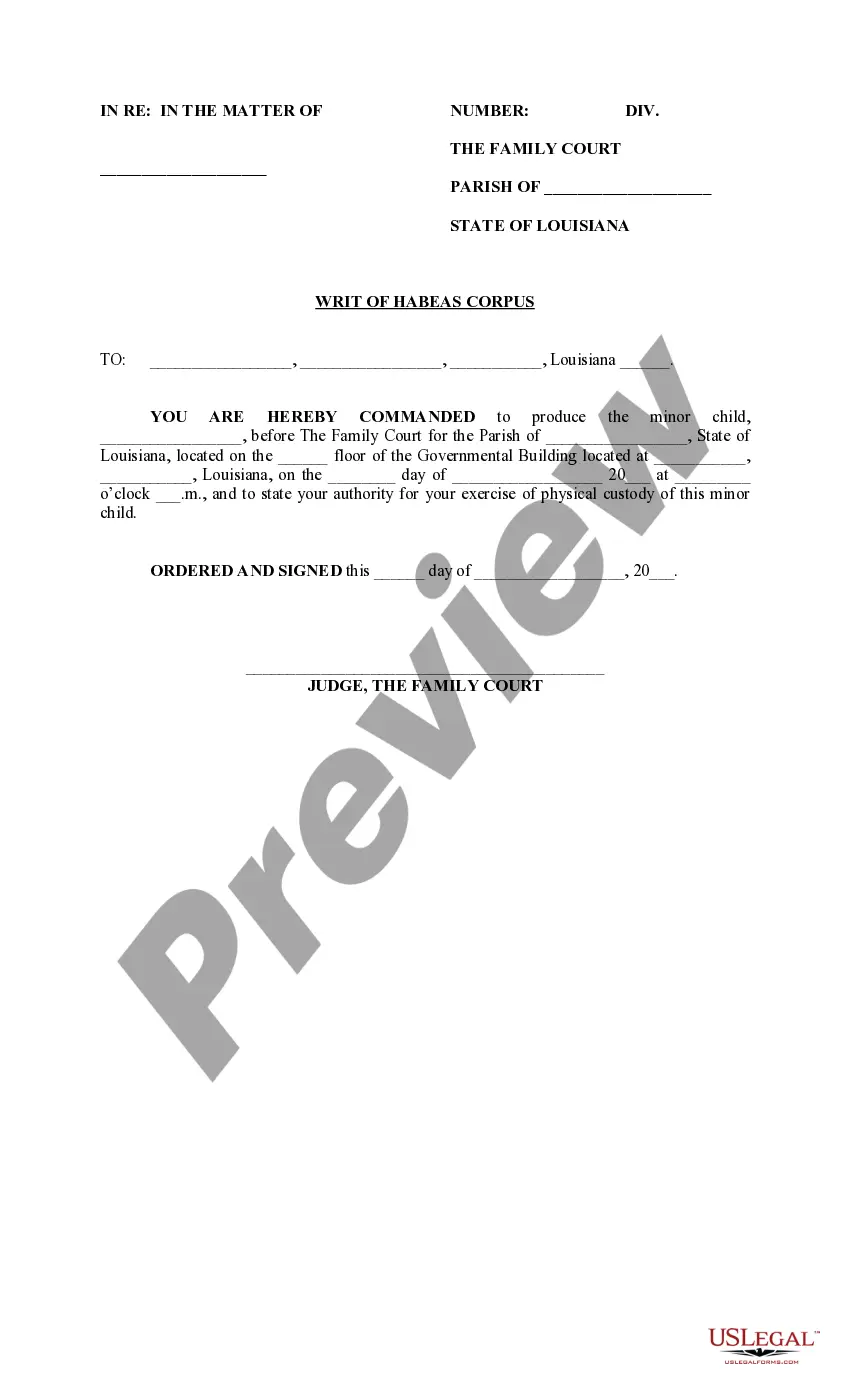
Writ of Habeas Corpus
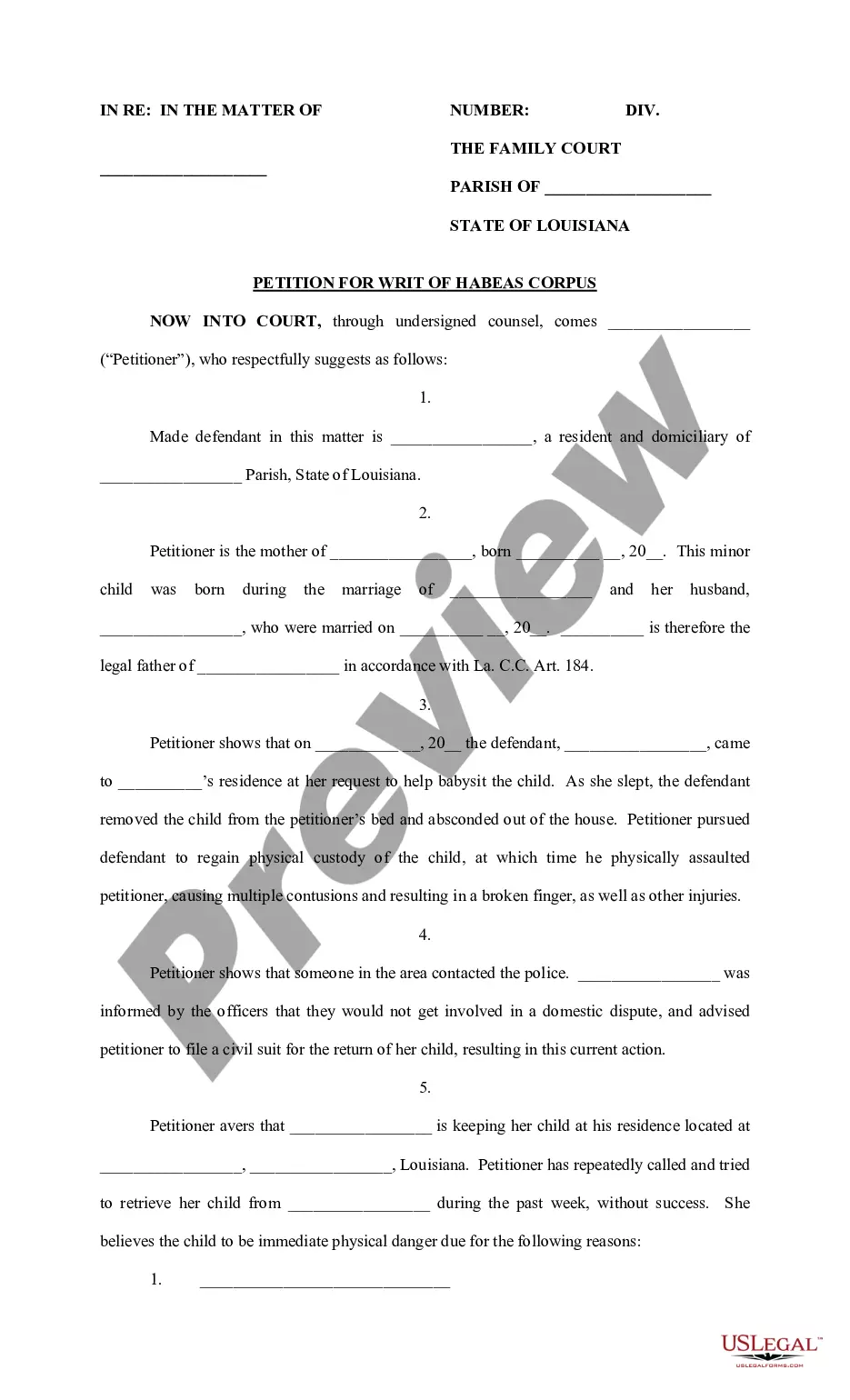
Petition for Writ of Habeas Corpus
Trusted and secure by over 3 million people of the world’s leading companies
CHAPTER 42.
Landlord and Tenant.
ARTICLE 1.
General Provisions.
Lessor and lessee not partners:
No lessor of property, merely by reason that he is to receive as rent or compensation for its use a share of the proceeds or net profits of the business in which it is employed, or any other uncertain consideration, shall be held a partner of the lessee. §42-1.
Attornment unnecessary on conveyance of reversions, etc:
Every conveyance of any rent, reversion, or remainder in lands, tenements or hereditaments, otherwise sufficient, shall be deemed complete without attornment by the holders of particular estates in said lands: Provided, no holder of a particular estate shall be prejudiced by any act done by him as holding under his grantor, without notice of such conveyance. §42-2.
Term forfeited for nonpayment of rent:
In all verbal or written leases of real property of any kind which is fixed a definite time for the payment of the rent reserved therein, there shall be implied a forfeiture of the term upon failure to pay the rent within 10 days after a demand is made by the lessor or his agent on said lessee for all past-due rent, and the lessor may forthwith enter and dispossess the tenant without having declared such forfeiture or reserved the right of reentry in the lease. §42-3.
Recovery for use and occupation:
When any person occupies land of another by the permission of such other, without any express agreement for rent, or upon a parol lease which is void, the landlord may recover a reasonable compensation for such occupation, and if by such parol lease a certain rent was reserved, such reservation may be received as evidence of the value of the occupation. §42-4.
Rent apportioned, where lease terminated by death:
If a lease of land, in which rent is reserved, payable at the end of the year or other certain period of time, is determined by the death of any person during one of the periods in which the rent was growing due, the lessor or his personal representative may recover a part of the rent which becomes due after the death, proportionate to the part of the period elapsed before the death, subject to all just allowances; and if any security was given for such rent it shall be apportioned in like manner. §42-5.
Rents, annuities, etc., apportioned, where right to payment terminated by death:
In all cases where rents, rent charges, annuities, pensions, dividends, or any other payments of any description, are made payable at fixed periods to successive owners under any instrument, or by any will, and where the right of any owner to receive payment is terminable by a death or other uncertain event, and where such right so terminates during a period in which a payment is growing due, the payment becoming due next after such terminating event shall be apportioned among the successive owners according to the parts of such periods elapsing before and after the terminating event. §42-6.
In lieu of emblements, farm lessee holds out year, with rents apportioned:
When any lease for years of any land let for farming on which a rent is reserved determines during a current year of the tenancy, by the happening of any uncertain event determining the estate of the lessor, or by a sale of said land under any mortgage or deed of trust, the tenant in lieu of emblements shall continue his occupation to the end of such current year, and shall then give up such possession to the succeeding owner of the land, and shall pay to such succeeding owner a part of the rent accrued since the last payment became due, proportionate to the part of the period of payment elapsing after the termination of the estate of the lessor to the giving up such possession; and the tenant in such case shall be entitled to a reasonable compensation for the tillage and seed of any crop not gathered at the expiration of such current year from the person succeeding to the possession. §42-7.
Grantees of reversion and assigns of lease have reciprocal rights under covenants:
The grantee in every conveyance of reversion in lands, tenements or hereditaments has the like advantages and remedies by action or entry against the holders of particular estates in such real property, and their assigns, for nonpayment of rent, and for the nonperformance of other conditions and agreements contained in the instruments by the tenants of such particular estates, as the grantor or lessor or his heirs might have; and the holders of such particular estates, and their assigns, have the like advantages and remedies against the grantee of the reversion, or any part thereof, for any conditions and agreements contained in such instruments, as they might have had against the grantor or his lessors or his heirs. §42-8.
Agreement to rebuild, how construed in case of fire:
An agreement in a lease to repair a demised house shall not be construed to bind the contracting party to rebuild or repair in case the house shall be destroyed or damaged to more than one half of its value, by accidental fire not occurring from the want of ordinary diligence on his part. §42-8.
Tenant not liable for accidental damage:
A tenant for life, or years, or for a less term, shall not be liable for damage occurring on the demised premises accidentally, and notwithstanding reasonable diligence on his part, unless he so contracts. §42-10.
Willful destruction by tenant misdemeanor:
If any tenant shall, during his term or after its expiration, willfully and unlawfully demolish, destroy, deface, injure or damage any tenement house, uninhabited house or other outhouse, belonging to his landlord or upon his premises by removing parts thereof or by burning, or in any other manner, or shall unlawfully and willfully burn, destroy, pull down, injure or remove any fence, wall or other inclosure or any part thereof, built or standing upon the premises of such landlord, or shall willfully and unlawfully cut down or destroy any timber, fruit, shade or ornamental tree belonging to said landlord, he shall be guilty of a Class 1 misdemeanor. § 42-11.
Lessee may surrender, where building destroyed or damaged:
If a demised house, or other building, is destroyed during the term, or so much damaged that it cannot be made reasonably fit for the purpose for which it was hired, except at an expense exceeding one year's rent of the premises, and the damage or destruction occur without negligence on the part of the lessee or his agents or servants, and there is no agreement in the lease respecting repairs, or providing for such a case, and the use of the house damaged or destroyed was the main inducement to the hiring, the lessee may surrender his estate in the demised premises by a writing to that effect delivered or tendered to the landlord within 10 days from the damage or destruction, and by paying or tendering at the same time all rent in arrear, and a part of the rent growing due at the time of the damage or destruction, proportionate to the time between the last period of payment and the occurrence of the damage or destruction, and the lessee shall be thenceforth discharged from all rent accruing afterwards; but not from any other agreement in the lease. This section shall not apply if a contrary intention appear from the lease. §42-12.
Wrongful surrender to other than landlord misdemeanor:
Any tenant or lessee of lands who shall willfully, wrongfully and with intent to defraud the landlord or lessor, give up the possession of the rented or leased premises to any person other than his landlord or lessor, shall be guilty of a Class 1 misdemeanor. § 42-13.
Notice to quit in certain tenancies:
A tenancy from year to year may be terminated by a notice to quit given one month or more before the end of the current year of the tenancy; a tenancy from month to month by a like notice of seven days; a tenancy from week to week, of two days. Provided, however, where the tenancy involves only the rental of a space for a manufactured home as defined in G.S. 143-143.9(6), a notice to quit must be given at least 30 days before the end of the current rental period, regardless of the term of the tenancy. § 42-14.
Rent control:
No county or city as defined by G.S. 160A-1 may enact, maintain, or enforce any ordinance or resolution which regulates the amount of rent to be charged for privately owned, single-family or multiple unit residential or commercial rental property. This section shall not be construed as prohibiting any county or city, or any authority created by a county or city for that purpose, from:
(1) Regulating in any way property belonging
to that city, county, or authority;
(2) Entering into agreements with private
persons which regulate the amount of rent charged for subsidized rental
properties; or
(3) Enacting ordinances or resolutions
restricting rent for properties assisted with Community Development Block
Grant Funds. § 42-14.1.
Death, illness, or conviction of certain crimes not a material fact:
In offering real property for rent or lease it shall not be deemed a material fact that the real property was occupied previously by a person who died or had a serious illness while occupying the property or that a person convicted of any crime for which registration is required by Article 27A of Chapter 14 of the General Statutes occupies, occupied, or resides near the property; provided, however, that no landlord or lessor may knowingly make a false statement regarding any such fact. § 42-14.2.
ARTICLE 2A.
Ejectment of Residential Tenants.
Manner of ejectment of residential tenants:
It is the public policy of the State of North Carolina, in order to maintain the public peace, that a residential tenant shall be evicted, dispossessed or otherwise constructively or actually removed from his dwelling unit only in accordance with the procedure prescribed in Article 3 or Article 7 of this Chapter. § 42-25.6.
Distress and distraint not permitted:
It is the public policy of the State of North Carolina that distress and distraint are prohibited and that landlords of residential rental property shall have rights concerning the personal property of their residential tenants only in accordance with G.S.
Contrary lease provisions:
Any lease or contract provision contrary to this Article shall be void as against public policy. §42-25.8.
Remedies:
(a) If any lessor, landlord, or agent removes or attempts
to remove a tenant from a dwelling unit in any manner contrary to this
Article, the tenant shall be entitled to recover possession or to terminate
his lease and the lessor, landlord or agent shall be liable to the tenant
for damages caused by the tenant's removal or attempted removal. Damages
in any action brought by a tenant under this Article shall be limited to
actual damages as in an action for trespass or conversion and shall not
include punitive damages, treble damages or damages for emotional distress.
(b) If any lessor, landlord, or agent seizes possession of
or interferes with a tenant's access to a tenant's or household member's
personal property in any manner not in accordance with G.S. 44A-2(e2),
42-25.9(d), 42-25.9(g), 42-25.9(h), or G.S. 42- 36.2 the tenant or household
member shall be entitled to recover possession of his personal property
or compensation for the value of the personal property, and, in any action
brought by a tenant or household member under this Article, the landlord
shall be liable to the tenant or household member for actual damages, but
not including punitive damages, treble damages or damages for emotional
distress.
(c) The remedies created by this section are supplementary
to all existing common-law and statutory rights and remedies.
(d) If any tenant abandons personal property of five hundred
dollar ($500.00) value or less in the demised premises, or fails
to remove such property at the time of execution of a writ of possession
in an action for summary ejectment, the landlord may, as an alternative
to the procedures provided in G.S. 42-25.9(g), 42-25.9(h), or 42-36.2,
deliver the property into the custody of a nonprofit organization regularly
providing free or at a nominal price clothing and household furnishings
to people in need, upon that organization agreeing to identify and separately
store the property for 30 days and to release the property to the tenant
at no charge within the 30-day period. A landlord electing to use this
procedure shall immediately post at the demised premises a notice containing
the name and address of the property recipient, post the same notice for
30 days or more at the place where rent is received, and send the same
notice by first-class mail to the tenant at the tenant's last known address.
Provided, however, that the notice shall not include a description of the
property.
(e) For purposes of subsection (d), personal property shall
be deemed abandoned if the landlord finds evidence that clearly shows the
premises have been voluntarily vacated after the paid rental period has
expired and the landlord has no notice of a disability that caused the
vacancy. A presumption of abandonment shall arise 10 or more days after
the landlord has posted conspicuously a notice of suspected abandonment
both inside and outside the premises and has received no response from
the tenant.
(f) Any nonprofit organization agreeing to receive personal
property under subsection (d) shall not be liable to the owner for a disposition
of such property provided that the property has been separately identified
and stored for release to the owner for a period of 30 days.
(g) Ten days after being placed in lawful possession by execution
of a writ of possession, a landlord may throw away, dispose of, or sell
all items of personal property remaining on the premises, except that in
the case of the lease of a space for a manufactured home as defined in
G.S. 143-143.9(6), G.S. 44A-2(e2) shall apply to the disposition of a
manufactured home with a current value in excess of five hundred dollars
($500.00) and its contents by a landlord after being placed in lawful possession
by execution of a writ of possession. During the 10-day period after being
placed in lawful possession by execution of a writ of possession, a landlord
may move for storage purposes, but shall not throw away, dispose of, or
sell any items of personal property remaining on the premises unless otherwise
provided for in this Chapter. Upon the tenant's request prior to the expiration
of the 10-day period, the landlord shall release possession of the property
to the tenant during regular business hours or at a time agreed upon. If
the landlord elects to sell the property at public or private sale, the
landlord shall give written notice to the tenant by first-class mail to
the tenant's last known address at least seven days prior to the day of
the sale. The seven-day notice of sale may run concurrently with the 10-day
period which allows the tenant to request possession of the property. The
written notice shall state the date, time, and place of the sale, and that
any surplus of proceeds from the sale, after payment of unpaid rents, damages,
storage fees, and sale costs, shall be disbursed to the tenant, upon request,
within 10 days after the sale, and will thereafter be delivered to the
government of the county in which the rental property is located. Upon
the tenant's request prior to the day of sale, the landlord shall release
possession of the property to the tenant during regular business hours
or at a time agreed upon. The landlord may apply the proceeds of the sale
to the unpaid rents, damages, storage fees, and sale costs. Any surplus
from the sale shall be disbursed to the tenant, upon request, within 10
days of the sale and shall thereafter be delivered to the government of
the county in which the rental property is located.
(h) If the total value of all property remaining on the premises
at the time of execution of a writ of possession in an action for summary
ejectment is less than one hundred dollars ($100.00), then the property
shall be deemed abandoned five days after the time of execution, and the
landlord may throw away or dispose of the property. Upon the tenant's request
prior to the expiration of the five-day period, the landlord shall release
possession of the property to the tenant during regular business hours
or at a time agreed upon. § 42-25.9.
ARTICLE 3.
Summary Ejectment.
Tenant holding over may be dispossessed in certain cases:
Any tenant or lessee of any house or land, and the assigns under the tenant or legal representatives of such tenant or lessee, who holds over and continues in the possession of the demised premises, or any part thereof, without the permission of the landlord, and after demand made for its surrender, may be removed from such premises in the manner hereinafter prescribed in any of the following cases:
(1) When a tenant in possession of real
estate holds over after his term has expired.
(2) When the tenant or lessee, or other
person under him, has done or omitted any act by which, according to the
stipulations of the lease, his estate has ceased.
(3) When any tenant or lessee of lands
or tenements, who is in arrear for rent or has agreed to cultivate
the demised premises and to pay a part of the crop to be made thereon as
rent, or who has given to the lessor a lien on such crop as a security
for the rent, deserts the demised premises, and leaves them unoccupied
and uncultivated. § 42-26.
Local: Refusal to perform contract ground for dispossession:
When any tenant or cropper who enters into a contract for the rental of land for the current or ensuing year willfully neglects or refuses to perform the terms of his contract without just cause, he shall forfeit his right of possession to the premises. This section applies only to the following counties: Alamance, Alexander, Alleghany, Anson, Ashe, Beaufort, Bertie, Bladen, Brunswick, Burke, Cabarrus, Camden, Carteret, Caswell, Chatham, Chowan, Cleveland, Columbus, Craven, Cumberland, Currituck, Davidson, Duplin, Edgecombe, Forsyth, Franklin, Gaston, Gates, Greene, Guilford, Halifax, Harnett, Hertford, Hoke, Hyde, Jackson, Johnston, Jones, Lee, Lenoir, Martin, Mecklenburg, Montgomery, Moore, Nash, Northampton, Onslow, Pasquotank, Pender, Perquimans, Pitt, Polk, Randolph, Robeson, Rockingham, Rowan, Rutherford, Sampson, Stokes, Surry, Swain, Tyrrell, Union, Wake, Warren, Washington, Wayne, Wilson, Yadkin. §42-27.
Summons issued by clerk:
When the lessor or his assignee files a complaint pursuant to G.S. 42-26 or 42-27, and asks to be put in possession of the leased premises, the clerk of the superior court shall issue a summons requiring the defendant to appear at a certain time and place not to exceed seven days from the issuance of the summons, excluding weekends and legal holidays, to answer the complaint.
The plaintiff may claim rent in arrears, and damages for the occupation of the premises since the cessation of the estate of the lessee, not to exceed the jurisdictional amount established by G.S. 7A-210(1), but if he omits to make such claim, he shall not be prejudiced thereby in any other action for their recovery. § 42-28.
Service of summons:
The officer receiving the summons shall mail a copy of the summons and complaint to the defendant no later than the end of the next business day or as soon as practicable at the defendant's last known address in a stamped addressed envelope provided by the plaintiff to the action. The officer may, within five days of the issuance of the summons, attempt to telephone the defendant requesting that the defendant either personally visit the officer to accept service, or schedule an appointment for the defendant to receive delivery of service from the officer. If the officer does not attempt to telephone the defendant or the attempt is unsuccessful or does not result in service to the defendant, the officer shall make at least one visit to the place of abode of the defendant within five days of the issuance of the summons at a time reasonably calculated to find the defendant at the place of abode to attempt personal delivery of service. He then shall deliver a copy of the summons together with a copy of the complaint to the defendant, or leave copies thereof at the defendant's dwelling house or usual place of abode with some person of suitable age and discretion then residing therein. If such service cannot be made the officer shall affix copies to some conspicuous part of the premises claimed and make due return showing compliance with this section. §42-29.
Judgment by confession or where plaintiff has proved case:
The summons shall be returned according to its tenor, and if on its return it appears to have been duly served, and if the plaintiff proves his case by a preponderance of the evidence, or the defendant admits the allegations of the complaint, the magistrate shall give judgment that the defendant be removed from, and the plaintiff be put in possession of, the demised premises; and if any rent or damages for the occupation of the premises after the cessation of the estate of the lessee, not exceeding the jurisdictional amount established by G.S. 7A-210(1), be claimed in the oath of the plaintiff as due and unpaid, the magistrate shall inquire thereof, and give judgment as he may find the fact to be. § 42-30.
Trial by magistrate:
If the defendant by his answer denies any material allegation in the oath of the plaintiff, the magistrate shall hear the evidence and give judgment as he shall find the facts to be. §42-31.
Damages assessed to trial:
On appeal to the district court, the jury trying issues joined shall assess the damages of the plaintiff for the detention of his possession to the time of the trial in that court; and, if the jury finds that the detention was wrongful and that the appeal was without merit and taken for the purpose of delay, the plaintiff, in addition to any other damages allowed, shall be entitled to the amount of rent in arrears, or which may have accrued, to the time of trial in the district court.
Judgment for the rent in arrears and for the damages assessed may, on motion, be rendered against the sureties to the appeal. §42-32. (1868-9, c. 156, s. 28; Code, s. 1775; Rev., s. 2006; C.S., s. 2371; 1945, c. 796; 1971, c. 533, s. 7; 1979, c. 820, s. 7.)
Rent and costs tendered by tenant:
If, in any action brought to recover the possession of demised premises upon a forfeiture for the nonpayment of rent, the tenant, before judgment given in such action, pays or tenders the rent due and the costs of the action, all further proceedings in such action shall cease. If the plaintiff further prosecutes his action, and the defendant pays into court for the use of the plaintiff a sum equal to that which shall be found to be due, and the costs, to the time of such payment, or to the time of a tender and refusal, if one has occurred, the defendant shall recover from the plaintiff all subsequent costs; the plaintiff shall be allowed to receive the sum paid into court for his use, and the proceedings shall be stayed. §42-33.
Undertaking on appeal and order staying execution:
(a) Upon appeal to the district court, either party may demand
that the case be tried at the first session of the court after the appeal
is docketed, but the presiding judge, in his discretion, may first try
any pending case in which the rights of the parties or the public demand
it. If the case has not been previously continued in district court, the
court shall continue the case for an appropriate period of time if any
party initiates discovery or files a motion to allow further pleadings
pursuant to G.S. 7A-220 or G.S. 7A-229, or for summary judgment pursuant
to Rule 56 of the Rules of Civil Procedure.
(b) During an appeal to district court, it shall be sufficient
to stay execution of a judgment for ejectment if the defendant appellant
pays to the clerk of superior court any rent in arrears as determined by
the magistrate and signs an undertaking that he or she will pay into
the office of the clerk of superior court the amount of the contract rent
as it becomes due periodically after the judgment was entered and, where
applicable, comply with subdivision (c) below. Provided however, when the
magistrate makes a finding in the record, based on evidence presented in
court, that there is an actual dispute as to the amount of rent in arrears
that is due and the magistrate specifies the specific amount of rent in
arrears in dispute, in order to stay execution of a judgment for ejectment,
the defendant appellant shall not be required to pay to the clerk of superior
court the amount of rent in arrears found by the magistrate to be in dispute,
even if the magistrate's judgment includes this amount in the amount of
rent found to be in arrears. If a defendant appellant appeared at the hearing
before the magistrate and the magistrate found an amount of rent in arrears
that was not in dispute, and if an attorney representing the defendant
appellant on appeal to the district court signs a pleading stating that
there is evidence of an actual dispute as to the amount of rent in arrears,
then the defendant appellant shall not be required to pay the rent in arrears
alleged to be in dispute to stay execution of a judgment for ejectment
pending appeal. Any magistrate, clerk, or district court judge shall order
stay of execution upon the defendant appellant's paying the undisputed
rent in arrears to the clerk and signing the undertaking. If either party
disputes the amount of the payment or the due date in the undertaking,
the aggrieved party may move for modification of the terms of the undertaking
before the clerk of superior court or the district court. Upon such motion
and upon notice to all interested parties, the clerk or court shall hold
a hearing and determine what modifications, if any, are appropriate.
(c) In an ejectment action based upon alleged nonpayment
of rent where the judgment is entered more than five working days before
the day when the next rent will be due under the lease, the appellant shall
make an additional undertaking to stay execution pending appeal. Such additional
undertaking shall be the payment of the prorated rent for the days between
the day that the judgment was entered and the next day when the rent will
be due under the lease.
(c1) Notwithstanding the provisions of subsection (b) of
this section, an indigent defendant appellant, as set forth in G.S. 1-110,
who prosecutes his or her appeal as an indigent and who meets the requirement
of G.S. 1-288 shall pay the amount of the contract rent as it becomes periodically
due as set forth in subsection (b) of this section, but shall not be required
to pay rent in arrears as set forth in subsection (b) of this section in
order to stay execution pending appeal.
(d) The undertaking by the appellant
and the order staying execution may be substantially in the following form:
"State of North Carolina,
County of __________
____________, Plaintiff
vs.
____________, Defendant
Bond to Stay Execution
On Appeal to District Court
Now comes the defendant in the above entitled action and respectfully shows the court that judgment for summary ejectment was entered against the defendant and for the plaintiff on the ________ day of ________, ________, by the Magistrate. Defendant has appealed the judgment to the District Court.
Pursuant to the terms of the lease between plaintiff and defendant, defendant is obligated to pay rent in the amount of $________ per ________, due on the ________ day of each ________.
Where the payment of rent in arrears or an additional undertaking is required by G.S. 42-34, the defendant hereby tenders $________ to the Court as required.
Defendant hereby undertakes to pay the periodic rent hereinafter due according to the aforesaid terms of the lease and moves the Court to stay execution on the judgment for summary ejectment until this matter is heard on appeal by the District Court.
This the ___ day of ______, ___.
Defendant"
"Upon execution of the above bond, execution on said judgment for summary ejectment is hereby stayed until the action is heard on appeal in the District Court. If defendant fails to make any rental payment to the clerk's office within five days of the due date, upon application of the plaintiff, the stay of execution shall dissolve and the sheriff may dispossess the defendant.
This the ___ day of ______, ___.
Assistant Clerk of Superior Court."
(e) Upon application of the plaintiff, the clerk of superior
court shall pay to the plaintiff any amount of the rental payments paid
by the defendant into the clerk's office which are not claimed by the defendant
in any pleadings.
(f) If the defendant fails to make a payment within five
days of the due date according to the undertaking and order staying execution,
the clerk, upon application of the plaintiff, shall issue execution
on the judgment for possession.
(g) When it appears by stipulation executed by all of the
parties or by final order of the court that the appeal has been resolved,
the clerk of court shall disburse any accrued moneys of the undertaking
remaining in the clerk's office according to the terms of the stipulation
or order. § 42-34.
Rent pending execution of judgment; post bond pending appeal:
(a) If the judgment in district court is against the defendant
appellant and the defendant appellant does not appeal the judgment, the
defendant appellant shall pay rent to the plaintiff for the time the defendant
appellant remains in possession of the premises after the judgment is given.
Rent shall be prorated if the judgment is executed before the day rent
would become due under the terms of the lease. The clerk of court shall
disperse any rent in arrears paid by the defendant appellant in accordance
with a stipulation executed by all parties or, if there is no stipulation,
in accordance with the judge's order.
(b) If the judgment in district court is against the defendant
appellant and the defendant appellant appeals the judgment, it shall be
sufficient to stay execution of the judgment if the defendant appellant
posts a bond as provided in G.S. 42-34(b). If the defendant appellant fails
to perfect the appeal or the appellate court upholds the judgment of the
district court, the execution of the judgment shall proceed. The clerk
of court shall not disperse any rent in arrears paid by the defendant appellant
until all appeals have been resolved. § 42-34.1.
Restitution of tenant, if case quashed, etc., on appeal:
If the proceedings before the magistrate are brought before a district court and quashed, or judgment is given against the plaintiff, the district or other court in which final judgment is given shall, if necessary, restore the defendant to the possession, and issue such writs as are proper for that purpose. §42-35.
Damages to tenant for dispossession, if proceedings quashed, etc:
If, by order of the magistrate, the plaintiff is put in possession, and the proceedings shall afterwards be quashed or reversed, the defendant may recover damages of the plaintiff for his removal. §42-36.
Lease or rental of manufactured homes:
The provisions of this Article shall apply to the lease or rental of manufactured homes, as defined in G.S. 143-145.
Judgments for possession more than 30 days old:
Prior to obtaining execution of a judgment that has been entered for more than 30 days for possession of demised premises, a landlord shall sign an affidavit stating that the landlord has neither entered into a formal lease with the defendant nor accepted rental money from the defendant for any period of time after entry of the judgment. § 42-36.1A.
Notice to tenant of execution of writ for possession of property; storage of evicted tenant's personal property:
(a) When Sheriff May Remove Property. -- Before removing
a tenant's personal property from demised premises pursuant to a writ for
possession of real property or an order, the sheriff shall give the tenant
notice of the approximate time the writ will be executed. The time within
which the sheriff shall have to execute the writ shall be no more than
seven days from the sheriff's receipt thereof. The sheriff shall remove
the tenant's property, as provided in the writ, no earlier than the time
specified in the notice, unless:
(1) The landlord, or his authorized agent,
signs a statement saying that the tenant's property can remain on the premises,
in which case the sheriff shall simply lock the premises; or
(2) The landlord, or his authorized agent,
signs a statement saying that the landlord does not want to eject the tenant
because the tenant has paid all court costs charged to him and has satisfied
his indebtedness to the landlord.
Upon receipt of either statement by the landlord, the sheriff shall
return the writ unexecuted to the issuing clerk of court and shall make
a notation on the writ of his reasons. The sheriff shall attach a copy of
the landlord's statement to the writ. If the writ is returned unexecuted
because the landlord signed a statement described in subdivision (2) of
this subsection, the clerk shall make an entry of satisfaction on the judgment
docket. If the sheriff padlocks, the costs of the proceeding shall be charged
as part of the court costs.
(b) Sheriff May Store Property. -- When the sheriff removes
the personal property of an evicted tenant from demised premises pursuant
to a writ or order the tenant shall take possession of his property. If
the tenant fails or refuses to take possession of his property, the sheriff
may deliver the property to any storage warehouse in the county, or in
an adjoining county if no storage warehouse is located in that county,
for storage. The sheriff may require the landlord to advance the cost of
delivering the property to a storage warehouse plus the cost of one month's
storage before delivering the property to a storage warehouse. If a landlord
refuses to advance these costs when requested to do so by the sheriff,
the sheriff shall not remove the tenant's property, but shall return the
writ unexecuted to the issuing clerk of court with a notation thereon of
his reason for not executing the writ. Except for the disposition of manufactured
homes and their contents as provided in G.S. 42-25.9(g) and G.S. 44A-2(e2),
within 10 days of the landlord's being placed in lawful possession by execution
of a writ of possession and upon the tenant's request within that 10-day
period, the landlord shall release possession of the property to the tenant
during regular business hours or at a time agreed upon. During the 10-day
period after being placed in lawful possession by execution of a writ of possession, a landlord may
move for storage purposes, but shall not throw away, dispose of, or sell
any items of personal property remaining on the premises unless otherwise
provided for in this Chapter. After the expiration of the 10-day period,
the landlord may throw away, dispose of, or sell the property in accordance
with the provisions of G.S. 42-25.9(g). If the tenant does not request
release of the property within 10 days, all costs of summary ejectment,
execution and storage proceedings shall be charged to the tenant as court
costs and shall constitute a lien against the stored property or a claim
against any remaining balance of the proceeds of a warehouseman's lien
sale.
(c) Liability of the Sheriff. -- A sheriff who stores a tenant's
property pursuant to this section and any person acting under the sheriff's
direction, control, or employment shall be liable for any claims arising
out of the willful or wanton negligence in storing the tenant's property.
(d) Notice. -- The notice required by subsection (a) shall,
except in actions involving the lease of a space for a manufactured home
as defined in G.S. 143-143.9(6), inform the tenant that failure to request
possession of any property on the premises within 10 days of execution
may result in the property being thrown away, disposed of, or sold. Notice
shall be made by one of the following methods:
(1) By delivering a copy of the notice
to the tenant or his authorized agent at least two days before the time
stated in the notice for serving the writ;
(2) By leaving a copy of the notice at
the tenant's dwelling or usual place of abode with a person of suitable
age and discretion who resides there at least two days before the time
stated in the notice for serving the writ; or
(3) By mailing a copy of the notice by
first-class mail to the tenant at his last known address at least five
days before the time stated in the notice for serving the writ. §42-36.2.
ARTICLE 4A.
Retaliatory Eviction.
Defense of retaliatory eviction:
(a) It is the public policy of the State of North Carolina to protect
tenants and other persons whose residence in the household is explicitly
or implicitly known to the landlord, who seek to exercise their rights
to decent, safe, and sanitary housing. Therefore, the following activities
of such persons are protected by law:
(1) A good faith complaint or request for
repairs to the landlord, his employee, or his agent about conditions or
defects in the premises that the landlord is obligated to repair under
G.S. 42-42;
(2) A good faith complaint to a government
agency about a landlord's alleged violation of any health or safety law,
or any regulation, code, ordinance, or State or federal law that regulates
premises used for dwelling purposes;
(3) A government authority's issuance of
a formal complaint to a landlord concerning premises rented by a tenant;
(4) A good faith attempt to exercise, secure
or enforce any rights existing under a valid lease or rental agreement
or under State or federal law; or
(5) A good faith attempt to organize, join,
or become otherwise involved with, any organization promoting or enforcing
tenants' rights.
(b) In an action for summary ejectment pursuant to G.S. 42-26,
a tenant may raise the affirmative defense of retaliatory eviction and
may present evidence that the landlord's action is substantially in response
to the occurrence within 12 months of the filing of such action of one
or more of the protected acts described in subsection (a) of this section.
(c) Notwithstanding subsections (a) and (b) of this section, a
landlord may prevail in an action for summary ejectment if:
(1) The tenant breached the covenant to
pay rent or any other substantial covenant of the lease for which the tenant
may be evicted, and such breach is the reason for the eviction; or
(2) In a case of a tenancy for a definite
period of time where the tenant has no option to renew the lease, the tenant
holds over after expiration of the term; or
(3) The violation of G.S. 42-42 complained
of was caused primarily by the willful or negligent conduct of the tenant,
member of the tenant's household, or their guests or invitees; or
(4) Compliance with the applicable building
or housing code requires demolition or major alteration or remodeling that
cannot be accomplished without completely displacing the tenant's household;
or
(5) The landlord seeks to recover possession
on the basis of a good faith notice to quit the premises, which notice
was delivered prior to the occurrence of any of the activities protected
by subsections (a) and (b) of this section; or
(6) The landlord seeks in good faith to
recover possession at the end of the tenant's term for use as the landlord's
own abode, to demolish or make major alterations or remodeling of the dwelling
unit in a manner that requires the complete displacement of the tenant's
household, or to terminate for at least six months the use of the property
as a rental dwelling unit. § 42-37.1.
Remedies:
(a) If the court finds that an ejectment action is retaliatory,
as defined by this Article, it shall deny the request for ejectment; provided,
that a dismissal of the request for ejectment shall not prevent the landlord
from receiving payments for rent due or any other appropriate judgment.
(b) The rights and remedies created by this Article are supplementary to all existing common law and statutory rights and
remedies. §42-37.2.
Waiver:
Any waiver by a tenant or a member of his household of the rights and remedies created by this Article is void as contrary to public policy. §42-37.3.
ARTICLE 5.
Residential Rental Agreements.
Application:
This Article determines the rights, obligations, and remedies under a rental agreement for a dwelling unit within this State. §42-38.
Exclusions:
(a) The provisions of this Article shall not apply to transient
occupancy in a hotel, motel, or similar lodging subject to regulation by
the Commission for Health Services.
(a1) The provisions of this Article shall not apply to vacation
rentals entered into under Chapter 42A of the General Statutes.
(b) Nothing in this Article shall apply to any dwelling furnished
without charge or rent. § 42-39.
Definitions:
For the purpose of this Article, the following definitions shall apply:
(1) "Action" includes recoupment, counterclaim, defense, setoff, and any other proceeding including an action for
possession.
(2) "Premises" means a dwelling unit, including mobile homes or mobile home spaces, and the structure of which
it is a part and facilities and appurtenances therein and grounds, areas,
and facilities normally held out for the use of residential tenants.
(3) "Landlord" means any owner and any
rental management company, rental agency, or any other person having the
actual or apparent authority of an agent to perform the duties imposed
by this Article. § 42-40.
Mutuality of obligations:
The tenant's obligation to pay rent under the rental agreement or assignment and to comply with G.S. 42-43 and the landlord's obligation to comply with G.S. 42-42(a) shall be mutually dependent. §42-41.
Landlord to provide fit premises:
(a) The landlord shall:
(1) Comply with the current applicable
building and housing codes, whether enacted before or after October 1,
1977, to the extent required by the operation of such codes; no new requirement
is imposed by this subdivision (a)(1) if a structure is exempt from a current
building code.
(2) Make all repairs and do whatever is
necessary to put and keep the premises in a fit and habitable condition.
(3) Keep all common areas of the premises
in safe condition.
(4) Maintain in good and safe working order
and promptly repair all electrical, plumbing, sanitary, heating, ventilating,
air conditioning, and other facilities and appliances supplied or required
to be supplied by the landlord provided that notification of needed repairs
is made to the landlord in writing by the tenant, except in emergency situations.
(5) Provide operable smoke detectors, either
battery-operated or electrical, having an Underwriters' Laboratories, Inc.,
listing or other equivalent national testing laboratory approval, and install
the smoke detectors in accordance with either the standards of the National
Fire Protection Association or the minimum protection designated in the
manufacturer's instructions, which the landlord shall retain or provide
as proof of compliance. The landlord shall replace or repair the smoke
detectors within 15 days of receipt of notification if the landlord is
notified of needed replacement or repairs in writing by the tenant. The
landlord shall ensure that a smoke detector is operable and in good repair
at the beginning of each tenancy. Unless the landlord and the tenant have
a written agreement to the contrary, the landlord shall place new batteries
in a battery-operated smoke detector at the beginning of a tenancy and
the tenant shall replace the batteries as needed during the tenancy. Failure
of the tenant to replace the batteries as needed shall not be considered
as negligence on the part of the tenant or the landlord.
(b) The landlord is not released of his obligations under
any part of this section by the tenant's explicit or implicit acceptance
of the landlord's failure to provide premises complying with this section,
whether done before the lease was made, when it was made, or after it was
made, unless a governmental subdivision imposes an impediment to repair
for a specific period of time not to exceed six months.
Notwithstanding the provisions of this subsection, the landlord
and tenant are not prohibited from making a subsequent written contract
wherein the tenant agrees to perform specified work on the premises, provided
that said contract is supported by adequate consideration other than the
letting of the premises and is not made with the purpose or effect of evading
the landlord's obligations under this Article. § 42-42.
Tenant to maintain dwelling unit:
(a) The tenant shall:
(1) Keep that part of the premises that
the tenant occupies and uses as clean and safe as the conditions of the
premises permit and cause no unsafe or unsanitary conditions in the common
areas and remainder of the premises that the tenant uses.
(2) Dispose of all ashes, rubbish, garbage,
and other waste in a clean and safe manner.
(3) Keep all plumbing fixtures in the dwelling
unit or used by the tenant as clean as their condition permits.
(4) Not deliberately or negligently destroy,
deface, damage, or remove any part of the premises, nor render inoperable
the smoke detector provided by the landlord, or knowingly permit any person
to do so.
(5) Comply with any and all obligations
imposed upon the tenant by current applicable building and housing codes.
(6) Be responsible for all damage, defacement,
or removal of any property inside a dwelling unit in the tenant's exclusive
control unless the damage, defacement or removal was due to ordinary wear
and tear, acts of the landlord or the landlord's agent, defective products
supplied or repairs authorized by the landlord, acts of third parties not
invitees of the tenant, or natural forces.
(7) Notify the landlord, in writing, of
the need for replacement of or repairs to a smoke detector. The landlord
shall ensure that a smoke detector is operable and in good repair at the
beginning of each tenancy. Unless the landlord and the tenant have a written
agreement to the contrary, the landlord shall place new batteries in a
battery-operated smoke detector at the beginning of a tenancy and the tenant
shall replace the batteries as needed during the tenancy. Failure of the
tenant to replace the batteries as needed shall not be considered as negligence
on the part of the tenant or the landlord.
(b) The landlord shall notify the tenant in writing of any
breaches of the tenant's obligations under this section except in emergency
situations. § 42-43.
General remedies, penalties, and limitations:
(a) Any right or obligation declared by this Chapter is enforceable
by civil action, in addition to other remedies of law and in equity.
(a1) If a landlord fails to provide, install, replace, or
repair a smoke detector under the provisions of G.S. 42-42(a)(5) within
30 days of having received written notice from the tenant or any agent
of State or local government of the landlord's failure to do so, the landlord
shall be responsible for an infraction and shall be subject to a fine of
not more than two hundred fifty dollars ($250.00) for each violation. The
landlord may temporarily disconnect a smoke detector in a dwelling unit
or common area for construction or rehabilitation activities when such
activities are likely to activate the smoke detector or make it inactive.
(a2) If a smoke detector is disabled or damaged, other than
through actions of the landlord, the landlord's agents, or acts of God,
the tenant shall reimburse the landlord the reasonable and actual cost
for repairing or replacing the smoke detector within 30 days of having
received written notice from the landlord or any agent of State or local
government of the need for the tenant to make such reimbursement. If the
tenant fails to make reimbursement within 30 days, the tenant shall be
responsible for an infraction and subject to a fine of not more than one
hundred dollars ($100.00) for each violation. The tenant may temporarily
disconnect a smoke detector in a dwelling unit to replace the batteries
or when it has been inadvertently activated.
(b) Repealed by Session Laws 1979, c. 820, s. 8.
(c) The tenant may not unilaterally withhold rent prior to
a judicial determination of a right to do so.
(d) A violation of this Article shall not constitute negligence
per se. § 42-44.
Early termination of rental agreement by military personnel:
(a) Any member of the United States Armed Forces who (i)
is required to move pursuant to permanent change of station orders to depart
50 miles or more from the location of the dwelling unit, or (ii) is prematurely
or involuntarily discharged or released from active duty with the United
States Armed Forces, may terminate his rental agreement for a dwelling
unit by providing the landlord with a written notice of termination to
be effective on a date stated in the notice that is at least 30 days after
the landlord's receipt of the notice. The notice to the landlord
must be accompanied by either a copy of the official military orders or
a written verification signed by the member's commanding officer.
Upon termination of a rental agreement under this section, the tenant
is liable for the rent due under the rental agreement prorated to the effective
date of the termination payable at such time as would have otherwise been
required by the terms of the rental agreement. The tenant is not
liable for any other rent or damages due to the early termination of the
tenancy except the liquidated damages provided in subsection (b) of this
section.
If a member terminates the rental agreement pursuant to this section
14 or more days prior to occupancy, no damages or penalties of any kind
shall be due.
(b) In consideration of early termination of the rental agreement,
the tenant is liable to the landlord for liquidated damages provided the tenant has
completed less than nine months of the tenancy and the landlord has suffered actual damages
due to loss of the tenancy. The liquidated damages shall be in an amount no greater than one month's rent
if the tenant has completed less than six months of the tenancy as of the effective date of termination, or one‑half of
one month's rent if the tenant has completed at least six but less than nine months of the tenancy as of the effective
date of termination.
(c) The provisions of this section may not be waived or modified by the agreement of the parties under any
circumstances. Nothing in this section shall affect the rights established by G.S. 42‑3. (1987, c. 478, s. 1.)
§ 42‑46. Late fees.
(a) In all residential rental agreements in which a definite time for the payment of the rent is fixed, the parties
may agree to a late fee not inconsistent with the provisions of this subsection, to be chargeable only if any rental payment
is five days or more late. If the rent:
(1) Is due in monthly installments, a landlord may charge a late fee not to exceed fifteen dollars ($15.00) or
five percent (5%) of the monthly rent, whichever is greater.
(2) Is due in weekly installments, a landlord may charge a late fee not to exceed four dollars ($4.00) or five
percent (5%) of the weekly rent, whichever is greater.
(3) Is subsidized by the United States Department of Housing and Urban Development, by the United States
Department of Agriculture, by a State agency, by a public housing authority, or by a local government, any late fee shall
be calculated in accordance with subdivisions (1) and (2) of this subsection on the tenant's share of the contract rent only,
and the rent subsidy shall not be included.
(b) A late fee under this section may be imposed only one time for each late rental payment. A late fee for
a specific late rental payment may not be deducted from a subsequent rental payment so as to cause the subsequent
rental payment to be in default.
(c) Any provision of a residential rental agreement contrary to the provisions of this section is against
the public policy of this State and therefore void and unenforceable.
(d) A lessor shall not charge a late fee to a lessee because of the lessee's failure
to pay for water or sewer services provided pursuant to G.S. 62‑110(g).
(1987, c. 530, s. 1; 2001‑502, s. 4; 2003‑370, s. 1; 2004‑143, s. 5.)
§§ 42‑47 through 42‑49: Reserved for future codification purposes.
Article 6.
Tenant Security Deposit Act.
§ 42‑50. Deposits from the tenant.
Security deposits from the tenant in residential dwelling units shall be deposited in a trust account with a licensed and insured bank or savings institution located in the State of North Carolina or the landlord may, at his option, furnish a bond from an insurance company licensed to do business in North Carolina. The security deposits from the tenant may be held in a trust account outside of the State of North Carolina only if the landlord provides the tenant with an adequate bond in the amount of said deposits. The landlord or his agent shall notify the tenant within 30 days after the beginning of the lease term of the name and address of the bank or institution where his deposit is currently located or the name of the insurance company providing the bond. (1977, c. 914, s. 1.)
§ 42‑51. Permitted uses of the deposit.
Security deposits for residential dwelling units shall be permitted only for the tenant's possible nonpayment of rent and costs for water or sewer services provided pursuant to G.S. 62‑110(g), damage to the premises, nonfulfillment of rental period, any unpaid bills that become a lien against the demised property due to the tenant's occupancy, costs of re‑renting the premises after breach by the tenant, costs of removal and storage of tenant's property after a summary ejectment proceeding or court costs in connection with terminating a tenancy. The security deposit shall not exceed an amount equal to two weeks' rent if a tenancy is week to week, one and one‑half months' rent if a tenancy is month to month, and two months' rent for terms greater than month to month. These deposits must be fully accounted for by the landlord as set forth in G.S. 42‑52. (1977, c. 914, s. 1; 1983, c. 672, s. 3; 2001‑502, s. 5; 2004‑143, s. 6.)
§ 42‑52. Landlord's obligations.
Upon termination of the tenancy, money held by the landlord as security may be applied as permitted in G.S. 42‑51 or, if not so applied, shall be refunded to the tenant. In either case the landlord in writing shall itemize any damage and mail or deliver same to the tenant, together with the balance of the security deposit, no later than 30 days after termination of the tenancy and delivery of possession by the tenant. If the tenant's address is unknown the landlord shall apply the deposit as permitted in G.S. 42‑51 after a period of 30 days and the landlord shall hold the balance of the deposit for collection by the tenant for at least six months. The landlord may not withhold as damages part of the security deposit for conditions that are due to normal wear and tear nor may the landlord retain an amount from the security deposit which exceeds his actual damages. (1977, c. 914, s. 1.)
§ 42‑53. Pet deposits.
Notwithstanding the provisions of this section, the landlord may charge a reasonable, nonrefundable fee for pets kept by the tenant on the premises. (1977, c. 914, s. 1.)
§ 42‑54. Transfer of dwelling units.
Upon termination of the landlord's interest in the dwelling unit in question, whether by sale, assignment, death, appointment of receiver or otherwise, the landlord or his agent shall, within 30 days, do one of the following acts, either of which shall relieve him of further liability with respect to such payment or deposit:
(1) Transfer the portion of such payment or deposit remaining after any lawful deductions made under
this section to the landlord's successor in interest and thereafter notify the tenant by mail of such transfer and of
the transferee's name and address; or
(2) Return the portion of such payment or deposit remaining after any lawful deductions made under
this section to the tenant. (1977, c. 914, s. 1.)
§ 42‑55. Remedies.
If the landlord or the landlord's successor in interest fails to account for and refund the balance of the tenant's security deposit as required by this Article, the tenant may institute a civil action to require the accounting of and the recovery of the balance of the deposit. In addition to other remedies at law and equity, the tenant may recover damages resulting from noncompliance by the landlord; and upon a finding by the court that the party against whom judgment is rendered was in willful noncompliance with this Article, the court may, in its discretion, allow a reasonable attorney's fee to the duly licensed attorney representing the prevailing party, such attorney's fee to be taxed as part of the cost of court. (1977, c. 914, s. 1.)
§ 42‑56. Application of Article.
The provisions of this Article shall apply to all persons, firms, or corporations engaged in the business of renting or managing residential dwelling units, excluding single rooms, on a weekly, monthly or annual basis. (1977, c. 914, s. 2.)
CHAPTER 42.
Landlord and Tenant.
ARTICLE 1.
General Provisions.
Lessor and lessee not partners:
No lessor of property, merely by reason that he is to receive as rent or compensation for its use a share of the proceeds or net profits of the business in which it is employed, or any other uncertain consideration, shall be held a partner of the lessee. §42-1.
Attornment unnecessary on conveyance of reversions, etc:
Every conveyance of any rent, reversion, or remainder in lands, tenements or hereditaments, otherwise sufficient, shall be deemed complete without attornment by the holders of particular estates in said lands: Provided, no holder of a particular estate shall be prejudiced by any act done by him as holding under his grantor, without notice of such conveyance. §42-2.
Term forfeited for nonpayment of rent:
In all verbal or written leases of real property of any kind which is fixed a definite time for the payment of the rent reserved therein, there shall be implied a forfeiture of the term upon failure to pay the rent within 10 days after a demand is made by the lessor or his agent on said lessee for all past-due rent, and the lessor may forthwith enter and dispossess the tenant without having declared such forfeiture or reserved the right of reentry in the lease. §42-3.
Recovery for use and occupation:
When any person occupies land of another by the permission of such other, without any express agreement for rent, or upon a parol lease which is void, the landlord may recover a reasonable compensation for such occupation, and if by such parol lease a certain rent was reserved, such reservation may be received as evidence of the value of the occupation. §42-4.
Rent apportioned, where lease terminated by death:
If a lease of land, in which rent is reserved, payable at the end of the year or other certain period of time, is determined by the death of any person during one of the periods in which the rent was growing due, the lessor or his personal representative may recover a part of the rent which becomes due after the death, proportionate to the part of the period elapsed before the death, subject to all just allowances; and if any security was given for such rent it shall be apportioned in like manner. §42-5.
Rents, annuities, etc., apportioned, where right to payment terminated by death:
In all cases where rents, rent charges, annuities, pensions, dividends, or any other payments of any description, are made payable at fixed periods to successive owners under any instrument, or by any will, and where the right of any owner to receive payment is terminable by a death or other uncertain event, and where such right so terminates during a period in which a payment is growing due, the payment becoming due next after such terminating event shall be apportioned among the successive owners according to the parts of such periods elapsing before and after the terminating event. §42-6.
In lieu of emblements, farm lessee holds out year, with rents apportioned:
When any lease for years of any land let for farming on which a rent is reserved determines during a current year of the tenancy, by the happening of any uncertain event determining the estate of the lessor, or by a sale of said land under any mortgage or deed of trust, the tenant in lieu of emblements shall continue his occupation to the end of such current year, and shall then give up such possession to the succeeding owner of the land, and shall pay to such succeeding owner a part of the rent accrued since the last payment became due, proportionate to the part of the period of payment elapsing after the termination of the estate of the lessor to the giving up such possession; and the tenant in such case shall be entitled to a reasonable compensation for the tillage and seed of any crop not gathered at the expiration of such current year from the person succeeding to the possession. §42-7.
Grantees of reversion and assigns of lease have reciprocal rights under covenants:
The grantee in every conveyance of reversion in lands, tenements or hereditaments has the like advantages and remedies by action or entry against the holders of particular estates in such real property, and their assigns, for nonpayment of rent, and for the nonperformance of other conditions and agreements contained in the instruments by the tenants of such particular estates, as the grantor or lessor or his heirs might have; and the holders of such particular estates, and their assigns, have the like advantages and remedies against the grantee of the reversion, or any part thereof, for any conditions and agreements contained in such instruments, as they might have had against the grantor or his lessors or his heirs. §42-8.
Agreement to rebuild, how construed in case of fire:
An agreement in a lease to repair a demised house shall not be construed to bind the contracting party to rebuild or repair in case the house shall be destroyed or damaged to more than one half of its value, by accidental fire not occurring from the want of ordinary diligence on his part. §42-8.
Tenant not liable for accidental damage:
A tenant for life, or years, or for a less term, shall not be liable for damage occurring on the demised premises accidentally, and notwithstanding reasonable diligence on his part, unless he so contracts. §42-10.
Willful destruction by tenant misdemeanor:
If any tenant shall, during his term or after its expiration, willfully and unlawfully demolish, destroy, deface, injure or damage any tenement house, uninhabited house or other outhouse, belonging to his landlord or upon his premises by removing parts thereof or by burning, or in any other manner, or shall unlawfully and willfully burn, destroy, pull down, injure or remove any fence, wall or other inclosure or any part thereof, built or standing upon the premises of such landlord, or shall willfully and unlawfully cut down or destroy any timber, fruit, shade or ornamental tree belonging to said landlord, he shall be guilty of a Class 1 misdemeanor. § 42-11.
Lessee may surrender, where building destroyed or damaged:
If a demised house, or other building, is destroyed during the term, or so much damaged that it cannot be made reasonably fit for the purpose for which it was hired, except at an expense exceeding one year's rent of the premises, and the damage or destruction occur without negligence on the part of the lessee or his agents or servants, and there is no agreement in the lease respecting repairs, or providing for such a case, and the use of the house damaged or destroyed was the main inducement to the hiring, the lessee may surrender his estate in the demised premises by a writing to that effect delivered or tendered to the landlord within 10 days from the damage or destruction, and by paying or tendering at the same time all rent in arrear, and a part of the rent growing due at the time of the damage or destruction, proportionate to the time between the last period of payment and the occurrence of the damage or destruction, and the lessee shall be thenceforth discharged from all rent accruing afterwards; but not from any other agreement in the lease. This section shall not apply if a contrary intention appear from the lease. §42-12.
Wrongful surrender to other than landlord misdemeanor:
Any tenant or lessee of lands who shall willfully, wrongfully and with intent to defraud the landlord or lessor, give up the possession of the rented or leased premises to any person other than his landlord or lessor, shall be guilty of a Class 1 misdemeanor. § 42-13.
Notice to quit in certain tenancies:
A tenancy from year to year may be terminated by a notice to quit given one month or more before the end of the current year of the tenancy; a tenancy from month to month by a like notice of seven days; a tenancy from week to week, of two days. Provided, however, where the tenancy involves only the rental of a space for a manufactured home as defined in G.S. 143-143.9(6), a notice to quit must be given at least 30 days before the end of the current rental period, regardless of the term of the tenancy. § 42-14.
Rent control:
No county or city as defined by G.S. 160A-1 may enact, maintain, or enforce any ordinance or resolution which regulates the amount of rent to be charged for privately owned, single-family or multiple unit residential or commercial rental property. This section shall not be construed as prohibiting any county or city, or any authority created by a county or city for that purpose, from:
(1) Regulating in any way property belonging
to that city, county, or authority;
(2) Entering into agreements with private
persons which regulate the amount of rent charged for subsidized rental
properties; or
(3) Enacting ordinances or resolutions
restricting rent for properties assisted with Community Development Block
Grant Funds. § 42-14.1.
Death, illness, or conviction of certain crimes not a material fact:
In offering real property for rent or lease it shall not be deemed a material fact that the real property was occupied previously by a person who died or had a serious illness while occupying the property or that a person convicted of any crime for which registration is required by Article 27A of Chapter 14 of the General Statutes occupies, occupied, or resides near the property; provided, however, that no landlord or lessor may knowingly make a false statement regarding any such fact. § 42-14.2.
ARTICLE 2A.
Ejectment of Residential Tenants.
Manner of ejectment of residential tenants:
It is the public policy of the State of North Carolina, in order to maintain the public peace, that a residential tenant shall be evicted, dispossessed or otherwise constructively or actually removed from his dwelling unit only in accordance with the procedure prescribed in Article 3 or Article 7 of this Chapter. § 42-25.6.
Distress and distraint not permitted:
It is the public policy of the State of North Carolina that distress and distraint are prohibited and that landlords of residential rental property shall have rights concerning the personal property of their residential tenants only in accordance with G.S.
Contrary lease provisions:
Any lease or contract provision contrary to this Article shall be void as against public policy. §42-25.8.
Remedies:
(a) If any lessor, landlord, or agent removes or attempts
to remove a tenant from a dwelling unit in any manner contrary to this
Article, the tenant shall be entitled to recover possession or to terminate
his lease and the lessor, landlord or agent shall be liable to the tenant
for damages caused by the tenant's removal or attempted removal. Damages
in any action brought by a tenant under this Article shall be limited to
actual damages as in an action for trespass or conversion and shall not
include punitive damages, treble damages or damages for emotional distress.
(b) If any lessor, landlord, or agent seizes possession of
or interferes with a tenant's access to a tenant's or household member's
personal property in any manner not in accordance with G.S. 44A-2(e2),
42-25.9(d), 42-25.9(g), 42-25.9(h), or G.S. 42- 36.2 the tenant or household
member shall be entitled to recover possession of his personal property
or compensation for the value of the personal property, and, in any action
brought by a tenant or household member under this Article, the landlord
shall be liable to the tenant or household member for actual damages, but
not including punitive damages, treble damages or damages for emotional
distress.
(c) The remedies created by this section are supplementary
to all existing common-law and statutory rights and remedies.
(d) If any tenant abandons personal property of five hundred
dollar ($500.00) value or less in the demised premises, or fails
to remove such property at the time of execution of a writ of possession
in an action for summary ejectment, the landlord may, as an alternative
to the procedures provided in G.S. 42-25.9(g), 42-25.9(h), or 42-36.2,
deliver the property into the custody of a nonprofit organization regularly
providing free or at a nominal price clothing and household furnishings
to people in need, upon that organization agreeing to identify and separately
store the property for 30 days and to release the property to the tenant
at no charge within the 30-day period. A landlord electing to use this
procedure shall immediately post at the demised premises a notice containing
the name and address of the property recipient, post the same notice for
30 days or more at the place where rent is received, and send the same
notice by first-class mail to the tenant at the tenant's last known address.
Provided, however, that the notice shall not include a description of the
property.
(e) For purposes of subsection (d), personal property shall
be deemed abandoned if the landlord finds evidence that clearly shows the
premises have been voluntarily vacated after the paid rental period has
expired and the landlord has no notice of a disability that caused the
vacancy. A presumption of abandonment shall arise 10 or more days after
the landlord has posted conspicuously a notice of suspected abandonment
both inside and outside the premises and has received no response from
the tenant.
(f) Any nonprofit organization agreeing to receive personal
property under subsection (d) shall not be liable to the owner for a disposition
of such property provided that the property has been separately identified
and stored for release to the owner for a period of 30 days.
(g) Ten days after being placed in lawful possession by execution
of a writ of possession, a landlord may throw away, dispose of, or sell
all items of personal property remaining on the premises, except that in
the case of the lease of a space for a manufactured home as defined in
G.S. 143-143.9(6), G.S. 44A-2(e2) shall apply to the disposition of a
manufactured home with a current value in excess of five hundred dollars
($500.00) and its contents by a landlord after being placed in lawful possession
by execution of a writ of possession. During the 10-day period after being
placed in lawful possession by execution of a writ of possession, a landlord
may move for storage purposes, but shall not throw away, dispose of, or
sell any items of personal property remaining on the premises unless otherwise
provided for in this Chapter. Upon the tenant's request prior to the expiration
of the 10-day period, the landlord shall release possession of the property
to the tenant during regular business hours or at a time agreed upon. If
the landlord elects to sell the property at public or private sale, the
landlord shall give written notice to the tenant by first-class mail to
the tenant's last known address at least seven days prior to the day of
the sale. The seven-day notice of sale may run concurrently with the 10-day
period which allows the tenant to request possession of the property. The
written notice shall state the date, time, and place of the sale, and that
any surplus of proceeds from the sale, after payment of unpaid rents, damages,
storage fees, and sale costs, shall be disbursed to the tenant, upon request,
within 10 days after the sale, and will thereafter be delivered to the
government of the county in which the rental property is located. Upon
the tenant's request prior to the day of sale, the landlord shall release
possession of the property to the tenant during regular business hours
or at a time agreed upon. The landlord may apply the proceeds of the sale
to the unpaid rents, damages, storage fees, and sale costs. Any surplus
from the sale shall be disbursed to the tenant, upon request, within 10
days of the sale and shall thereafter be delivered to the government of
the county in which the rental property is located.
(h) If the total value of all property remaining on the premises
at the time of execution of a writ of possession in an action for summary
ejectment is less than one hundred dollars ($100.00), then the property
shall be deemed abandoned five days after the time of execution, and the
landlord may throw away or dispose of the property. Upon the tenant's request
prior to the expiration of the five-day period, the landlord shall release
possession of the property to the tenant during regular business hours
or at a time agreed upon. § 42-25.9.
ARTICLE 3.
Summary Ejectment.
Tenant holding over may be dispossessed in certain cases:
Any tenant or lessee of any house or land, and the assigns under the tenant or legal representatives of such tenant or lessee, who holds over and continues in the possession of the demised premises, or any part thereof, without the permission of the landlord, and after demand made for its surrender, may be removed from such premises in the manner hereinafter prescribed in any of the following cases:
(1) When a tenant in possession of real
estate holds over after his term has expired.
(2) When the tenant or lessee, or other
person under him, has done or omitted any act by which, according to the
stipulations of the lease, his estate has ceased.
(3) When any tenant or lessee of lands
or tenements, who is in arrear for rent or has agreed to cultivate
the demised premises and to pay a part of the crop to be made thereon as
rent, or who has given to the lessor a lien on such crop as a security
for the rent, deserts the demised premises, and leaves them unoccupied
and uncultivated. § 42-26.
Local: Refusal to perform contract ground for dispossession:
When any tenant or cropper who enters into a contract for the rental of land for the current or ensuing year willfully neglects or refuses to perform the terms of his contract without just cause, he shall forfeit his right of possession to the premises. This section applies only to the following counties: Alamance, Alexander, Alleghany, Anson, Ashe, Beaufort, Bertie, Bladen, Brunswick, Burke, Cabarrus, Camden, Carteret, Caswell, Chatham, Chowan, Cleveland, Columbus, Craven, Cumberland, Currituck, Davidson, Duplin, Edgecombe, Forsyth, Franklin, Gaston, Gates, Greene, Guilford, Halifax, Harnett, Hertford, Hoke, Hyde, Jackson, Johnston, Jones, Lee, Lenoir, Martin, Mecklenburg, Montgomery, Moore, Nash, Northampton, Onslow, Pasquotank, Pender, Perquimans, Pitt, Polk, Randolph, Robeson, Rockingham, Rowan, Rutherford, Sampson, Stokes, Surry, Swain, Tyrrell, Union, Wake, Warren, Washington, Wayne, Wilson, Yadkin. §42-27.
Summons issued by clerk:
When the lessor or his assignee files a complaint pursuant to G.S. 42-26 or 42-27, and asks to be put in possession of the leased premises, the clerk of the superior court shall issue a summons requiring the defendant to appear at a certain time and place not to exceed seven days from the issuance of the summons, excluding weekends and legal holidays, to answer the complaint.
The plaintiff may claim rent in arrears, and damages for the occupation of the premises since the cessation of the estate of the lessee, not to exceed the jurisdictional amount established by G.S. 7A-210(1), but if he omits to make such claim, he shall not be prejudiced thereby in any other action for their recovery. § 42-28.
Service of summons:
The officer receiving the summons shall mail a copy of the summons and complaint to the defendant no later than the end of the next business day or as soon as practicable at the defendant's last known address in a stamped addressed envelope provided by the plaintiff to the action. The officer may, within five days of the issuance of the summons, attempt to telephone the defendant requesting that the defendant either personally visit the officer to accept service, or schedule an appointment for the defendant to receive delivery of service from the officer. If the officer does not attempt to telephone the defendant or the attempt is unsuccessful or does not result in service to the defendant, the officer shall make at least one visit to the place of abode of the defendant within five days of the issuance of the summons at a time reasonably calculated to find the defendant at the place of abode to attempt personal delivery of service. He then shall deliver a copy of the summons together with a copy of the complaint to the defendant, or leave copies thereof at the defendant's dwelling house or usual place of abode with some person of suitable age and discretion then residing therein. If such service cannot be made the officer shall affix copies to some conspicuous part of the premises claimed and make due return showing compliance with this section. §42-29.
Judgment by confession or where plaintiff has proved case:
The summons shall be returned according to its tenor, and if on its return it appears to have been duly served, and if the plaintiff proves his case by a preponderance of the evidence, or the defendant admits the allegations of the complaint, the magistrate shall give judgment that the defendant be removed from, and the plaintiff be put in possession of, the demised premises; and if any rent or damages for the occupation of the premises after the cessation of the estate of the lessee, not exceeding the jurisdictional amount established by G.S. 7A-210(1), be claimed in the oath of the plaintiff as due and unpaid, the magistrate shall inquire thereof, and give judgment as he may find the fact to be. § 42-30.
Trial by magistrate:
If the defendant by his answer denies any material allegation in the oath of the plaintiff, the magistrate shall hear the evidence and give judgment as he shall find the facts to be. §42-31.
Damages assessed to trial:
On appeal to the district court, the jury trying issues joined shall assess the damages of the plaintiff for the detention of his possession to the time of the trial in that court; and, if the jury finds that the detention was wrongful and that the appeal was without merit and taken for the purpose of delay, the plaintiff, in addition to any other damages allowed, shall be entitled to the amount of rent in arrears, or which may have accrued, to the time of trial in the district court.
Judgment for the rent in arrears and for the damages assessed may, on motion, be rendered against the sureties to the appeal. §42-32. (1868-9, c. 156, s. 28; Code, s. 1775; Rev., s. 2006; C.S., s. 2371; 1945, c. 796; 1971, c. 533, s. 7; 1979, c. 820, s. 7.)
Rent and costs tendered by tenant:
If, in any action brought to recover the possession of demised premises upon a forfeiture for the nonpayment of rent, the tenant, before judgment given in such action, pays or tenders the rent due and the costs of the action, all further proceedings in such action shall cease. If the plaintiff further prosecutes his action, and the defendant pays into court for the use of the plaintiff a sum equal to that which shall be found to be due, and the costs, to the time of such payment, or to the time of a tender and refusal, if one has occurred, the defendant shall recover from the plaintiff all subsequent costs; the plaintiff shall be allowed to receive the sum paid into court for his use, and the proceedings shall be stayed. §42-33.
Undertaking on appeal and order staying execution:
(a) Upon appeal to the district court, either party may demand
that the case be tried at the first session of the court after the appeal
is docketed, but the presiding judge, in his discretion, may first try
any pending case in which the rights of the parties or the public demand
it. If the case has not been previously continued in district court, the
court shall continue the case for an appropriate period of time if any
party initiates discovery or files a motion to allow further pleadings
pursuant to G.S. 7A-220 or G.S. 7A-229, or for summary judgment pursuant
to Rule 56 of the Rules of Civil Procedure.
(b) During an appeal to district court, it shall be sufficient
to stay execution of a judgment for ejectment if the defendant appellant
pays to the clerk of superior court any rent in arrears as determined by
the magistrate and signs an undertaking that he or she will pay into
the office of the clerk of superior court the amount of the contract rent
as it becomes due periodically after the judgment was entered and, where
applicable, comply with subdivision (c) below. Provided however, when the
magistrate makes a finding in the record, based on evidence presented in
court, that there is an actual dispute as to the amount of rent in arrears
that is due and the magistrate specifies the specific amount of rent in
arrears in dispute, in order to stay execution of a judgment for ejectment,
the defendant appellant shall not be required to pay to the clerk of superior
court the amount of rent in arrears found by the magistrate to be in dispute,
even if the magistrate's judgment includes this amount in the amount of
rent found to be in arrears. If a defendant appellant appeared at the hearing
before the magistrate and the magistrate found an amount of rent in arrears
that was not in dispute, and if an attorney representing the defendant
appellant on appeal to the district court signs a pleading stating that
there is evidence of an actual dispute as to the amount of rent in arrears,
then the defendant appellant shall not be required to pay the rent in arrears
alleged to be in dispute to stay execution of a judgment for ejectment
pending appeal. Any magistrate, clerk, or district court judge shall order
stay of execution upon the defendant appellant's paying the undisputed
rent in arrears to the clerk and signing the undertaking. If either party
disputes the amount of the payment or the due date in the undertaking,
the aggrieved party may move for modification of the terms of the undertaking
before the clerk of superior court or the district court. Upon such motion
and upon notice to all interested parties, the clerk or court shall hold
a hearing and determine what modifications, if any, are appropriate.
(c) In an ejectment action based upon alleged nonpayment
of rent where the judgment is entered more than five working days before
the day when the next rent will be due under the lease, the appellant shall
make an additional undertaking to stay execution pending appeal. Such additional
undertaking shall be the payment of the prorated rent for the days between
the day that the judgment was entered and the next day when the rent will
be due under the lease.
(c1) Notwithstanding the provisions of subsection (b) of
this section, an indigent defendant appellant, as set forth in G.S. 1-110,
who prosecutes his or her appeal as an indigent and who meets the requirement
of G.S. 1-288 shall pay the amount of the contract rent as it becomes periodically
due as set forth in subsection (b) of this section, but shall not be required
to pay rent in arrears as set forth in subsection (b) of this section in
order to stay execution pending appeal.
(d) The undertaking by the appellant
and the order staying execution may be substantially in the following form:
"State of North Carolina,
County of __________
____________, Plaintiff
vs.
____________, Defendant
Bond to Stay Execution
On Appeal to District Court
Now comes the defendant in the above entitled action and respectfully shows the court that judgment for summary ejectment was entered against the defendant and for the plaintiff on the ________ day of ________, ________, by the Magistrate. Defendant has appealed the judgment to the District Court.
Pursuant to the terms of the lease between plaintiff and defendant, defendant is obligated to pay rent in the amount of $________ per ________, due on the ________ day of each ________.
Where the payment of rent in arrears or an additional undertaking is required by G.S. 42-34, the defendant hereby tenders $________ to the Court as required.
Defendant hereby undertakes to pay the periodic rent hereinafter due according to the aforesaid terms of the lease and moves the Court to stay execution on the judgment for summary ejectment until this matter is heard on appeal by the District Court.
This the ___ day of ______, ___.
Defendant"
"Upon execution of the above bond, execution on said judgment for summary ejectment is hereby stayed until the action is heard on appeal in the District Court. If defendant fails to make any rental payment to the clerk's office within five days of the due date, upon application of the plaintiff, the stay of execution shall dissolve and the sheriff may dispossess the defendant.
This the ___ day of ______, ___.
Assistant Clerk of Superior Court."
(e) Upon application of the plaintiff, the clerk of superior
court shall pay to the plaintiff any amount of the rental payments paid
by the defendant into the clerk's office which are not claimed by the defendant
in any pleadings.
(f) If the defendant fails to make a payment within five
days of the due date according to the undertaking and order staying execution,
the clerk, upon application of the plaintiff, shall issue execution
on the judgment for possession.
(g) When it appears by stipulation executed by all of the
parties or by final order of the court that the appeal has been resolved,
the clerk of court shall disburse any accrued moneys of the undertaking
remaining in the clerk's office according to the terms of the stipulation
or order. § 42-34.
Rent pending execution of judgment; post bond pending appeal:
(a) If the judgment in district court is against the defendant
appellant and the defendant appellant does not appeal the judgment, the
defendant appellant shall pay rent to the plaintiff for the time the defendant
appellant remains in possession of the premises after the judgment is given.
Rent shall be prorated if the judgment is executed before the day rent
would become due under the terms of the lease. The clerk of court shall
disperse any rent in arrears paid by the defendant appellant in accordance
with a stipulation executed by all parties or, if there is no stipulation,
in accordance with the judge's order.
(b) If the judgment in district court is against the defendant
appellant and the defendant appellant appeals the judgment, it shall be
sufficient to stay execution of the judgment if the defendant appellant
posts a bond as provided in G.S. 42-34(b). If the defendant appellant fails
to perfect the appeal or the appellate court upholds the judgment of the
district court, the execution of the judgment shall proceed. The clerk
of court shall not disperse any rent in arrears paid by the defendant appellant
until all appeals have been resolved. § 42-34.1.
Restitution of tenant, if case quashed, etc., on appeal:
If the proceedings before the magistrate are brought before a district court and quashed, or judgment is given against the plaintiff, the district or other court in which final judgment is given shall, if necessary, restore the defendant to the possession, and issue such writs as are proper for that purpose. §42-35.
Damages to tenant for dispossession, if proceedings quashed, etc:
If, by order of the magistrate, the plaintiff is put in possession, and the proceedings shall afterwards be quashed or reversed, the defendant may recover damages of the plaintiff for his removal. §42-36.
Lease or rental of manufactured homes:
The provisions of this Article shall apply to the lease or rental of manufactured homes, as defined in G.S. 143-145.
Judgments for possession more than 30 days old:
Prior to obtaining execution of a judgment that has been entered for more than 30 days for possession of demised premises, a landlord shall sign an affidavit stating that the landlord has neither entered into a formal lease with the defendant nor accepted rental money from the defendant for any period of time after entry of the judgment. § 42-36.1A.
Notice to tenant of execution of writ for possession of property; storage of evicted tenant's personal property:
(a) When Sheriff May Remove Property. -- Before removing
a tenant's personal property from demised premises pursuant to a writ for
possession of real property or an order, the sheriff shall give the tenant
notice of the approximate time the writ will be executed. The time within
which the sheriff shall have to execute the writ shall be no more than
seven days from the sheriff's receipt thereof. The sheriff shall remove
the tenant's property, as provided in the writ, no earlier than the time
specified in the notice, unless:
(1) The landlord, or his authorized agent,
signs a statement saying that the tenant's property can remain on the premises,
in which case the sheriff shall simply lock the premises; or
(2) The landlord, or his authorized agent,
signs a statement saying that the landlord does not want to eject the tenant
because the tenant has paid all court costs charged to him and has satisfied
his indebtedness to the landlord.
Upon receipt of either statement by the landlord, the sheriff shall
return the writ unexecuted to the issuing clerk of court and shall make
a notation on the writ of his reasons. The sheriff shall attach a copy of
the landlord's statement to the writ. If the writ is returned unexecuted
because the landlord signed a statement described in subdivision (2) of
this subsection, the clerk shall make an entry of satisfaction on the judgment
docket. If the sheriff padlocks, the costs of the proceeding shall be charged
as part of the court costs.
(b) Sheriff May Store Property. -- When the sheriff removes
the personal property of an evicted tenant from demised premises pursuant
to a writ or order the tenant shall take possession of his property. If
the tenant fails or refuses to take possession of his property, the sheriff
may deliver the property to any storage warehouse in the county, or in
an adjoining county if no storage warehouse is located in that county,
for storage. The sheriff may require the landlord to advance the cost of
delivering the property to a storage warehouse plus the cost of one month's
storage before delivering the property to a storage warehouse. If a landlord
refuses to advance these costs when requested to do so by the sheriff,
the sheriff shall not remove the tenant's property, but shall return the
writ unexecuted to the issuing clerk of court with a notation thereon of
his reason for not executing the writ. Except for the disposition of manufactured
homes and their contents as provided in G.S. 42-25.9(g) and G.S. 44A-2(e2),
within 10 days of the landlord's being placed in lawful possession by execution
of a writ of possession and upon the tenant's request within that 10-day
period, the landlord shall release possession of the property to the tenant
during regular business hours or at a time agreed upon. During the 10-day
period after being placed in lawful possession by execution of a writ of possession, a landlord may
move for storage purposes, but shall not throw away, dispose of, or sell
any items of personal property remaining on the premises unless otherwise
provided for in this Chapter. After the expiration of the 10-day period,
the landlord may throw away, dispose of, or sell the property in accordance
with the provisions of G.S. 42-25.9(g). If the tenant does not request
release of the property within 10 days, all costs of summary ejectment,
execution and storage proceedings shall be charged to the tenant as court
costs and shall constitute a lien against the stored property or a claim
against any remaining balance of the proceeds of a warehouseman's lien
sale.
(c) Liability of the Sheriff. -- A sheriff who stores a tenant's
property pursuant to this section and any person acting under the sheriff's
direction, control, or employment shall be liable for any claims arising
out of the willful or wanton negligence in storing the tenant's property.
(d) Notice. -- The notice required by subsection (a) shall,
except in actions involving the lease of a space for a manufactured home
as defined in G.S. 143-143.9(6), inform the tenant that failure to request
possession of any property on the premises within 10 days of execution
may result in the property being thrown away, disposed of, or sold. Notice
shall be made by one of the following methods:
(1) By delivering a copy of the notice
to the tenant or his authorized agent at least two days before the time
stated in the notice for serving the writ;
(2) By leaving a copy of the notice at
the tenant's dwelling or usual place of abode with a person of suitable
age and discretion who resides there at least two days before the time
stated in the notice for serving the writ; or
(3) By mailing a copy of the notice by
first-class mail to the tenant at his last known address at least five
days before the time stated in the notice for serving the writ. §42-36.2.
ARTICLE 4A.
Retaliatory Eviction.
Defense of retaliatory eviction:
(a) It is the public policy of the State of North Carolina to protect
tenants and other persons whose residence in the household is explicitly
or implicitly known to the landlord, who seek to exercise their rights
to decent, safe, and sanitary housing. Therefore, the following activities
of such persons are protected by law:
(1) A good faith complaint or request for
repairs to the landlord, his employee, or his agent about conditions or
defects in the premises that the landlord is obligated to repair under
G.S. 42-42;
(2) A good faith complaint to a government
agency about a landlord's alleged violation of any health or safety law,
or any regulation, code, ordinance, or State or federal law that regulates
premises used for dwelling purposes;
(3) A government authority's issuance of
a formal complaint to a landlord concerning premises rented by a tenant;
(4) A good faith attempt to exercise, secure
or enforce any rights existing under a valid lease or rental agreement
or under State or federal law; or
(5) A good faith attempt to organize, join,
or become otherwise involved with, any organization promoting or enforcing
tenants' rights.
(b) In an action for summary ejectment pursuant to G.S. 42-26,
a tenant may raise the affirmative defense of retaliatory eviction and
may present evidence that the landlord's action is substantially in response
to the occurrence within 12 months of the filing of such action of one
or more of the protected acts described in subsection (a) of this section.
(c) Notwithstanding subsections (a) and (b) of this section, a
landlord may prevail in an action for summary ejectment if:
(1) The tenant breached the covenant to
pay rent or any other substantial covenant of the lease for which the tenant
may be evicted, and such breach is the reason for the eviction; or
(2) In a case of a tenancy for a definite
period of time where the tenant has no option to renew the lease, the tenant
holds over after expiration of the term; or
(3) The violation of G.S. 42-42 complained
of was caused primarily by the willful or negligent conduct of the tenant,
member of the tenant's household, or their guests or invitees; or
(4) Compliance with the applicable building
or housing code requires demolition or major alteration or remodeling that
cannot be accomplished without completely displacing the tenant's household;
or
(5) The landlord seeks to recover possession
on the basis of a good faith notice to quit the premises, which notice
was delivered prior to the occurrence of any of the activities protected
by subsections (a) and (b) of this section; or
(6) The landlord seeks in good faith to
recover possession at the end of the tenant's term for use as the landlord's
own abode, to demolish or make major alterations or remodeling of the dwelling
unit in a manner that requires the complete displacement of the tenant's
household, or to terminate for at least six months the use of the property
as a rental dwelling unit. § 42-37.1.
Remedies:
(a) If the court finds that an ejectment action is retaliatory,
as defined by this Article, it shall deny the request for ejectment; provided,
that a dismissal of the request for ejectment shall not prevent the landlord
from receiving payments for rent due or any other appropriate judgment.
(b) The rights and remedies created by this Article are supplementary to all existing common law and statutory rights and
remedies. §42-37.2.
Waiver:
Any waiver by a tenant or a member of his household of the rights and remedies created by this Article is void as contrary to public policy. §42-37.3.
ARTICLE 5.
Residential Rental Agreements.
Application:
This Article determines the rights, obligations, and remedies under a rental agreement for a dwelling unit within this State. §42-38.
Exclusions:
(a) The provisions of this Article shall not apply to transient
occupancy in a hotel, motel, or similar lodging subject to regulation by
the Commission for Health Services.
(a1) The provisions of this Article shall not apply to vacation
rentals entered into under Chapter 42A of the General Statutes.
(b) Nothing in this Article shall apply to any dwelling furnished
without charge or rent. § 42-39.
Definitions:
For the purpose of this Article, the following definitions shall apply:
(1) "Action" includes recoupment, counterclaim, defense, setoff, and any other proceeding including an action for
possession.
(2) "Premises" means a dwelling unit, including mobile homes or mobile home spaces, and the structure of which
it is a part and facilities and appurtenances therein and grounds, areas,
and facilities normally held out for the use of residential tenants.
(3) "Landlord" means any owner and any
rental management company, rental agency, or any other person having the
actual or apparent authority of an agent to perform the duties imposed
by this Article. § 42-40.
Mutuality of obligations:
The tenant's obligation to pay rent under the rental agreement or assignment and to comply with G.S. 42-43 and the landlord's obligation to comply with G.S. 42-42(a) shall be mutually dependent. §42-41.
Landlord to provide fit premises:
(a) The landlord shall:
(1) Comply with the current applicable
building and housing codes, whether enacted before or after October 1,
1977, to the extent required by the operation of such codes; no new requirement
is imposed by this subdivision (a)(1) if a structure is exempt from a current
building code.
(2) Make all repairs and do whatever is
necessary to put and keep the premises in a fit and habitable condition.
(3) Keep all common areas of the premises
in safe condition.
(4) Maintain in good and safe working order
and promptly repair all electrical, plumbing, sanitary, heating, ventilating,
air conditioning, and other facilities and appliances supplied or required
to be supplied by the landlord provided that notification of needed repairs
is made to the landlord in writing by the tenant, except in emergency situations.
(5) Provide operable smoke detectors, either
battery-operated or electrical, having an Underwriters' Laboratories, Inc.,
listing or other equivalent national testing laboratory approval, and install
the smoke detectors in accordance with either the standards of the National
Fire Protection Association or the minimum protection designated in the
manufacturer's instructions, which the landlord shall retain or provide
as proof of compliance. The landlord shall replace or repair the smoke
detectors within 15 days of receipt of notification if the landlord is
notified of needed replacement or repairs in writing by the tenant. The
landlord shall ensure that a smoke detector is operable and in good repair
at the beginning of each tenancy. Unless the landlord and the tenant have
a written agreement to the contrary, the landlord shall place new batteries
in a battery-operated smoke detector at the beginning of a tenancy and
the tenant shall replace the batteries as needed during the tenancy. Failure
of the tenant to replace the batteries as needed shall not be considered
as negligence on the part of the tenant or the landlord.
(b) The landlord is not released of his obligations under
any part of this section by the tenant's explicit or implicit acceptance
of the landlord's failure to provide premises complying with this section,
whether done before the lease was made, when it was made, or after it was
made, unless a governmental subdivision imposes an impediment to repair
for a specific period of time not to exceed six months.
Notwithstanding the provisions of this subsection, the landlord
and tenant are not prohibited from making a subsequent written contract
wherein the tenant agrees to perform specified work on the premises, provided
that said contract is supported by adequate consideration other than the
letting of the premises and is not made with the purpose or effect of evading
the landlord's obligations under this Article. § 42-42.
Tenant to maintain dwelling unit:
(a) The tenant shall:
(1) Keep that part of the premises that
the tenant occupies and uses as clean and safe as the conditions of the
premises permit and cause no unsafe or unsanitary conditions in the common
areas and remainder of the premises that the tenant uses.
(2) Dispose of all ashes, rubbish, garbage,
and other waste in a clean and safe manner.
(3) Keep all plumbing fixtures in the dwelling
unit or used by the tenant as clean as their condition permits.
(4) Not deliberately or negligently destroy,
deface, damage, or remove any part of the premises, nor render inoperable
the smoke detector provided by the landlord, or knowingly permit any person
to do so.
(5) Comply with any and all obligations
imposed upon the tenant by current applicable building and housing codes.
(6) Be responsible for all damage, defacement,
or removal of any property inside a dwelling unit in the tenant's exclusive
control unless the damage, defacement or removal was due to ordinary wear
and tear, acts of the landlord or the landlord's agent, defective products
supplied or repairs authorized by the landlord, acts of third parties not
invitees of the tenant, or natural forces.
(7) Notify the landlord, in writing, of
the need for replacement of or repairs to a smoke detector. The landlord
shall ensure that a smoke detector is operable and in good repair at the
beginning of each tenancy. Unless the landlord and the tenant have a written
agreement to the contrary, the landlord shall place new batteries in a
battery-operated smoke detector at the beginning of a tenancy and the tenant
shall replace the batteries as needed during the tenancy. Failure of the
tenant to replace the batteries as needed shall not be considered as negligence
on the part of the tenant or the landlord.
(b) The landlord shall notify the tenant in writing of any
breaches of the tenant's obligations under this section except in emergency
situations. § 42-43.
General remedies, penalties, and limitations:
(a) Any right or obligation declared by this Chapter is enforceable
by civil action, in addition to other remedies of law and in equity.
(a1) If a landlord fails to provide, install, replace, or
repair a smoke detector under the provisions of G.S. 42-42(a)(5) within
30 days of having received written notice from the tenant or any agent
of State or local government of the landlord's failure to do so, the landlord
shall be responsible for an infraction and shall be subject to a fine of
not more than two hundred fifty dollars ($250.00) for each violation. The
landlord may temporarily disconnect a smoke detector in a dwelling unit
or common area for construction or rehabilitation activities when such
activities are likely to activate the smoke detector or make it inactive.
(a2) If a smoke detector is disabled or damaged, other than
through actions of the landlord, the landlord's agents, or acts of God,
the tenant shall reimburse the landlord the reasonable and actual cost
for repairing or replacing the smoke detector within 30 days of having
received written notice from the landlord or any agent of State or local
government of the need for the tenant to make such reimbursement. If the
tenant fails to make reimbursement within 30 days, the tenant shall be
responsible for an infraction and subject to a fine of not more than one
hundred dollars ($100.00) for each violation. The tenant may temporarily
disconnect a smoke detector in a dwelling unit to replace the batteries
or when it has been inadvertently activated.
(b) Repealed by Session Laws 1979, c. 820, s. 8.
(c) The tenant may not unilaterally withhold rent prior to
a judicial determination of a right to do so.
(d) A violation of this Article shall not constitute negligence
per se. § 42-44.
Early termination of rental agreement by military personnel:
(a) Any member of the United States Armed Forces who (i)
is required to move pursuant to permanent change of station orders to depart
50 miles or more from the location of the dwelling unit, or (ii) is prematurely
or involuntarily discharged or released from active duty with the United
States Armed Forces, may terminate his rental agreement for a dwelling
unit by providing the landlord with a written notice of termination to
be effective on a date stated in the notice that is at least 30 days after
the landlord's receipt of the notice. The notice to the landlord
must be accompanied by either a copy of the official military orders or
a written verification signed by the member's commanding officer.
Upon termination of a rental agreement under this section, the tenant
is liable for the rent due under the rental agreement prorated to the effective
date of the termination payable at such time as would have otherwise been
required by the terms of the rental agreement. The tenant is not
liable for any other rent or damages due to the early termination of the
tenancy except the liquidated damages provided in subsection (b) of this
section.
If a member terminates the rental agreement pursuant to this section
14 or more days prior to occupancy, no damages or penalties of any kind
shall be due.
(b) In consideration of early termination of the rental agreement,
the tenant is liable to the landlord for liquidated damages provided the tenant has
completed less than nine months of the tenancy and the landlord has suffered actual damages
due to loss of the tenancy. The liquidated damages shall be in an amount no greater than one month's rent
if the tenant has completed less than six months of the tenancy as of the effective date of termination, or one‑half of
one month's rent if the tenant has completed at least six but less than nine months of the tenancy as of the effective
date of termination.
(c) The provisions of this section may not be waived or modified by the agreement of the parties under any
circumstances. Nothing in this section shall affect the rights established by G.S. 42‑3. (1987, c. 478, s. 1.)
§ 42‑46. Late fees.
(a) In all residential rental agreements in which a definite time for the payment of the rent is fixed, the parties
may agree to a late fee not inconsistent with the provisions of this subsection, to be chargeable only if any rental payment
is five days or more late. If the rent:
(1) Is due in monthly installments, a landlord may charge a late fee not to exceed fifteen dollars ($15.00) or
five percent (5%) of the monthly rent, whichever is greater.
(2) Is due in weekly installments, a landlord may charge a late fee not to exceed four dollars ($4.00) or five
percent (5%) of the weekly rent, whichever is greater.
(3) Is subsidized by the United States Department of Housing and Urban Development, by the United States
Department of Agriculture, by a State agency, by a public housing authority, or by a local government, any late fee shall
be calculated in accordance with subdivisions (1) and (2) of this subsection on the tenant's share of the contract rent only,
and the rent subsidy shall not be included.
(b) A late fee under this section may be imposed only one time for each late rental payment. A late fee for
a specific late rental payment may not be deducted from a subsequent rental payment so as to cause the subsequent
rental payment to be in default.
(c) Any provision of a residential rental agreement contrary to the provisions of this section is against
the public policy of this State and therefore void and unenforceable.
(d) A lessor shall not charge a late fee to a lessee because of the lessee's failure
to pay for water or sewer services provided pursuant to G.S. 62‑110(g).
(1987, c. 530, s. 1; 2001‑502, s. 4; 2003‑370, s. 1; 2004‑143, s. 5.)
§§ 42‑47 through 42‑49: Reserved for future codification purposes.
Article 6.
Tenant Security Deposit Act.
§ 42‑50. Deposits from the tenant.
Security deposits from the tenant in residential dwelling units shall be deposited in a trust account with a licensed and insured bank or savings institution located in the State of North Carolina or the landlord may, at his option, furnish a bond from an insurance company licensed to do business in North Carolina. The security deposits from the tenant may be held in a trust account outside of the State of North Carolina only if the landlord provides the tenant with an adequate bond in the amount of said deposits. The landlord or his agent shall notify the tenant within 30 days after the beginning of the lease term of the name and address of the bank or institution where his deposit is currently located or the name of the insurance company providing the bond. (1977, c. 914, s. 1.)
§ 42‑51. Permitted uses of the deposit.
Security deposits for residential dwelling units shall be permitted only for the tenant's possible nonpayment of rent and costs for water or sewer services provided pursuant to G.S. 62‑110(g), damage to the premises, nonfulfillment of rental period, any unpaid bills that become a lien against the demised property due to the tenant's occupancy, costs of re‑renting the premises after breach by the tenant, costs of removal and storage of tenant's property after a summary ejectment proceeding or court costs in connection with terminating a tenancy. The security deposit shall not exceed an amount equal to two weeks' rent if a tenancy is week to week, one and one‑half months' rent if a tenancy is month to month, and two months' rent for terms greater than month to month. These deposits must be fully accounted for by the landlord as set forth in G.S. 42‑52. (1977, c. 914, s. 1; 1983, c. 672, s. 3; 2001‑502, s. 5; 2004‑143, s. 6.)
§ 42‑52. Landlord's obligations.
Upon termination of the tenancy, money held by the landlord as security may be applied as permitted in G.S. 42‑51 or, if not so applied, shall be refunded to the tenant. In either case the landlord in writing shall itemize any damage and mail or deliver same to the tenant, together with the balance of the security deposit, no later than 30 days after termination of the tenancy and delivery of possession by the tenant. If the tenant's address is unknown the landlord shall apply the deposit as permitted in G.S. 42‑51 after a period of 30 days and the landlord shall hold the balance of the deposit for collection by the tenant for at least six months. The landlord may not withhold as damages part of the security deposit for conditions that are due to normal wear and tear nor may the landlord retain an amount from the security deposit which exceeds his actual damages. (1977, c. 914, s. 1.)
§ 42‑53. Pet deposits.
Notwithstanding the provisions of this section, the landlord may charge a reasonable, nonrefundable fee for pets kept by the tenant on the premises. (1977, c. 914, s. 1.)
§ 42‑54. Transfer of dwelling units.
Upon termination of the landlord's interest in the dwelling unit in question, whether by sale, assignment, death, appointment of receiver or otherwise, the landlord or his agent shall, within 30 days, do one of the following acts, either of which shall relieve him of further liability with respect to such payment or deposit:
(1) Transfer the portion of such payment or deposit remaining after any lawful deductions made under
this section to the landlord's successor in interest and thereafter notify the tenant by mail of such transfer and of
the transferee's name and address; or
(2) Return the portion of such payment or deposit remaining after any lawful deductions made under
this section to the tenant. (1977, c. 914, s. 1.)
§ 42‑55. Remedies.
If the landlord or the landlord's successor in interest fails to account for and refund the balance of the tenant's security deposit as required by this Article, the tenant may institute a civil action to require the accounting of and the recovery of the balance of the deposit. In addition to other remedies at law and equity, the tenant may recover damages resulting from noncompliance by the landlord; and upon a finding by the court that the party against whom judgment is rendered was in willful noncompliance with this Article, the court may, in its discretion, allow a reasonable attorney's fee to the duly licensed attorney representing the prevailing party, such attorney's fee to be taxed as part of the cost of court. (1977, c. 914, s. 1.)
§ 42‑56. Application of Article.
The provisions of this Article shall apply to all persons, firms, or corporations engaged in the business of renting or managing residential dwelling units, excluding single rooms, on a weekly, monthly or annual basis. (1977, c. 914, s. 2.)