Motion to Enforce Settlement
What is this form?
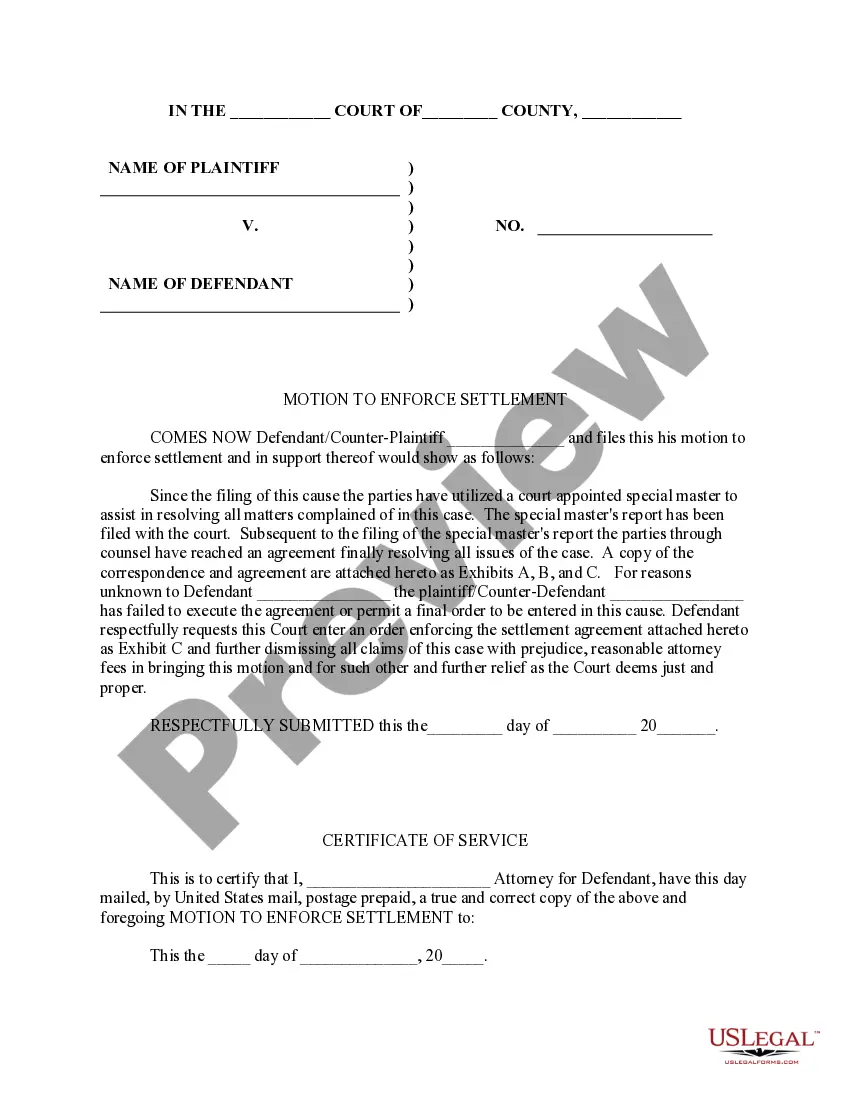
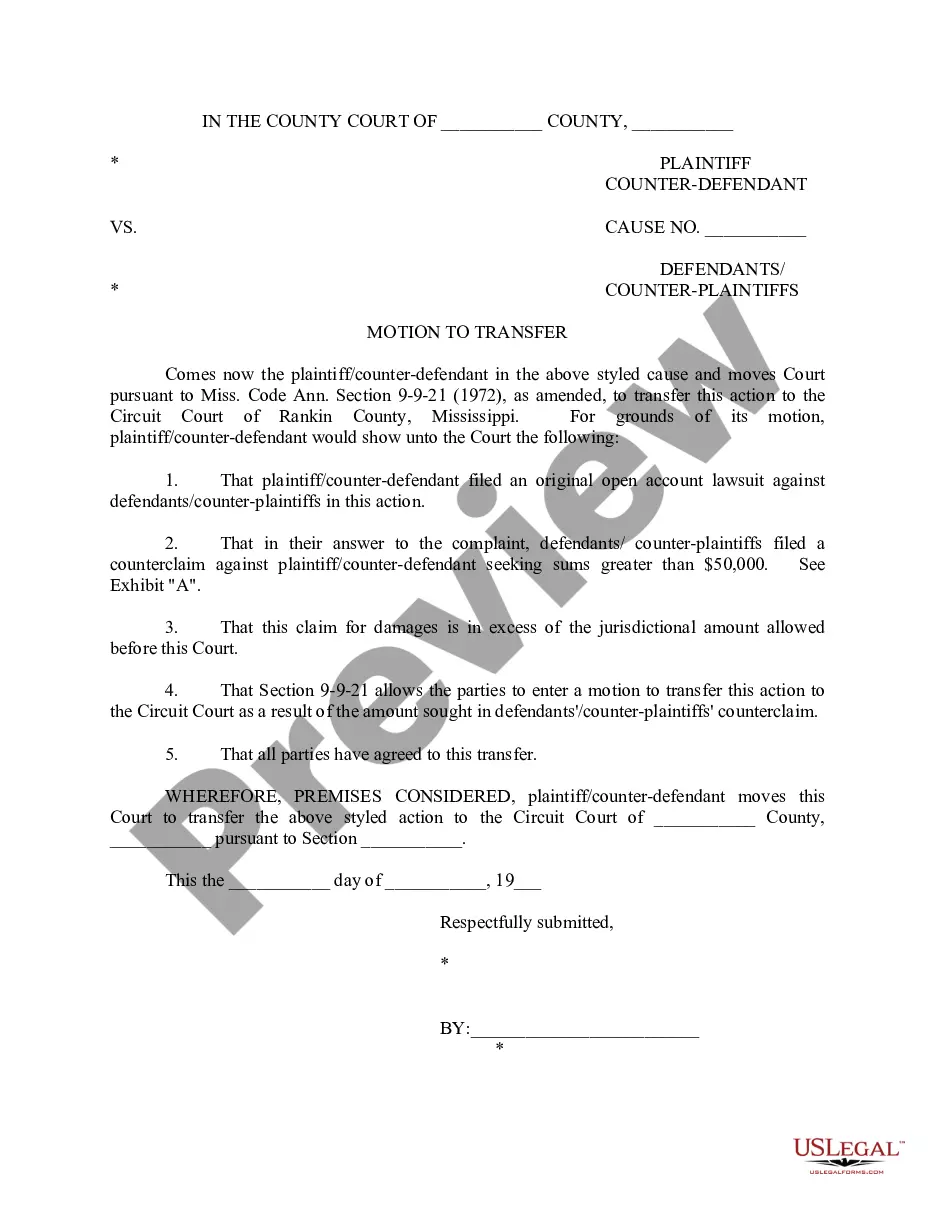
The Motion to Enforce Settlement is a legal document used to compel compliance with a settlement agreement that has been reached between parties in a dispute. This form is critical when one party fails to fulfill their obligations as stipulated in the settlement agreement. Unlike a typical settlement agreement, this motion is specifically designed to request a court order that enforces the terms of the agreement and may include requests for attorney fees and dismissal of claims in the case.
Main sections of this form
- Heading indicating the court and parties involved.
- Identification of the motion's purpose and supporting facts.
- Attachment of relevant exhibits that detail the settlement agreement.
- Request for the court to enforce the settlement and other forms of relief.
- Certificate of service noting that copies were sent to all relevant parties.


Situations where this form applies
This form is used when you have reached a settlement agreement in a legal case, but one party is not following through with their obligations. You may need to file this motion when the other party refuses to honor the terms of the agreement, thereby necessitating intervention by the court to enforce compliance.
Who should use this form
- Individuals or entities involved in a legal dispute who have a settlement agreement in place.
- The party seeking to enforce the terms of a settlement against another party.
- Attorneys representing clients in cases where a settlement is not being executed as agreed.
Instructions for completing this form
- Identify the parties involved in the motion and their roles (e.g., Plaintiff, Defendant).
- Summarize the history of the case and outline the agreement that is being enforced.
- Attach the necessary exhibits that support your claim, including correspondence and the original settlement agreement.
- Specify the relief you are requesting from the court, including enforcement of the agreement and attorney fees.
- Sign and date the form and ensure the certificate of service is completed.
Does this form need to be notarized?
This form does not typically require notarization unless specified by local law. Ensure that you check your jurisdictionâs requirements for additional stipulations regarding notarization before submission.
Get your form ready online
Our built-in tools help you complete, sign, share, and store your documents in one place.
Make edits, fill in missing information, and update formatting in US Legal Forms—just like you would in MS Word.
Download a copy, print it, send it by email, or mail it via USPS—whatever works best for your next step.
Sign and collect signatures with our SignNow integration. Send to multiple recipients, set reminders, and more. Go Premium to unlock E-Sign.
If this form requires notarization, complete it online through a secure video call—no need to meet a notary in person or wait for an appointment.
We protect your documents and personal data by following strict security and privacy standards.

Make edits, fill in missing information, and update formatting in US Legal Forms—just like you would in MS Word.

Download a copy, print it, send it by email, or mail it via USPS—whatever works best for your next step.

Sign and collect signatures with our SignNow integration. Send to multiple recipients, set reminders, and more. Go Premium to unlock E-Sign.

If this form requires notarization, complete it online through a secure video call—no need to meet a notary in person or wait for an appointment.

We protect your documents and personal data by following strict security and privacy standards.
Typical mistakes to avoid
- Failing to attach all relevant exhibits that demonstrate the agreement.
- Not specifying the relief sought clearly, making it harder for the court to understand what you are requesting.
- Not filling out the parties' names and roles properly.
- Missing the signature or date on the motion, which can delay the court's processing.
Why complete this form online
- Quick access to professionally drafted legal documents.
- Easy to edit and customize according to your case specifics.
- Downloadable format allows for convenient printing and filing.
- Access to customer support for any questions you may have during completion.
Looking for another form?
Form popularity
FAQ
A breach is when either party refuses to adhere to the agreed terms and conditions outlined in the settlement contract. In brief, a party that breaches a settlement agreement will risk being forced to complete the agreement and paying the legal costs of the party seeking to enforce the agreement.
No, a settlement offer is not binding until the other side accepts it. A settlement offer is just a proposal to resolve the case.When the parties memorialize their agreement as required by the law in their jurisdiction, a finalized settlement offer becomes binding.
In most cases, the parties enter into an agreement settling their dispute before the court issues a final judgment in the case.
A settlement agreement need be signed by only one of the parties to be enforceable under Code of Civil Procedure §664.6. The court can enforce a settlement pursuant to Code of Civil Procedure A§664.6 if the parties state in the settlement agreement that the court will reserve jurisdiction.