Client Concerns
Overview of this form
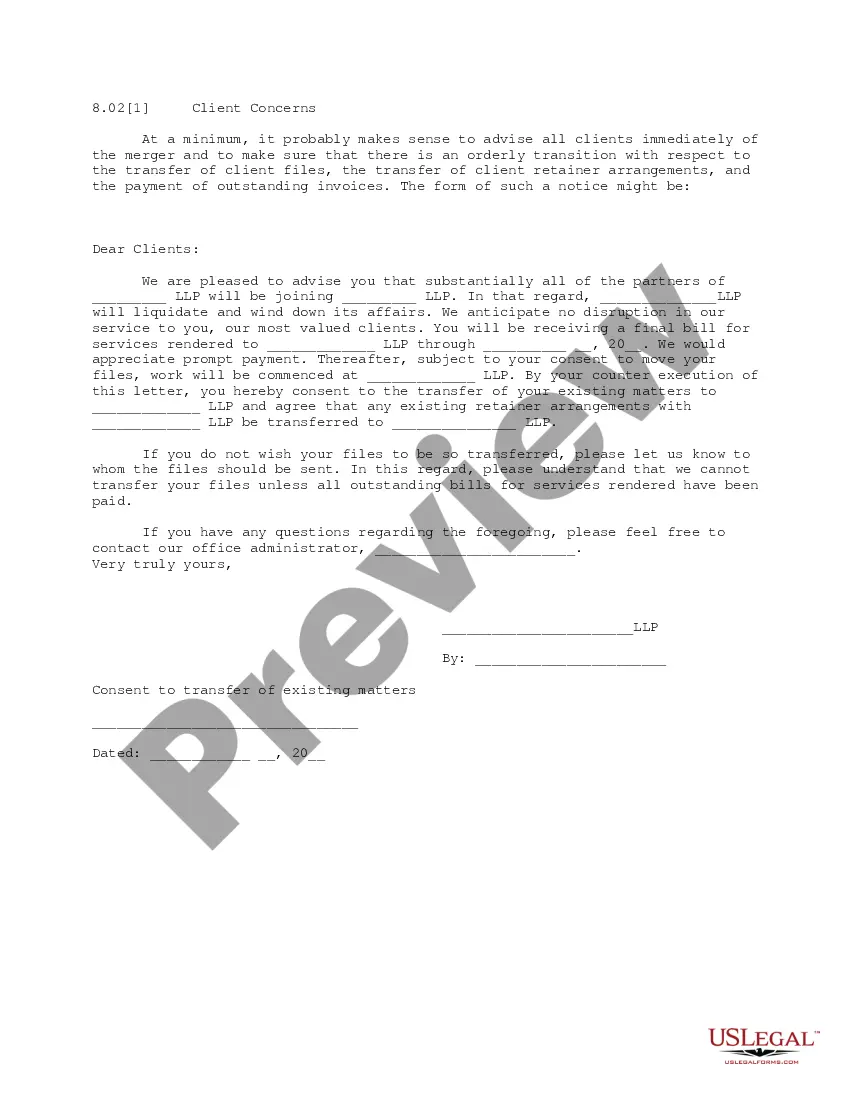
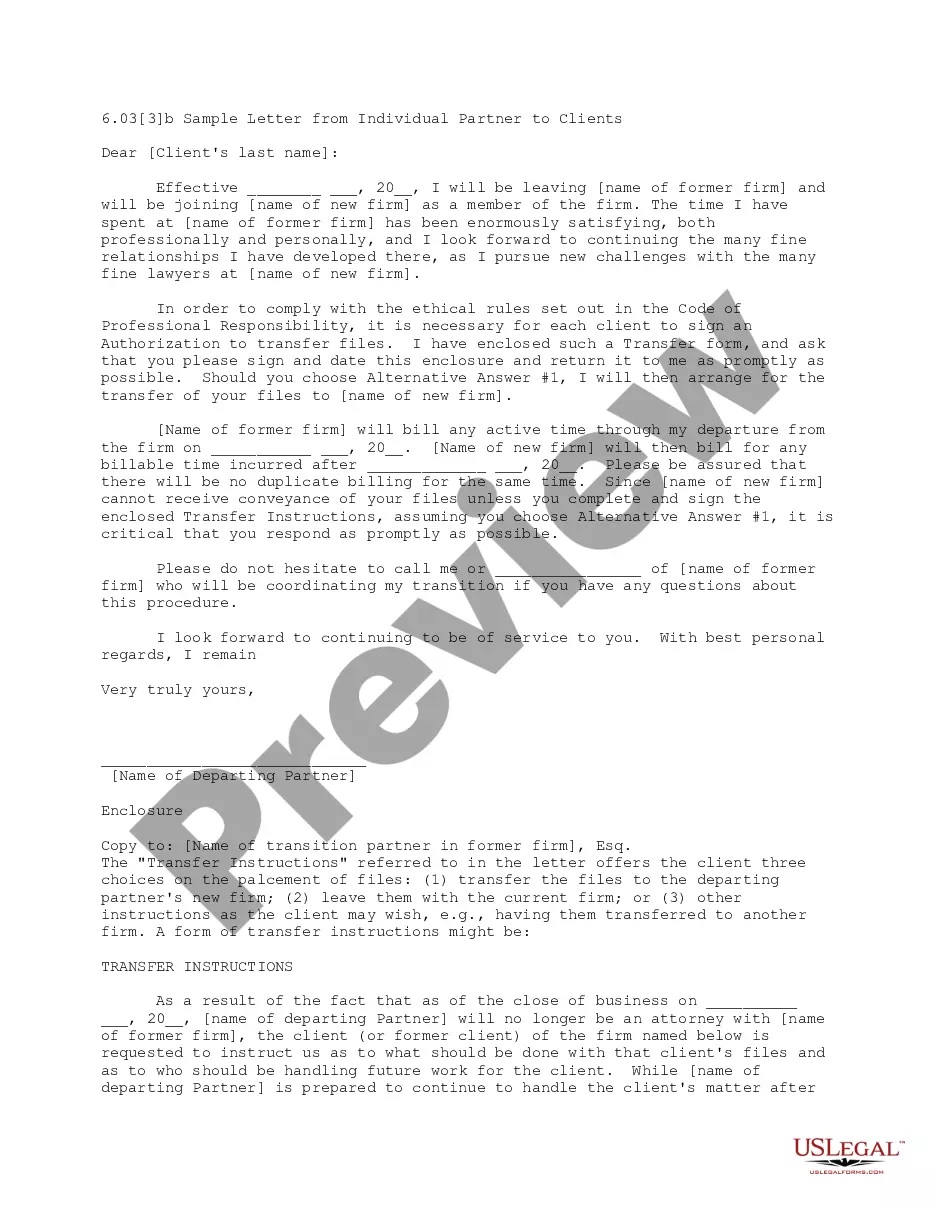
The Client Concerns letter is a formal communication from a law firm to its clients, notifying them of a merger with another firm. This letter outlines the transition, assures clients of continued service, and seeks their consent for transferring files to the new firm. Unlike other legal notices, this form specifically addresses client relationships amid structural changes within law firms.
Key components of this form
- Notification of the merger between law firms.
- Assurance that most partners will join the new firm.
- Request for client consent to transfer their files.
- Instructions regarding outstanding invoices and final billing.
- Contact information for further inquiries.
Common use cases
This form should be used when a law firm is merging with another, and formal notification to clients is necessary. It is essential in ensuring that clients are informed about changes that affect their legal representation and to facilitate the smooth transfer of documents and files to the new firm.
Intended users of this form
This form is intended for:
- Law firms undergoing mergers.
- Legal administrators responsible for client communications.
- Lawyers needing to inform clients about changes in representation.
Instructions for completing this form
- Begin with a professional greeting addressed to clients.
- Insert the names of the merging firms appropriately.
- Specify the effective date of the merger and mention final billing details.
- Request client consent for the transfer of existing matters.
- Provide contact information for any client queries or concerns.
- Ensure all parties sign and date the letter for validation.
Is notarization required?
This form does not typically require notarization to be legally valid. However, some jurisdictions or document types may still require it. US Legal Forms provides secure online notarization powered by Notarize, available 24/7 for added convenience.
Get your form ready online
Our built-in tools help you complete, sign, share, and store your documents in one place.
Make edits, fill in missing information, and update formatting in US Legal Forms—just like you would in MS Word.
Download a copy, print it, send it by email, or mail it via USPS—whatever works best for your next step.
Sign and collect signatures with our SignNow integration. Send to multiple recipients, set reminders, and more. Go Premium to unlock E-Sign.
If this form requires notarization, complete it online through a secure video call—no need to meet a notary in person or wait for an appointment.
We protect your documents and personal data by following strict security and privacy standards.

Make edits, fill in missing information, and update formatting in US Legal Forms—just like you would in MS Word.

Download a copy, print it, send it by email, or mail it via USPS—whatever works best for your next step.

Sign and collect signatures with our SignNow integration. Send to multiple recipients, set reminders, and more. Go Premium to unlock E-Sign.

If this form requires notarization, complete it online through a secure video call—no need to meet a notary in person or wait for an appointment.

We protect your documents and personal data by following strict security and privacy standards.
Common mistakes to avoid
- Failing to clearly state the reasons for the merger.
- Not providing sufficient billing information or deadlines.
- Omitting contact details for client follow-up.
- Neglecting to have all necessary signatures on the document.
Why complete this form online
- Convenient access to a professionally drafted document.
- Editable format allows customization to specific client needs.
- Provides reliable structure to facilitate clear communication.
- Ensures compliance with legal standards for client notifications.
Legal use & context
The Client Concerns letter serves as a formal notice and is essential for maintaining the transparency of client-lawyer relationships during transitions. Proper use of this form can help in mitigating potential disputes or misunderstandings following a merger.
Summary of main points
- The form is essential for notifying clients about law firm mergers.
- It ensures consent for transferring client files, fostering trust.
- Attention to detail in completion is crucial to avoid common pitfalls.
- Accessing this form online simplifies the process for legal professionals.
Looking for another form?
Form popularity
FAQ
Make Sure the Focus is on the Client. Although this tip may seem obvious to someone with a degree in counseling, it's arguably the most important. Walk the Line between Pushy and Coddling. Stay Confidential. Ask for Clarification. Practice Your Questions. Structure the Session.
First off, be sure you have a box of tissues on the table. We've got a checklist for refreshing our conference and meeting rooms, and tissues are the number one item on the list. Second, acknowledge the upset. Third, tell the client that crying is normal. Finally, get on with it.
The key to getting a client to open up is to understand what they are and what they aren't saying. Understand what the client is asking. Build an authoritative trusted adviser rapport. Never assume you know the entire issue. Sell yourself as an asset for solving the problem.
Determine the Client's Stage of Readiness. Give the Client Choices. Establish a Set of Rules. Focus on Client Strengths. Don't Ask Why Pay Attention to Patient Behavior. Provide Alternative Constructs. Be Aware of Client Questions.
Identify the problem. This is critical: you must try to solve the right problem. Analyze the problem. Identify decision criteria. Develop multiple solutions. Choose the optimal solution.
If it seems as though you're often feeling anger toward a particular client, it's important to check your counter-transference toward the client, seek consultation, and perhapsas a last resortrefer him to another professional, she says. Discuss your emotional reaction with the client.
To identify needs, you must both listen and ask the right questions. After identifying needs, always check for additional or related needs. Use your knowledge and experience to identify and present the right products, services, and solutions to meet your customers' needs.
Stay calm. Listen well. Acknowledge the problem. Get the facts. Offer a solution.
First and foremost, listen. Build rapport through empathy. Lower your voice. Respond as if all your customers are watching. Know when to give in. Stay calm. Don't take it personally. Remember that you're interacting with a human.