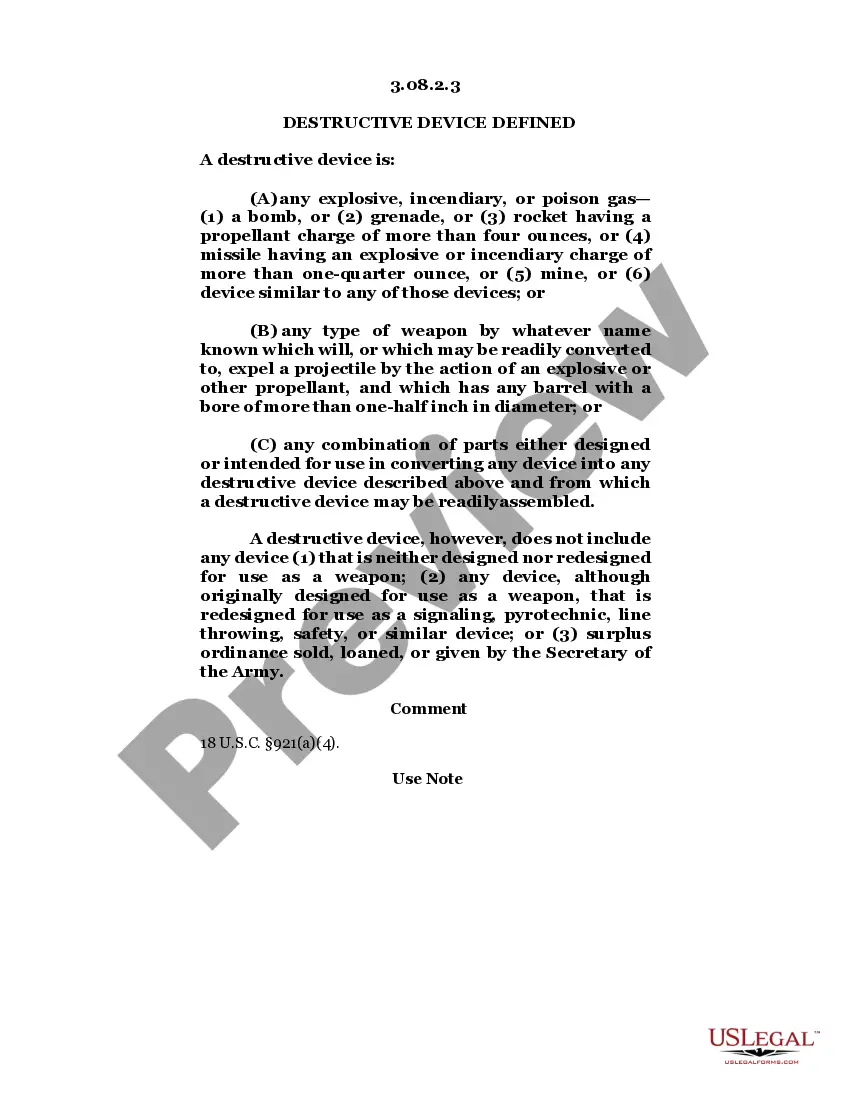
DESTRUCTIVE DEVICE DEFINED
About this form
The "Destructive Device Defined" form provides a legal definition of what constitutes a destructive device under U.S. law. This form clarifies the types of explosives, incendiary devices, and other weaponry included in this category, differentiating them from items that are not classified as such. Understanding this definition is critical for legal compliance and making informed decisions regarding ownership and use of these devices.
Form components explained
- Definition of a destructive device, including types such as bombs, grenades, and missiles.
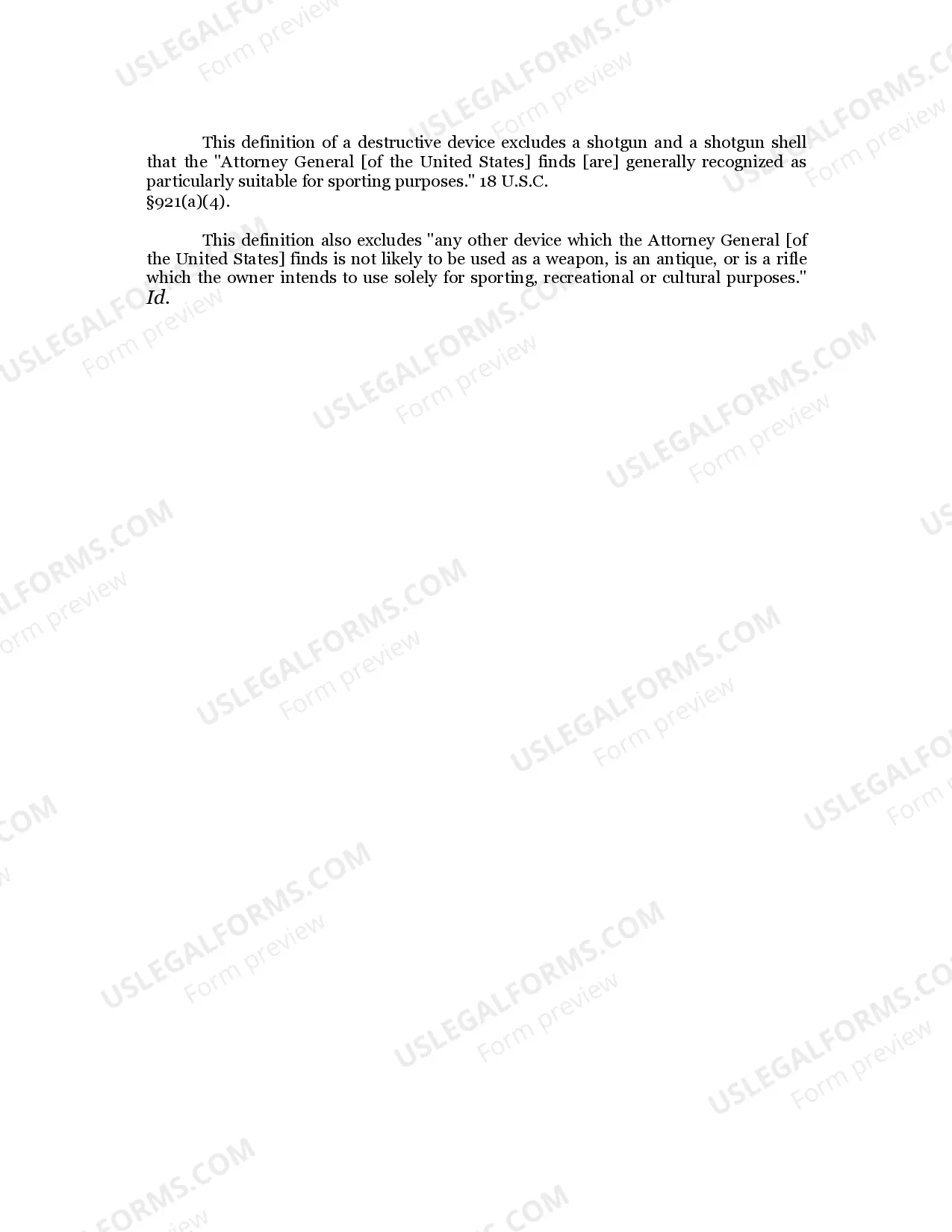
- Exemptions for devices not designed as weapons or intended for sporting use.
- Specific guidelines for the barrel diameter and projectile expulsion mechanisms.
- Clarifications on devices classified as antiques or uncommon weapons.
- Reference to relevant U.S. legal statutes for enforceability.
Situations where this form applies
This form is used when individuals need to determine whether a specific item is classified as a destructive device. It is particularly relevant for legal professionals, law enforcement, or individuals involved in regulated activities concerning weapons. Understanding this definition helps to ensure compliance with federal and state laws regarding explosive materials and weaponry.
Who can use this document
- Legal professionals seeking to clarify the definition of destructive devices for casework.
- Law enforcement agencies that need a reference for compliance and enforcement actions.
- Individuals or businesses involved in activities related to firearms or explosives.
- Students and researchers studying legal definitions of weaponry in U.S. law.
Instructions for completing this form
- Read the full definition carefully to understand the criteria for a destructive device.
- Identify any items you own or are considering for classification as a destructive device.
- Refer to the exemptions listed to determine if your item qualifies as a non-destructive device.
- Document any questions or clarifications needed for legal consultation if necessary.
- Ensure you are aware of the legal implications associated with ownership and use.
Does this document require notarization?
This form does not typically require notarization unless specified by local law. It is designed for informational purposes and to clarify definitions in legal contexts.
Get your form ready online
Our built-in tools help you complete, sign, share, and store your documents in one place.
Make edits, fill in missing information, and update formatting in US Legal Forms—just like you would in MS Word.
Download a copy, print it, send it by email, or mail it via USPS—whatever works best for your next step.
Sign and collect signatures with our SignNow integration. Send to multiple recipients, set reminders, and more. Go Premium to unlock E-Sign.
If this form requires notarization, complete it online through a secure video call—no need to meet a notary in person or wait for an appointment.
We protect your documents and personal data by following strict security and privacy standards.

Make edits, fill in missing information, and update formatting in US Legal Forms—just like you would in MS Word.

Download a copy, print it, send it by email, or mail it via USPS—whatever works best for your next step.

Sign and collect signatures with our SignNow integration. Send to multiple recipients, set reminders, and more. Go Premium to unlock E-Sign.

If this form requires notarization, complete it online through a secure video call—no need to meet a notary in person or wait for an appointment.

We protect your documents and personal data by following strict security and privacy standards.
Common mistakes to avoid
- Failing to consider exemptions for specific devices not classified as destructive.
- Misunderstanding barrel diameter requirements which can lead to incorrect classification.
- Ignoring state-specific regulations that may differ from federal definitions.
- Assuming all explosive devices are considered destructive without checking definitions.
Why complete this form online
- Convenient access to the legal definition without needing a physical visit to a law library.
- Immediate download options for personal use or legal reference.
- Editable format allowing for personal notes and clarifications.
- Reliable legal resources prepared by licensed attorneys to ensure accuracy.
Legal use & context
- This definition serves as a legal standard for identifying destructive devices under United States law.
- Understanding this classification is crucial for compliance with federal regulations regarding explosives.
- It is advisable to consult legal counsel if there are uncertainties about specific items.
Main things to remember
- The form provides a clear definition of destructive devices within U.S. law.
- It highlights exemptions that prevent certain items from being classified as destructive.
- Knowledge of this definition is essential for legal professionals, law enforcement, and individuals in the weapons field.
Looking for another form?
Form popularity
FAQ
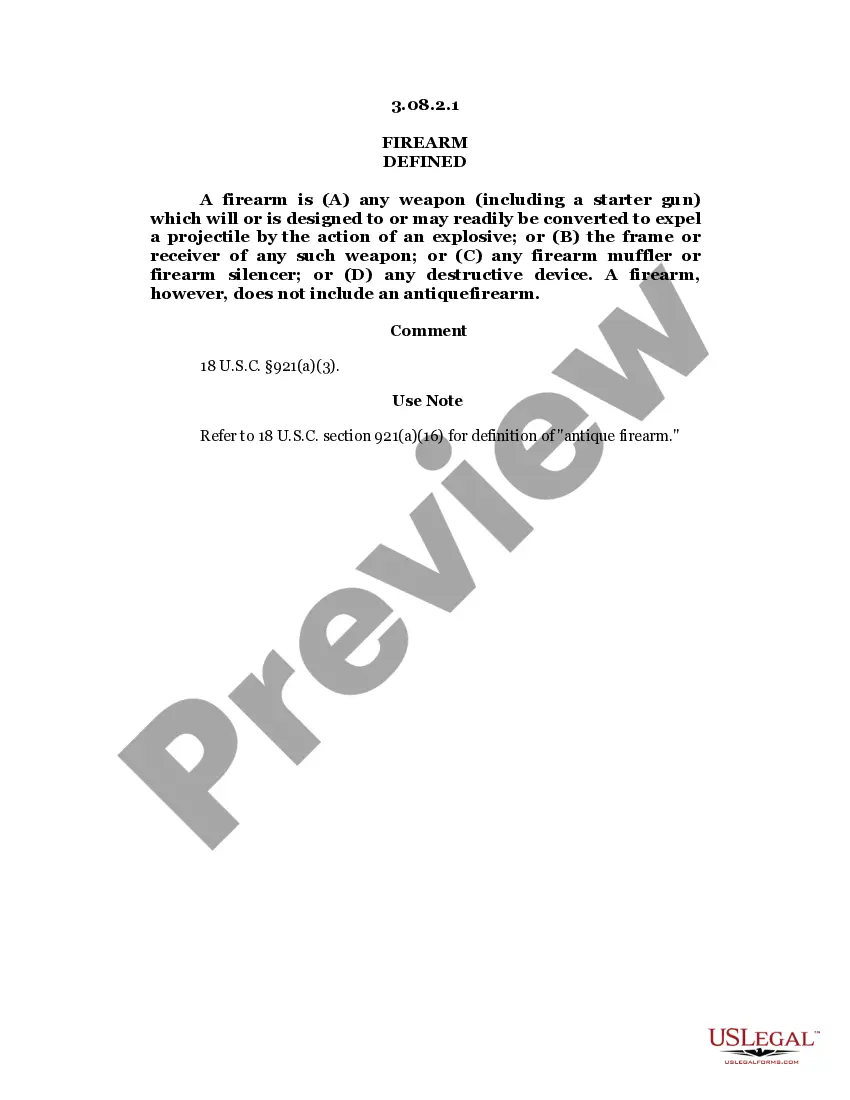
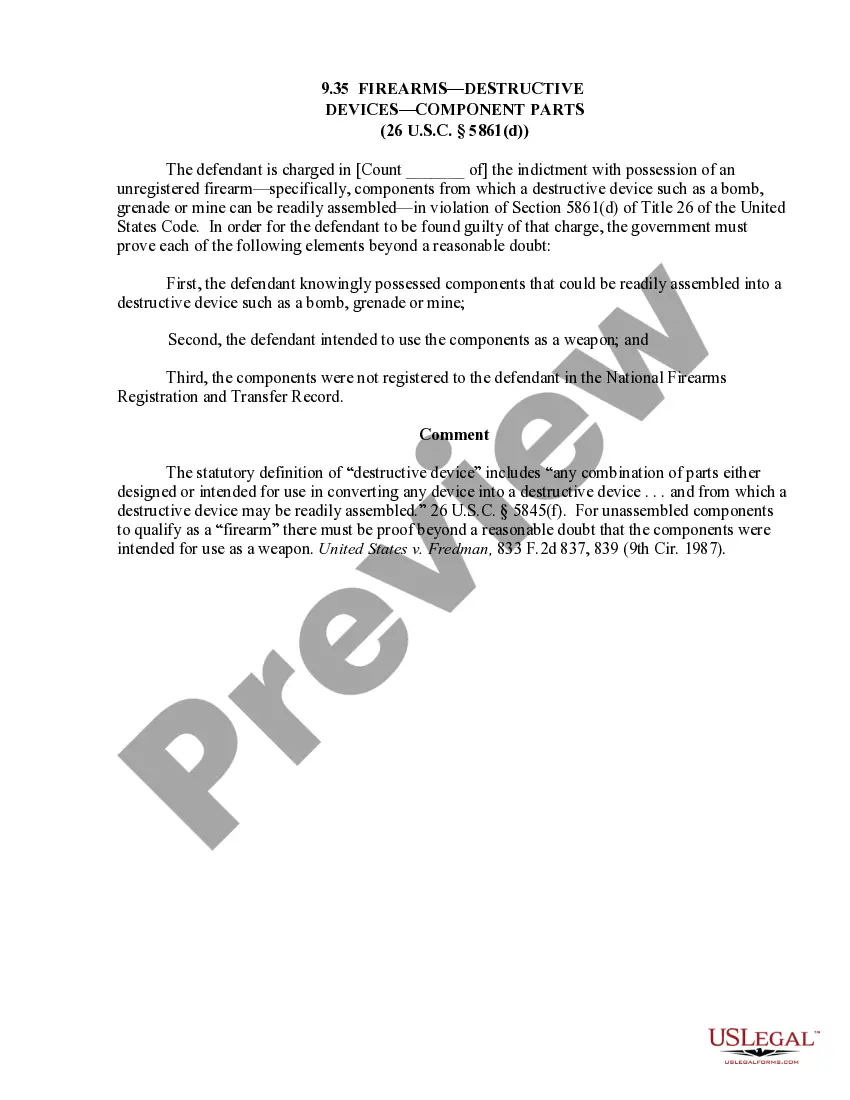
The term ?destructive device? means (1) any explosive, incendiary, or poison gas (A) bomb, (B) grenade, (C) rocket having a propellent charge of more than four ounces, (D) missile having an explosive or incendiary charge of more than one-quarter ounce, (E) mine, or (F) similar device; (2) any type of weapon by whatever
The term ?destructive device? means (1) any explosive, incendiary, or poison gas (A) bomb, (B) grenade, (C) rocket having a propellent charge of more than four ounces, (D) missile having an explosive or incendiary charge of more than one-quarter ounce, (E) mine, or (F) similar device; (2) any type of weapon by whatever
--The term ?destructive device? means (2) any type of weapon by whatever name known which will, or which may be readily converted to, expel a projectile by the action of an explosive or other propellant, the barrel or barrels of which have a bore of more than one-half inch in diameter, except a shotgun or shotgun
The USAS-12 shotgun has a bore of more than one-half inch in diameter and is not generally recognized as particularly suitable for sporting purposes. Therefore, it is classified as a destructive device for purposes of the National Firearms Act, 26 U.S.C.
Other 20mm HE and HEI projectiles do not contain more than one-quarter ounce of explosive and are not destructive devices.
Background. Machine guns and fifty caliber rifles are highly destructive weapons appropriate only for military use. Machine guns have been comprehensively regulated at the federal level since the 1930s, and the manufacture or importation of new machine guns for sale to civilians has been banned since 1986.
Examples of destructive devices include grenades, grenade launchers, artillery weapons, and firearms with a bore over one half of an inch (. 50 inches or 12.7 mm), excluding some rifles and most shotguns, both semi automatic and manually operated.