Telecommunications Services Agreement between Channelnet Limited and Norweb Telecom Limited
What this document covers
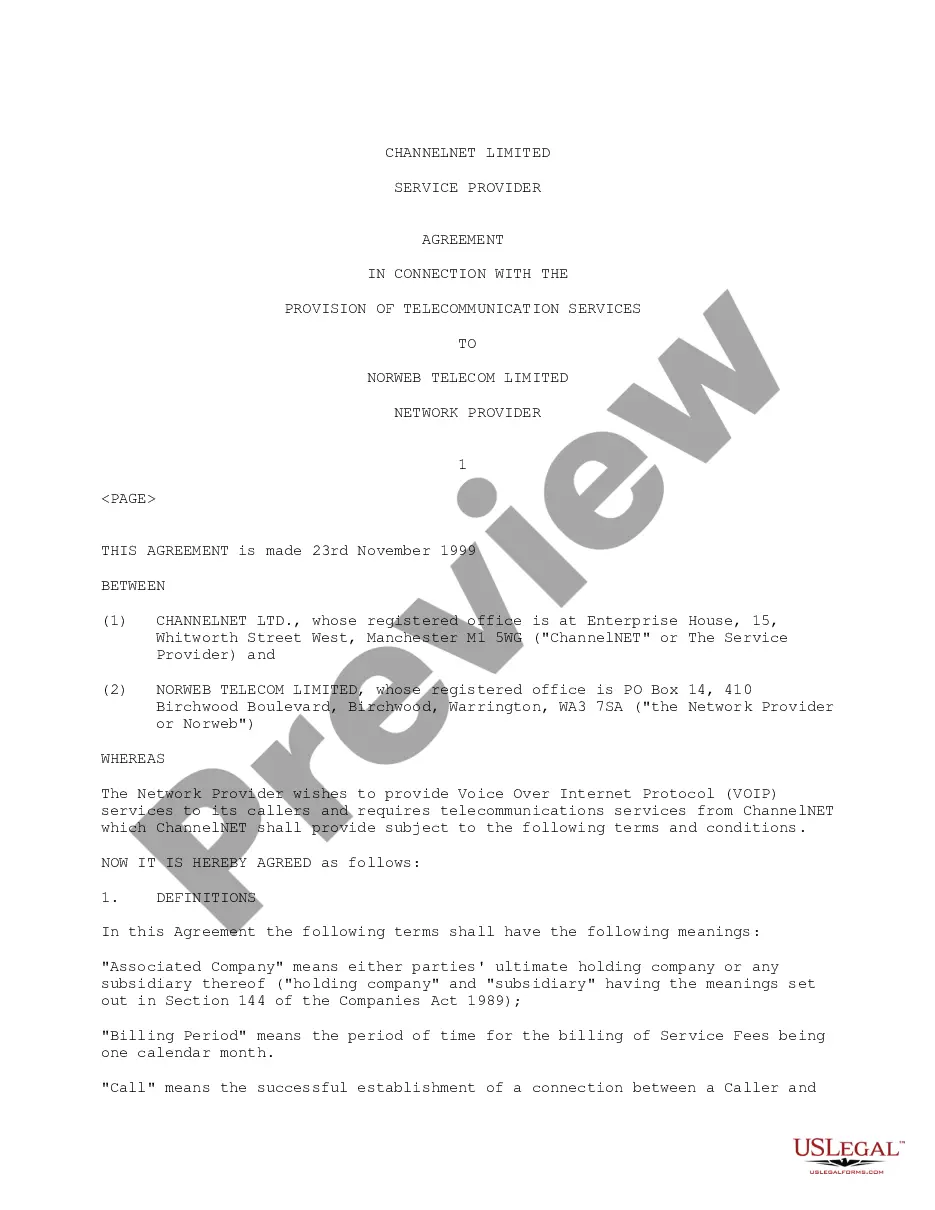
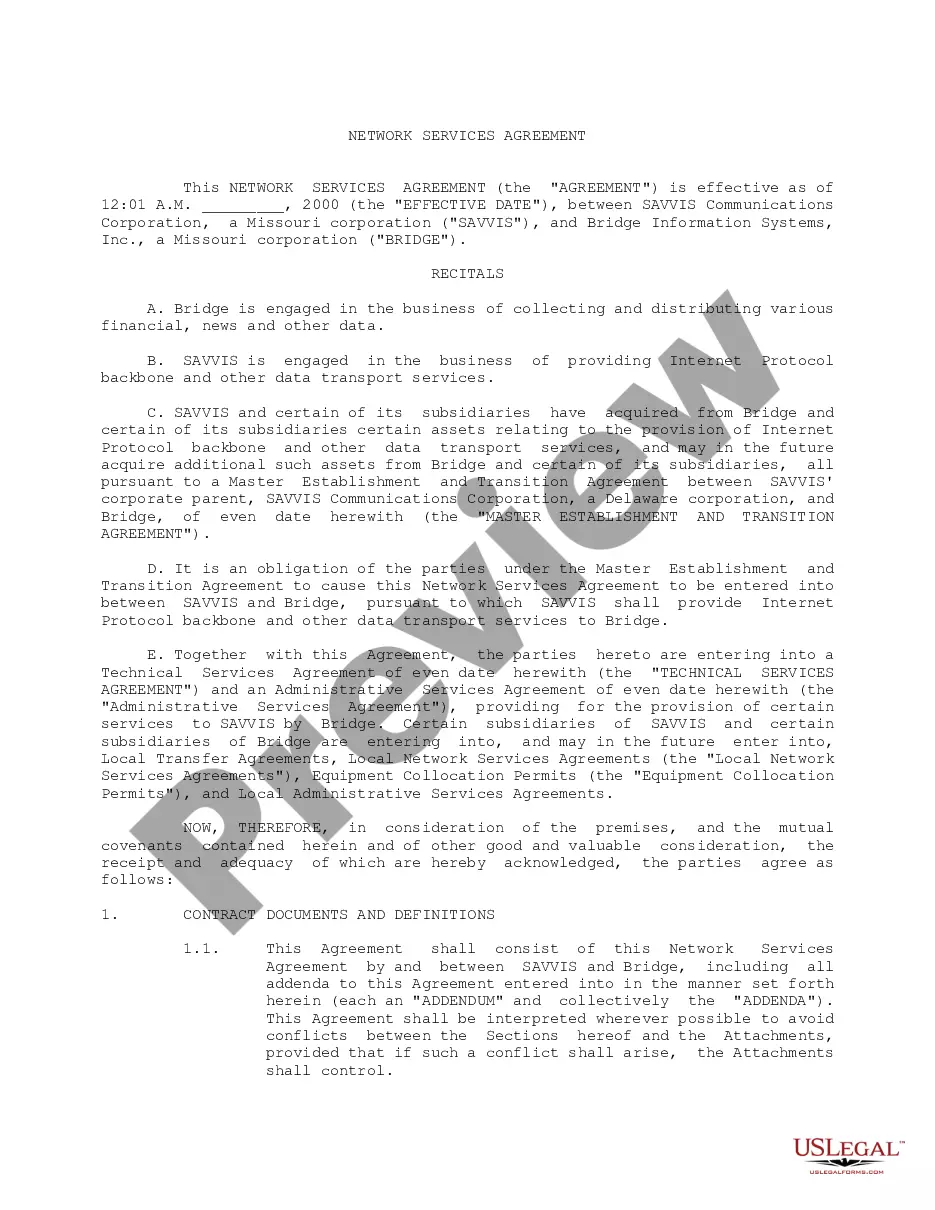
The Telecommunications Services Agreement is a legal document that outlines the terms under which Channelnet Limited provides telecommunication services to Norweb Telecom Limited. This agreement specifically focuses on the provision of Voice Over Internet Protocol (VOIP) services. Unlike similar agreements, this document is tailored for these specific entities and was executed on November 23, 1999, ensuring clarity in the service details and obligations of both parties involved.
What’s included in this form
- Definitions of key terms related to telecommunications services.
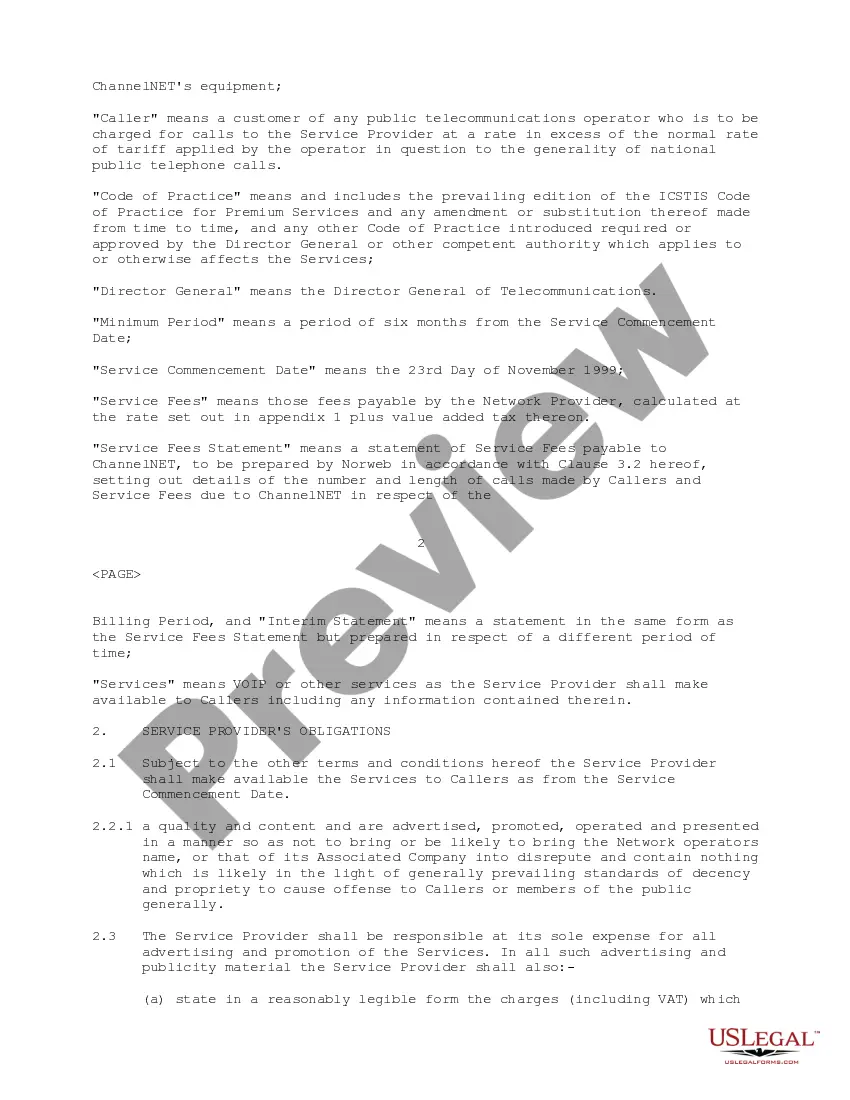
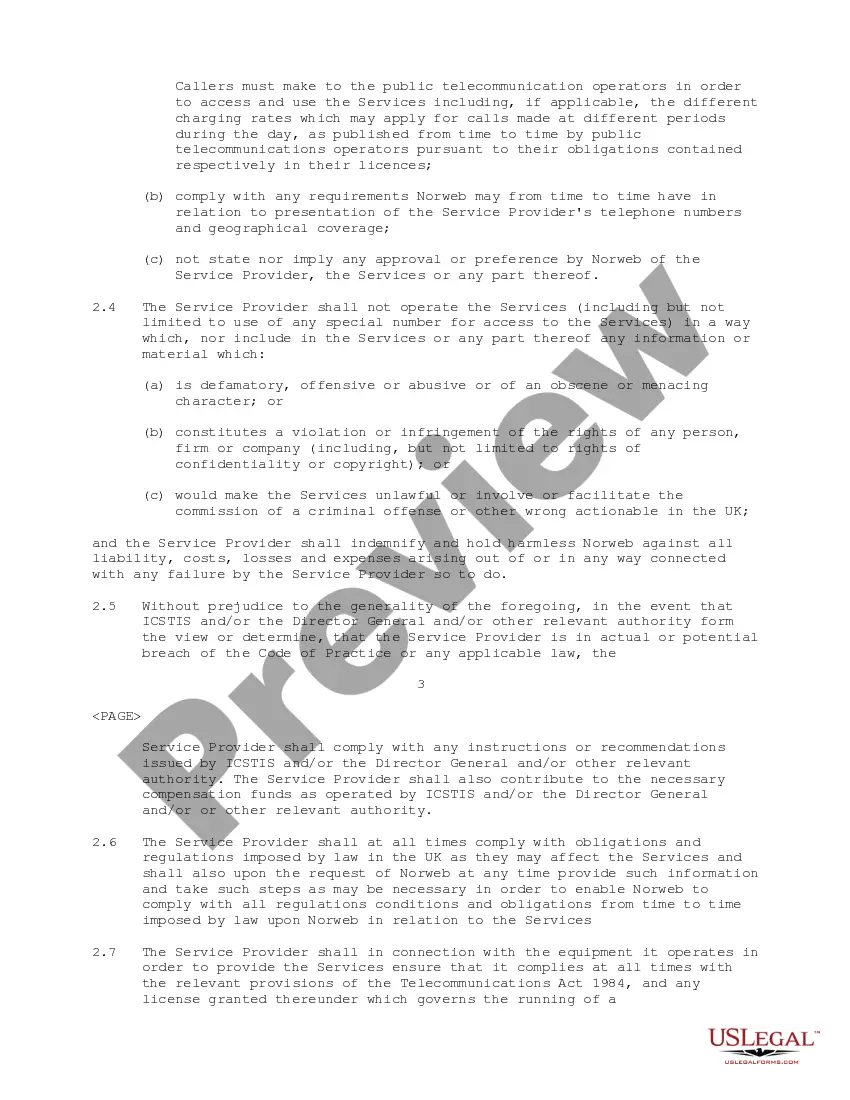
- Obligations of the service provider regarding service quality and advertising.
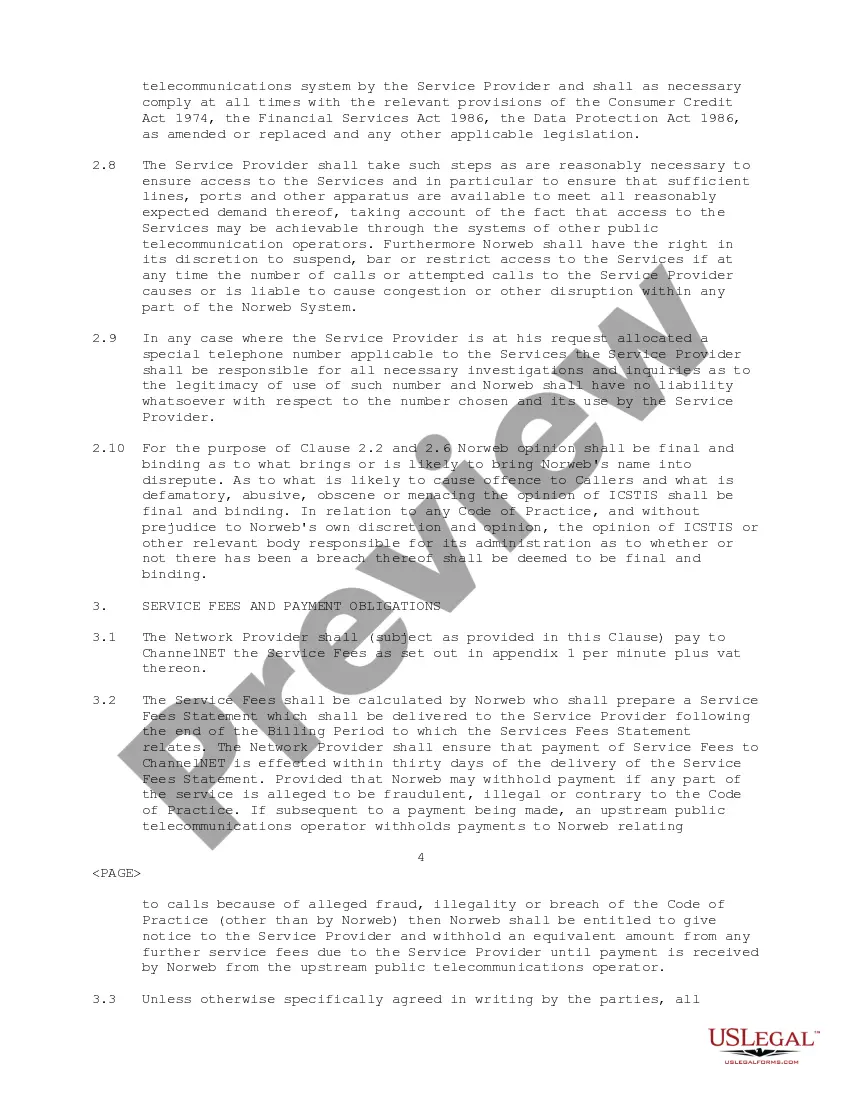
- Details on service fees and payment obligations between the parties.
- Provisions for the duration, suspension, and termination of the agreement.
- Confidentiality obligations to ensure protection of sensitive information.

Situations where this form applies
This form is necessary when entities like Channelnet Limited and Norweb Telecom Limited enter into a formal agreement for telecommunication services, specifically for VOIP. If you're a telecommunications service provider or network provider looking to formalize service terms, this agreement clarifies roles, responsibilities, and payment structures, ensuring both parties are legally protected.
Intended users of this form
- Telecommunications service providers seeking to offer VOIP services.
- Network providers interested in establishing terms with service providers.
- Legal professionals drafting telecommunications agreements for clients.
- Business owners in the telecom sector who need clear contractual terms.
Instructions for completing this form
- Identify the parties involved: Channelnet Limited as the service provider and Norweb Telecom Limited as the network provider.
- Specify the service commencement date, which is November 23, 1999, in this agreement.
- Detail the service fees in accordance with the rates outlined in Appendix 1.
- Fill in any specific obligations related to service quality and promotion for the services provided.
- Ensure both parties sign the document to formalize the agreement.
Is notarization required?
This form does not typically require notarization unless specified by local law. Ensure that both parties retain copies of the signed agreement for their records to avoid any future disputes.
Get your form ready online
Our built-in tools help you complete, sign, share, and store your documents in one place.
Make edits, fill in missing information, and update formatting in US Legal Forms—just like you would in MS Word.
Download a copy, print it, send it by email, or mail it via USPS—whatever works best for your next step.
Sign and collect signatures with our SignNow integration. Send to multiple recipients, set reminders, and more. Go Premium to unlock E-Sign.
If this form requires notarization, complete it online through a secure video call—no need to meet a notary in person or wait for an appointment.
We protect your documents and personal data by following strict security and privacy standards.

Make edits, fill in missing information, and update formatting in US Legal Forms—just like you would in MS Word.

Download a copy, print it, send it by email, or mail it via USPS—whatever works best for your next step.

Sign and collect signatures with our SignNow integration. Send to multiple recipients, set reminders, and more. Go Premium to unlock E-Sign.

If this form requires notarization, complete it online through a secure video call—no need to meet a notary in person or wait for an appointment.

We protect your documents and personal data by following strict security and privacy standards.
Typical mistakes to avoid
- Failing to fully understand service obligations before signing.
- Neglecting to specify all fees and payment responsibilities clearly.
- Omitting necessary signatures, which can render the agreement void.
- Ignoring state-specific legal requirements that may apply.
Why complete this form online
- Immediate access to a reliable, professionally drafted agreement.
- Easy customization to meet specific business needs.
- The ability to download and store the form securely.
- Convenience of completing the form at your own pace without the need for an in-person visit.
Legal use & context
- The agreement is legally enforceable once signed by both parties.
- It is important for both parties to abide by the specified terms to prevent legal disputes.
- Compliance with local telecommunications laws must be maintained to ensure validity.
Quick recap
- This form establishes a contractual relationship for telecommunications services.
- Clearly defining terms and obligations is crucial for both partiesâ protection.
- Understanding payment and service duration terms can prevent future disputes.
- The agreement should be customized to reflect specific needs and compliance requirements.
Looking for another form?





Form popularity
FAQ
The Telecommunications (Lawful Business Practice) (Interception of Communications) Regulations 2000 (the Regulations) give businesses the right to monitor communications on their own networks. Previously such interception would have been unlawful unless consent had been given by both the sender and the recipient.
A short and simple MSA for telecommunications providers. Designed to be structured with service addenda/schedules.
Modem is an example of telecommunication device. It encodes digital information through carrier wave signal. Modem is a combined device for modulation and demodulation for example between the digital data of a computer and and the analog signal of telephone line.
It Satisfies Our Basic Needs. Information technology and the ability to connect and communicate is a fundamental part of how our society operates. In today's digital ecosystem, telecommunication has become the foundation for businesses, governments, communities, and families to seamlessly connect and share information.
Telecommunications, or telecom, refers to the process of exchanging information such as voice, data and video transmissions via electronic technologies like telephones (wired and wireless), microwave communications, fiber optics, satellites, radio and television broadcasting, and the internet.
Telecommunications are the means of electronic transmission of information over distances. The information may be in the form of voice telephone calls, data, text, images, or video. Today, telecommunications are used to organize more or less remote computer systems into telecommunications networks.
Telecommunications Policy is concerned with the changing roles of telecommunications in the economy and society.Its scope includes issues of telecom reform at national, regional and international levels, including issues confronting both developed and developing countries.
Telecommunication is communication at a distance using electrical signals or electromagnetic waves. Examples of telecommunications systems are the telephone network, the radio broadcasting system, computer networks and the Internet.