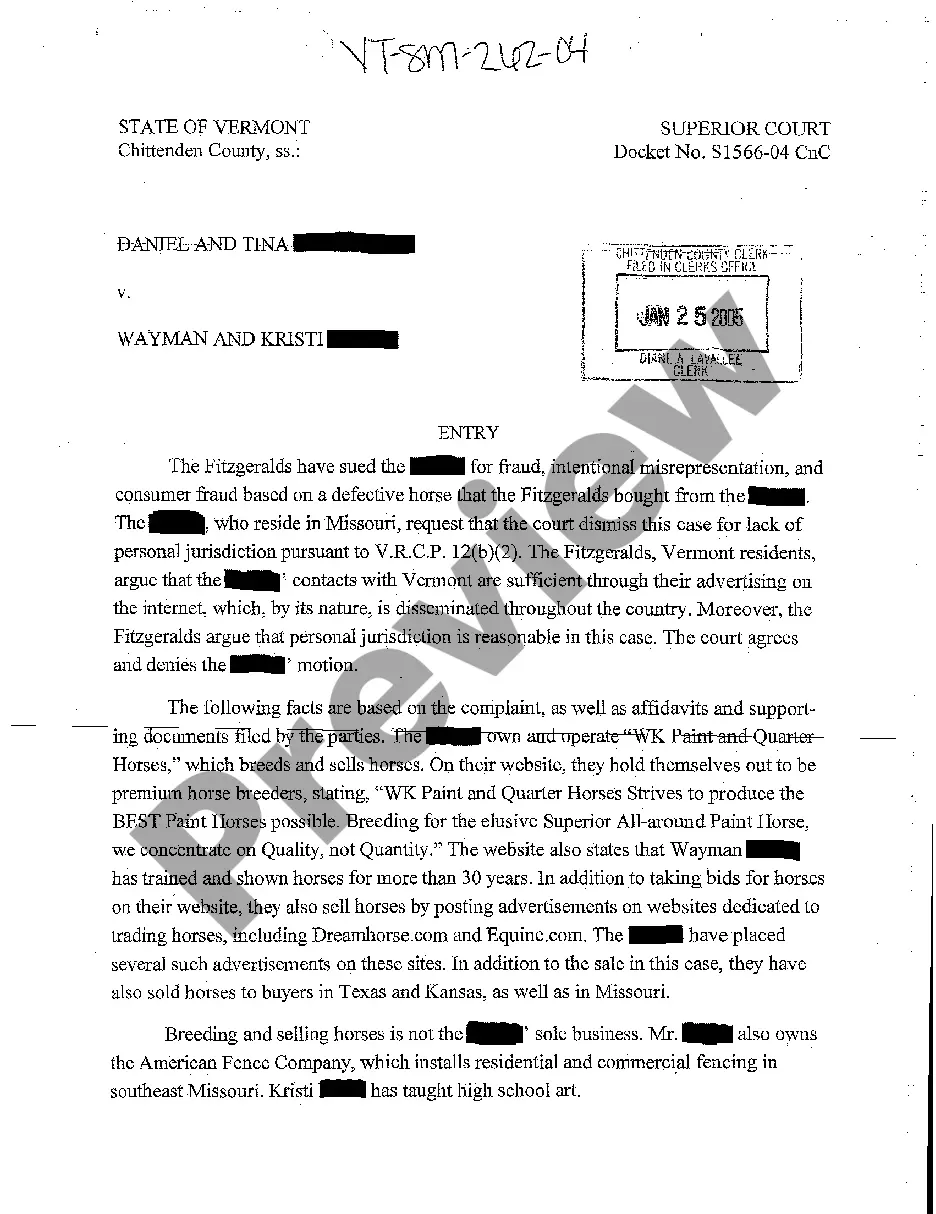
Checklist for Sequential Activities to Organize Automobile Action
What is this form?
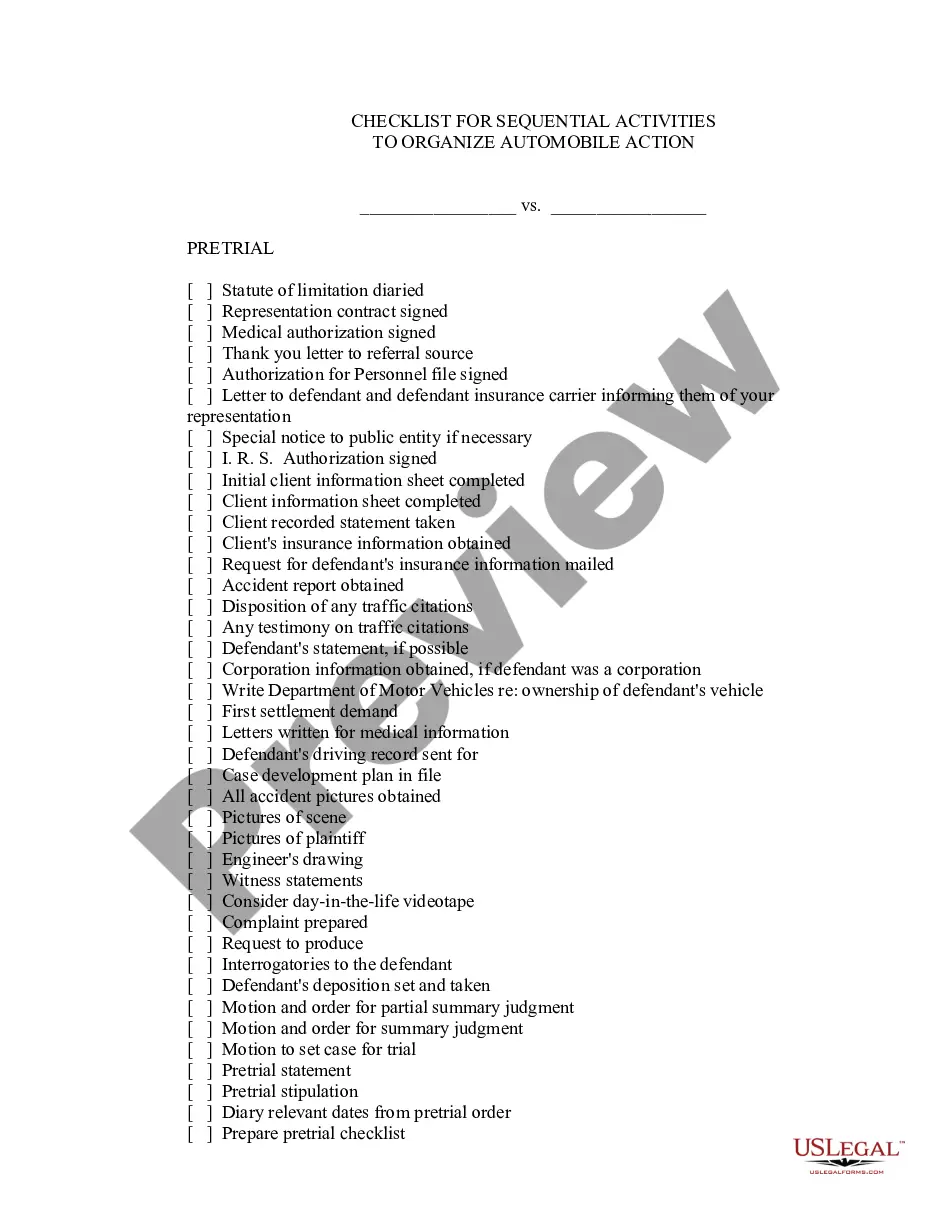
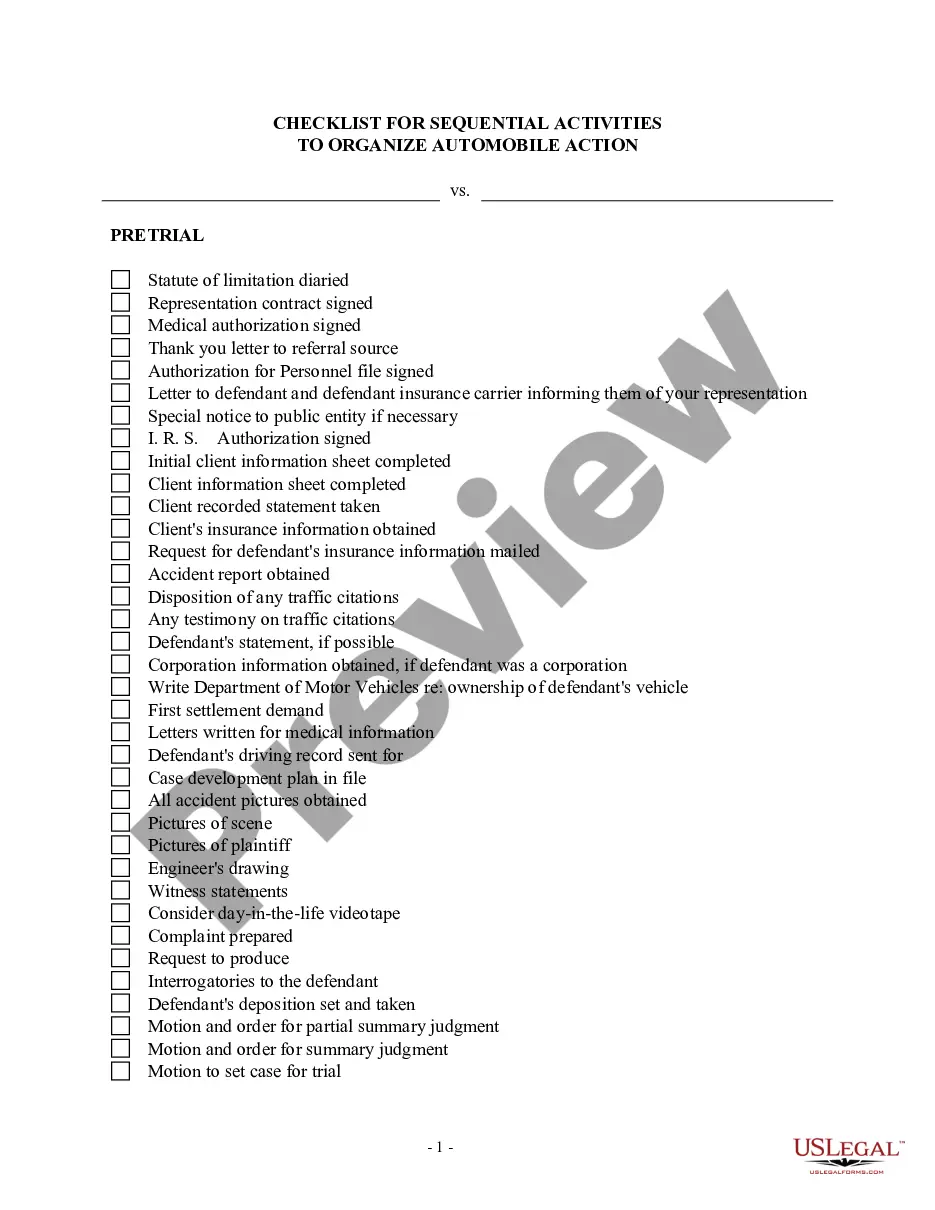
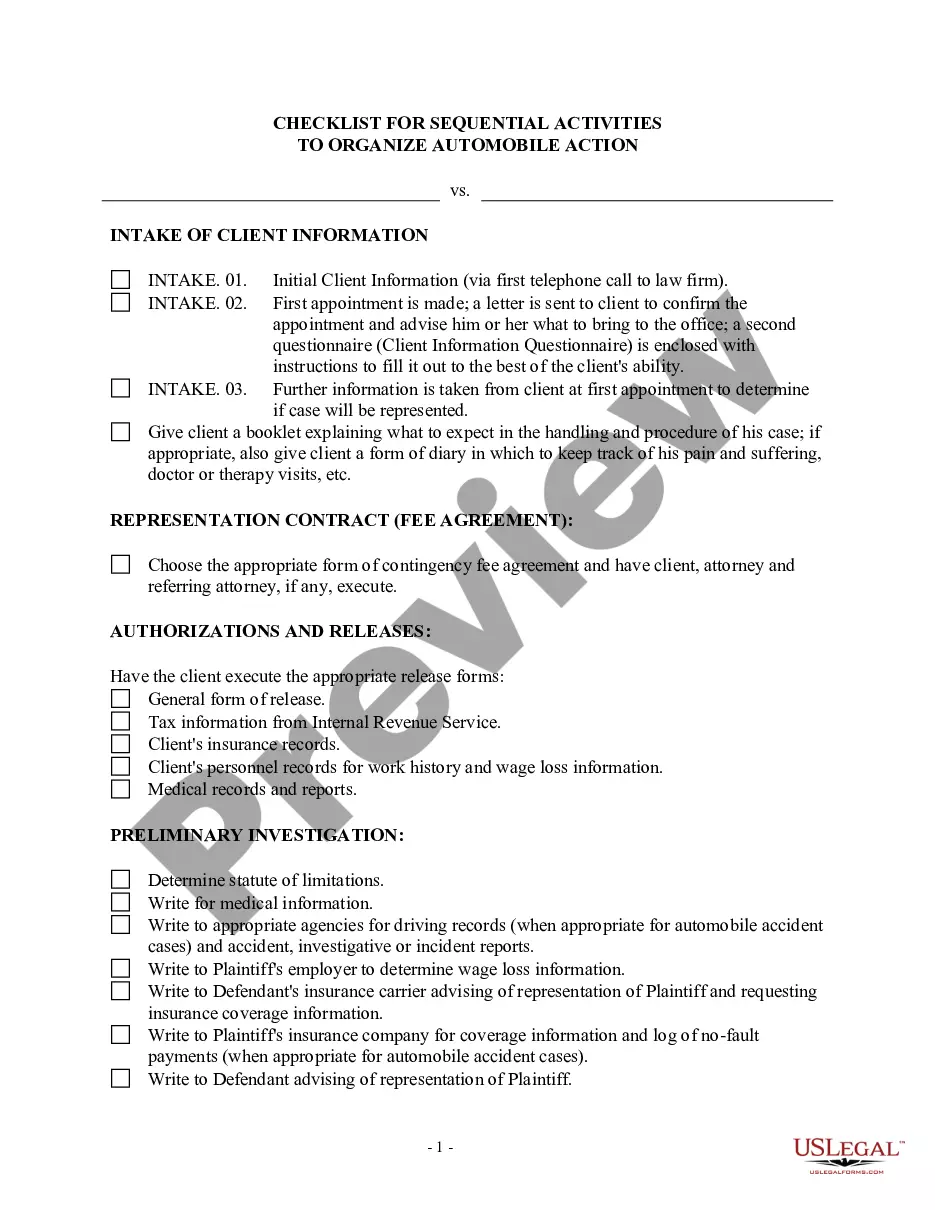
The Checklist for Sequential Activities to Organize Automobile Action is an essential tool designed specifically for attorneys managing auto accident cases. This comprehensive checklist outlines the steps necessary to efficiently organize a case, covering tasks from initial client intake through to post-trial activities. Unlike other legal forms, this checklist acts as a strategic guide to help attorneys streamline their workflow, ensuring no critical steps are overlooked during the case process.
Key parts of this document
- Pretrial checklist with items such as statute of limitation diaried and initial client information sheet completed.
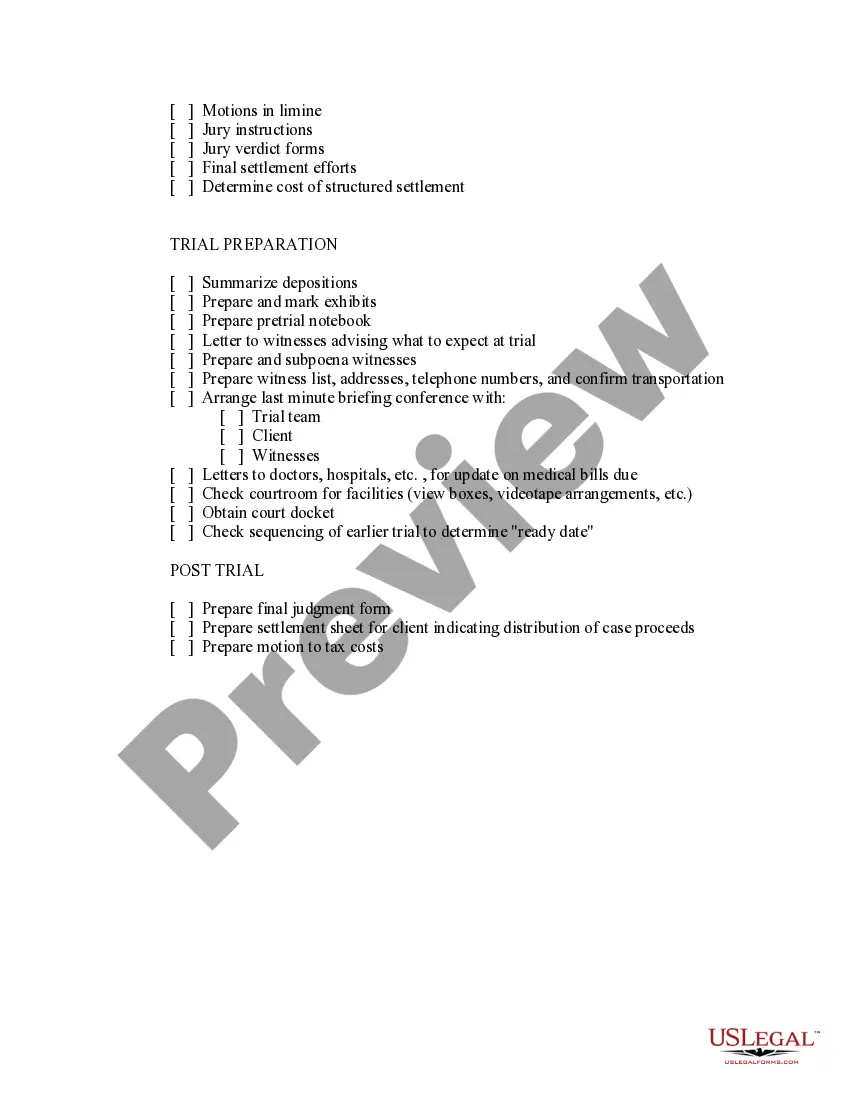
- Detailed steps for trial preparation including summarizing depositions and preparing exhibits.
- Post-trial requirements, including preparing final judgment forms and settlement sheets for clients.
- Includes necessary communications such as letters to defendants and medical providers.
- Checklist for managing witness preparations and courtroom arrangements.
When to use this form
This checklist should be utilized by attorneys at the onset of an auto accident case, especially when they are transitioning from client intake to trial preparation and post-trial activities. It is beneficial in scenarios where organization and attention to detail are critical, ensuring all procedural requirements are met in a timely manner. This form is particularly useful for new attorneys who may not have experience in handling the complexities of auto accident litigation.
Intended users of this form
This checklist is intended for:
- Attorneys new to plaintiff-oriented practice focusing on auto accident cases.
- Legal assistants or paralegals supporting attorneys in managing auto accident litigation.
- Experienced attorneys looking for a structured approach to case management in automobile actions.
How to complete this form
- Identify the parties involved in the automobile action and fill in the corresponding section.
- Complete the pretrial checklist, ensuring all necessary documents are accounted for and deadlines tracked.
- Gather and organize evidence, such as accident reports, witness statements, and medical records.
- Prepare trial materials, including exhibits and witness lists, following the outlined steps.
- After the trial, finalize all required documents, such as judgment forms and settlement sheets.
Does this document require notarization?
This form usually doesn’t need to be notarized. However, local laws or specific transactions may require it. Our online notarization service, powered by Notarize, lets you complete it remotely through a secure video session, available 24/7.
Get your form ready online
Our built-in tools help you complete, sign, share, and store your documents in one place.
Make edits, fill in missing information, and update formatting in US Legal Forms—just like you would in MS Word.
Download a copy, print it, send it by email, or mail it via USPS—whatever works best for your next step.
Sign and collect signatures with our SignNow integration. Send to multiple recipients, set reminders, and more. Go Premium to unlock E-Sign.
If this form requires notarization, complete it online through a secure video call—no need to meet a notary in person or wait for an appointment.
We protect your documents and personal data by following strict security and privacy standards.

Make edits, fill in missing information, and update formatting in US Legal Forms—just like you would in MS Word.

Download a copy, print it, send it by email, or mail it via USPS—whatever works best for your next step.

Sign and collect signatures with our SignNow integration. Send to multiple recipients, set reminders, and more. Go Premium to unlock E-Sign.

If this form requires notarization, complete it online through a secure video call—no need to meet a notary in person or wait for an appointment.

We protect your documents and personal data by following strict security and privacy standards.
Avoid these common issues
- Failing to diarize the statute of limitations, which can jeopardize the case.
- Neglecting to gather all necessary medical documentation early in the process.
- Not preparing witnesses adequately for trial, leading to unexpected issues.
- Missing deadlines for filing motions or submitting necessary paperwork.
- Overlooking post-trial tasks that are crucial for finalizing client settlements.
Why use this form online
- Immediate access to a structured checklist that saves time and reduces errors.
- Edit and customize the form easily to suit specific case needs and personal workflows.
- Reliable guidance drafted by licensed attorneys, ensuring legal compliance.
- Convenient download options allow for use in various settings, such as offices or courtrooms.
Looking for another form?

Form popularity
FAQ
Is a 14 a good ACT score? A score of 14 is definitely low. It places you in the bottom 13th percentile nationally out of the 2 million test takers of the ACT entrance exam. The score indicates you've done a very poor job answering the questions on the English, Math, Reading and Science sections of the test.
A score of 24 means you've scored better than about 74% of students. A 28 means you've scored better than 88% of students, and a 30 means you've scored better than 93% of them! Anything 35 or above is in the 99th percentilea truly phenomenal score.
Students who earned an ACT Composite score of 12 in 7th grade scored at the national mean (an ACT Composite score of 211), on average, in grade 11 or 12. For 7th grade scores of 20 or higher, median scores for grades 11/12 are 30 or higher.
Is a 17 a good ACT score? A score of 17 is pretty low. It places you in the bottom 31st percentile nationally out of the 2 million test takers of the ACT entrance exam. The score indicates you've done a well below average job answering the questions on the English, Math, Reading and Science sections of the test.
Nationally, What's a Bad ACT Score? If you look at the ACT percentiles, any composite score below 20 (the 50th percentile) is below average. (For more on how the ACT is scored and how the composite is calculated, see our guide.) In other words, to be above average nationally, you need at least a 21 ACT composite score.
Both ACT and SAT scores are used for college admissions decisions and awarding merit-based scholarships. Most colleges do not prefer one test over the other. Neither the SAT or ACT is harder than the other. Different students tend to do better on one test over the other.
With a 12 ACT score, you're already strongly competitive for these schools. You're very likely to get admitted if you apply. If you improve your ACT score, your Safety Schools will get better and better.
Students who earned an ACT Composite score of 12 in 7th grade scored at the national mean (an ACT Composite score of 211), on average, in grade 11 or 12. For 7th grade scores of 20 or higher, median scores for grades 11/12 are 30 or higher.
Composite ACT score which is 20 or below 20 is known to be below average in terms of National average.So, nationally stating, 17 ACT scores may be considered as bad ACT scores. This indicates that you got to score more than 17 as an ACT score if you don't want it to be considered below average.
Even if you don't think you're eligible for scholarships, it doesn't hurt to check2026and double-check. With a GPA of 3.0 and a 24 ACT score (remember, the average is 21), you could still get up to $7,000 a year at Oklahoma State University. Get that score even higherabove 30and you can get up to $12,500 a year.