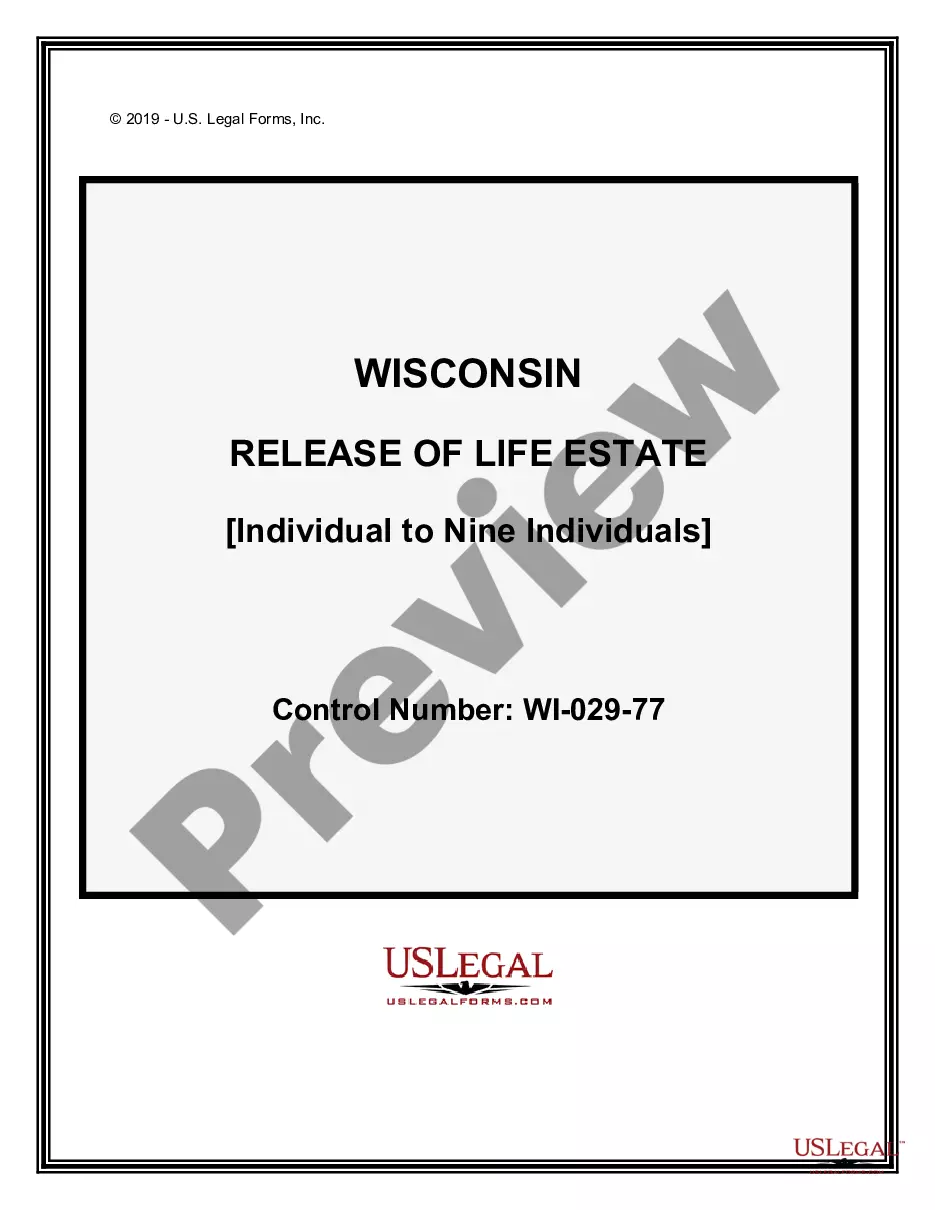
Life Estate Form Wisconsin
Description

Get your form ready online
Our built-in tools help you complete, sign, share, and store your documents in one place.
Make edits, fill in missing information, and update formatting in US Legal Forms—just like you would in MS Word.
Download a copy, print it, send it by email, or mail it via USPS—whatever works best for your next step.
Sign and collect signatures with our SignNow integration. Send to multiple recipients, set reminders, and more. Go Premium to unlock E-Sign.
If this form requires notarization, complete it online through a secure video call—no need to meet a notary in person or wait for an appointment.
We protect your documents and personal data by following strict security and privacy standards.

Make edits, fill in missing information, and update formatting in US Legal Forms—just like you would in MS Word.

Download a copy, print it, send it by email, or mail it via USPS—whatever works best for your next step.

Sign and collect signatures with our SignNow integration. Send to multiple recipients, set reminders, and more. Go Premium to unlock E-Sign.

If this form requires notarization, complete it online through a secure video call—no need to meet a notary in person or wait for an appointment.

We protect your documents and personal data by following strict security and privacy standards.
Looking for another form?


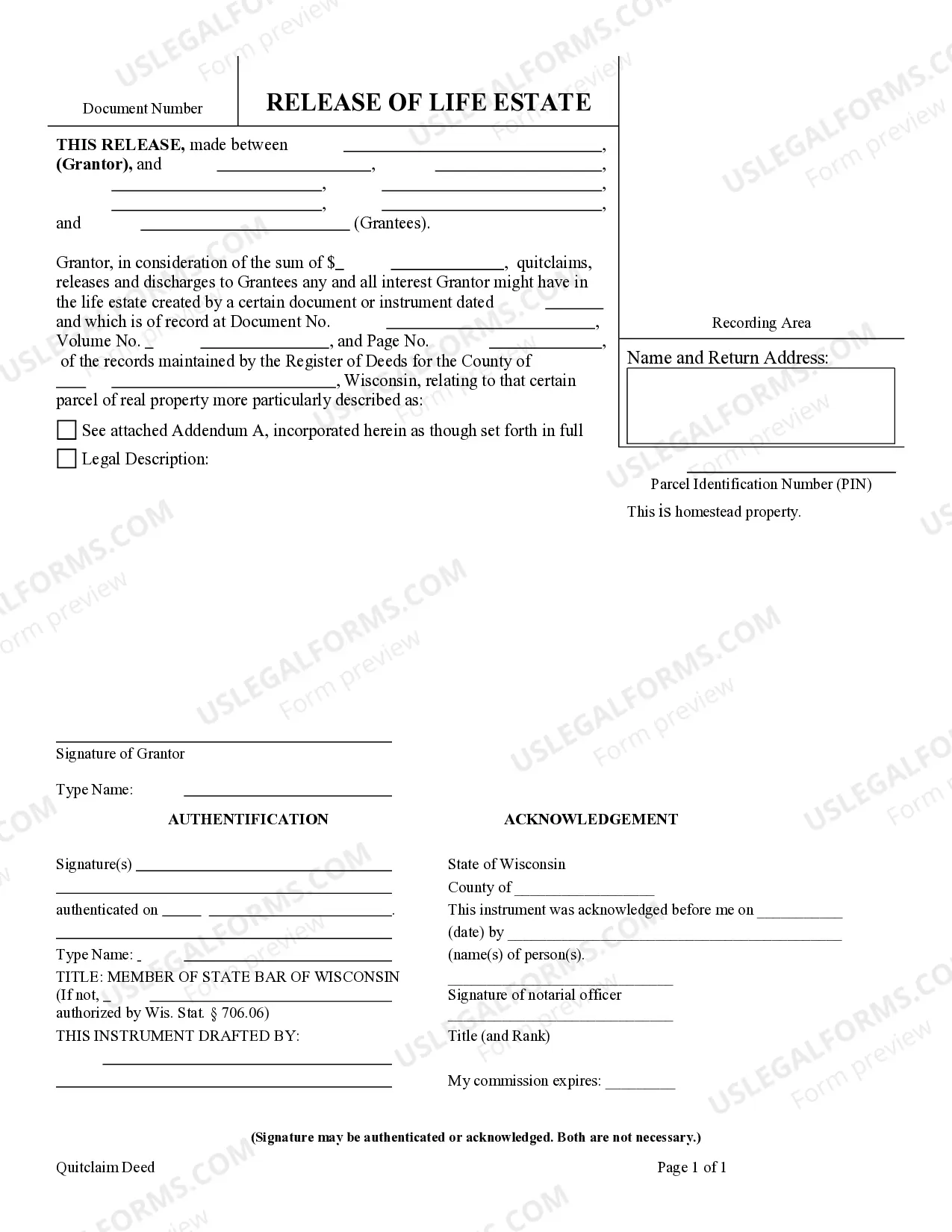
How to fill out Wisconsin Release Deed - Life Estate - Individual To Nine Individuals?
There's no longer a reason to squander hours searching for legal documents to meet your local state regulations.
US Legal Forms has compiled all of them in one location and streamlined their accessibility.
Our platform provides over 85,000 templates for any business and personal legal situations, organized by state and area of application.
Preparing official documents under federal and state laws and regulations is quick and simple with our platform. Try US Legal Forms now to keep your documentation organized!
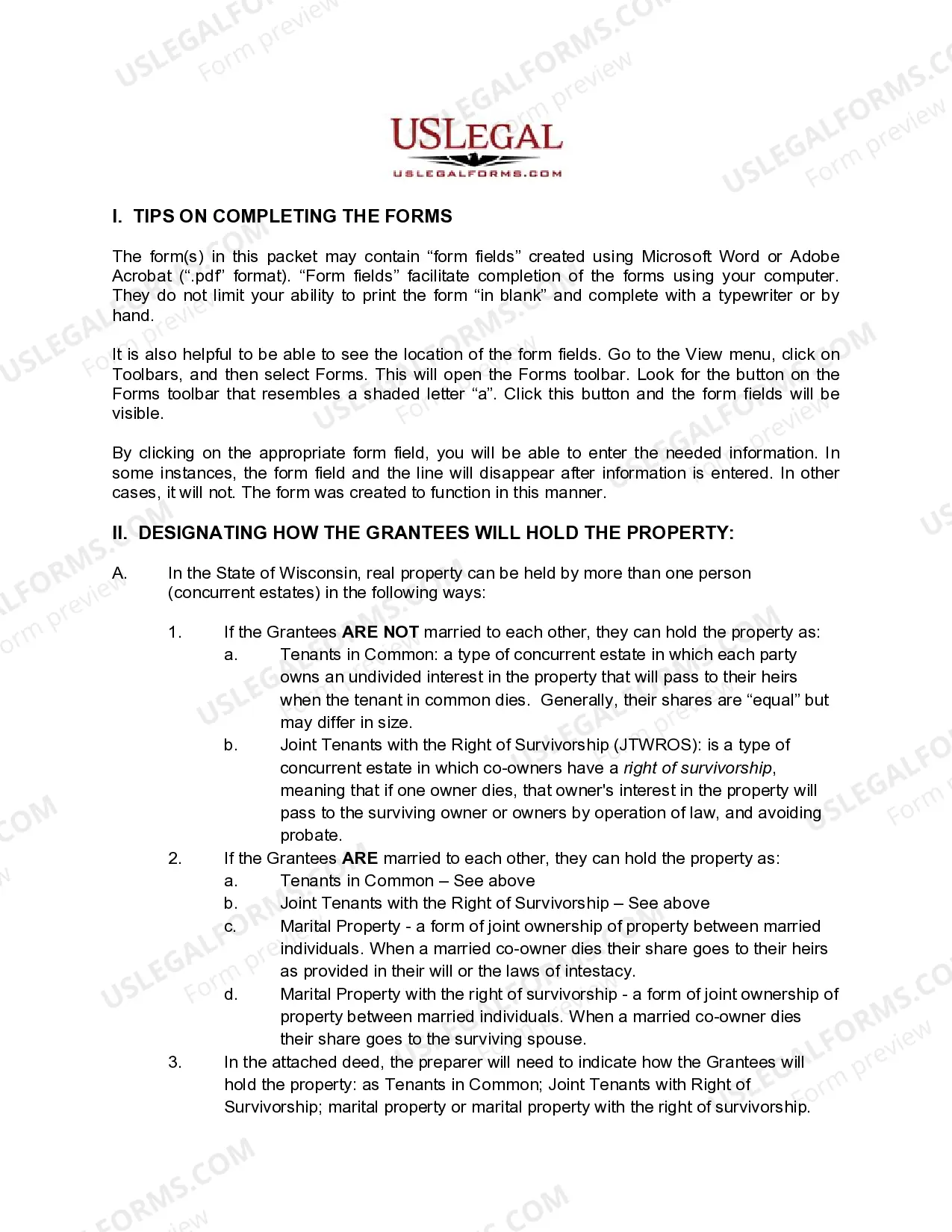
- All forms are professionally prepared and verified for legality, so you can trust in obtaining an up-to-date Life Estate Form for Wisconsin.
- If you are acquainted with our service and already possess an account, ensure your subscription is active before accessing any templates.
- Log In to your account, select the document, and click Download.
- You can also access all previously obtained documents anytime needed by visiting the My documents tab in your profile.
- If you have never used our service before, the process will involve a few extra steps to complete.
- Here's how new users can locate the Life Estate Form for Wisconsin in our library.
- Review the content of the page carefully to ensure it contains the sample you need.
- To do this, utilize the form description and preview options if available.
Form popularity
FAQ
Calculating the value of a life estate in Wisconsin involves determining the property's fair market value and applying a specific formula that accounts for the life tenant's age and life expectancy. This calculation helps in understanding the financial implications of the life estate. If you need assistance with valuation, consider using a life estate form in Wisconsin to gather all necessary details and facilitate the process.
A life estate in Wisconsin allows one person to use a property for their lifetime while designating another person, the remainderman, to receive the property after the life tenant's passing. This arrangement protects the life tenant's residence rights while providing a smooth transition of property upon death. Understanding how a life estate form in Wisconsin functions can help individuals plan their estates more effectively.
To write a life estate, you need to create a legal document that clearly defines the life estate's terms and conditions. This document should include the names of the life tenant and remainderman, along with a description of the property. Using a reliable service like USLegalForms can simplify this process, ensuring your life estate form in Wisconsin is crafted correctly and adheres to state laws.
Yes, you can sell a home in a life estate, but there are important factors to consider. The owner of the life estate has the right to live in the home for their lifetime, but this right does not automatically allow them to fully sell the property. If you are looking to sell a property under a life estate form in Wisconsin, it's essential to consult legal advice to understand the implications and restrictions.
The negatives of a life estate include potential tax implications and restrictions on property use. Life tenants may face issues with property maintenance costs, and any changes to the property usually require approval from the remainderman. Moreover, disputes can arise, particularly regarding the property’s future, making it crucial to communicate clearly when utilizing a life estate form Wisconsin.
To create a life estate in Wisconsin, you need to fill out and file a life estate form Wisconsin with the appropriate land records office. This form should clearly outline the life tenant and the remainderman. It is advisable to consult with a legal professional to ensure the form is completed accurately and meets all state requirements, making the process smooth and legally binding.
A life estate allows individuals to retain rights to a property while ensuring it passes directly to their chosen heirs upon their death. This approach can simplify the estate planning process and avoid probate, making it an attractive option. Many choose a life estate form Wisconsin to maintain control over their property during their lifetime while providing security for their loved ones afterward.
One downside of a life estate is that the life tenant cannot sell or transfer the property without the consent of the remainderman. This restriction can limit your options regarding the property during your lifetime. Additionally, a life estate may complicate your estate planning, as you need to ensure that beneficiaries understand their roles. Using a life estate form Wisconsin can help define these terms clearly.
A life estate generally does not override a will. If you set up a life estate, the property passes according to the terms of the life estate rather than what is stated in your will. Therefore, it is essential to understand how these two legal documents interact when using a life estate form Wisconsin. Consulting with a legal expert can clarify how to align both documents.
In Wisconsin, the person holding the life estate owns the property for the duration of their lifetime. This means you can live in or use the property as you wish. Once the life tenant passes away, the property automatically transfers to the remainderman, who is named in the life estate form Wisconsin. This arrangement allows for clear ownership succession.
