Joint Tenancy In Agreement
Description
Get your form ready online
Our built-in tools help you complete, sign, share, and store your documents in one place.
Make edits, fill in missing information, and update formatting in US Legal Forms—just like you would in MS Word.
Download a copy, print it, send it by email, or mail it via USPS—whatever works best for your next step.
Sign and collect signatures with our SignNow integration. Send to multiple recipients, set reminders, and more. Go Premium to unlock E-Sign.
If this form requires notarization, complete it online through a secure video call—no need to meet a notary in person or wait for an appointment.
We protect your documents and personal data by following strict security and privacy standards.

Make edits, fill in missing information, and update formatting in US Legal Forms—just like you would in MS Word.

Download a copy, print it, send it by email, or mail it via USPS—whatever works best for your next step.

Sign and collect signatures with our SignNow integration. Send to multiple recipients, set reminders, and more. Go Premium to unlock E-Sign.

If this form requires notarization, complete it online through a secure video call—no need to meet a notary in person or wait for an appointment.

We protect your documents and personal data by following strict security and privacy standards.
Looking for another form?




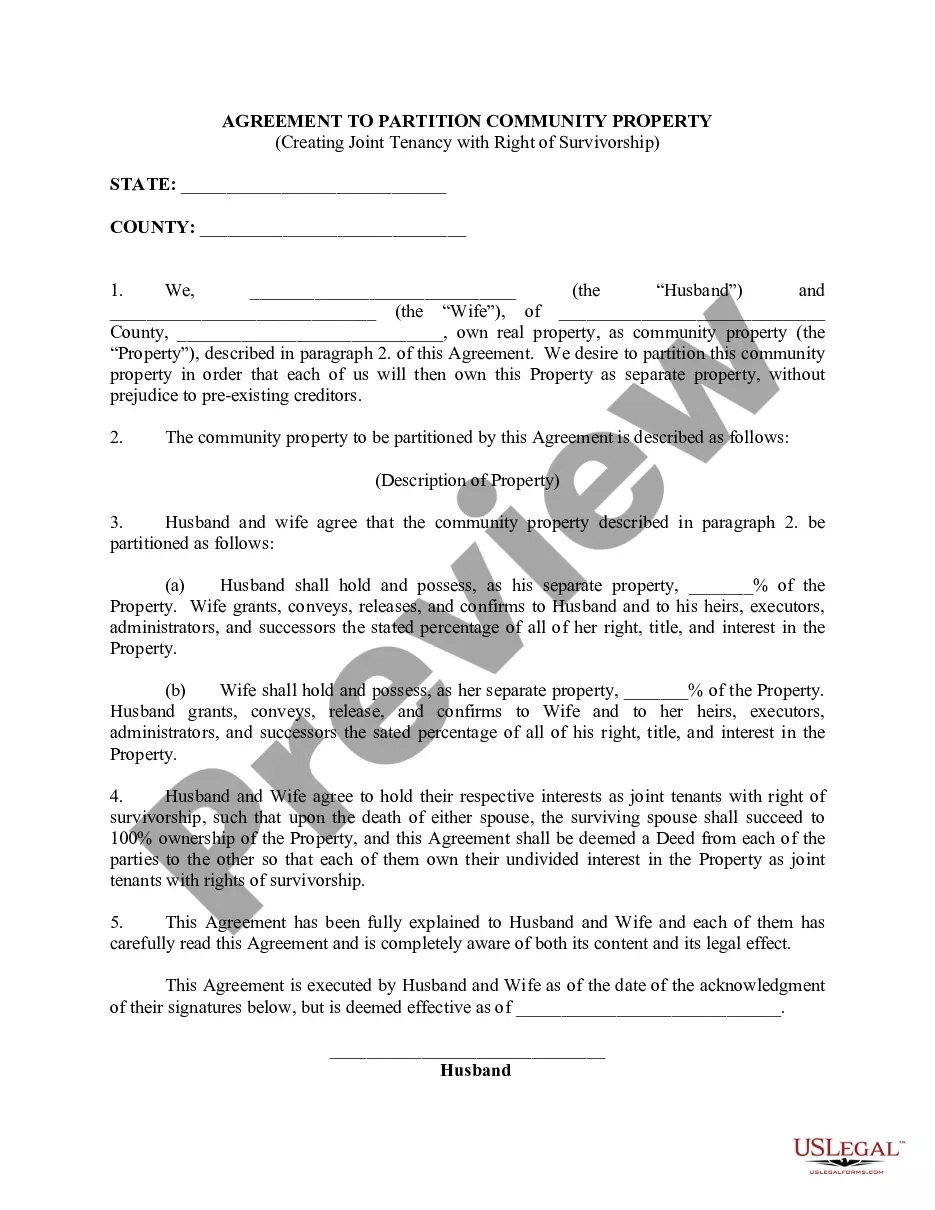
How to fill out Agreement To Partition Community Property Creating Joint Tenancy With Right Of Survivorship?
Whether for business purposes or for individual affairs, everyone has to handle legal situations sooner or later in their life. Completing legal paperwork demands careful attention, starting with choosing the right form template. For instance, when you select a wrong edition of the Joint Tenancy In Agreement, it will be declined when you send it. It is therefore important to have a dependable source of legal documents like US Legal Forms.
If you need to obtain a Joint Tenancy In Agreement template, stick to these easy steps:
- Find the sample you need using the search field or catalog navigation.
- Examine the form’s information to make sure it fits your case, state, and region.
- Click on the form’s preview to examine it.
- If it is the incorrect document, return to the search function to find the Joint Tenancy In Agreement sample you need.
- Get the template if it meets your needs.
- If you already have a US Legal Forms profile, click Log in to access previously saved templates in My Forms.
- If you do not have an account yet, you can download the form by clicking Buy now.
- Select the correct pricing option.
- Finish the profile registration form.
- Choose your payment method: use a bank card or PayPal account.
- Select the file format you want and download the Joint Tenancy In Agreement.
- After it is downloaded, you are able to fill out the form with the help of editing applications or print it and complete it manually.
With a large US Legal Forms catalog at hand, you never need to spend time seeking for the appropriate sample across the web. Take advantage of the library’s easy navigation to get the proper form for any situation.
Form popularity
FAQ
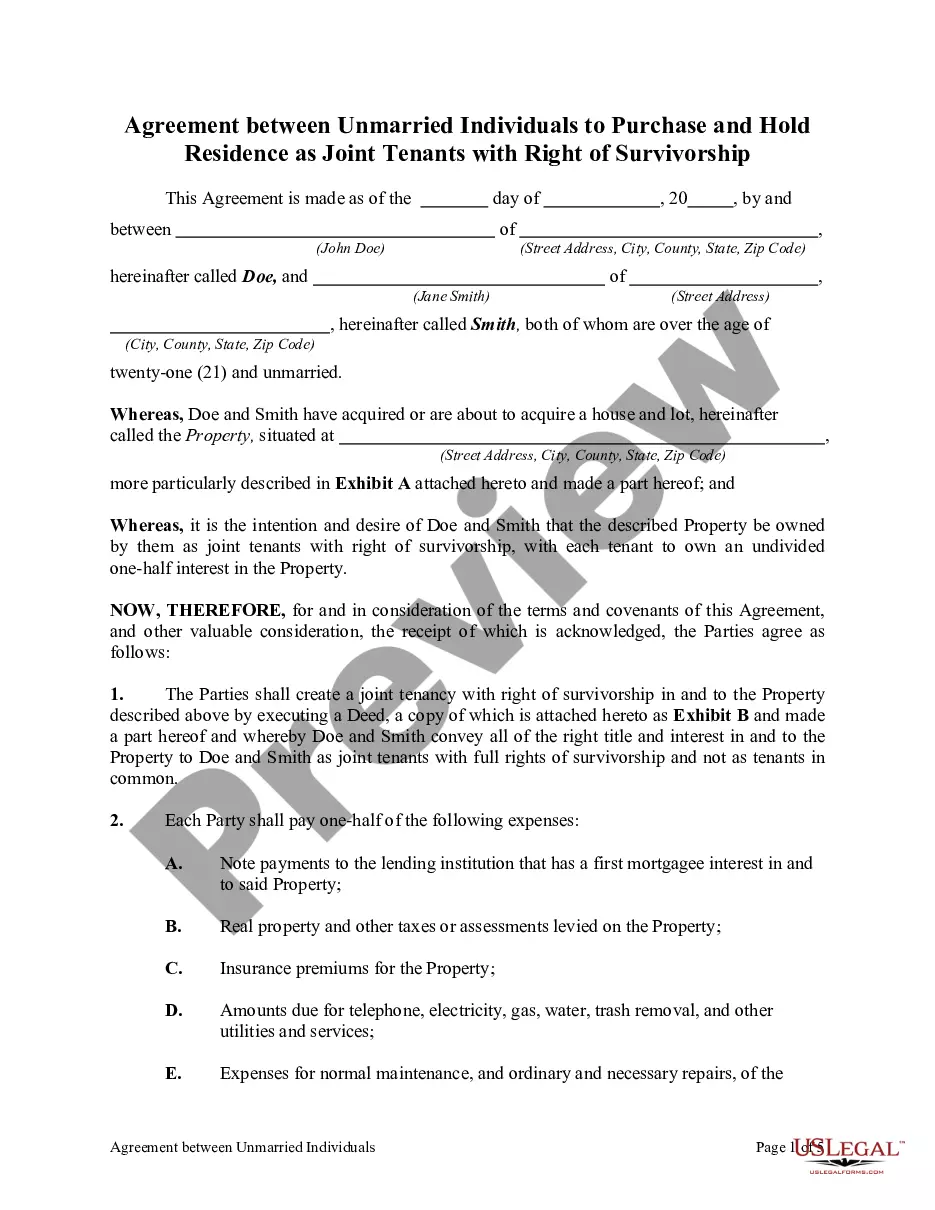
Joint tenancy is a co-ownership arrangement that provides all parties with equal interest in and responsibility for the real estate purchased.
Joint Tenancy Has Some Disadvantages They include: Control Issues. Since every owner has a co-equal share of the asset, any decision must be mutual. You might not be able to sell or mortgage a home if your co-owner does not agree.
The four unities can be thought of as four requirements that need to exist simultaneously for a true joint tenancy estate to be created. Those four requirements are interest, time, title, and possession.
Key Takeaways. Some of the main benefits of joint tenancy include avoiding probate courts, sharing responsibility, and maintaining continuity. The primary pitfalls are the need for agreement, the potential for assets to be frozen, and loss of control over the distribution of assets after death.
Depending on the jurisdiction, the following phrases will create a joint tenancy: "As joint tenants" "As joint tenants with rights of survivorship" "As joint tenants with rights of survivorship and not as tenants in common" "As husband and wife" (unless otherwise stated).