Finding Fact Sample For Estimating A Population Proportion
Description
Get your form ready online
Our built-in tools help you complete, sign, share, and store your documents in one place.
Make edits, fill in missing information, and update formatting in US Legal Forms—just like you would in MS Word.
Download a copy, print it, send it by email, or mail it via USPS—whatever works best for your next step.
Sign and collect signatures with our SignNow integration. Send to multiple recipients, set reminders, and more. Go Premium to unlock E-Sign.
If this form requires notarization, complete it online through a secure video call—no need to meet a notary in person or wait for an appointment.
We protect your documents and personal data by following strict security and privacy standards.

Make edits, fill in missing information, and update formatting in US Legal Forms—just like you would in MS Word.

Download a copy, print it, send it by email, or mail it via USPS—whatever works best for your next step.

Sign and collect signatures with our SignNow integration. Send to multiple recipients, set reminders, and more. Go Premium to unlock E-Sign.

If this form requires notarization, complete it online through a secure video call—no need to meet a notary in person or wait for an appointment.

We protect your documents and personal data by following strict security and privacy standards.
Looking for another form?




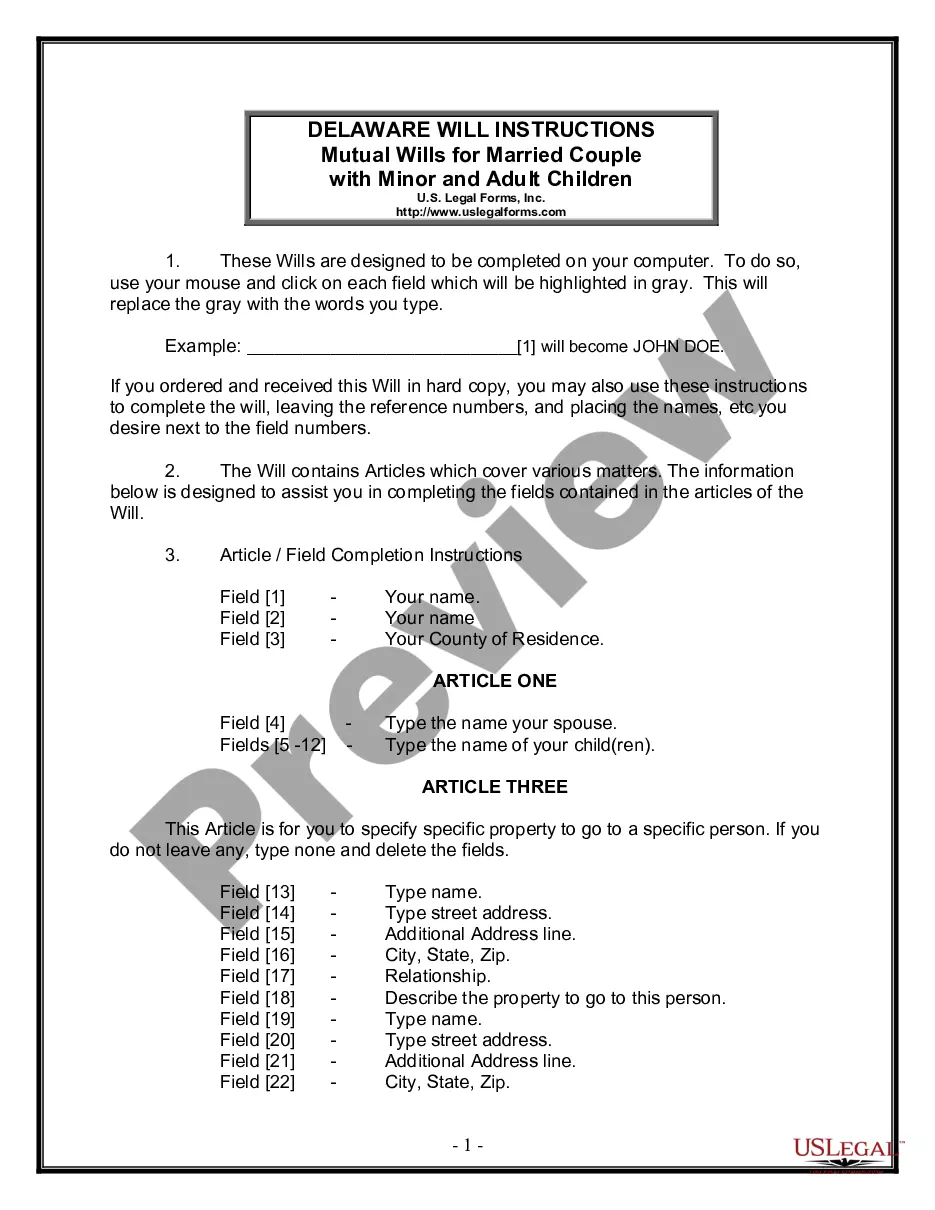




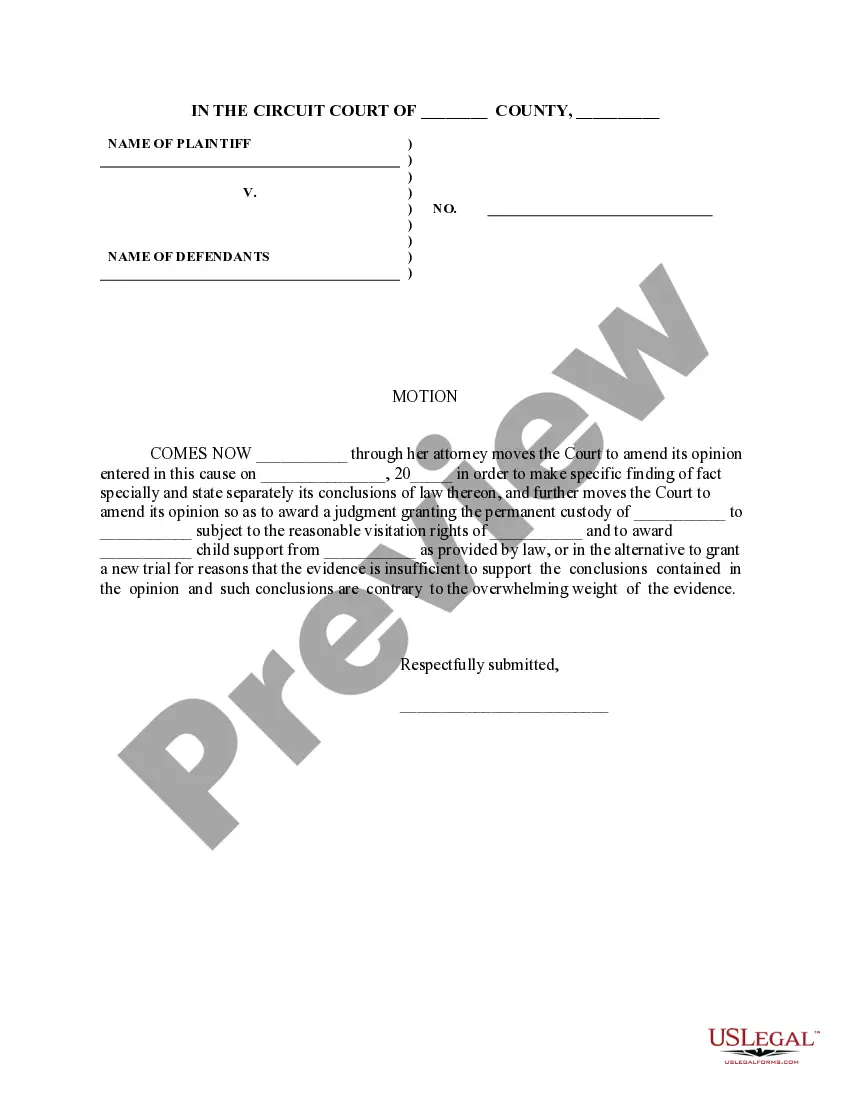
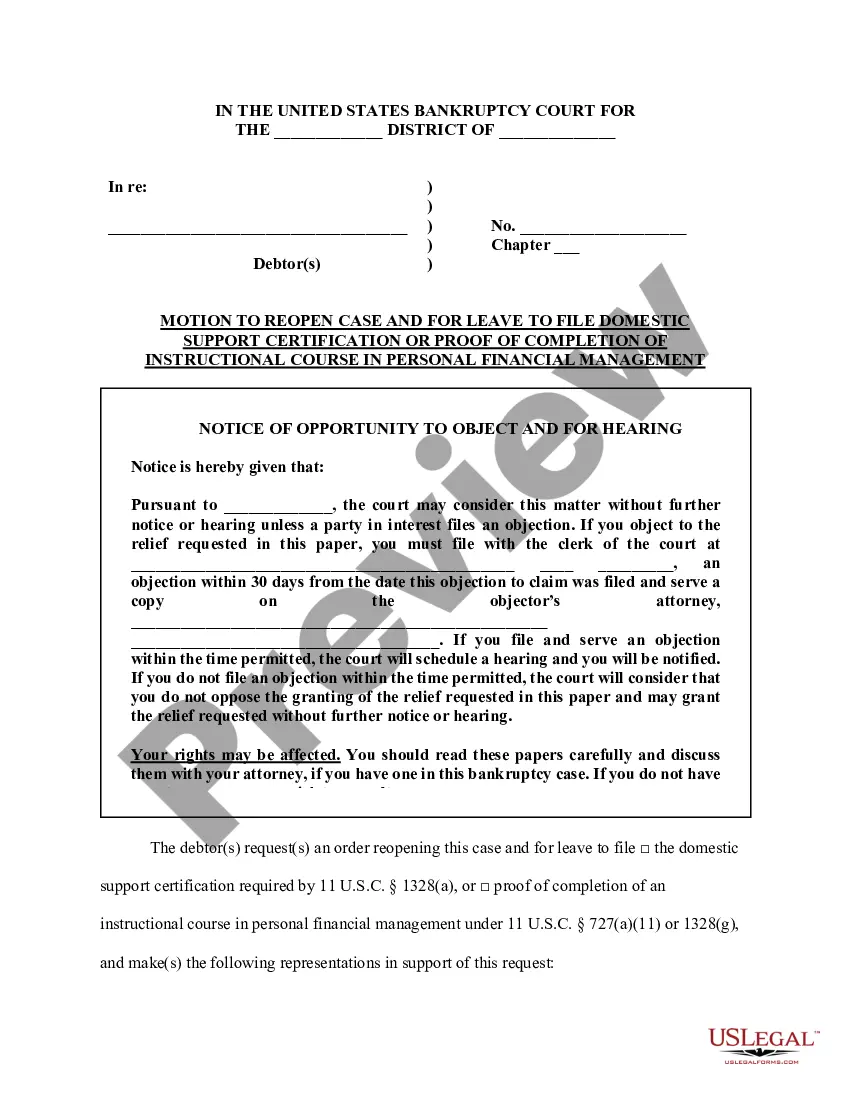
How to fill out Motion To Make Specific Findings Of Fact And State Conclusions Of Law - Domestic Relations?
Accessing legal document examples that adhere to federal and regional laws is crucial, and the internet provides numerous alternatives to consider.
However, what is the benefit of spending time searching for the appropriate Finding Fact Sample For Estimating A Population Proportion document online when the US Legal Forms digital library already consolidates such templates in one location.
US Legal Forms is the largest online legal repository featuring more than 85,000 editable templates created by legal professionals for various business and personal scenarios.
Examine the template using the Preview option or through the text description to confirm it meets your requirements. Search for another sample using the search tool at the top of the page if necessary. When you have located the correct form, click Buy Now and select a subscription plan. Create an account or sign in and complete payment via PayPal or a credit card. Choose the format for your Finding Fact Sample For Estimating A Population Proportion and download it. All templates you find through US Legal Forms are reuseable. To re-download and complete previously saved forms, navigate to the My documents section in your profile. Utilize the most comprehensive and user-friendly legal documentation service!
- They are easy to navigate with all documents categorized by state and intended use.
- Our specialists keep up with legal updates, ensuring your documents remain current and compliant when acquiring a Finding Fact Sample For Estimating A Population Proportion from our site.
- Getting a Finding Fact Sample For Estimating A Population Proportion is straightforward and swift for both existing and new clients.
- If you already hold an account with an active subscription, Log In and download the template you need in the appropriate format.
- If you are unfamiliar with our site, follow the steps below.
Form popularity
FAQ
Finding the mean from a population proportion involves using the proportion to estimate the expected value of a variable based on your sample. You can calculate this by taking the population proportion and multiplying it by the total population size. This process is part of the overall strategy when finding fact samples for estimating a population proportion, helping you derive more precise and reliable results.
To find the sample mean from a population proportion, first, you need to determine the sample size and the number of successes. Then, you can calculate the sample proportion by dividing the number of successes by the sample size. Understanding how to do this is crucial when finding fact samples for estimating a population proportion, as it offers insights into your data and improves accuracy.
The formula for estimating a population proportion involves using the sample proportion as an estimate of the true population proportion. You can calculate this by dividing the number of successes by the total sample size. This method is essential when you are finding fact samples for estimating a population proportion. When done correctly, this helps you make informed decisions based on statistical evidence.
To estimate a population proportion, start by selecting a representative sample from the population. Gather your data and count the number of successful outcomes, followed by calculating the proportion of these successes in relation to your total sample size. This gives you a clear estimate of the population proportion. For additional guidance, consider using US Legal Forms to find fact samples for estimating a population proportion effectively.
Estimating a population proportion begins with collecting data through a sample. You can then calculate the proportion by dividing the number of successes by the total sample size. This sample proportion serves as a point estimate of the actual population proportion. If you're looking for a structured approach, US Legal Forms can help, especially in finding fact samples for estimating a population proportion.
To calculate sample size when estimating a population proportion, you first need to determine the desired level of confidence and the margin of error you can accept. Then, you can use the formula for sample size: n = (Z^2 p (1-p)) / E^2. Here, Z is the Z-value corresponding to your confidence level, p is the estimated proportion, and E is the margin of error. While this formula provides a starting point, using tools like US Legal Forms can streamline the process of finding fact samples for estimating a population proportion.
Estimating population proportion involves calculating the fraction of a specific characteristic within a population based on sample data. This estimation helps in understanding trends, preferences, or behaviors in a community. By analyzing a representative sample, you can infer the characteristics of the entire population. In this context, finding fact sample for estimating a population proportion is a vital process.
To estimate population size from a sample, first determine the total number of individuals in your sample and the proportion that meets your criteria. You can then use this information to extrapolate to the entire population. This method helps in creating a more engaging understanding of demographics. When engaging this process, finding fact sample for estimating a population proportion can enhance accuracy.
Sampling is used to estimate the population because it allows for efficient data collection and analysis. Instead of surveying every individual in a population, a well-chosen sample can yield valuable insights. This method reduces time and costs, making it an ideal choice for researchers. It is particularly useful when finding fact sample for estimating a population proportion.
The sample statistic used to estimate the population proportion is typically the sample proportion itself. This is derived by dividing the number of successes in your sample by the total number of observations. This ratio provides insight into what you might expect in the larger population. You can enhance your analysis by exploring finding fact sample for estimating a population proportion.