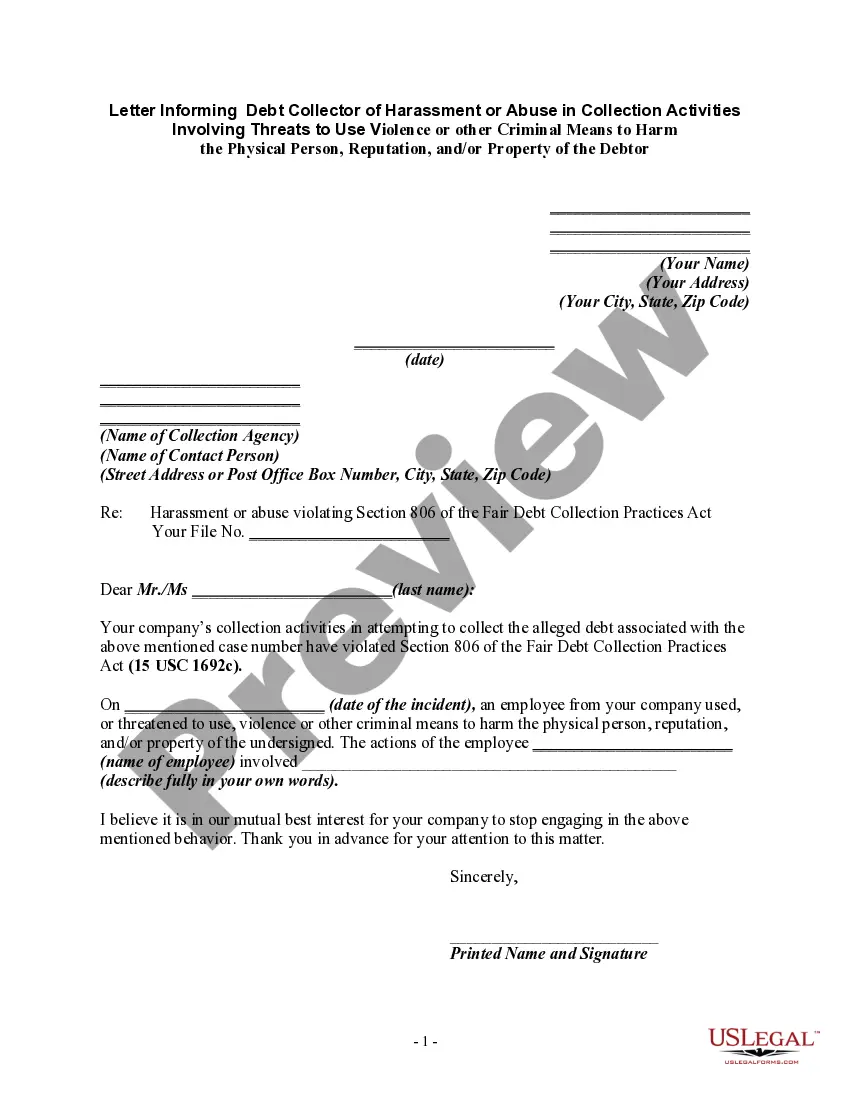
Collector Harassment Involving Withdrawal
Description
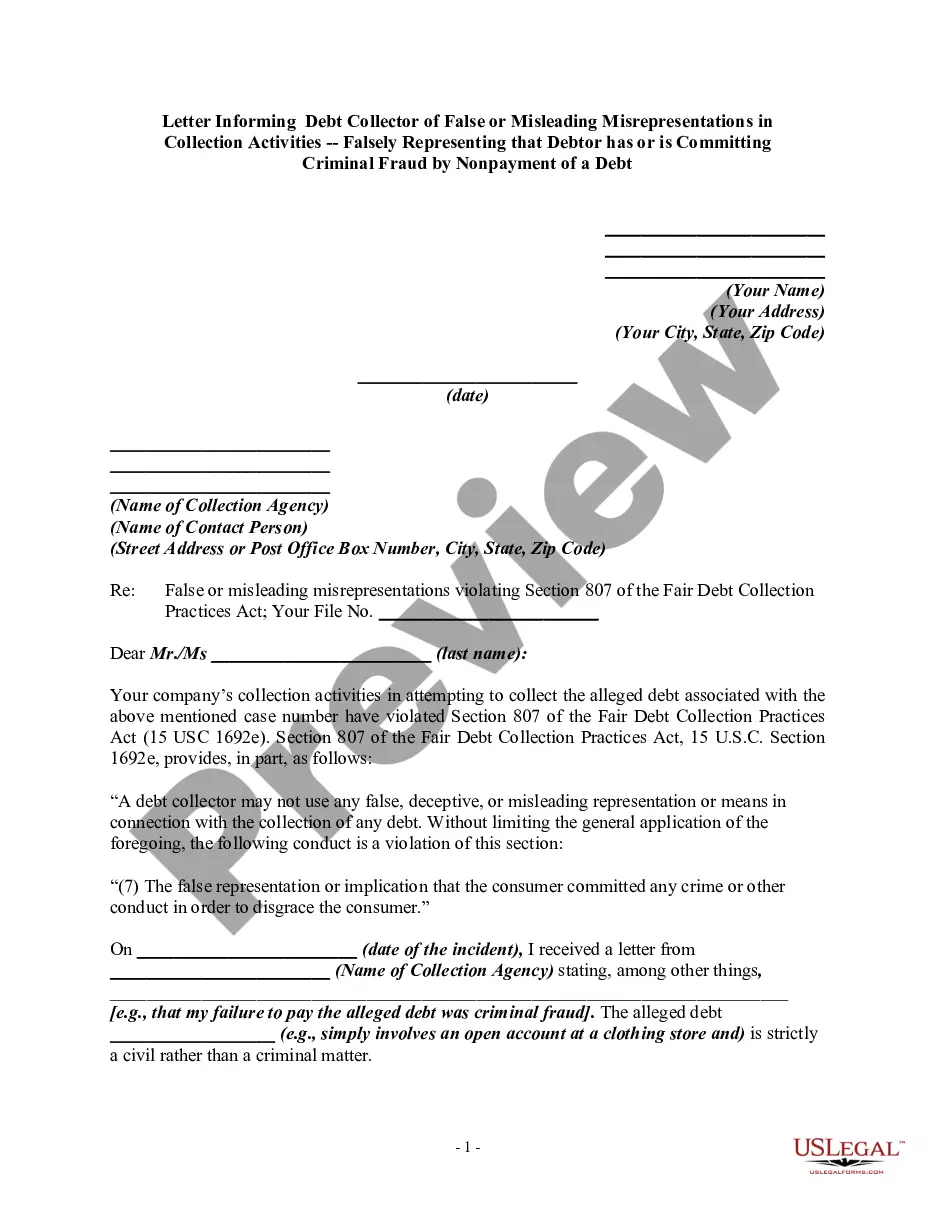
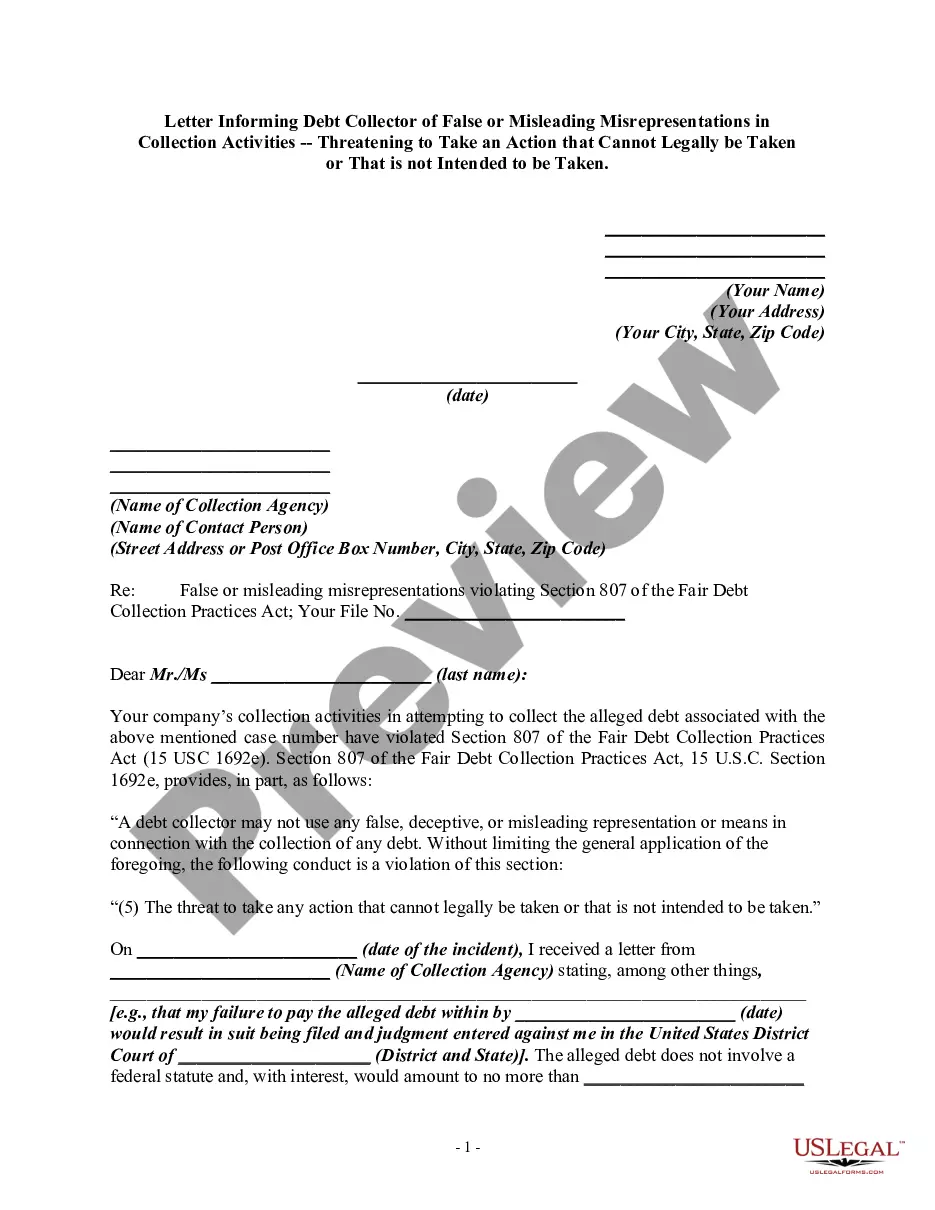
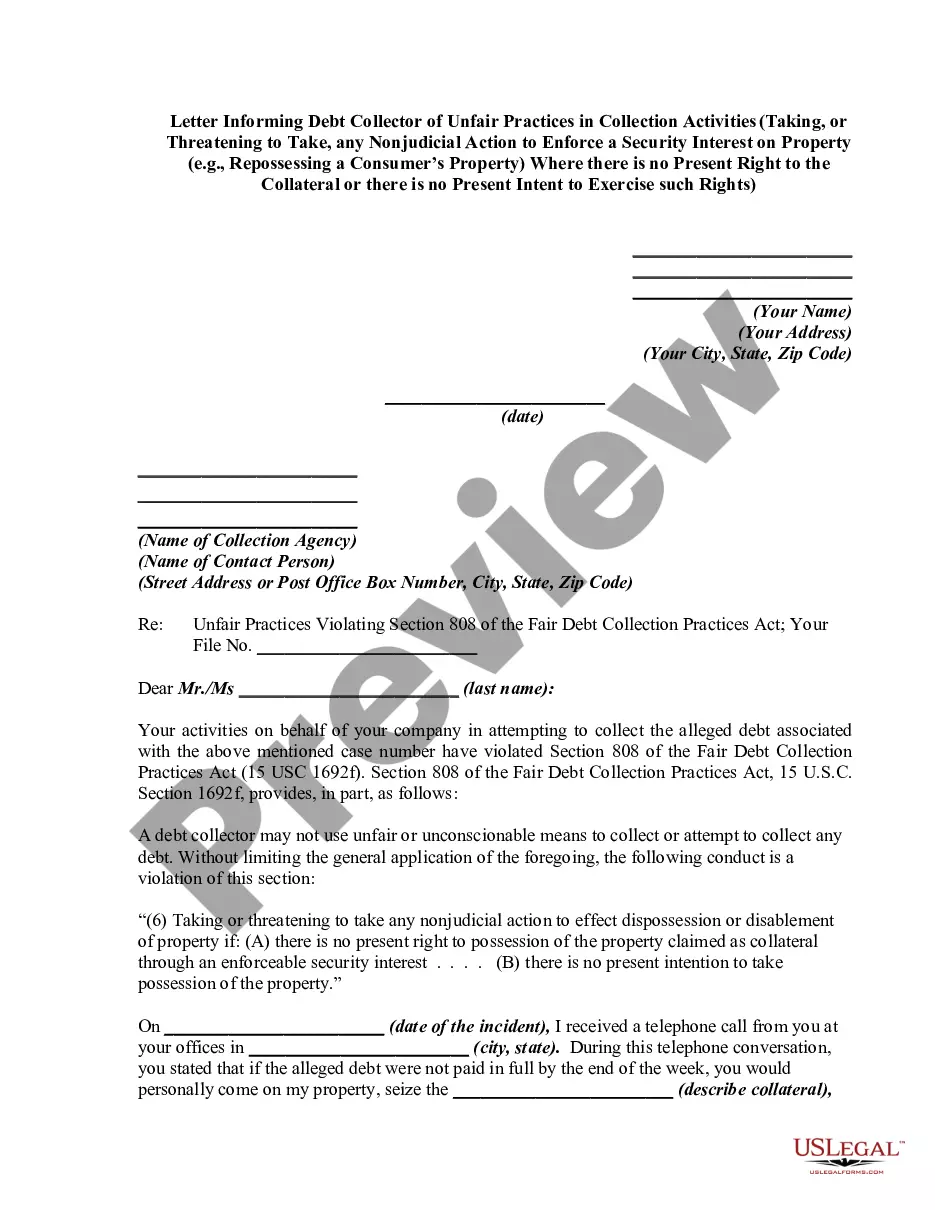
Get your form ready online
Our built-in tools help you complete, sign, share, and store your documents in one place.
Make edits, fill in missing information, and update formatting in US Legal Forms—just like you would in MS Word.
Download a copy, print it, send it by email, or mail it via USPS—whatever works best for your next step.
Sign and collect signatures with our SignNow integration. Send to multiple recipients, set reminders, and more. Go Premium to unlock E-Sign.
If this form requires notarization, complete it online through a secure video call—no need to meet a notary in person or wait for an appointment.
We protect your documents and personal data by following strict security and privacy standards.

Make edits, fill in missing information, and update formatting in US Legal Forms—just like you would in MS Word.

Download a copy, print it, send it by email, or mail it via USPS—whatever works best for your next step.

Sign and collect signatures with our SignNow integration. Send to multiple recipients, set reminders, and more. Go Premium to unlock E-Sign.

If this form requires notarization, complete it online through a secure video call—no need to meet a notary in person or wait for an appointment.

We protect your documents and personal data by following strict security and privacy standards.
Looking for another form?



How to fill out Letter Informing Debt Collector Of Harassment Or Abuse In Collection Activities Involving Threats To Use Violence Or Other Criminal Means To Harm The Physical Person, Reputation, And/or Property Of The Debtor?
Whether for commercial reasons or personal issues, everyone must confront legal circumstances at some point in their lives. Completing legal forms demands meticulous focus, starting from selecting the suitable form example.
For example, if you choose an incorrect version of the Collector Harassment Involving Withdrawal, it will be rejected upon submission. Thus, it is essential to have a trustworthy source of legal documents like US Legal Forms.
With an extensive US Legal Forms catalog available, you don’t have to waste time searching for the appropriate template on the internet. Use the library’s straightforward navigation to find the correct template for any situation.
- Locate the template you require by using the search bar or catalog browsing.
- Review the form’s description to verify that it fits your circumstances, state, and area.
- Click on the form’s preview to view it.
- If it is the incorrect form, return to the search feature to find the Collector Harassment Involving Withdrawal template you need.
- Obtain the document when it aligns with your requirements.
- If you already possess a US Legal Forms account, simply click Log in to access previously saved documents in My documents.
- If you do not yet have an account, you can acquire the form by clicking Buy now.
- Select the appropriate payment option.
- Fill out the account registration form.
- Choose your payment method: use a credit card or PayPal account.
- Select the file format you desire and download the Collector Harassment Involving Withdrawal.
- Once saved, you can fill in the form using editing software or print it out and complete it by hand.
Form popularity
FAQ
The number of calls that constitute harassment can vary, but generally, more than seven calls within a week may be deemed excessive. Continuously receiving calls, especially if they are aggressive or threatening, can be classified as harassment. If you find yourself in this situation, consider documenting each call to support your case. Resources from US Legal Forms can guide you in addressing collector harassment involving withdrawal effectively.
The 777 rule refers to a guideline that limits the number of times a debt collector can contact a debtor within a specific time frame. Under this rule, collectors cannot call more than seven times in a week without violating fair debt collection practices. Understanding this rule can empower you if you face collector harassment involving withdrawal. You can use platforms like US Legal Forms to gain more insights and document your experiences.
Harassment from a debt collector involves aggressive and abusive tactics to collect a debt. This includes threats of violence, using obscene language, or calling at unreasonable hours. Such actions not only violate regulations but also create significant stress for individuals. If you experience collector harassment involving withdrawal, it may be beneficial to seek help from resources like US Legal Forms.
Dealing with collector harassment involving withdrawal requires a strategic approach. First, document every incident, including dates, times, and the nature of the harassment. You can also inform the collector in writing to cease communications, which can help protect your rights. If the harassment continues, consider using platforms like uslegalforms to access legal resources and templates that can assist you in taking formal action.
To successfully sue for collector harassment involving withdrawal, you need to gather evidence that shows the harassment occurred. This can include phone records, written communications, or witness statements that document the behavior of the debt collector. It’s crucial to keep a detailed log of all interactions and any emotional distress caused. By compiling this information, you can strengthen your case and increase your chances of winning.
Making a complaint about a collection agency If you feel that the debt collector you're dealing with isn't respecting your rights, contact the appropriate regulator.
If you are struggling with debt and debt collectors, Farmer & Morris Law, PLLC can help. As soon as you use the 11-word phrase ?please cease and desist all calls and contact with me immediately? to stop the harassment, call us for a free consultation about what you can do to resolve your debt problems for good.
Don't pay, don't promise to pay and don't give any payment information the collector may use later. Ask for information on the debt and say you'll call back to discuss it later. Making a single payment ? even just $5 or $10 ? is an acknowledgment of the debt and can have serious repercussions.
You can also say you'll take legal action if there is any further harassment. You can request the collector only contact you in writing or through your lawyer. They're legally obliged to cooperate. Also, consider sending a written letter outlining your proposal for paying back the debt.
Steps You Can Take to Stop Collection Harassment in Canada Send A Letter. Send the debt collector a written letter which states that you believe they are breaking the law and they should cease doing so immediately. ... Report Harassment to Authorities. ... Get a Lawyer Involved. ... If Possible, Pay Your Debts in Full.