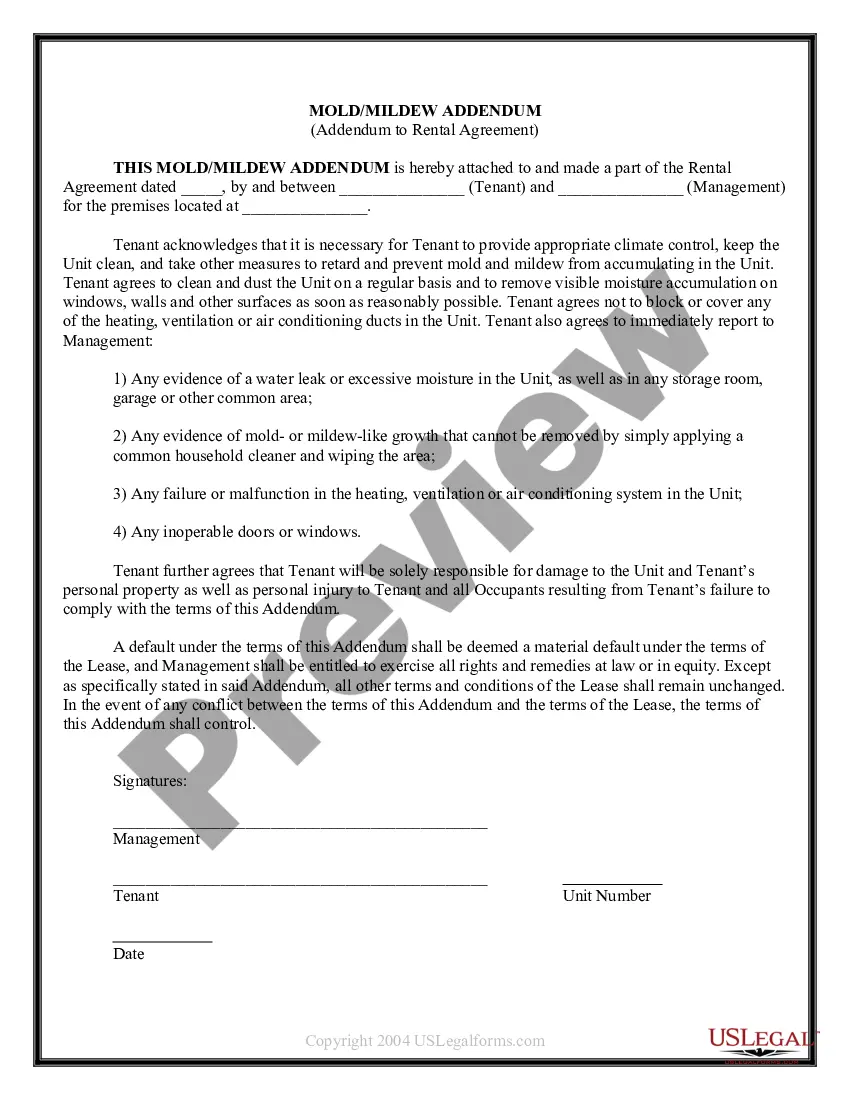
Lease Clause For Mold
Description
Get your form ready online
Our built-in tools help you complete, sign, share, and store your documents in one place.
Make edits, fill in missing information, and update formatting in US Legal Forms—just like you would in MS Word.
Download a copy, print it, send it by email, or mail it via USPS—whatever works best for your next step.
Sign and collect signatures with our SignNow integration. Send to multiple recipients, set reminders, and more. Go Premium to unlock E-Sign.
If this form requires notarization, complete it online through a secure video call—no need to meet a notary in person or wait for an appointment.
We protect your documents and personal data by following strict security and privacy standards.

Make edits, fill in missing information, and update formatting in US Legal Forms—just like you would in MS Word.

Download a copy, print it, send it by email, or mail it via USPS—whatever works best for your next step.

Sign and collect signatures with our SignNow integration. Send to multiple recipients, set reminders, and more. Go Premium to unlock E-Sign.

If this form requires notarization, complete it online through a secure video call—no need to meet a notary in person or wait for an appointment.

We protect your documents and personal data by following strict security and privacy standards.
Looking for another form?








How to fill out Addendum To Apartment Lease Regarding Mold?
It’s obvious that you can’t become a legal expert overnight, nor can you figure out how to quickly prepare Lease Clause For Mold without the need of a specialized background. Creating legal forms is a time-consuming process requiring a specific education and skills. So why not leave the preparation of the Lease Clause For Mold to the pros?
With US Legal Forms, one of the most comprehensive legal document libraries, you can find anything from court paperwork to templates for internal corporate communication. We know how crucial compliance and adherence to federal and local laws and regulations are. That’s why, on our platform, all templates are location specific and up to date.
Here’s how you can get started with our platform and get the form you need in mere minutes:
- Discover the form you need by using the search bar at the top of the page.
- Preview it (if this option available) and read the supporting description to determine whether Lease Clause For Mold is what you’re looking for.
- Begin your search again if you need any other template.
- Register for a free account and choose a subscription plan to purchase the template.
- Choose Buy now. Once the payment is complete, you can get the Lease Clause For Mold, complete it, print it, and send or send it by post to the designated people or entities.
You can re-gain access to your forms from the My Forms tab at any time. If you’re an existing customer, you can simply log in, and find and download the template from the same tab.
No matter the purpose of your documents-be it financial and legal, or personal-our platform has you covered. Try US Legal Forms now!
Form popularity
FAQ
2) Do not withhold rent to get the landlord to make repairs. The law does not allow a tenant to withhold the rent even when the landlord is not making necessary repairs. In fact, if tenants want access to legal remedies, the law requires them to first be current in rent.
If a landlord fails to fix a verified mold or moisture problem, you may file a complaint with the Department of Agriculture, Trade and Consumer Protection (DATCP) by contacting the Consumer Protection Hotline at 800-422-7128.
Give a written request to your landlord for repairs that are needed and keep a copy for your records. It is not recommended that you stop paying rent. The Tennessee Department of Health does not have authority to inspect and require landlords to address mold issues in rental property.
If the mold damage is located in your living room, kitchen or the bathroom, the experts will recommend you to find alternative lodging for the time being. Also, if you have infants and elderly people at home or have family members with a weak immune system, you should probably leave your home for a while.
Informing your landlord about a mold problem doesn't have to be a scary ordeal (depending on your landlord, of course). First, let them know that you've spotted a potential mold problem. If there's an obvious cause, like a burst pipe, let them know that too. Ask them how they'd like to handle it.