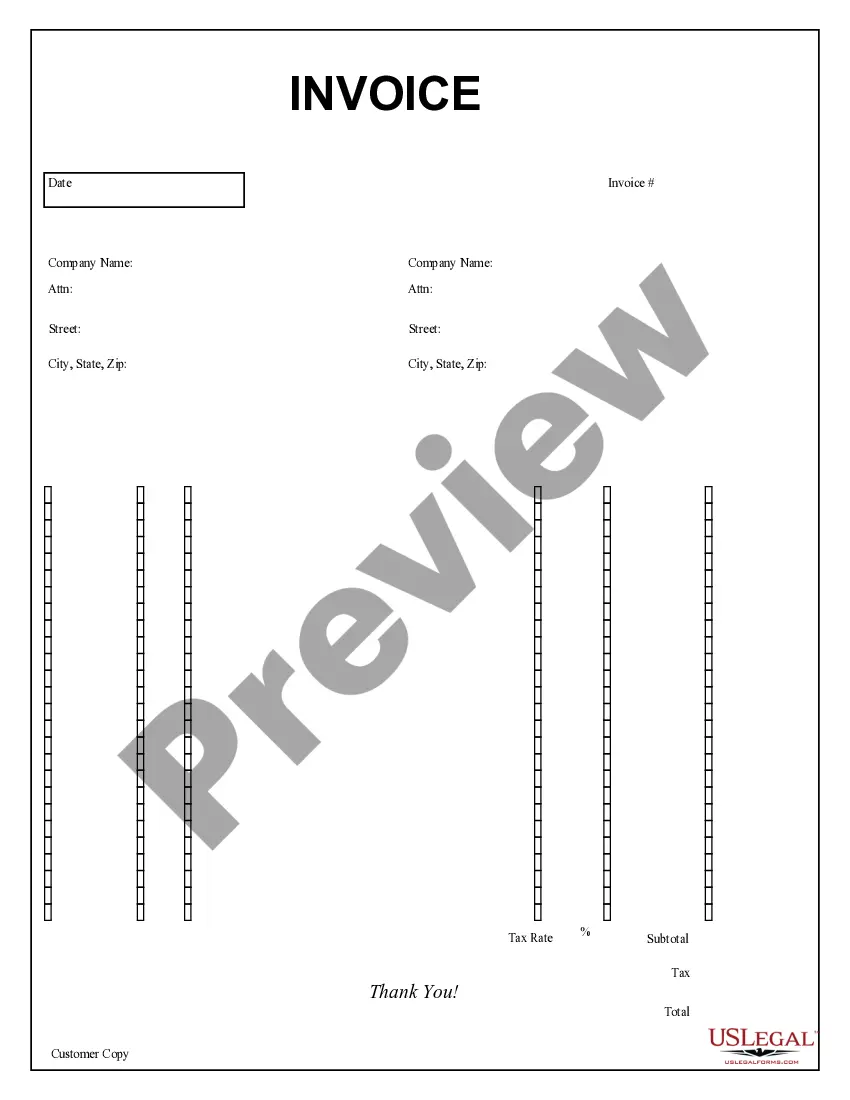
Example Of Invoice With Reverse Charge
Description
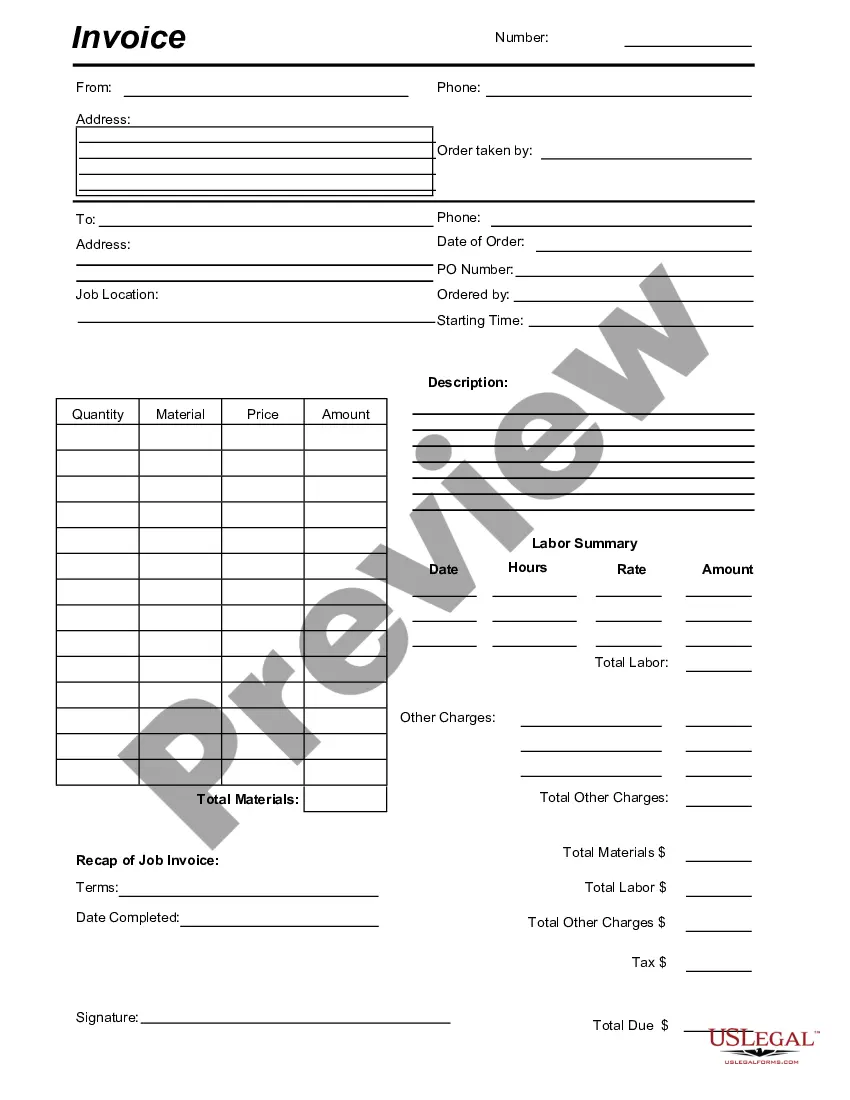

How to fill out Purchase Invoice?
The Sample Invoice Featuring Reverse Charge displayed on this page is a versatile legal document crafted by experienced attorneys in accordance with national and regional statutes and regulations.
For over 25 years, US Legal Forms has supplied individuals, companies, and legal experts with more than 85,000 validated, state-specific documents for various business and personal needs.
Redownload your documents as needed. Access the My documents tab in your account to retrieve any previously downloaded forms.
- Conduct a search for the document you require and examine it.
- Browse the sample you sought and view it or review the document description to confirm it meets your criteria. If it doesn’t, utilize the search feature to find the suitable one. Click Buy Now once you locate the template you need.
- Select a subscription plan that fits your needs and create an account. Use PayPal or a credit card for immediate payment. If you already possess an account, Log In and confirm your subscription to continue.
- Obtain the editable template. Select the format you prefer for your Sample Invoice Featuring Reverse Charge (PDF, DOCX, RTF) and download the document to your device.
- Complete and sign the document. Print the template to fill it out manually. Alternatively, employ an online multifunctional PDF editor to quickly and correctly complete and endorse your form with a legally binding electronic signature.
Form popularity
FAQ
To effectively show an RCM invoice, start by listing all items or services provided, followed by a distinct section indicating the reverse charge details. Include a reference that clearly states the application of the reverse charge mechanism. By using an example of an invoice with reverse charge, you can guide your client on how to properly account for the tax that they need to handle. Using platforms like US Legal Forms can help you generate compliant invoices easily.
When you create an invoice with reverse charge, it is crucial to clearly state that RCM applies. You should include a line on the invoice that specifies the reverse charge mechanism. This informs your clients about their responsibility for the tax under this arrangement. A well-structured example of an invoice with reverse charge will prevent confusion and ensure compliance with tax regulations.
Invoicing rules require that every invoice must contain essential details such as the invoice number, date, and a description of goods or services provided. When creating an invoice with reverse charge, clear communication of tax responsibilities is vital. Additionally, including payment terms and tracking information enhances clarity for both parties. US Legal Forms provides customizable templates to help you create compliant and professional invoices effortlessly.
In the context of reverse charge mechanism (RCM), the recipient of goods or services is responsible for paying the applicable tax. To illustrate, an example of invoice with reverse charge should clearly indicate the details of the supply, including the GST amount the recipient must self-assess. It's crucial to include both the supplier's and recipient's information, along with mention of RCM. Using a reliable platform like US Legal Forms can help ensure your invoices comply with the latest regulations.
CIS domestic reverse charge VAT invoices must include the following information: Your business name, address, and VAT number (VRN) The buyer's name, address, and VAT number (VRN) A unique invoice number. The invoice issue date and the date of supply. The description, quantity, and net price of each product or service.
To comply with the DRC regulation, you need to manually add it to your invoice. To do this, you can: Add it to the Description field of an otherwise empty line item on the invoice. Set it as the default sales description of an inventory item, then add the inventory item to your DRC invoice.
Reverse charge VAT invoices must generally also include the following details: The applicable VAT amount or rate (there may be different rates for different items) Address of the provider. Valid VAT identification numbers of both the provider and the customers.
A domestic reverse charge invoice should include all of the mandatory fields found on a VAT invoice. This includes your business information and the customer's information, an invoice number, a description of the services, and a breakdown of the VAT due.
DRC is about what you, as a subcontractor, show on your invoices. Under DRC, your invoice should show 0% VAT ? and this applies to materials, travel etc, not just to labour. On your invoice, you must also state that ?Domestic Reverse Charge applies to this invoice and the VAT would be £X? ? or something similar.