Indemnity Clause With Cap
Description
Get your form ready online
Our built-in tools help you complete, sign, share, and store your documents in one place.
Make edits, fill in missing information, and update formatting in US Legal Forms—just like you would in MS Word.
Download a copy, print it, send it by email, or mail it via USPS—whatever works best for your next step.
Sign and collect signatures with our SignNow integration. Send to multiple recipients, set reminders, and more. Go Premium to unlock E-Sign.
If this form requires notarization, complete it online through a secure video call—no need to meet a notary in person or wait for an appointment.
We protect your documents and personal data by following strict security and privacy standards.

Make edits, fill in missing information, and update formatting in US Legal Forms—just like you would in MS Word.

Download a copy, print it, send it by email, or mail it via USPS—whatever works best for your next step.

Sign and collect signatures with our SignNow integration. Send to multiple recipients, set reminders, and more. Go Premium to unlock E-Sign.

If this form requires notarization, complete it online through a secure video call—no need to meet a notary in person or wait for an appointment.

We protect your documents and personal data by following strict security and privacy standards.
Looking for another form?


How to fill out Indemnification Agreement For A Trust?
It’s well-known that you can’t become a legal expert instantly, nor can you understand how to swiftly draft an Indemnity Clause With Cap without a specialized background.
Drafting legal documents is a lengthy procedure that necessitates specific training and abilities.
So why not entrust the composition of the Indemnity Clause With Cap to the professionals.
You can regain access to your forms from the My documents tab at any time.
If you’re an existing customer, you can simply Log In, and find and download the template from the same tab.
- Locate the form you require using the search bar at the top of the page.
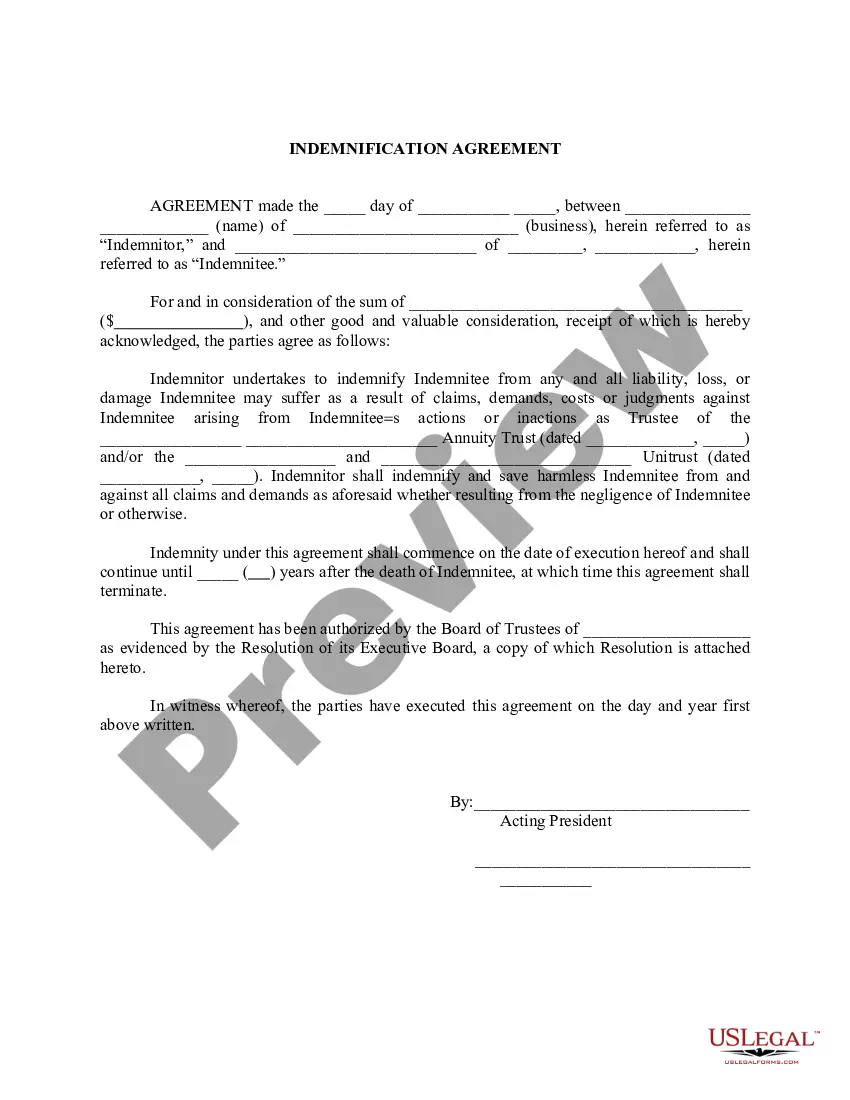
- View it (if this option is available) and read the accompanying description to ascertain whether Indemnity Clause With Cap is what you need.
- Start your search anew if you require a different template.
- Create a free account and select a subscription plan to purchase the form.
- Select Buy now. Once the transaction is complete, you can obtain the Indemnity Clause With Cap, complete it, print it, and deliver it by mail to the relevant parties or organizations.
Form popularity
FAQ
Yes, you can put a cap on an indemnity by clearly stating the limit in the indemnity clause. This practice helps clarify financial responsibilities and protect against unexpected claims. By doing so, you can create a more secure contract that benefits all parties involved.
The rule of indemnity in insurance ensures that an insured party is compensated for their loss but not allowed to profit from it. Essentially, it means that you can recover your losses but not exceed the actual damage incurred. This principle is crucial for maintaining fairness and preventing fraud within the insurance industry.
Capping indemnity involves specifying a maximum liability amount within the indemnity clause. You can achieve this by drafting language that explicitly states the cap in the agreement. This practice helps prevent unforeseen financial burdens and provides clarity for all parties involved in the contract.
To invoke an indemnity clause, the injured party must typically provide written notice to the indemnifying party. This notice should outline the nature of the claim and the basis for indemnification. Following this, the indemnifying party can take appropriate action, which might include settling the claim or defending against it under the terms of the indemnity clause with cap.
Yes, capping indemnification is often a wise decision. It allows businesses to mitigate potential losses in case of claims or lawsuits. By implementing an indemnity clause with cap, you can establish a clear limit on your financial exposure. This strategy helps create a balanced risk management approach.
To limit an indemnification clause, you can establish specific conditions under which indemnity applies and set a maximum liability amount. Clearly define the scope of indemnity, specifying which types of claims are covered. Including a cap on the total monetary liability helps control financial exposure. A well-structured indemnity clause with cap can offer balanced protection for all parties involved.
Writing an indemnity clause requires careful consideration of the terms and conditions that will govern liability. Start by defining the parties involved and the circumstances under which indemnity applies. Next, specify any limits, such as a cap on the amount of liability. A clear and concise indemnity clause with cap protects both parties and minimizes risks, ensuring smoother contractual relationships.
Filling out an indemnity agreement involves specifying the parties involved, the scope of indemnity, and any limitations, such as a cap on liability. You should clearly outline the situations that trigger indemnity and include definitions for terms used throughout the document. This clarity helps prevent misunderstandings and disputes. Platforms like uslegalforms can provide templates and guidance for creating a comprehensive indemnity clause with cap.
A capped indemnity refers to a specific type of indemnity clause with cap that limits the amount one party can claim from another in the event of a loss or damage. This clause provides a safety net by setting a maximum limit on liability, which helps parties manage risk effectively. It is commonly used in contracts to ensure that potential expenses do not exceed a predetermined amount. By understanding capped indemnity, you can negotiate better terms and protect your interests.