Student Letter Of Recommendation
Description
Get your form ready online
Our built-in tools help you complete, sign, share, and store your documents in one place.
Make edits, fill in missing information, and update formatting in US Legal Forms—just like you would in MS Word.
Download a copy, print it, send it by email, or mail it via USPS—whatever works best for your next step.
Sign and collect signatures with our SignNow integration. Send to multiple recipients, set reminders, and more. Go Premium to unlock E-Sign.
If this form requires notarization, complete it online through a secure video call—no need to meet a notary in person or wait for an appointment.
We protect your documents and personal data by following strict security and privacy standards.

Make edits, fill in missing information, and update formatting in US Legal Forms—just like you would in MS Word.

Download a copy, print it, send it by email, or mail it via USPS—whatever works best for your next step.

Sign and collect signatures with our SignNow integration. Send to multiple recipients, set reminders, and more. Go Premium to unlock E-Sign.

If this form requires notarization, complete it online through a secure video call—no need to meet a notary in person or wait for an appointment.

We protect your documents and personal data by following strict security and privacy standards.
Looking for another form?

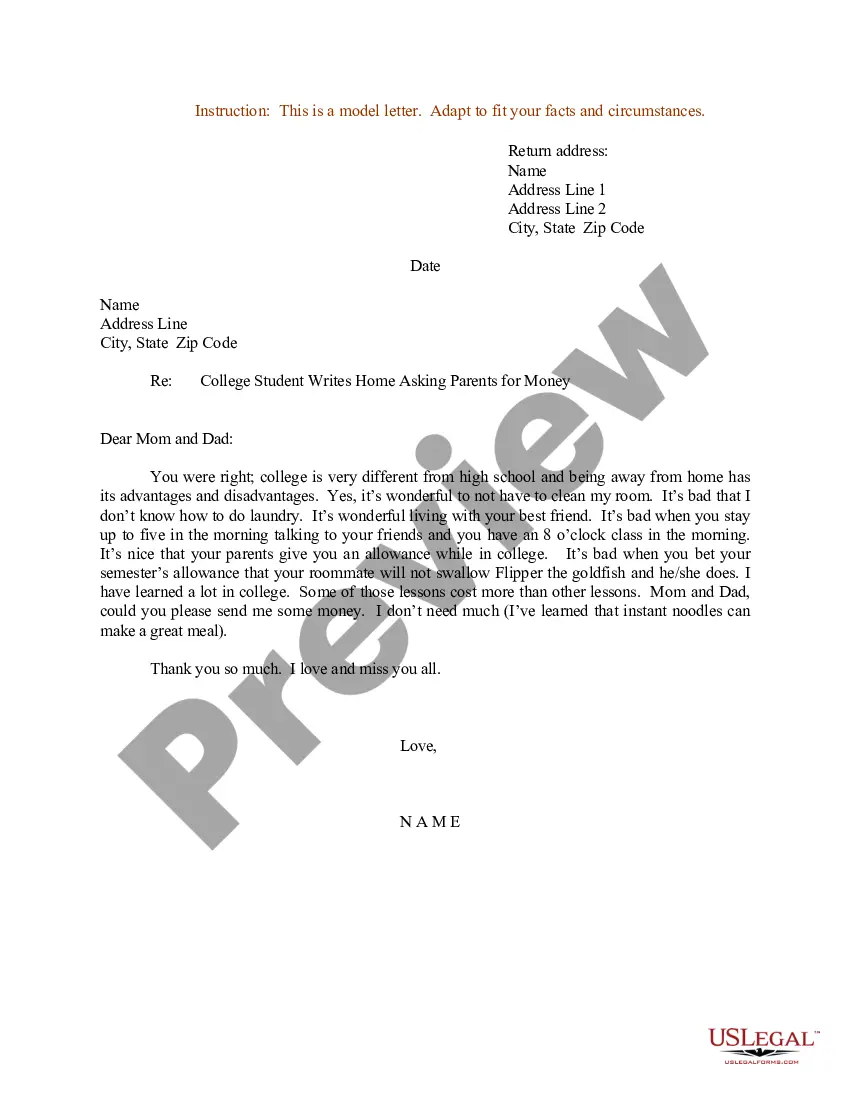
How to fill out Sample Letter For College Student Requesting Parents To Send Money?
Regardless of whether it's for professional objectives or individual concerns, everyone must confront legal matters at some point in their lives.
Completing legal documents demands meticulous care, beginning with choosing the suitable form template.
With an extensive US Legal Forms catalog available, you do not have to waste time searching for the right template online. Use the library's easy navigation to find the correct form for any circumstance.
- Locate the template you require by using the search option or browsing the catalog.
- Review the form's details to ensure it aligns with your situation, state, and county.
- Select the form's preview to examine it.
- If it is the incorrect document, return to the search feature to find the Student Letter Of Recommendation template you need.
- Obtain the template when it satisfies your requirements.
- If you possess a US Legal Forms account, simply click Log in to access previously saved templates in My documents.
- If you have not created an account yet, you can acquire the form by clicking Buy now.
- Select the appropriate pricing option.
- Fill out the profile registration form.
- Choose your payment method: either a credit card or PayPal account.
- Pick the document format you prefer and download the Student Letter Of Recommendation.
- Once it's downloaded, you can complete the form using editing software or print it and finish it by hand.
Form popularity
FAQ
(If you don't know the student well, and don't have much to say, add a short paragraph explaining what the course is and why it's good that the student excelled in it. This won't fool most people, but will soften the blow of a short letter.) However, don't ramble: make it succinct and to the point.
How to write an academic recommendation letter Address the letter. Include a brief introduction. Outline the student's qualifications. Describe a time that the student impressed you. End the letter with a particular endorsement. Provide your contact information.
Keep it concise. Summarize in one sentence how you know the student, identify their strengths, and provide 1-2 examples or stories. Use concrete examples, not generalizations. Tell stories that illustrate the student's character.
A letter of recommendation for a student should describe their positive qualities, including their academic achievements, interpersonal skills, work ethic, and character. To be effective, the letter should focus on skills and qualifications that are most valuable in the job or program for which the student is applying.
The format typically consists of 1) the letterhead and full contact information, 2) a salutation, 3) an introduction, 4) an overview, 5) a personal story, 6) a closing sentence and 7) your signature. The three types of recommendation letters are employment, academic, and character recommendation letters.