Survivorship
Description

Get your form ready online
Our built-in tools help you complete, sign, share, and store your documents in one place.
Make edits, fill in missing information, and update formatting in US Legal Forms—just like you would in MS Word.
Download a copy, print it, send it by email, or mail it via USPS—whatever works best for your next step.
Sign and collect signatures with our SignNow integration. Send to multiple recipients, set reminders, and more. Go Premium to unlock E-Sign.
If this form requires notarization, complete it online through a secure video call—no need to meet a notary in person or wait for an appointment.
We protect your documents and personal data by following strict security and privacy standards.

Make edits, fill in missing information, and update formatting in US Legal Forms—just like you would in MS Word.

Download a copy, print it, send it by email, or mail it via USPS—whatever works best for your next step.

Sign and collect signatures with our SignNow integration. Send to multiple recipients, set reminders, and more. Go Premium to unlock E-Sign.

If this form requires notarization, complete it online through a secure video call—no need to meet a notary in person or wait for an appointment.

We protect your documents and personal data by following strict security and privacy standards.
Looking for another form?







How to fill out Survivorship Affidavit?
- If you're an existing user, log into your account to access and download your required form template by clicking on the Download button. Ensure your subscription is active; if not, renew it based on your selected plan.
- For new users, first, view the Preview mode and form descriptions of various templates. Confirm that the document aligns with your needs and complies with your local jurisdiction.
- If necessary, search for additional templates by utilizing the Search tab at the top of the page. Once you find the correct document, proceed to the next step.
- Purchase the form by clicking the Buy Now button and choosing your desired subscription plan. You'll need to create an account to access the library.
- Complete your transaction by entering your credit card information or using PayPal for payment.
- Download your selected form and save it to your device. You can access it anytime under the My Forms section in your profile.
By following these steps, you can efficiently secure the legal documents you need concerning survivorship. US Legal Forms provides users with a robust collection of over 85,000 forms, alongside access to premium expert assistance, ensuring your documents are accurate and legally compliant.
Don't hesitate to start your journey with US Legal Forms today to simplify your legal form needs!
Form popularity
FAQ
In legal terms, survivorship describes the right of a surviving co-owner to inherit property automatically after the death of a joint owner. This concept is commonly implemented in joint tenancies and community property arrangements. In these cases, property does not become part of the deceased owner's estate, making the transition smoother for the surviving owner. Understanding this concept can empower you to manage your assets effectively.
Survivorship refers to the legal concept in which the surviving owners of a property gain full ownership when one owner dies. This principle is vital in contexts like joint ownership where multiple parties share rights to an asset. By enabling the direct transfer of ownership, survivorship eliminates unnecessary delays and complications. As a result, it offers peace of mind knowing your assets are secure.
Survivorship offers several benefits, primarily the seamless transfer of assets upon death. This process avoids the lengthy probate proceedings, ensuring that surviving owners retain control over the property right away. Additionally, survivorship can help minimize estate taxes and provide clarity in asset distribution. Overall, embracing survivorship can simplify asset management for you and your family.
The rule of survivorship is a legal principle that ensures property automatically passes to a surviving co-owner upon the death of the other. This rule is commonly associated with joint tenancy, where two or more individuals own a property together. The surviving co-owner immediately gains full ownership without going through probate. Therefore, understanding the rule of survivorship can help you make informed decisions about your estate.
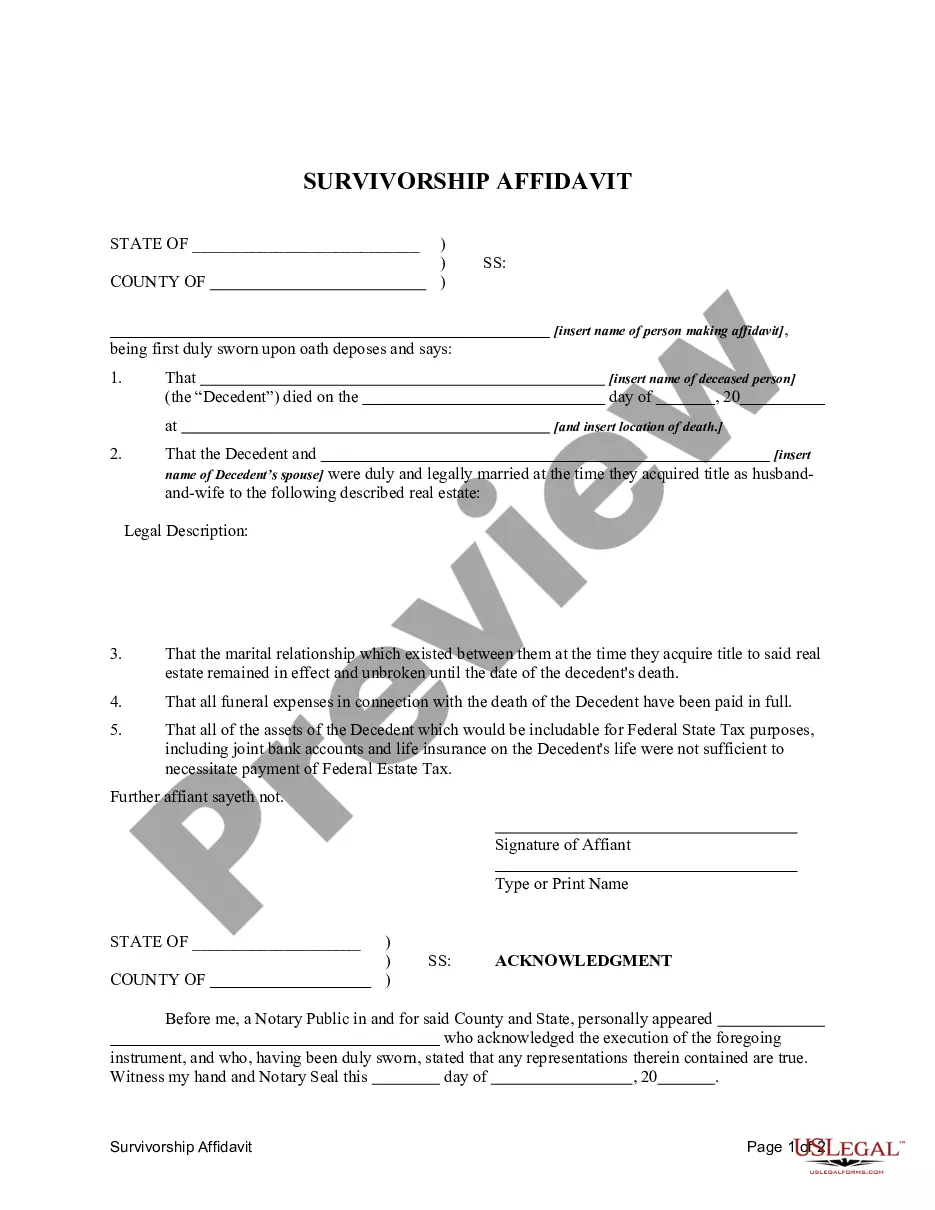
To fill out a survivorship affidavit, start by entering your name and the deceased person's details at the beginning of the document. Provide specific information about the property in question, stating that you are the surviving owner. After writing a brief statement about the transfer of rights, sign the affidavit in front of a notary public to authenticate it. Utilizing a service like US Legal Forms can offer handy templates to assist you with this process.
The right of survivorship is a legal principle that allows the surviving owner to inherit the deceased owner's share of property automatically. For example, if two people own a bank account jointly with rights of survivorship, upon the death of one, the entire balance transfers to the surviving owner. This eliminates the probate process, making it easier to access the funds immediately. Understanding survivorship aids in effective estate planning.
To complete an affidavit of survivorship PDF, first, download the document and enter your personal information clearly. Next, provide details about the deceased individual and explain how ownership of shared property transfers to you or other beneficiaries. After reviewing the document for accuracy, sign it before a notary public to validate the survivorship claim. Using a reliable platform like US Legal Forms can simplify this process.
Filling out an affidavit involves clearly stating your identity, including your name and address, followed by a detailed description of the specific matter you need to address. You should include the facts or events supporting your claim, ensuring all information is accurate and truthful. Finally, sign your affidavit in the presence of a notary public. This process is vital in establishing ownership rights, including aspects of survivorship.
The right to survivorship is typically granted to joint property owners or account holders, as specified in the deed or account agreement. This right ensures that when one owner passes away, the other immediately inherits the deceased's share. It's crucial to clarify ownership types when setting up joint accounts or purchasing real estate. USLegalForms can assist you in creating the appropriate documents to secure these rights.
Eligibility for survivorship benefits usually includes joint account holders or co-owners of property designated with a right of survivorship. Typically, spouses or family members often qualify, depending on the type of asset and state laws. Understanding the qualifications can ensure that your estate is passed on according to your wishes. Utilize USLegalForms to explore specific requirements tailored to your situation.