Policies
Description
Get your form ready online
Our built-in tools help you complete, sign, share, and store your documents in one place.
Make edits, fill in missing information, and update formatting in US Legal Forms—just like you would in MS Word.
Download a copy, print it, send it by email, or mail it via USPS—whatever works best for your next step.
Sign and collect signatures with our SignNow integration. Send to multiple recipients, set reminders, and more. Go Premium to unlock E-Sign.
If this form requires notarization, complete it online through a secure video call—no need to meet a notary in person or wait for an appointment.
We protect your documents and personal data by following strict security and privacy standards.

Make edits, fill in missing information, and update formatting in US Legal Forms—just like you would in MS Word.

Download a copy, print it, send it by email, or mail it via USPS—whatever works best for your next step.

Sign and collect signatures with our SignNow integration. Send to multiple recipients, set reminders, and more. Go Premium to unlock E-Sign.

If this form requires notarization, complete it online through a secure video call—no need to meet a notary in person or wait for an appointment.

We protect your documents and personal data by following strict security and privacy standards.
Looking for another form?



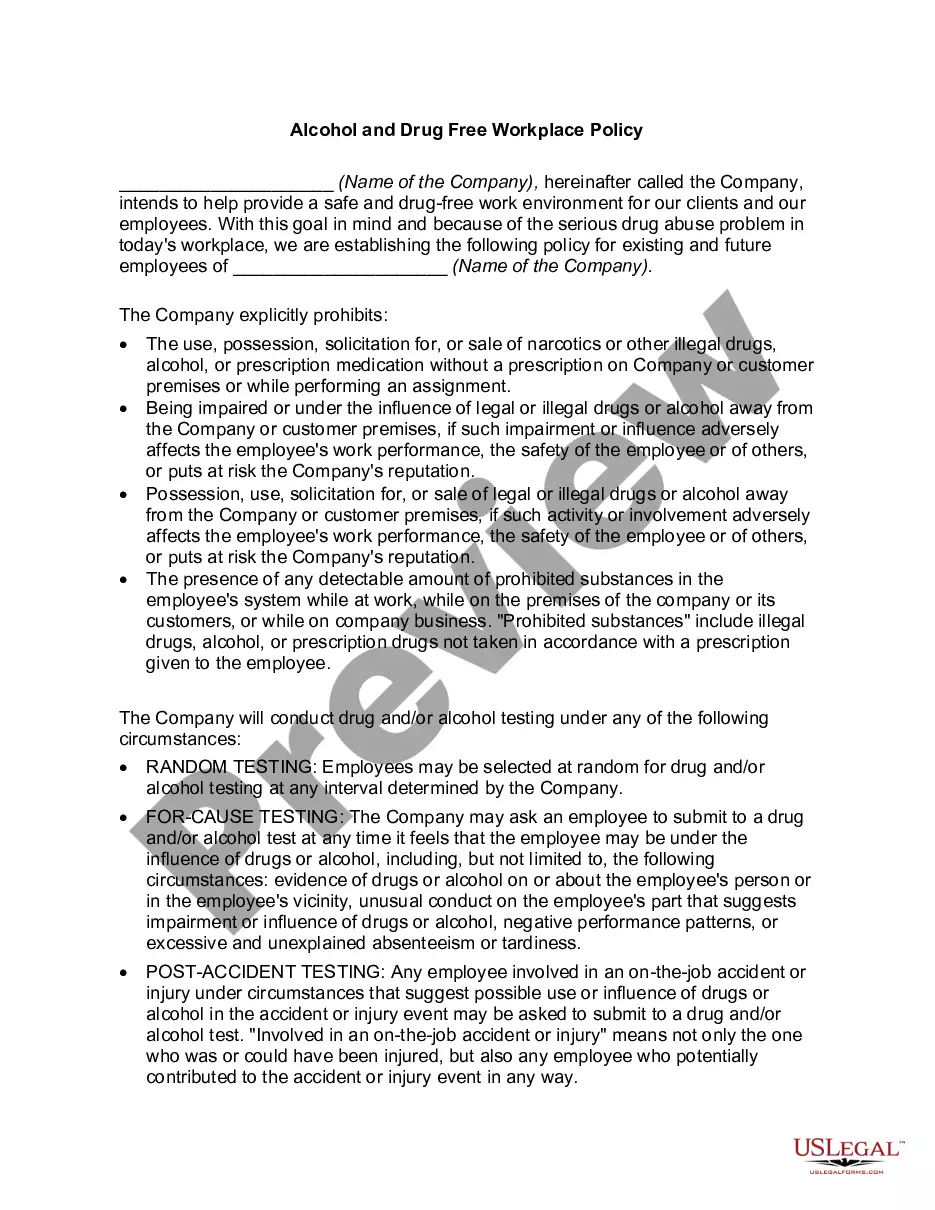
How to fill out Alcohol And Drug Free Workplace Policy?
- If you are a returning user, log in to your existing account. Ensure your subscription remains valid; if it has lapsed, renew it through your payment plan.
- For new users, start by exploring the Preview mode and form descriptions. Confirm you select the right form that matches your specific needs and complies with your local jurisdiction.
- If necessary, search the library for alternative templates. Utilize the Search tab to find any forms that better suit your requirements before proceeding.
- To acquire your chosen document, click on the Buy Now button and select a subscription plan. You will need to create an account to access the full library.
- Complete your payment. Enter your credit card information or opt for your PayPal account to secure your subscription.
- Finally, download your form. Save the template to your device for easy access, and remember, you can find it anytime in the My Forms section of your profile.
By utilizing US Legal Forms, you gain access to over 85,000 easily fillable and editable legal forms, along with expert assistance ensuring your documents are accurate and compliant.
Don't wait any longer—start leveraging the convenience and reliability of US Legal Forms today!
Form popularity
FAQ
The six steps to developing a policy include identifying the need for the policy, conducting research, drafting the policy, reviewing it with stakeholders, implementing the policy, and finally monitoring its effectiveness. Each step contributes to creating a comprehensive policy that meets the needs of your organization. Utilizing platforms like US Legal Forms can streamline the process and ensure compliance.
Creating policies and procedures involves recognizing the need for documented guidelines and processes. First, outline the objectives of your policy, then draft procedures that clearly describe the steps to achieve those objectives. Consistent consultation with stakeholders will refine your draft, while resources like US Legal Forms offer templates to enhance your work.
To develop policies, start by conducting thorough research on existing laws and standards relevant to your sector. Create a draft that includes a purpose statement, procedures for implementation, and guidelines for enforcement. Review your policy with legal advisors and stakeholders to ensure it addresses all necessary concerns before finalizing it.
When developing policies and procedures, consider the necessity and purpose, compliance with relevant laws, the impact on your organization or community, and the clarity of the language used. It is also important to involve stakeholders for their viewpoints and to ensure the policies are practical. Taking these factors into account leads to more robust and effective policies.
To develop effective policies and procedures, start by assessing the needs of your organization or area of focus. Engage with stakeholders for insights and gather data to understand best practices in your field. Once you've identified core issues, outline guidelines and processes that address those needs while remaining compliant with legal requirements.
Creating a policy begins with clearly defining its purpose and scope. Identify the key constituents affected by this policy and ensure you gather their input for a well-rounded perspective. Then, refine your policy draft by including necessary details, ensuring it meets legal standards. Platforms like US Legal Forms can provide templates to simplify the drafting process.
To find policies, start by searching reputable sources such as government websites, legal firms, or specialized organizations. You can also use online platforms like US Legal Forms that provide easy access to a variety of policies tailored to your needs. Utilize keywords related to your specific requirements to streamline your search.
Policies refer to the frameworks that guide actions and decisions in numerous contexts, such as business, law, and governance. They help establish clear standards and expectations for behavior. By understanding policies, you can better navigate the environments they influence and contribute to their effectiveness.
Yes, the word 'policy' becomes 'policies' in the plural form. This distinction is important when discussing multiple guidelines or rules that govern conduct or decision-making. Recognizing the plural form can enhance clarity in communication regarding various policies.
A synonym for policies includes 'guidelines', 'rules', or 'principles'. Each of these terms conveys the intent of establishing a consistent approach towards managing particular issues. Using these synonyms can help clarify discussions about policies in various contexts.