Writing With Movement
Description
Get your form ready online
Our built-in tools help you complete, sign, share, and store your documents in one place.
Make edits, fill in missing information, and update formatting in US Legal Forms—just like you would in MS Word.
Download a copy, print it, send it by email, or mail it via USPS—whatever works best for your next step.
Sign and collect signatures with our SignNow integration. Send to multiple recipients, set reminders, and more. Go Premium to unlock E-Sign.
If this form requires notarization, complete it online through a secure video call—no need to meet a notary in person or wait for an appointment.
We protect your documents and personal data by following strict security and privacy standards.

Make edits, fill in missing information, and update formatting in US Legal Forms—just like you would in MS Word.

Download a copy, print it, send it by email, or mail it via USPS—whatever works best for your next step.

Sign and collect signatures with our SignNow integration. Send to multiple recipients, set reminders, and more. Go Premium to unlock E-Sign.

If this form requires notarization, complete it online through a secure video call—no need to meet a notary in person or wait for an appointment.

We protect your documents and personal data by following strict security and privacy standards.
Looking for another form?


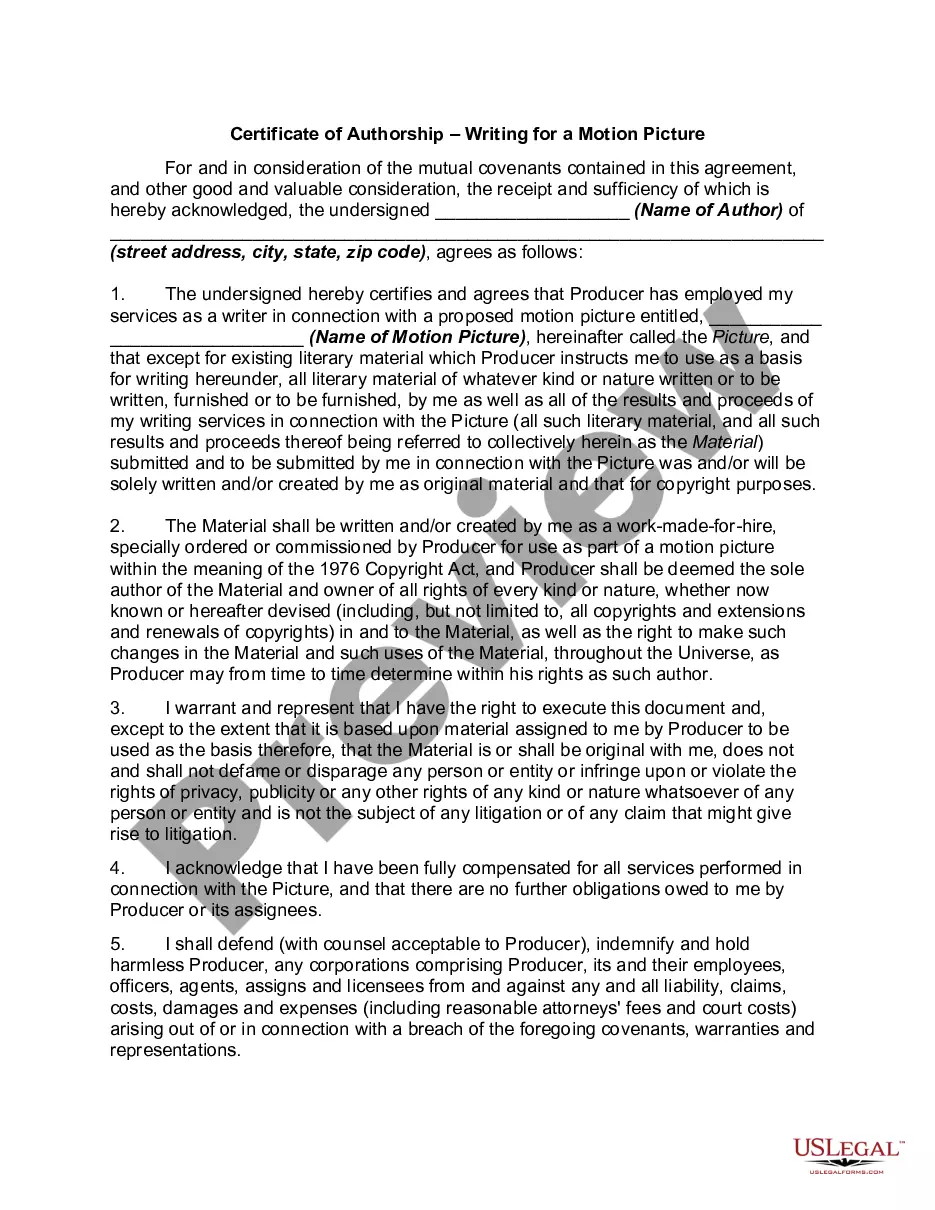
How to fill out Certificate Of Authorship - Writing For A Motion Picture?
The Writing With Movement displayed on this page is a reusable formal template created by expert attorneys in adherence to federal and local statutes and regulations.
For over 25 years, US Legal Forms has supplied individuals, organizations, and legal professionals with more than 85,000 authenticated, state-specific forms for any commercial and personal circumstance. It’s the quickest, most direct, and most reliable method to acquire the documents you require, as the service assures bank-level data security and malware protection.
Subscribe to US Legal Forms to access verified legal templates for all of life's situations whenever you need them.
- Search for the document you require and examine it.
- Review the sample you found and preview it or check the form description to verify it meets your needs. If it doesn’t, utilize the search bar to find the correct one. Click Buy Now once you have identified the template you require.
- Register and Log In.
- Choose the pricing plan that fits you and create an account. Use PayPal or a credit card for a quick payment. If you already possess an account, Log In and check your subscription to continue.
- Acquire the editable template.
- Select the format you desire for your Writing With Movement (PDF, Word, RTF) and save the sample to your device.
- Complete and sign the documents.
- Print the template to finish it manually. Alternatively, use an online multifunctional PDF editor to quickly and accurately complete and sign your form with a valid signature.
- Download your documents once again.
- Use the same document repeatedly whenever needed. Open the My documents tab in your profile to redownload any previously acquired forms.
Form popularity
FAQ
The International Movement Writing Alphabet (IMWA) is a set of symbols that can be used to describe and record movement. Its creator, Valerie Sutton, also invented MovementWriting, a writing system which employs IMWA. It in turn has several application areas within which it is specialised.
Too much movement: Readers are intelligent, so you don't have to spell every gesture out for them. If your character is getting up from a desk you don't have to say ?Hunter pushed his chair back from the desk and stood up out of the chair? you can simply say ?Hunter stood.? Your reader will understand.
Enhances Spatial Orientation ? Because a child is using her body to move around a room or to form letters, her sense of space and direction will improve. When a child forms himself into the letter 'A' or curves around like the letter 'S,' instead of just writing it on paper, he can better understand these dimensions.
What Are Literary Movements? Literary movements divide literary works into groups based on their similarities, as opposed to grouping them by period or genre. Some movements are defined by the authors themselves, while others are defined decades or even centuries later.
How to use movement and action in dialogue writing: Use background action to add tone and mood. Add movement in dialogue to keep the story moving. Use mid-dialogue actions for tense interruption. Reveal character relationships through gesture. Add dramatic emphasis to characters' emotions.