Writing For Motion For Summary Judgment
Description
Get your form ready online
Our built-in tools help you complete, sign, share, and store your documents in one place.
Make edits, fill in missing information, and update formatting in US Legal Forms—just like you would in MS Word.
Download a copy, print it, send it by email, or mail it via USPS—whatever works best for your next step.
Sign and collect signatures with our SignNow integration. Send to multiple recipients, set reminders, and more. Go Premium to unlock E-Sign.
If this form requires notarization, complete it online through a secure video call—no need to meet a notary in person or wait for an appointment.
We protect your documents and personal data by following strict security and privacy standards.

Make edits, fill in missing information, and update formatting in US Legal Forms—just like you would in MS Word.

Download a copy, print it, send it by email, or mail it via USPS—whatever works best for your next step.

Sign and collect signatures with our SignNow integration. Send to multiple recipients, set reminders, and more. Go Premium to unlock E-Sign.

If this form requires notarization, complete it online through a secure video call—no need to meet a notary in person or wait for an appointment.

We protect your documents and personal data by following strict security and privacy standards.
Looking for another form?




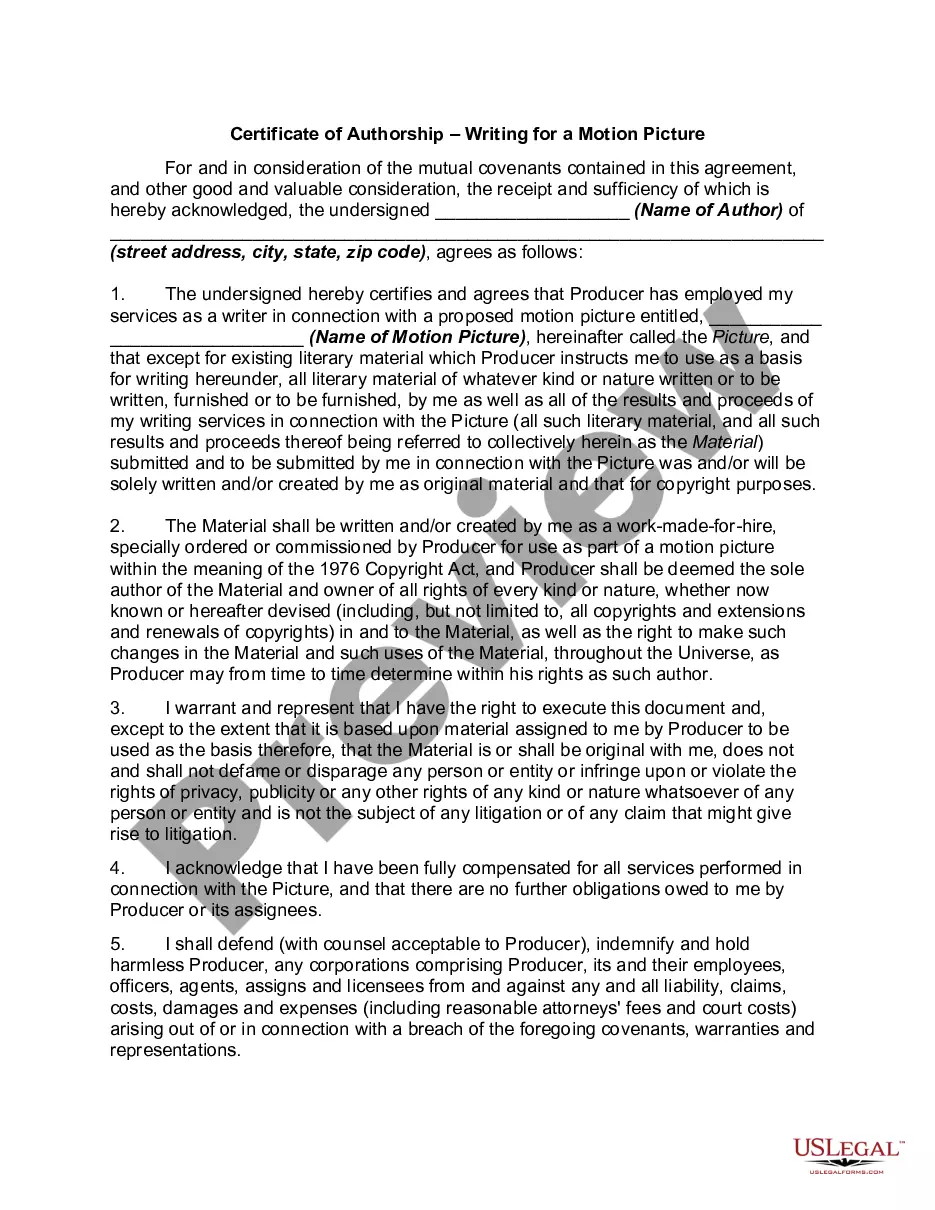
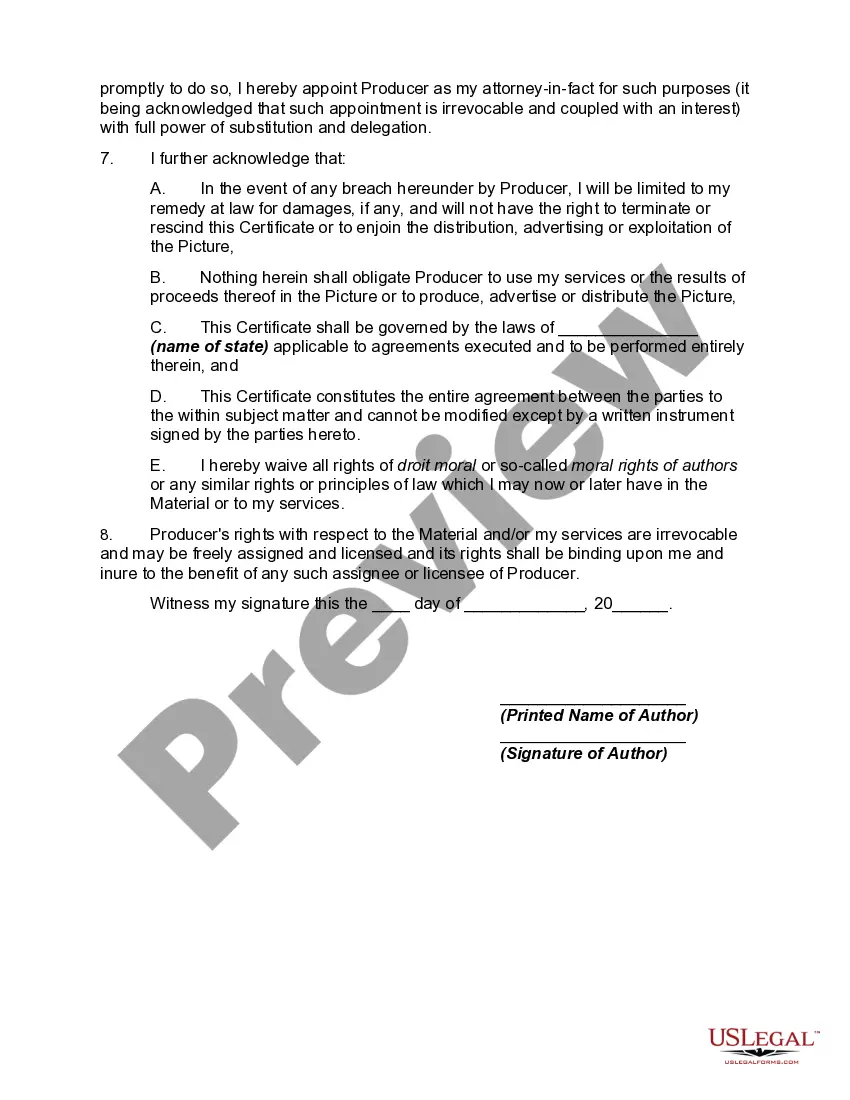
How to fill out Certificate Of Authorship - Writing For A Motion Picture?
Creating legal documents from the ground up can occasionally be quite daunting. Certain situations may require extensive research and significant financial investment. If you’re looking for a more straightforward and cost-effective method for producing Writing For Motion For Summary Judgment or other forms without having to navigate through obstacles, US Legal Forms is always accessible to you.
Our digital library featuring over 85,000 current legal documents covers nearly every facet of your financial, legal, and personal affairs. With only a few clicks, you can swiftly obtain state- and county-compliant templates meticulously prepared by our legal experts.
Utilize our website whenever you require a dependable and trustworthy service through which you can quickly locate and download the Writing For Motion For Summary Judgment. If you’re already familiar with our services and have established an account with us, simply Log In to your account, choose the template and download it or retrieve it again later from the My documents section.
Not yet registered? No worries. Setting up an account and exploring the library takes minimal time. But before diving directly into downloading Writing For Motion For Summary Judgment, consider these suggestions.
US Legal Forms boasts an impeccable reputation and over 25 years of expertise. Join us now and make the process of document completion effortless and efficient!
- Examine the form preview and descriptions to ensure you are viewing the document you need.
- Verify that the form you choose meets the standards of your state and county.
- Select the most suitable subscription option to purchase the Writing For Motion For Summary Judgment.
- Download the document. Then complete, authenticate, and print it out.
Form popularity
FAQ
To request summary judgment, you need to file a motion with the court that outlines your legal arguments and supporting evidence. Start by drafting a concise document that adheres to local court rules. In your writing for a motion for summary judgment, be sure to cite relevant laws and precedents. If you require assistance, consider using platforms like UsLegalForms, which can guide you in crafting a comprehensive and effective motion.
The grounds for a motion for summary judgment typically include the absence of genuine issues of material fact and the entitlement of one party to judgment as a matter of law. For successful writing for a motion for summary judgment, you should demonstrate how the evidence aligns with these grounds. Compelling evidence such as affidavits, depositions, and documents strengthens your position. Remember, a strong foundation is crucial for persuading the court.
Yes, a motion for summary judgment is indeed a written motion. This legal document submits a request to the court to rule in favor of one party based on the lack of disputed material facts. In your writing for a motion for summary judgment, it is essential to articulate your position clearly and provide ample evidence to support it. Ultimately, this written form helps expedite the legal process.
When writing for a motion for summary judgment, you should first clearly identify the legal issues at hand. Then, gather all relevant evidence and documents that support your position. Organize your argument logically, using headings and subheadings to enhance clarity. Additionally, ensure you include a persuasive conclusion that reinforces your request for the court to grant the motion.
To ask for a summary judgment, you need to draft a formal motion that outlines your arguments and the evidence supporting your position. Writing for motion for summary judgment requires clarity and precision to persuade the court that a trial is unnecessary. Engaging with resources like US Legal Forms can simplify this process, offering templates and advice tailored to your needs.
The timeline for writing a motion for summary judgment can vary, but generally, you should anticipate spending a few days to several weeks on it. This time includes researching relevant laws, compiling evidence, and carefully crafting your arguments. Utilizing platforms like US Legal Forms can streamline the process by providing templates and guidance, ensuring your motion is both effective and compliant.
Common grounds for summary judgment often include failure to establish essential elements of a claim, lack of material fact, and affirmative defenses that legally entitle a party to judgment. Writing for motion for summary judgment can spotlight these grounds effectively, allowing you to argue why the case should not proceed to trial. Many cases revolve around contract disputes or negligence, providing ample opportunity for summarizing clear legal standpoints.
When engaging in writing for motion for summary judgment, you need to establish that the evidence supports your claims and that no essential facts require a trial. This involves presenting documented evidence, such as affidavits or depositions. Additionally, you must show that the opposing party lacks evidence that could dispute your case.
Writing for motion for summary judgment requires demonstrating that there is no genuine dispute of material fact. This means that the evidence presented must be so clear that a reasonable jury could only rule in favor of one party. You must support your arguments with sufficient evidence and legal standards to meet this requirement effectively.
When writing for a motion for summary judgment, you must demonstrate that there are no genuine disputes about any material facts. Include supporting affidavits, documents, and any other relevant evidence. Each jurisdiction may have specific formatting rules and standards for your motion, so it is vital to follow these closely. Platforms like US Legal Forms can help you access templates that are compliant with your local rules, streamlining your efforts in preparing an effective motion.