What Is A Timeshare For Hotels
Description
Get your form ready online
Our built-in tools help you complete, sign, share, and store your documents in one place.
Make edits, fill in missing information, and update formatting in US Legal Forms—just like you would in MS Word.
Download a copy, print it, send it by email, or mail it via USPS—whatever works best for your next step.
Sign and collect signatures with our SignNow integration. Send to multiple recipients, set reminders, and more. Go Premium to unlock E-Sign.
If this form requires notarization, complete it online through a secure video call—no need to meet a notary in person or wait for an appointment.
We protect your documents and personal data by following strict security and privacy standards.

Make edits, fill in missing information, and update formatting in US Legal Forms—just like you would in MS Word.

Download a copy, print it, send it by email, or mail it via USPS—whatever works best for your next step.

Sign and collect signatures with our SignNow integration. Send to multiple recipients, set reminders, and more. Go Premium to unlock E-Sign.

If this form requires notarization, complete it online through a secure video call—no need to meet a notary in person or wait for an appointment.

We protect your documents and personal data by following strict security and privacy standards.
Looking for another form?




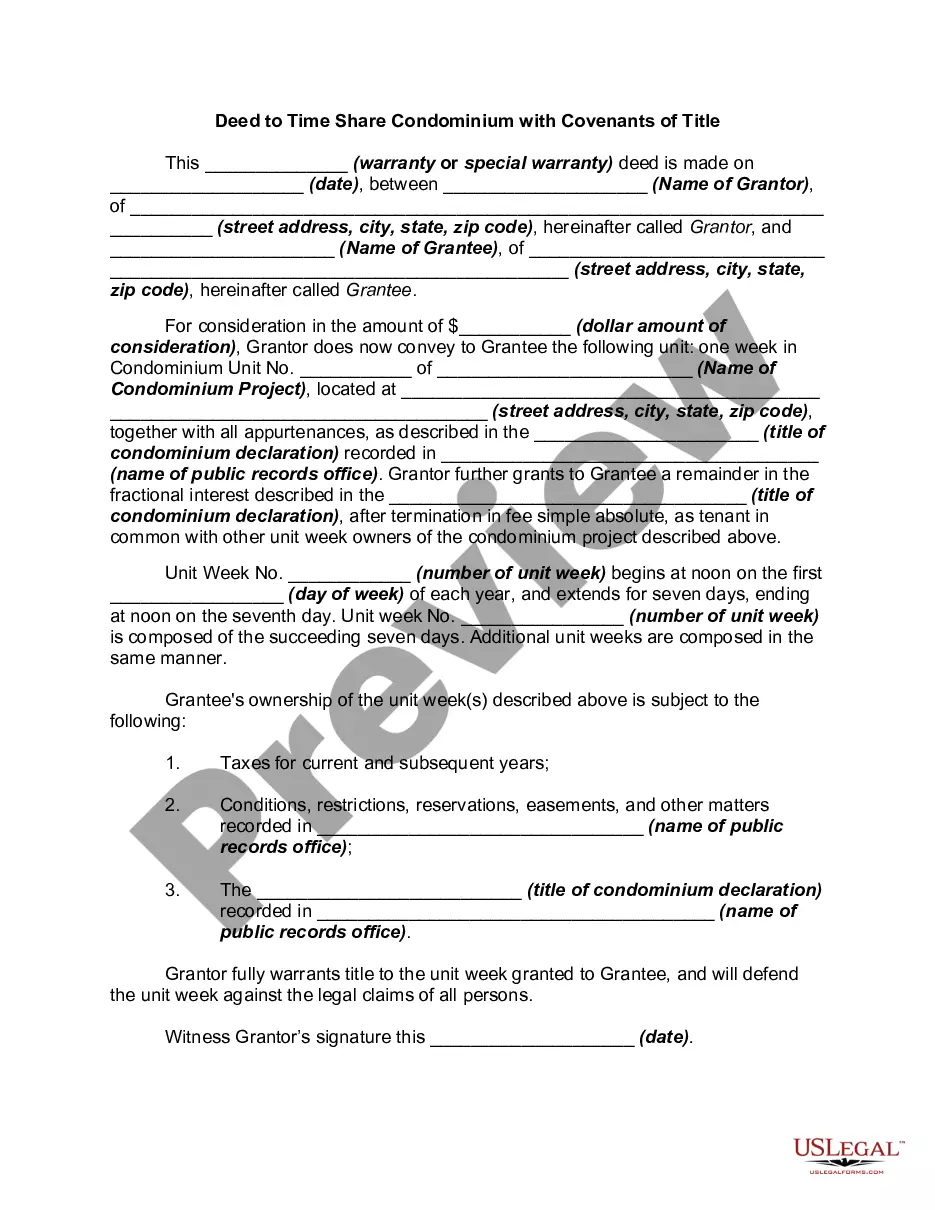
How to fill out Deed To Time Share Condominium With Covenants Of Title?
- Visit the US Legal Forms website and log in to your account if you are a returning user. Ensure your subscription is up-to-date; if it's expired, renew it before proceeding.
- Browse the available legal forms. Utilize the Preview mode to confirm that the document suits your specific needs and complies with local jurisdiction requirements.
- If you need a different template, use the Search functionality to locate the correct form. Once satisfied, you can move to the next step.
- Select your document by clicking 'Buy Now.' Choose the subscription plan that fits your needs, and create an account if you don't have one.
- Complete your purchase by entering your credit card information or opting for PayPal. Ensure your payment goes through.
- Download your chosen form and save it. You can access it later in the 'My Forms' section of your account whenever needed.
In conclusion, US Legal Forms streamlines the process of obtaining essential legal documents, empowering users with options and expert assistance. Their extensive library and premium features make it easier than ever to navigate legal requirements successfully.
Start your journey with US Legal Forms today to gain access to thousands of legal templates and expert support!
Form popularity
FAQ
Deciding if a hotel timeshare is worth it depends on your travel habits and preferences. For frequent travelers who enjoy returning to the same destination, a timeshare can offer significant savings. Additionally, these arrangements often provide access to upscale accommodations and a community of like-minded vacationers. Evaluating whether hotel timeshares are worth it for you can lead to enhanced travel experiences.
A timeshare for hotels allows multiple owners to share ownership of a vacation property. Typically, owners buy the right to use the property for a set time each year. This system helps reduce maintenance costs and makes luxury stays more affordable. By understanding how hotel timeshares work, you can enjoy regular vacations at premium locations.
Timeshares function by allowing owners to buy a fraction of a hotel or resort property, giving them access for certain weeks annually. This split ownership often involves purchasing a deeded unit, which means you own a share of the property itself. As you explore what is a timeshare for hotels, it's crucial to understand the responsibilities, including fees and usage rules, to make informed decisions about your vacation investments.
Timeshare owners typically have a form of estate known as a 'time share estate' or 'time share interest.' This setup allows owners to use the property for a designated time each year. Depending on the timeshare's structure, holders can enjoy varying degrees of rights related to property usage and access. Knowing what a timeshare for hotels encompasses helps clarify your value in this ownership arrangement.
Whether a timeshare is classified as real or personal property depends largely on its ownership structure. Deeded timeshares are categorized as real property, while right-to-use timeshares fall under personal property. This classification affects how timeshares are treated in legal situations, such as taxes and transfers. Being informed about what a timeshare for hotels means can help simplify your ownership experience.
Timeshares are generally considered a form of shared property. Depending on ownership structure, they can be classified as either real property or personal property. Understanding this distinction can impact your rights and responsibilities as a timeshare owner. Clarity on what a timeshare for hotels represents allows you to engage more confidently in potential transactions.
Timeshares are now often referred to as vacation ownership. This term emphasizes the experience of owning a shared interest in a property, rather than just a financial investment. Some might also hear the term 'fractional ownership' as it shares similarities with timeshares. Understanding this language is crucial when discussing what a timeshare for hotels means in today’s market.
A timeshare typically falls under two main categories: deeded ownership or right-to-use. With deeded ownership, you hold a portion of the actual property title, while right-to-use grants you access for a specified period, without ownership. Both types of timeshares offer unique benefits, but they align with different personal and financial goals. Knowing what a timeshare for hotels entails will help you choose the right type.
In a divorce, a timeshare may be classified as real property, depending on the terms of ownership. If both spouses share a deeded interest, the timeshare often becomes part of the marital assets to divide. It's essential to consult a legal professional for specific advice on timeshares and property rights during a divorce. Understanding what a timeshare for hotels means can help you navigate this aspect of your situation more effectively.