Assignment Operator Salesforce
Description
Get your form ready online
Our built-in tools help you complete, sign, share, and store your documents in one place.
Make edits, fill in missing information, and update formatting in US Legal Forms—just like you would in MS Word.
Download a copy, print it, send it by email, or mail it via USPS—whatever works best for your next step.
Sign and collect signatures with our SignNow integration. Send to multiple recipients, set reminders, and more. Go Premium to unlock E-Sign.
If this form requires notarization, complete it online through a secure video call—no need to meet a notary in person or wait for an appointment.
We protect your documents and personal data by following strict security and privacy standards.

Make edits, fill in missing information, and update formatting in US Legal Forms—just like you would in MS Word.

Download a copy, print it, send it by email, or mail it via USPS—whatever works best for your next step.

Sign and collect signatures with our SignNow integration. Send to multiple recipients, set reminders, and more. Go Premium to unlock E-Sign.

If this form requires notarization, complete it online through a secure video call—no need to meet a notary in person or wait for an appointment.

We protect your documents and personal data by following strict security and privacy standards.
Looking for another form?

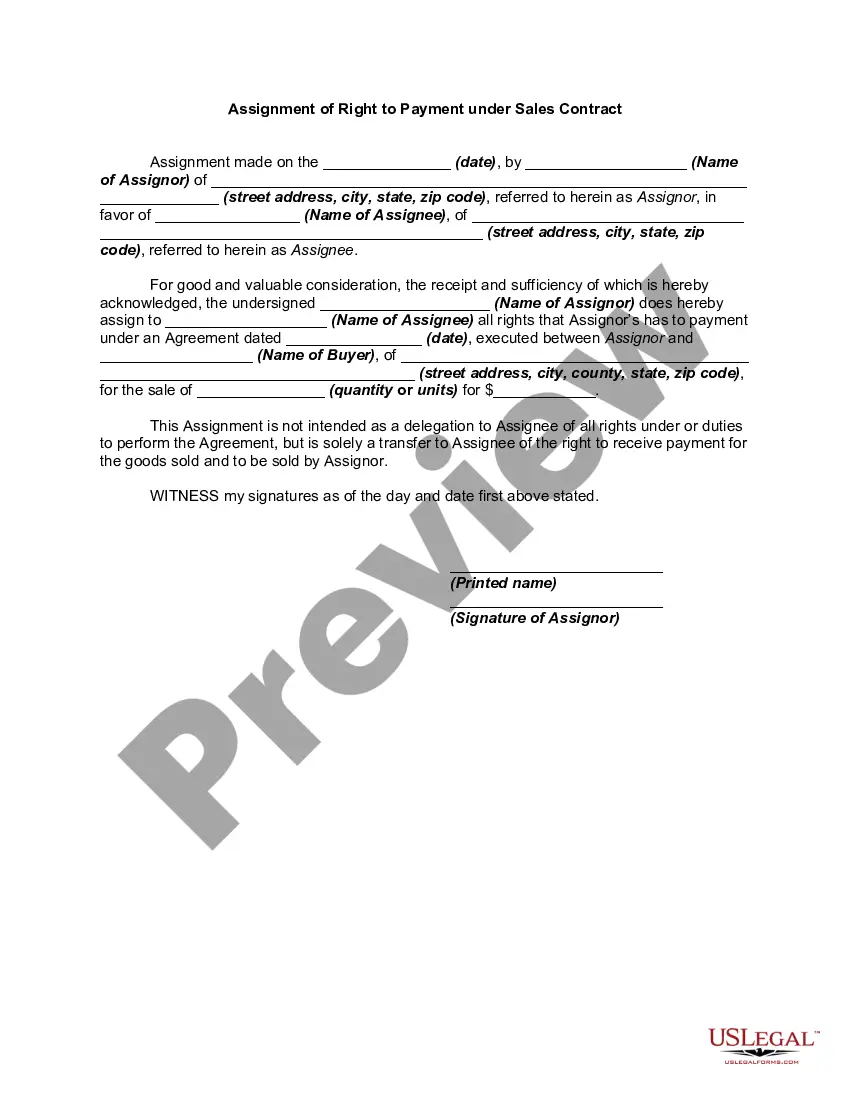
How to fill out Assignment Of Right To Payment Under Sales Contract?
Managing legal documents can be daunting, even for experienced professionals.
If you're looking for an Assignment Operator Salesforce but lack the time to search for the correct and current version, the process can become taxing.
US Legal Forms caters to any requirements you may have, encompassing everything from personal to corporate documents, all in one location.
Utilize sophisticated tools to complete and oversee your Assignment Operator Salesforce.
After obtaining the form you need, follow these steps: Verify its correctness by previewing and reviewing its description, confirm that the template is valid in your jurisdiction, click Buy Now when ready, choose a subscription plan, and select the file format you require, then Download, complete, sign, print, and send your document. Enjoy the US Legal Forms online catalog, supported by 25 years of expertise and reliability. Streamline your daily document management into a simple and user-friendly process today.
- Access a library of articles, guides, and resources pertinent to your circumstances and requirements.
- Save time and energy in searching for the documents you need, employing US Legal Forms' refined search and Preview feature to find Assignment Operator Salesforce.
- If you have a subscription, Log In to your US Legal Forms account, search for the required form, and retrieve it.
- Visit the My documents tab to review the documents you have previously downloaded and manage your files as desired.
- If this is your initial experience with US Legal Forms, create a complimentary account to gain unlimited access to all platform features.
- A comprehensive online form repository can revolutionize how individuals handle these situations efficiently.
- US Legal Forms stands as a leader in digital legal documents, offering over 85,000 state-specific forms accessible whenever needed.
- With US Legal Forms, you can find state- or county-specific legal and business forms.
Form popularity
FAQ
Collection Assignment Operators in Flow 1- Equals. Equals operator replaces the value of the Variable. ... 2- Add. Add operator adds the Value as a new item at the end of the collection in Variable. ... 3- Remove First. ... 4- Remove Before First. ... 5- Remove After First. ... 7- Add At Start. ... 9- Remove Position.
The assignment operator = assigns the value of its right-hand operand to a variable, a property, or an indexer element given by its left-hand operand. The result of an assignment expression is the value assigned to the left-hand operand.
Assignment is usually used for more complex operations (ex. in a loop or as a switch). If you simply want to change record fields, an Update Records element should be sufficient. There are three main fields ? Variable, Operator, and Value.
The Assignment element is one of the Logic elements, which means that it does not directly affect the contents of the Salesforce database. Instead, it is used to interact with records and resources within the flow by changing, adding, or subtracting the values of variables and fields.
Create a Variable From Setup, enter Flows in the Quick Find box and then click Flows. Click New Flow. Select a flow type and click Create. ... Click. ... Click New Resource. ... For Resource Type, select Variable. Enter an API name and description for your variable. For Data Type, select Text.