Dissolution Divorce Form With Court
Description

Get your form ready online
Our built-in tools help you complete, sign, share, and store your documents in one place.
Make edits, fill in missing information, and update formatting in US Legal Forms—just like you would in MS Word.
Download a copy, print it, send it by email, or mail it via USPS—whatever works best for your next step.
Sign and collect signatures with our SignNow integration. Send to multiple recipients, set reminders, and more. Go Premium to unlock E-Sign.
If this form requires notarization, complete it online through a secure video call—no need to meet a notary in person or wait for an appointment.
We protect your documents and personal data by following strict security and privacy standards.

Make edits, fill in missing information, and update formatting in US Legal Forms—just like you would in MS Word.

Download a copy, print it, send it by email, or mail it via USPS—whatever works best for your next step.

Sign and collect signatures with our SignNow integration. Send to multiple recipients, set reminders, and more. Go Premium to unlock E-Sign.

If this form requires notarization, complete it online through a secure video call—no need to meet a notary in person or wait for an appointment.

We protect your documents and personal data by following strict security and privacy standards.
Looking for another form?



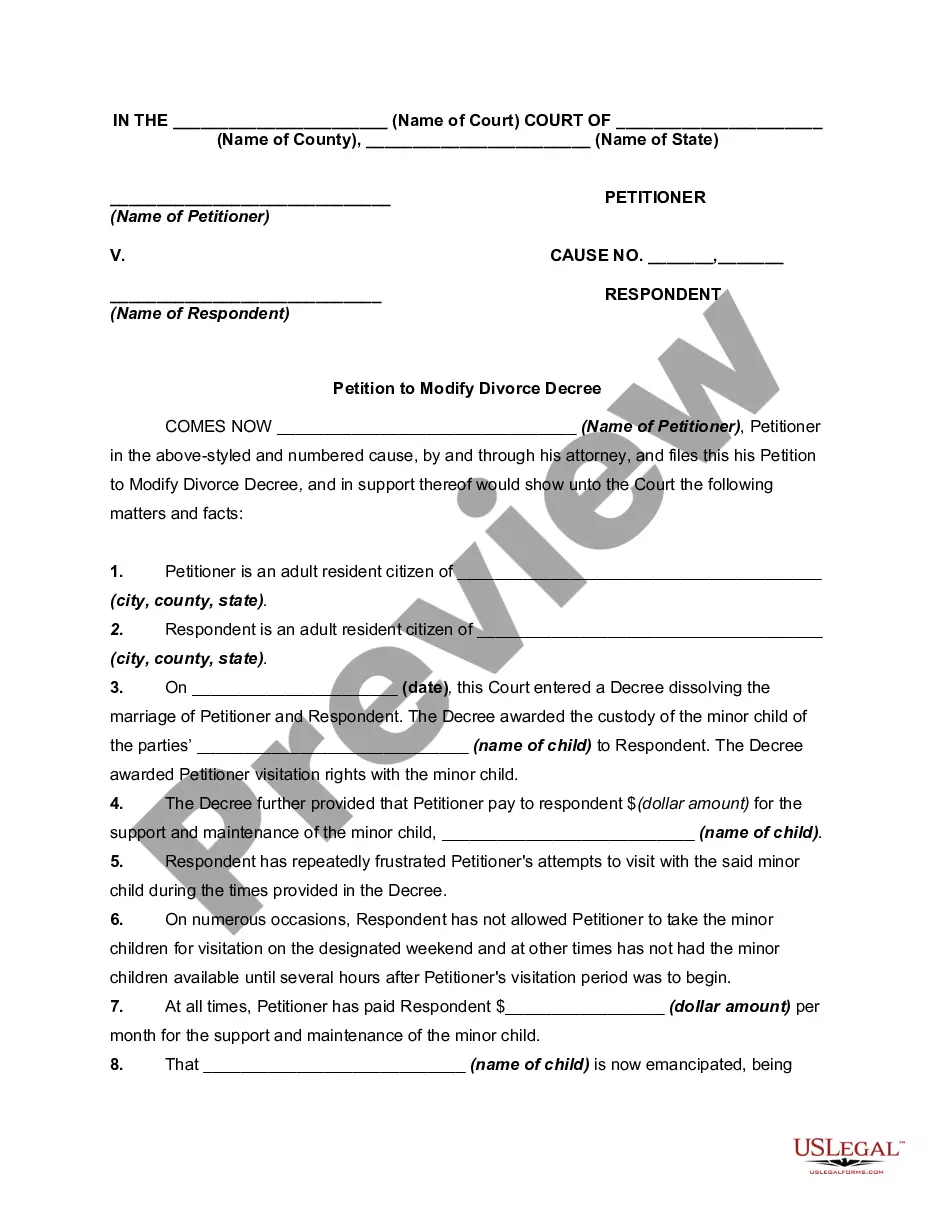




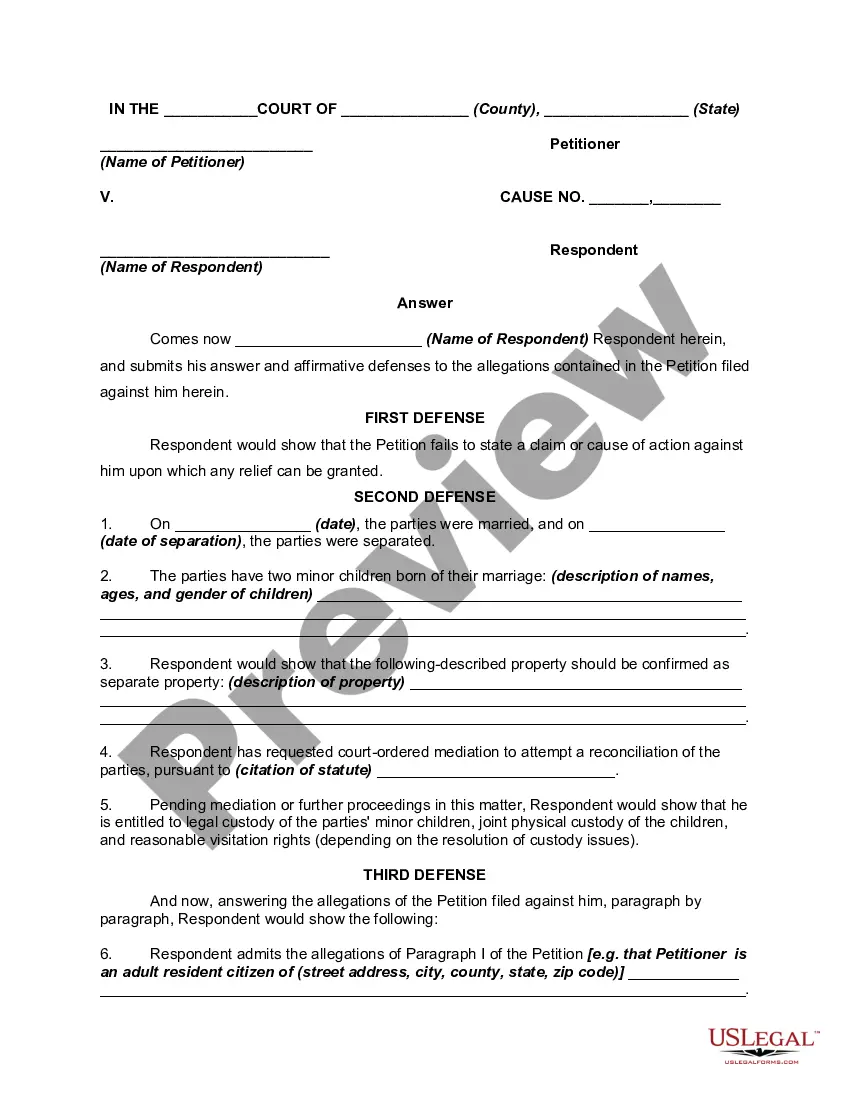
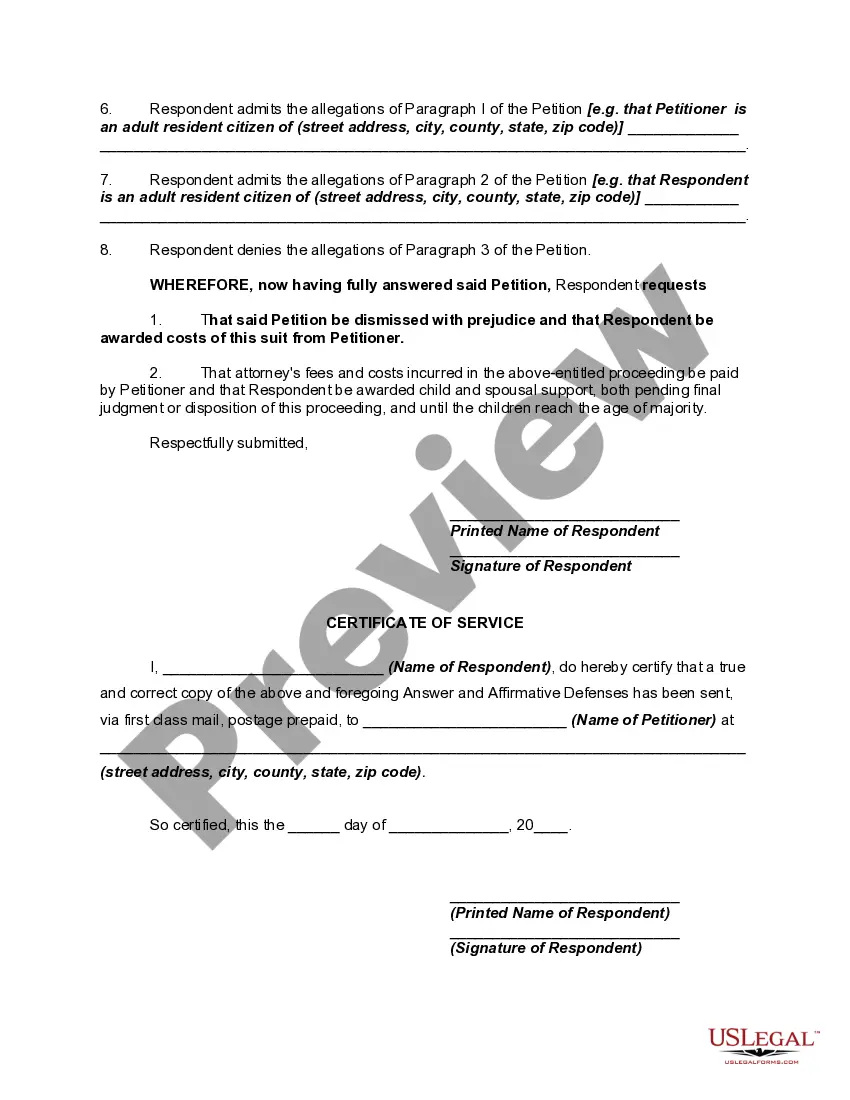
How to fill out Answer Or Response To Petition Or Complaint For Dissolution Of Marriage Or Divorce?
Managing legal documents can be daunting, even for the most experienced experts.
When you require a Dissolution Divorce Form With Court and lack the time to dedicate to finding the correct and current version, the process can be anxiety-inducing.
With US Legal Forms, you can.
Access a database of articles, guides, and resources pertinent to your circumstances and needs.
Confirm it is the correct form by reviewing it and checking its description.
- Save time and effort searching for the necessary paperwork, and utilize US Legal Forms’ enhanced search and Review tool to locate the Dissolution Divorce Form With Court and obtain it.
- If you have a membership, Log In to your US Legal Forms account, search for the form, and download it.
- Check your My documents tab to see the documents you've previously saved and to organize your folders as you wish.
- If this is your first time using US Legal Forms, create a complimentary account to gain unlimited access to all of the platform's features.
- Here are the steps to follow after downloading the desired form.
- A comprehensive online form catalog can revolutionize the way anyone tackles these matters efficiently.
- US Legal Forms is a leading provider in online legal documents, offering more than 85,000 state-specific legal forms available to you at any moment.
- Utilize advanced tools to complete and handle your Dissolution Divorce Form With Court.
Form popularity
FAQ
Bellamy's version of the pledge is largely the same as the one formally adopted by Congress 50 years later, in 1942. The official name of The Pledge of Allegiance was adopted in 1945. The most recent alteration of its wording came on Flag Day (June 14) in 1954, when the words "under God" were added.
In 1923 the groups pushed for ?my flag? to be replaced by ?the Flag of the United States of America.? The organizations felt that with so many immigrants coming to the country that it was important for newcomers to affirm their loyalty to the U.S. In 1954 Congress added the words ?under God,? to the pledge.
Congress added ?Under God? to the Pledge in 1954 ? during the Cold War. Many members of Congress reportedly wanted to emphasize the distinctions between the United States and the officially atheistic Soviet Union.
Its use in government funded schools has been the most controversial, as critics contend that a government-sanctioned endorsement of religion violates the Establishment Clause of the First Amendment to the U.S. Constitution.
Barnette, 319 U.S. 624 (1943), is a landmark decision by the United States Supreme Court holding that the Free Speech Clause of the First Amendment protects students from being forced to salute the American flag or say the Pledge of Allegiance in public school.
There were approximately four changes to the Pledge of Allegiance from the original two drafts to the version which exists today.
Bellamy had hoped that the pledge would be used by citizens in any country. In its original form it read: "I pledge allegiance to my Flag and the Republic for which it stands, one nation, indivisible, with liberty and justice for all." In 1923, the words, "the Flag of the United States of America" were added.
History of the Pledge of Allegiance It was first given wide publicity through the official program of the National Public Schools Celebration of Columbus Day, which was printed in The Youth's Companion of September 8, 1892, and at the same time sent out in leaflet form to schools throughout the country.