Intestate Succession Explained With Examples
Description
Get your form ready online
Our built-in tools help you complete, sign, share, and store your documents in one place.
Make edits, fill in missing information, and update formatting in US Legal Forms—just like you would in MS Word.
Download a copy, print it, send it by email, or mail it via USPS—whatever works best for your next step.
Sign and collect signatures with our SignNow integration. Send to multiple recipients, set reminders, and more. Go Premium to unlock E-Sign.
If this form requires notarization, complete it online through a secure video call—no need to meet a notary in person or wait for an appointment.
We protect your documents and personal data by following strict security and privacy standards.

Make edits, fill in missing information, and update formatting in US Legal Forms—just like you would in MS Word.

Download a copy, print it, send it by email, or mail it via USPS—whatever works best for your next step.

Sign and collect signatures with our SignNow integration. Send to multiple recipients, set reminders, and more. Go Premium to unlock E-Sign.

If this form requires notarization, complete it online through a secure video call—no need to meet a notary in person or wait for an appointment.

We protect your documents and personal data by following strict security and privacy standards.
Looking for another form?





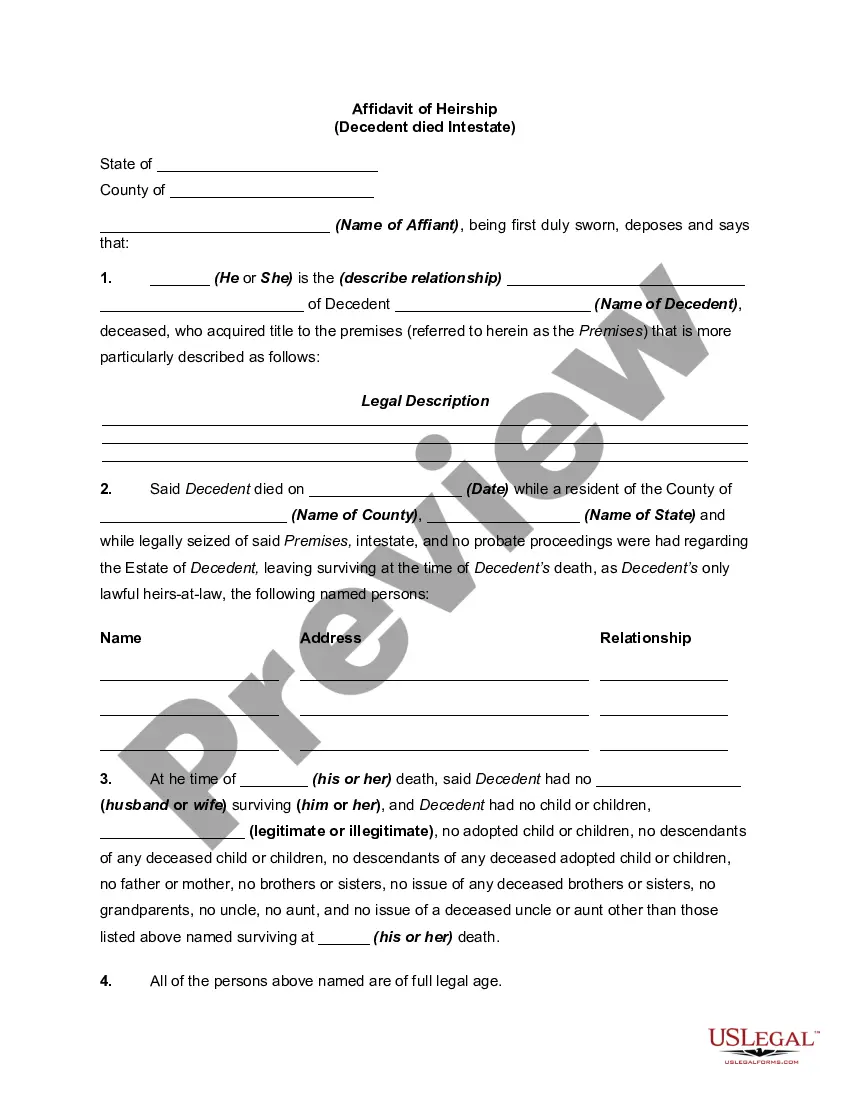
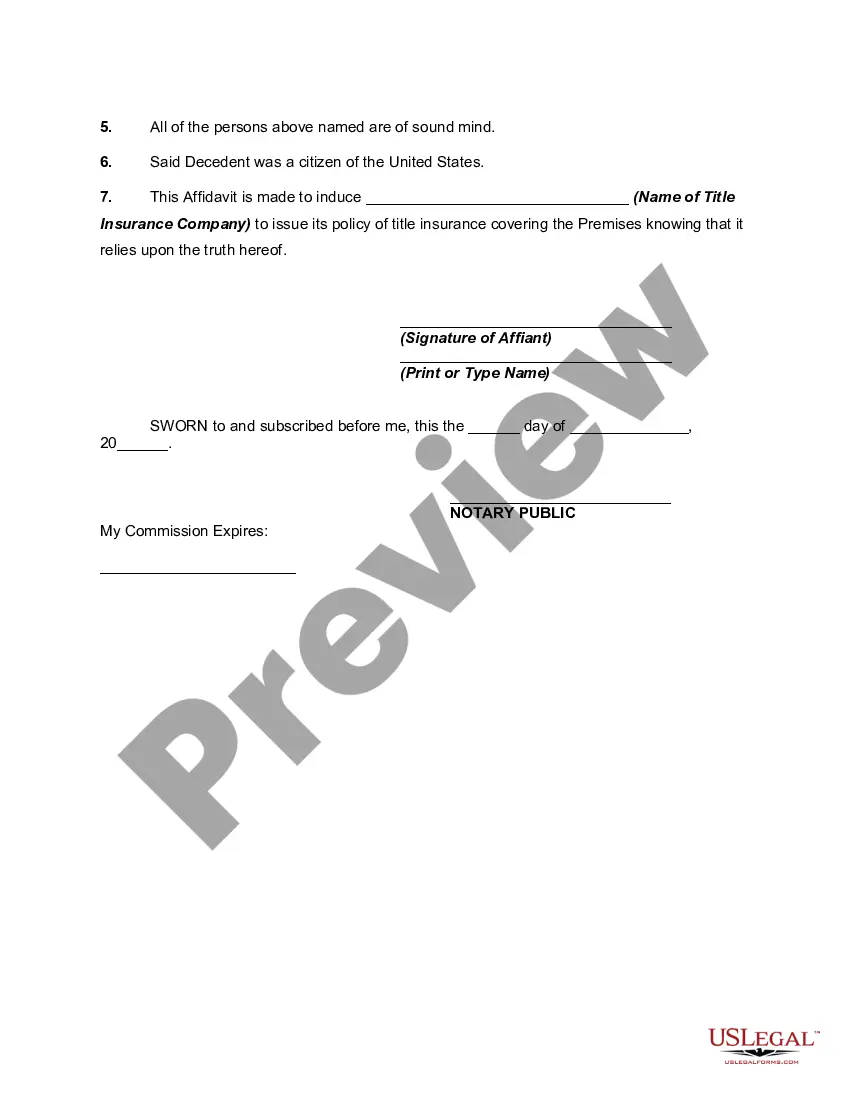
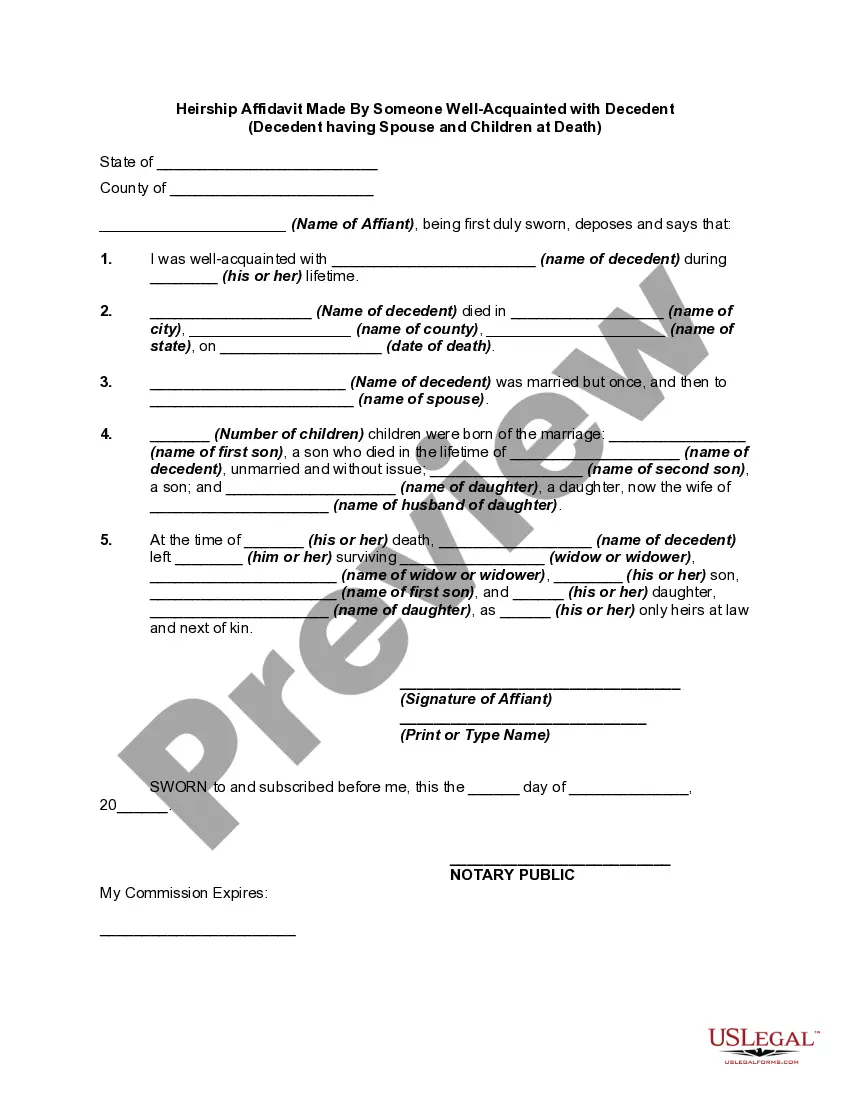
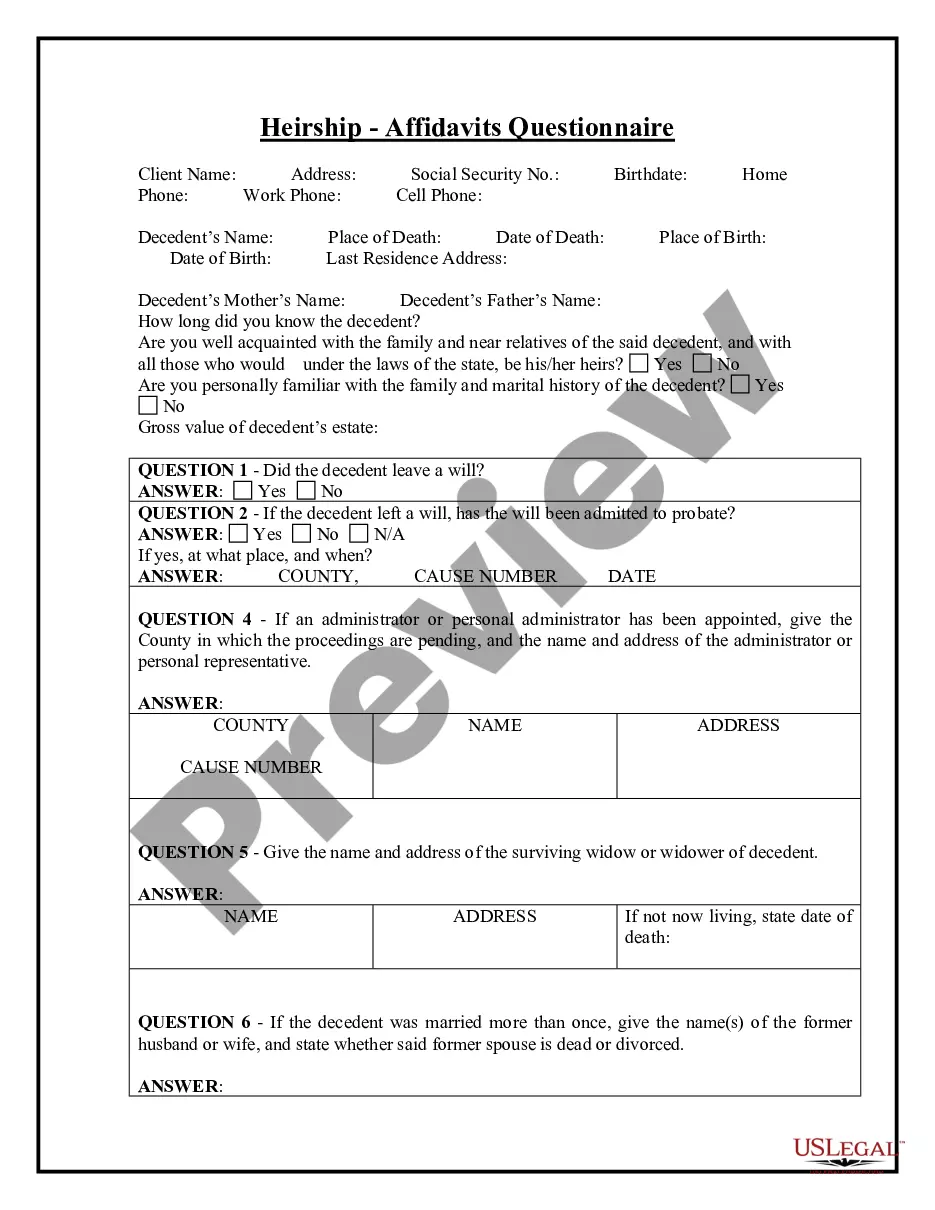
How to fill out Affidavit Of Heirship, Next Of Kin Or Descent - Decedent Died Intestate?
Legal documents administration can be daunting, even for seasoned professionals.
When you're searching for an Intestate Succession Clarified With Instances and don't have the time to seek out the correct and up-to-date version, the processes can be overwhelming.
Access state- or county-specific legal and business forms.
US Legal Forms addresses any requirements you may have, from personal to corporate documents, all in one place.
If this is your first experience with US Legal Forms, create a free account and gain unlimited access to all the benefits of the library. Here are the steps to follow after obtaining the form you need: Verify that this is the correct form by previewing it and reviewing its description. Ensure that the template is authorized in your state or county. Click Buy Now when you are ready. Choose a subscription plan. Select the format you prefer, and Download, fill out, sign, print, and submit your document. Take advantage of the US Legal Forms online catalogue, supported by 25 years of expertise and trustworthiness. Transform your routine document management into a simple and user-friendly process today.
- Employ cutting-edge tools to complete and manage your Intestate Succession Clarified With Instances.
- Access an extensive resource pool of articles, guides, manuals, and materials pertinent to your circumstances and needs.
- Conserve time and effort searching for the documents you require, and utilize US Legal Forms’ advanced search and Review feature to find Intestate Succession Clarified With Instances and download it.
- If you hold a monthly subscription, Log In to your US Legal Forms account, search for the form, and download it.
- Check the My documents tab to view the documents you’ve previously saved and manage your folders as needed.
- An effective online form repository can be a game-changer for anyone looking to manage these scenarios proficiently.
- US Legal Forms stands as a leader in online legal documentation, offering over 85,000 state-specific legal forms available to you at any moment.
- With US Legal Forms, you can.
Form popularity
FAQ
In most cases, the estate of a person who died without making a will is divided between their heirs, which can be their surviving spouse, uncle, aunt, parents, nieces, nephews, and distant relatives. If, however, no relatives come forward to claim their share in the property, the entire estate goes to the state.
When a person does not have a valid will when they die, it is called an intestacy. When this happens, Ontario's Succession Law Reform Act sets out how the estate is distributed. In general, when a person dies without a will, the people who can inherit their estate include their spouse and closest next-of-kin.
(c) where a 3[widow or widower of any relative] of an intestate has married again in the lifetime of the intestate, 4[such widow or widower] shall not be entitled to receive any share of the property of which the intestate has died intestate, and 4[such widow or widower] shall be deemed not to be existing at the ...
In an intestate situation, the surviving spouse receives all of the community property and a portion of the separate property based on a predetermined formula set out in probate law. If the decedent was not married but has children, then the children will inherit everything equally.
If you have a surviving spouse but no children, your spouse gets 100% of your estate. If you have a spouse and children, your spouse gets 1/3 of your estate and the remaining 2/3 is divided equally between your children. If you only have children, your entire estate is divided evenly among them.