Sample Return From Mars
Description

Get your form ready online
Our built-in tools help you complete, sign, share, and store your documents in one place.
Make edits, fill in missing information, and update formatting in US Legal Forms—just like you would in MS Word.
Download a copy, print it, send it by email, or mail it via USPS—whatever works best for your next step.
Sign and collect signatures with our SignNow integration. Send to multiple recipients, set reminders, and more. Go Premium to unlock E-Sign.
If this form requires notarization, complete it online through a secure video call—no need to meet a notary in person or wait for an appointment.
We protect your documents and personal data by following strict security and privacy standards.

Make edits, fill in missing information, and update formatting in US Legal Forms—just like you would in MS Word.

Download a copy, print it, send it by email, or mail it via USPS—whatever works best for your next step.

Sign and collect signatures with our SignNow integration. Send to multiple recipients, set reminders, and more. Go Premium to unlock E-Sign.

If this form requires notarization, complete it online through a secure video call—no need to meet a notary in person or wait for an appointment.

We protect your documents and personal data by following strict security and privacy standards.
Looking for another form?
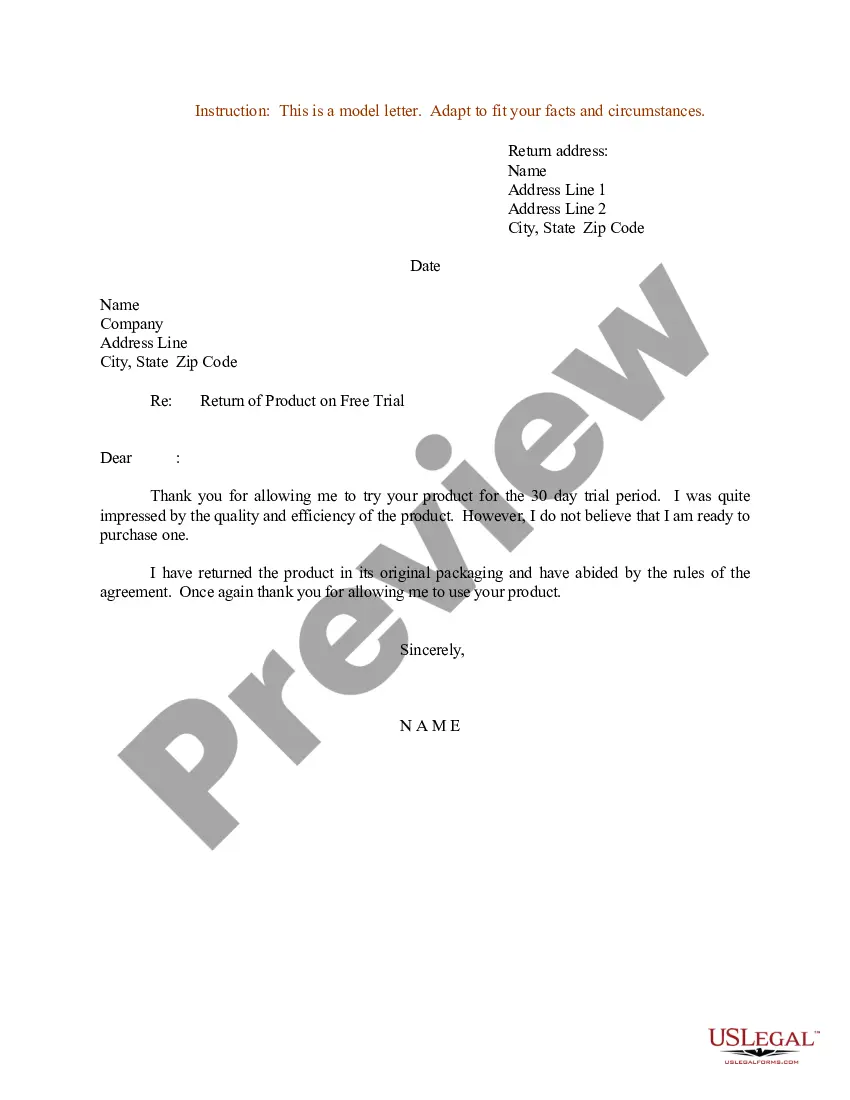
How to fill out Sample Letter For Return Of Product On Free Trial?
The Example Return from Mars displayed on this page is a reusable formal template created by expert attorneys in compliance with federal and local laws.
For over 25 years, US Legal Forms has supplied individuals, organizations, and legal experts with more than 85,000 validated, state-specific documents for any business or personal event. It is the quickest, most direct, and most dependable method to acquire the paperwork you require, as the service guarantees the utmost level of data security and anti-malware safeguards.
Subscribe to US Legal Forms to have authenticated legal templates for all of life's circumstances readily available.
- Search for the document you require and examine it.
- Choose the pricing plan that fits you and create an account. Make a quick payment using PayPal or a credit card. If you already possess an account, Log In and verify your subscription to continue.
- Select the format you desire for your Example Return from Mars (PDF, Word, RTF) and save the document on your device.
- Print the template to complete it by hand. Alternatively, utilize an online multifunctional PDF editor to swiftly and accurately fill out and sign your form with a valid.
- Use the same document again whenever necessary. Access the My documents tab in your profile to redownload any previously acquired documents.
Form popularity
FAQ
As of now, no sample has been returned from Mars. The upcoming Mars Sample Return mission represents the first effort to bring Martian material back to Earth. This groundbreaking project promises to unlock secrets about Mars' environment and history. The sample return from Mars is a key milestone in space exploration that could significantly advance our understanding of the universe.
In 2028, a mission will focus on collecting rock samples from Mars using a highly advanced rover. The rover will analyze the terrain and select the most promising areas for sample collection. After gathering the rocks, the samples will be sealed and prepared for launch back to Earth. This initiative highlights the ambitious nature of the sample return from Mars and its potential to enhance our knowledge of the planet.
To retrieve samples from Mars, a multi-step approach is used. First, a lander will deploy a rover to gather samples from the Martian surface. After collecting the samples, the rover will place them in a container, which will then be launched from Mars to return to Earth. This innovative method represents a groundbreaking sample return from Mars, providing valuable insights into the planet's history.
Mars Sample Return works through a series of carefully planned missions. Initially, a rover will collect samples and store them in sealed containers. Then, a rocket will launch from Mars, carrying these samples back to Earth. This process ensures that the sample return from Mars is conducted safely and efficiently, allowing researchers to study the materials in detail.
The Mars Sample Return proposal aims to collect and return rock and soil samples from Mars to Earth. This mission is a collaboration between NASA and the European Space Agency. By bringing back these samples, scientists hope to better understand Mars' geology and search for signs of past life. The sample return from Mars represents a significant step in our exploration of the Red Planet.
As of now, we have not yet received any samples back from Mars. However, future missions are planned to achieve this goal, marking a significant milestone in space exploration. The sample return from Mars will provide invaluable insights into the planet's geology and potential for life. Stay tuned for updates, as these missions will expand our understanding of Mars and its history.
Mars samples get back to Earth through a carefully designed process involving multiple space missions. First, a rover collects and stores samples from the Martian surface. Then, the samples are transferred to a return vehicle, which launches from Mars and travels back to Earth. This sample return from Mars requires advanced technology and collaboration between various space agencies to ensure safe delivery.
No, the Mars sample return program is not cancelled. Although there may be challenges and delays, NASA and its partners are committed to this ambitious project. They are working diligently to ensure the safe collection and return of these samples to Earth. Keeping track of updates on this program is essential, as it holds significant importance for space exploration.
The Mars sample return program aims to bring back samples from the surface of Mars to Earth. This initiative will help scientists study Martian soil and rocks, providing insights into the planet's history and potential for life. By analyzing these samples, we can better understand Mars' geology and climate. This program is crucial for future exploration and understanding the broader universe.
Currently, we do not have any soil samples from Mars returned to Earth. While several rovers have analyzed Martian soil in situ, the sample return from Mars remains a goal for future missions. These planned missions will focus on collecting and returning soil samples, providing scientists with valuable data to study Mars' environmental conditions and geology. The quest for Martian soil samples will enhance our knowledge of the planet's potential for hosting life.