Condo Unit Owner Fort Lauderdale
Description
Get your form ready online
Our built-in tools help you complete, sign, share, and store your documents in one place.
Make edits, fill in missing information, and update formatting in US Legal Forms—just like you would in MS Word.
Download a copy, print it, send it by email, or mail it via USPS—whatever works best for your next step.
Sign and collect signatures with our SignNow integration. Send to multiple recipients, set reminders, and more. Go Premium to unlock E-Sign.
If this form requires notarization, complete it online through a secure video call—no need to meet a notary in person or wait for an appointment.
We protect your documents and personal data by following strict security and privacy standards.

Make edits, fill in missing information, and update formatting in US Legal Forms—just like you would in MS Word.

Download a copy, print it, send it by email, or mail it via USPS—whatever works best for your next step.

Sign and collect signatures with our SignNow integration. Send to multiple recipients, set reminders, and more. Go Premium to unlock E-Sign.

If this form requires notarization, complete it online through a secure video call—no need to meet a notary in person or wait for an appointment.

We protect your documents and personal data by following strict security and privacy standards.
Looking for another form?






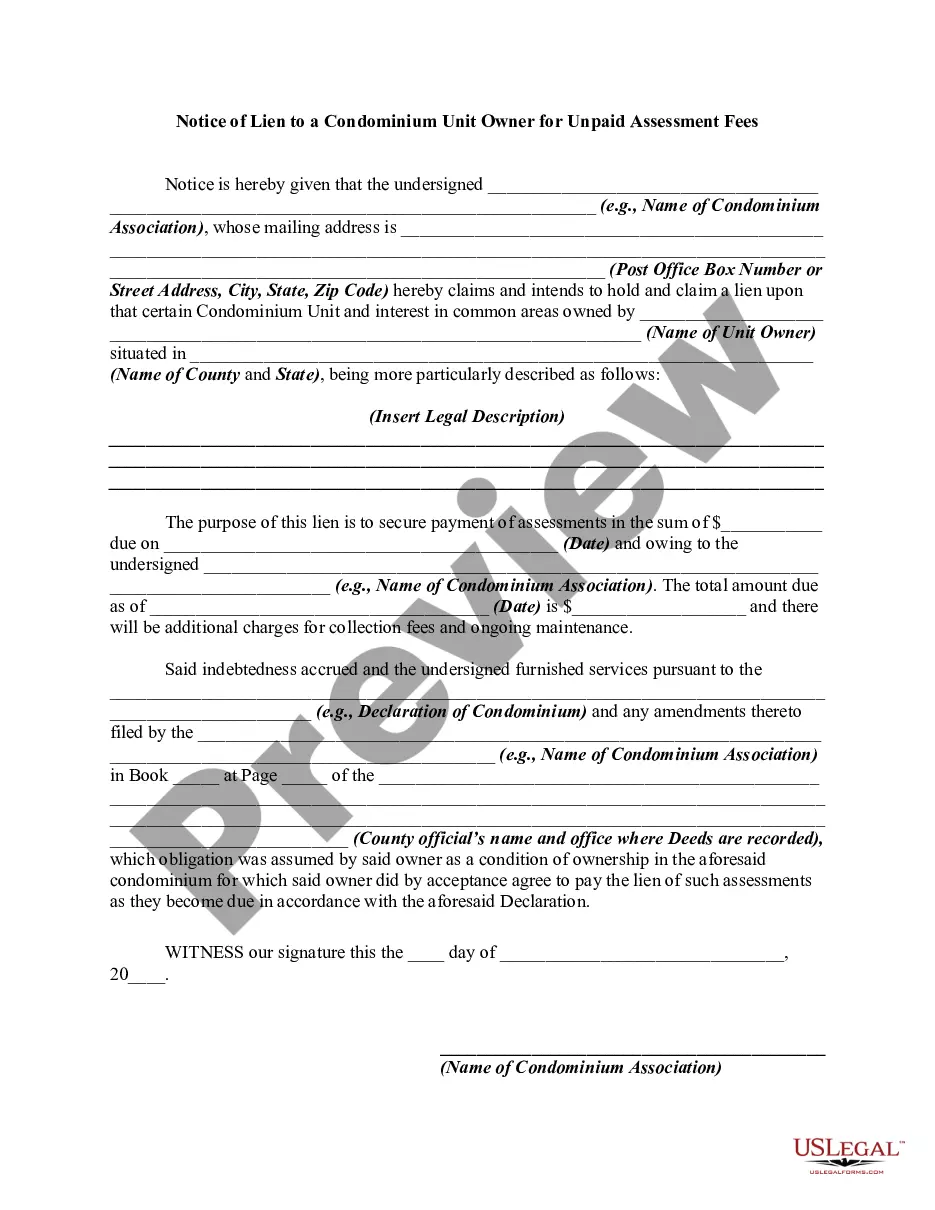
How to fill out Notice Of Lien To A Condominium Unit Owner For Unpaid Assessment Fees?
Whether for commercial objectives or for personal matters, everyone encounters legal circumstances at some stage in their life.
Completing legal documents requires meticulous care, starting with selecting the suitable form template.
Once it is downloaded, you can fill out the form using editing software or print it and complete it manually. With a comprehensive US Legal Forms catalog available, you do not need to waste time searching for the right sample online. Utilize the library’s user-friendly navigation to find the correct template for any circumstance.
- For example, if you select an incorrect version of the Condo Unit Owner Fort Lauderdale, it will be rejected when you submit it.
- Thus, it is essential to find a reliable source of legal documents like US Legal Forms.
- If you need to acquire a Condo Unit Owner Fort Lauderdale template, follow these simple steps.
- Retrieve the sample you require by utilizing the search bar or catalog navigation.
- Review the form’s details to ensure it fits your situation, state, and county.
- Click on the form’s preview to inspect it.
- If it is the incorrect document, return to the search function to find the Condo Unit Owner Fort Lauderdale template you need.
- Obtain the file when it meets your specifications.
- If you already possess a US Legal Forms profile, simply click Log in to access previously saved templates in My documents.
- If you do not have an account yet, you can download the form by clicking Buy now.
- Select the appropriate pricing option.
- Complete the profile registration form.
- Choose your payment method: you can utilize a credit card or PayPal account.
- Select the document format you desire and download the Condo Unit Owner Fort Lauderdale.
Form popularity
FAQ
A condo owner actually owns the interior space of their unit, along with a percentage of the shared common areas of the condominium. This includes amenities like pools, gyms, and landscaped grounds, which are collectively owned by all unit owners. As a condo unit owner in Fort Lauderdale, it's important to recognize that your ownership comes with responsibilities, such as adhering to association rules and paying dues. Platforms like USLegalForms can assist you in understanding and managing these obligations effectively.
The owner of a condo unit is the individual or entity that holds the title to the specific unit within the condominium complex. This ownership typically includes the interior space of the unit and a share of the common areas, such as hallways and recreational facilities. As a condo unit owner in Fort Lauderdale, you have the right to occupy and modify your unit, subject to the rules of the condo association. Understanding your ownership rights is essential for maintaining your property and enjoying your living experience.
The new law for condo owners in Florida aims to enhance transparency and governance within condo associations. It introduces requirements for financial disclosures and mandates that boards provide greater access to records. As a condo unit owner in Fort Lauderdale, it's crucial to stay informed about these changes, as they can impact your rights and responsibilities. You can find resources and support through platforms like USLegalForms to help navigate these new regulations.
The owner of a condominium unit is an individual or entity that holds the title to that specific unit. As a condo unit owner in Fort Lauderdale, you possess exclusive rights to your unit, while also sharing ownership of common areas with other residents. This unique ownership structure allows for community living alongside shared responsibilities. Understanding your ownership rights is essential for effective participation in your condo association.
The Florida Condominium Act 2025 introduces significant reforms aimed at protecting condo unit owners in Fort Lauderdale. Key changes include stricter requirements for financial disclosures and enhanced rights for owners to participate in association meetings. These reforms are designed to foster a more collaborative environment between owners and associations. Familiarizing yourself with these changes can benefit you as an informed unit owner.
Every condo buyer in Florida must receive specific documents, including the declaration of condominium, bylaws, and a current financial statement. As a condo unit owner in Fort Lauderdale, these documents help you understand the community rules and financial health of your condo association. Additionally, buyers should receive any rules and regulations that govern the property. Ensuring you have these documents is vital for informed decision-making.
The new condo rule in Florida focuses on enhancing transparency and accountability within condo associations. For condo unit owners in Fort Lauderdale, this means improved access to records and increased requirements for disclosures. These changes aim to protect owners and ensure that they have a voice in association matters. Staying informed about these rules can empower you as a unit owner.
Yes, condo documents are accessible to all unit owners in Florida. As a condo unit owner in Fort Lauderdale, you have the right to review important documents such as the declaration, bylaws, and financial statements. These documents provide crucial information about the management and obligations of your condo association. Accessing these documents can help you understand your rights and responsibilities as a unit owner.