General Partnership Vs Limited Partnership
Description


Get your form ready online
Our built-in tools help you complete, sign, share, and store your documents in one place.
Make edits, fill in missing information, and update formatting in US Legal Forms—just like you would in MS Word.
Download a copy, print it, send it by email, or mail it via USPS—whatever works best for your next step.
Sign and collect signatures with our SignNow integration. Send to multiple recipients, set reminders, and more. Go Premium to unlock E-Sign.
If this form requires notarization, complete it online through a secure video call—no need to meet a notary in person or wait for an appointment.
We protect your documents and personal data by following strict security and privacy standards.

Make edits, fill in missing information, and update formatting in US Legal Forms—just like you would in MS Word.

Download a copy, print it, send it by email, or mail it via USPS—whatever works best for your next step.

Sign and collect signatures with our SignNow integration. Send to multiple recipients, set reminders, and more. Go Premium to unlock E-Sign.

If this form requires notarization, complete it online through a secure video call—no need to meet a notary in person or wait for an appointment.

We protect your documents and personal data by following strict security and privacy standards.
Looking for another form?
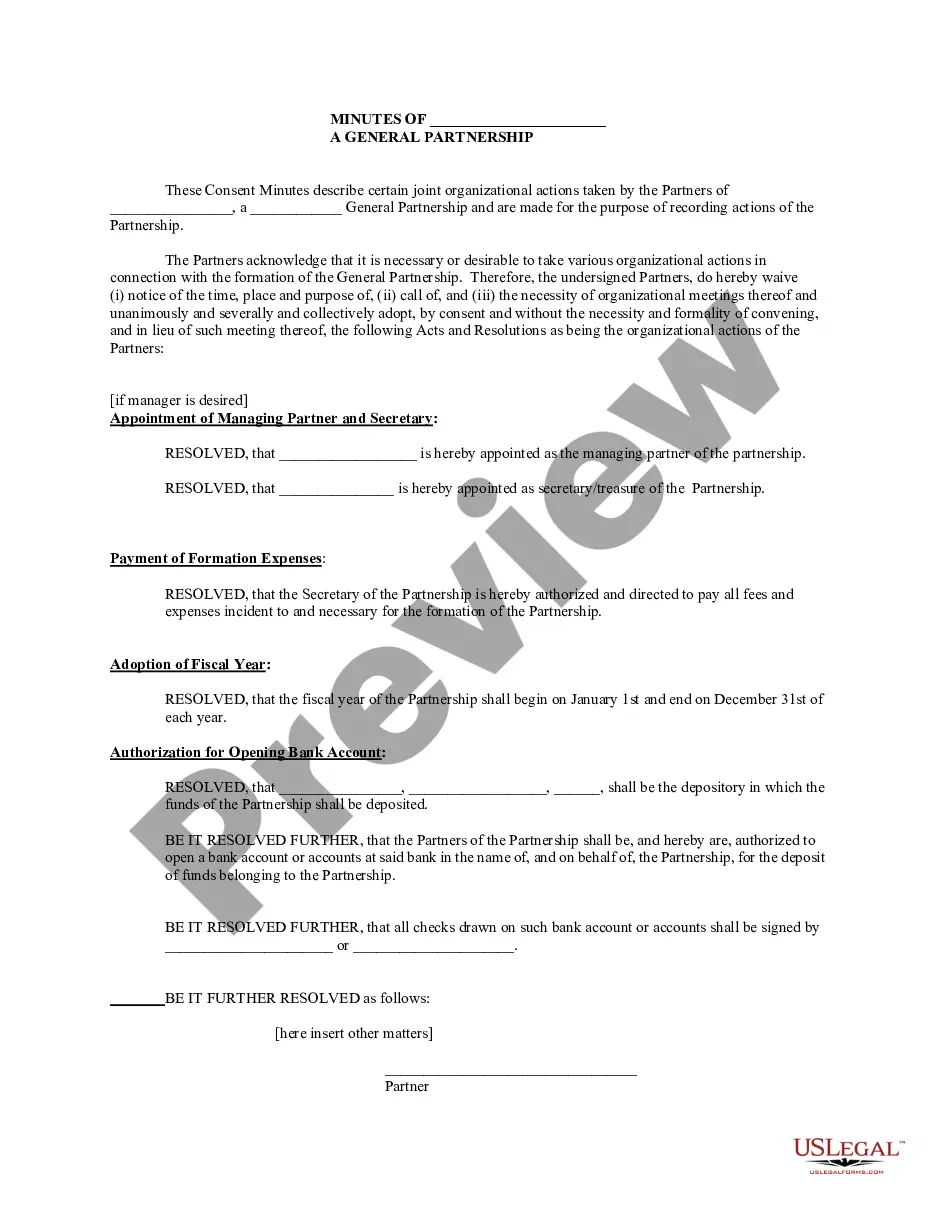
How to fill out Minutes For Partnership?
- Visit the US Legal Forms website and log in to your account if you're an existing user. Click the Download button to save the relevant form template on your device, ensuring your subscription is active.
- If you're new to US Legal Forms, begin by checking the Preview mode and form description to confirm you have selected the right document that meets your local jurisdictional requirements.
- Utilize the Search tab to find alternative templates if needed. Look for any inconsistencies before proceeding.
- Purchasing the document is next. Click on the Buy Now button and select your desired subscription plan, making sure to create an account to access a variety of resources.
- Complete your purchase by entering your payment details, either via credit card or PayPal.
- Download the form to your device so you can complete it later. It will also be accessible in the My Forms section of your account whenever you require it.
US Legal Forms provides an extensive library of over 85,000 easily fillable legal documents, ensuring that users have more options than with competitors at a similar cost.
With access to premium experts for assistance, you can ensure that your legal documents are completed accurately. Start your journey toward successful partnerships today!
Form popularity
FAQ
A general partnership involves all partners sharing responsibility for management and liabilities equally. In contrast, a limited partnership consists of at least one general partner who manages the business, while limited partners have restricted liability and do not engage in management activities. Understanding these distinctions can greatly impact your decision-making process related to general partnership vs limited partnership.
In a GP partnership, all partners are involved in management and share full liability. Conversely, an LP partnership allows certain partners to contribute capital without involvement in management responsibilities. This difference fundamentally influences how the partnership operates, particularly when considering the implications of general partnership vs limited partnership.
Whether it is better to be a GP or LP depends on your goals and risk tolerance. As a general partner, you gain control over the business but face greater liability. On the other hand, as a limited partner, your risk is minimal, but your ability to influence management decisions is limited. Assessing your priorities is key when weighing the general partnership vs limited partnership options.
The primary difference between GP (general partner) and LP (limited partner) lies in their roles and liabilities. General partners manage the business and are fully liable for debts, while limited partners typically have restricted liability and do not engage in day-to-day operations. This distinction is crucial when evaluating the dynamics of a general partnership vs limited partnership.
A fund limited partner is typically more of a passive investor who contributes capital without participating in daily operations. In contrast, a general partner actively manages the fund and assumes full liability for its debts. Understanding these roles can help you navigate the complexities of a general partnership vs limited partnership structure.
An LLC and a general partnership serve different purposes. An LLC offers personal liability protection, while a general partnership does not. This means that in a general partnership, your personal assets may be at risk if the business incurs debt. It is essential to consider your specific needs when comparing an LLC to a general partnership vs limited partnership.
A limited partnership consists of at least one general partner who manages the business and one or more limited partners who invest but do not manage. This contrasts with a general partnership, where all partners share management responsibilities and liability for debts. This distinction in a general partnership vs limited partnership affects how you structure your business and protect your assets. For tailored guidance, consider using platforms like uslegalforms to navigate these complexities.
In a partnership context, a general member has the authority to manage the business and becomes liable for its debts. In contrast, a limited member typically invests capital but does not participate in management decisions, thereby limiting their risk. Understanding the roles in a general partnership vs limited partnership helps in deciding which option best fits your business goals. It's important to define these roles clearly when forming your partnership.
Limited Liability Companies (LLCs) do not have general or limited partners in the same way that partnerships do. Instead, LLCs have members, who can manage the business fully or simply invest. Unlike a general partnership vs limited partnership situation, LLC members enjoy personal liability protection. This structure allows for greater flexibility in management and profit distribution.
To obtain a limited partnership, begin by selecting your partners and deciding on the business structure. Next, prepare and file the appropriate legal paperwork with your state, including a certificate of limited partnership. You will also want to draft an agreement that outlines responsibilities and profit-sharing among partners. Using a resource like UsLegalForms can make the process smoother and ensure compliance with laws related to general partnership vs limited partnership.