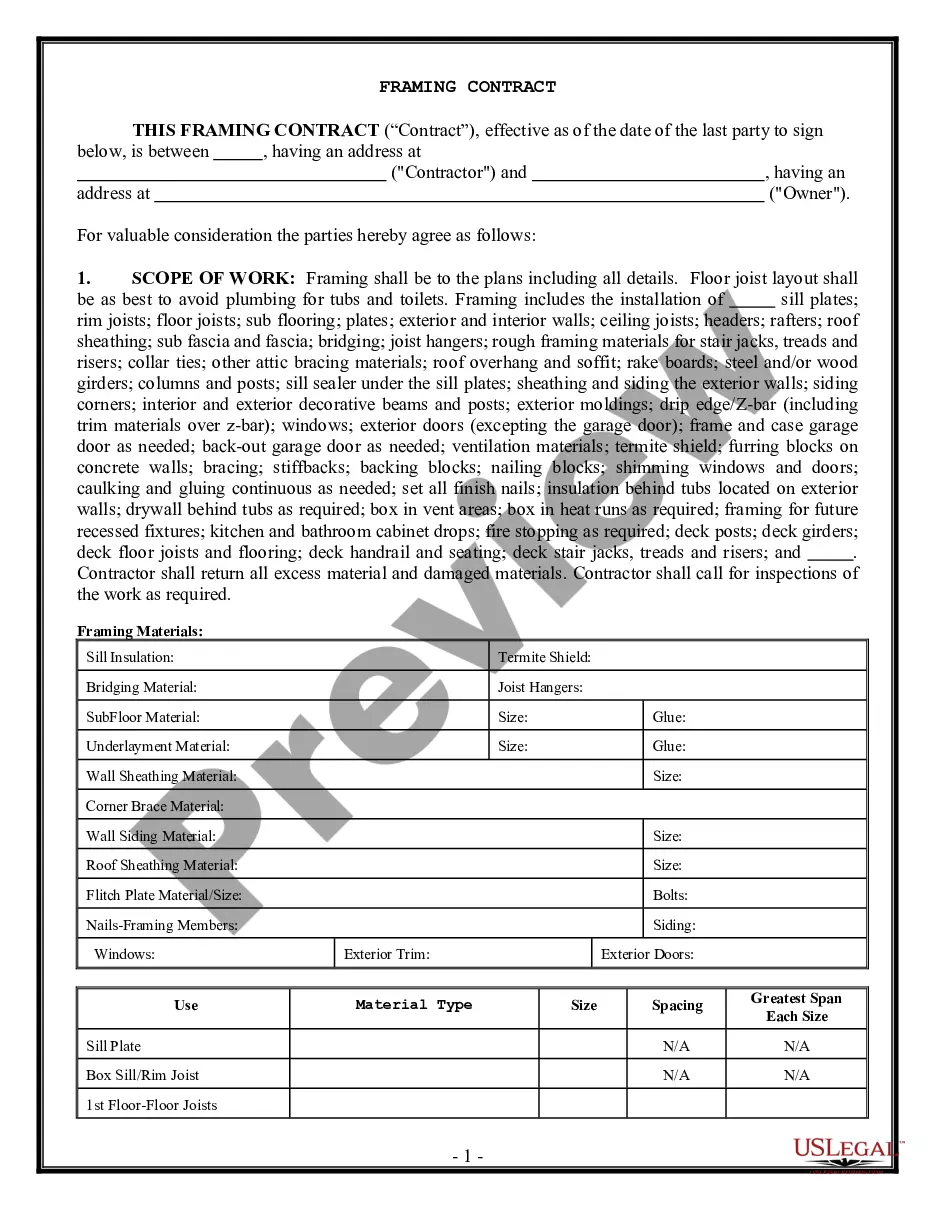
Building Contract For New Homes In San Diego
Description


Get your form ready online
Our built-in tools help you complete, sign, share, and store your documents in one place.
Make edits, fill in missing information, and update formatting in US Legal Forms—just like you would in MS Word.
Download a copy, print it, send it by email, or mail it via USPS—whatever works best for your next step.
Sign and collect signatures with our SignNow integration. Send to multiple recipients, set reminders, and more. Go Premium to unlock E-Sign.
If this form requires notarization, complete it online through a secure video call—no need to meet a notary in person or wait for an appointment.
We protect your documents and personal data by following strict security and privacy standards.

Make edits, fill in missing information, and update formatting in US Legal Forms—just like you would in MS Word.

Download a copy, print it, send it by email, or mail it via USPS—whatever works best for your next step.

Sign and collect signatures with our SignNow integration. Send to multiple recipients, set reminders, and more. Go Premium to unlock E-Sign.

If this form requires notarization, complete it online through a secure video call—no need to meet a notary in person or wait for an appointment.

We protect your documents and personal data by following strict security and privacy standards.
Looking for another form?



Form popularity
FAQ
How To Write A Construction Contract With 7 Steps Step 1: Define the Parties Involved. Step 2: Outline the Scope of Work. Step 3: Establish the Timeline. Step 4: Determine the Payment Terms. Step 5: Include Necessary Legal Clauses. Step 6: Address Change Orders and Modifications. Step 7: Sign and Execute the Contract.
Turnkey Contract or Lump Sum Contract In Turnkey or Lump Sum Contract the complete responsibility of Engineering, Liasoning, Procurement and Construction is given to a contractor. Generally homeowners prefer to give construction projects to Turnkey contracts only.
A Building permit is required to construct any new structure or improve existing buildings and other structures. The more common building permit applications are for new or remodels to single dwelling units, multi-dwelling units, commercial and industrial buildings and accessory structures.
A Building permit is required to construct any new structure or improve existing buildings and other structures. The more common building permit applications are for new or remodels to single dwelling units, multi-dwelling units, commercial and industrial buildings and accessory structures.
BUILDING PERMITS A permit is required to construct, enlarge, alter, convert (including change of occupancy, use, or character), repair, move, or demolish a structure. Permits are also required for grading, plumbing, electrical, and mechanical work. Permits must be obtained prior to construction.
Overall processing time to obtain a new single family dwelling building permit is typically six months to one year from submittal to issuance of the permit. Plan check turnaround times for “log-in” plan checks vary due to workload.
San Diego may not require a building permit for sheds that are 120 square feet or less that don't have any utilities. However, they still require a planning permit for sheds that are under 120 square feet. Learn more about this or obtain one of the aforementioned permits through the San Diego County Building Division.
Overall, it usually takes around 24 months to build a home from beginning to end. Typically, we estimate that the lot search will last between 2-5 months, followed by 3-5 months of designing the house, and 10-12 months of actual construction time.
