Fee Cost Plus Without Contract
Description

Get your form ready online
Our built-in tools help you complete, sign, share, and store your documents in one place.
Make edits, fill in missing information, and update formatting in US Legal Forms—just like you would in MS Word.
Download a copy, print it, send it by email, or mail it via USPS—whatever works best for your next step.
Sign and collect signatures with our SignNow integration. Send to multiple recipients, set reminders, and more. Go Premium to unlock E-Sign.
If this form requires notarization, complete it online through a secure video call—no need to meet a notary in person or wait for an appointment.
We protect your documents and personal data by following strict security and privacy standards.

Make edits, fill in missing information, and update formatting in US Legal Forms—just like you would in MS Word.

Download a copy, print it, send it by email, or mail it via USPS—whatever works best for your next step.

Sign and collect signatures with our SignNow integration. Send to multiple recipients, set reminders, and more. Go Premium to unlock E-Sign.

If this form requires notarization, complete it online through a secure video call—no need to meet a notary in person or wait for an appointment.

We protect your documents and personal data by following strict security and privacy standards.
Looking for another form?




How to fill out Construction Contract For Home - Fixed Fee Or Cost Plus?
It's clear that you cannot transform into a legal expert instantly, nor can you learn how to swiftly create a Fee Cost Plus Without Contract without possessing a unique set of competencies.
Assembling legal paperwork is a labor-intensive task that necessitates a particular education and abilities. So why not entrust the creation of the Fee Cost Plus Without Contract to the experts.
With US Legal Forms, one of the largest collections of legal templates, you can find anything from court documents to templates for internal business communication. We recognize how crucial compliance and adherence to federal and state regulations are. Hence, on our platform, all templates are region-specific and current.
Select Buy now. As soon as the payment is processed, you can access the Fee Cost Plus Without Contract, complete it, print it, and send or mail it to the relevant individuals or institutions.
You can revisit your documents from the My documents tab at any moment. If you're an existing client, you can simply Log In and locate and download the template from the same tab.
- Begin with our platform and obtain the form you require in just a few minutes.
- Find the document you need using the search bar at the top of the page.
- Preview it (if this option is available) and review the accompanying description to determine if Fee Cost Plus Without Contract is what you're looking for.
- Initiate your search again if you require a different template.
- Create a complimentary account and choose a subscription plan to purchase the template.
Form popularity
FAQ
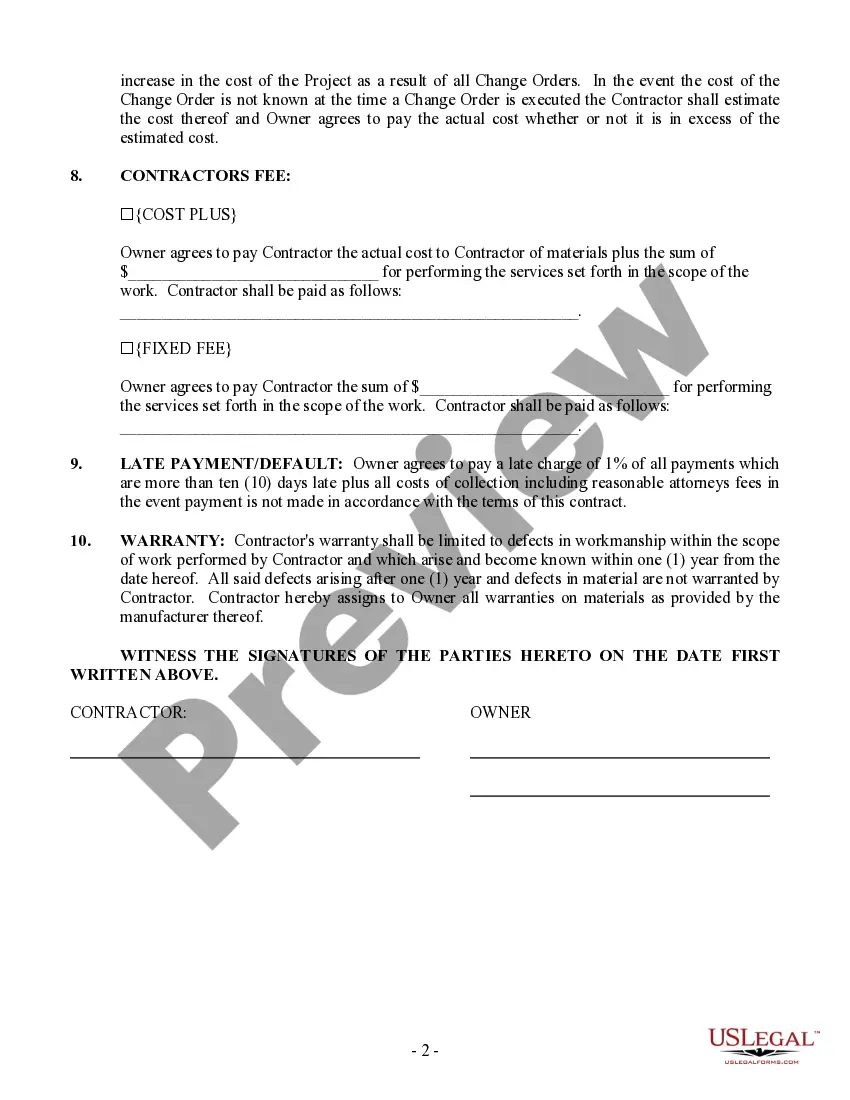
reimbursement no fee contract allows a contractor to receive reimbursement for allowable costs incurred during the performance of a project, but without any added profit margin. In this arrangement, the contractor simply seeks to recover their expenses, which can be beneficial in some scenarios. This type of contract, particularly regarding fee cost plus without contract, emphasizes transparency and serves projects where the scope may not be fully defined at the start. To explore various contract forms, uslegalforms offers resources to help you understand your options.
To calculate a cost-plus-incentive-fee contract, start by estimating the total costs associated with the project. Then, establish the base fee, which is typically a percentage of the estimated costs. Finally, determine the incentive structure, where additional fees are earned based on cost savings or performance metrics. For clarity on fee cost plus without contract, using tools provided by uslegalforms can streamline your calculations.
Cost-plus contracts allow parties to bill for actual costs incurred in completing a project plus an additional fee for profit. It's important to ensure that all costs are documented clearly, and the fee structure should be agreed upon before the work begins. When considering a fee cost plus without contract, transparency in communication is key, as it helps prevent misunderstandings later. For those seeking a straightforward approach, the US Legal Forms platform can provide templates that simplify the process, helping you understand and implement these rules effectively.
plus fee contract is an arrangement where the client pays the contractor for all construction costs, plus an additional fee for profit. This fee can be a flat amount or a percentage of the costs incurred. This model provides flexibility and encourages efficient project management, as the contractor can focus on quality without the pressure of fixed costs. If you're considering this model, the fee cost plus without contract may be an attractive option to explore.
Billing for cost-plus contracts typically involves detailing both direct costs, such as materials and labor, and any additional agreed-upon fees. It's essential to keep thorough documentation of all expenses, as transparency fosters trust and clarity. You should ensure that your invoicing aligns with the terms set in your contract to avoid misunderstandings. Considering a fee cost plus without contract can make the billing process smoother for both parties.
The four common types of contracts are express contracts, implied contracts, unilateral contracts, and bilateral contracts. Each type has its unique characteristics and implications in legal situations. Understanding these contracts can help you navigate legal agreements effectively, especially if you prefer fee cost plus without contract options. If you need assistance, the US Legal Forms platform offers resources that break down these contract types for better clarity.
Once the three major credit reporting agencies, Transunion, Experian and Equifax receive the judgment, it will become part of the records section of the applicant's credit report. Collection accounts remain on a credit report for seven years from the filing date or delinquency date.
A Maine eviction process does not allow a landlord to evict a tenant without good cause. The landlord must either wait for the tenant to commit a violation or wait for their rental term to end. However, tenants can be evicted if they stay in the property even a day after their lease term ends.
In a tenancy at will, the landlord, or their agent, must deliver the 7-day or 30-day notice to the tenant in person. The notice does not have to be served by a sheriff. Exception: The landlord, or their agent, must make 3 good faith efforts to hand deliver you the notice.
A landlord must give you adequate notice before you are evicted or your rent is increased. The landlord cannot abuse your security deposits. Tenants always have a right to a court hearing before the landlord can evict them. Unfair rental contracts can be in violation of the Maine Unfair Trade Practices Act.