Sublease Apartment Rental With Utilities Included In Wayne
Description


Get your form ready online
Our built-in tools help you complete, sign, share, and store your documents in one place.
Make edits, fill in missing information, and update formatting in US Legal Forms—just like you would in MS Word.
Download a copy, print it, send it by email, or mail it via USPS—whatever works best for your next step.
Sign and collect signatures with our SignNow integration. Send to multiple recipients, set reminders, and more. Go Premium to unlock E-Sign.
If this form requires notarization, complete it online through a secure video call—no need to meet a notary in person or wait for an appointment.
We protect your documents and personal data by following strict security and privacy standards.

Make edits, fill in missing information, and update formatting in US Legal Forms—just like you would in MS Word.

Download a copy, print it, send it by email, or mail it via USPS—whatever works best for your next step.

Sign and collect signatures with our SignNow integration. Send to multiple recipients, set reminders, and more. Go Premium to unlock E-Sign.

If this form requires notarization, complete it online through a secure video call—no need to meet a notary in person or wait for an appointment.

We protect your documents and personal data by following strict security and privacy standards.
Looking for another form?

Form popularity
FAQ
A person who formally allows someone else to rent from them all or part of a building that they are renting from the owner. (Definition of sublessor from the Cambridge Business English Dictionary © Cambridge University Press)
A lease is a rental contract between a landlord and a tenant, whereas a sublease is a contract between a tenant and a sub-tenant who has assumed obligations of the tenant's lease.
Subletting is when the original renter (the “sublessor”) remains responsible for a lease, and either lives with a sublessee (the new tenant), or has a sublessee take their place living in the home.
The original lessee, who is leasing the asset from the primary lessor, becomes the sublessor when they decide to lease the asset, or part of it, to another party. This new party is known as the sublessee.
The original tenant, or sublessor, remains responsible for the lease with the landlord, while the subtenant occupies the property and pays rent to the sublessor under the terms of a separate sublease agreement.
A potentially devastating detriment to a sublease is its subject to the original tenant not defaulting. You could be compliant with your sublease and receive notice your lease is terminated because the original tenant defaulted. You could be subject to the landlord's new terms or be forced to vacate.
A subletter is someone who takes over the lease agreement from the original tenant, known as the sublessor. They essentially become a tenant of the property but with a temporary arrangement. 1. Definition: A subletter is an individual who temporarily takes over a lease from the original tenant, known as the sublessor.
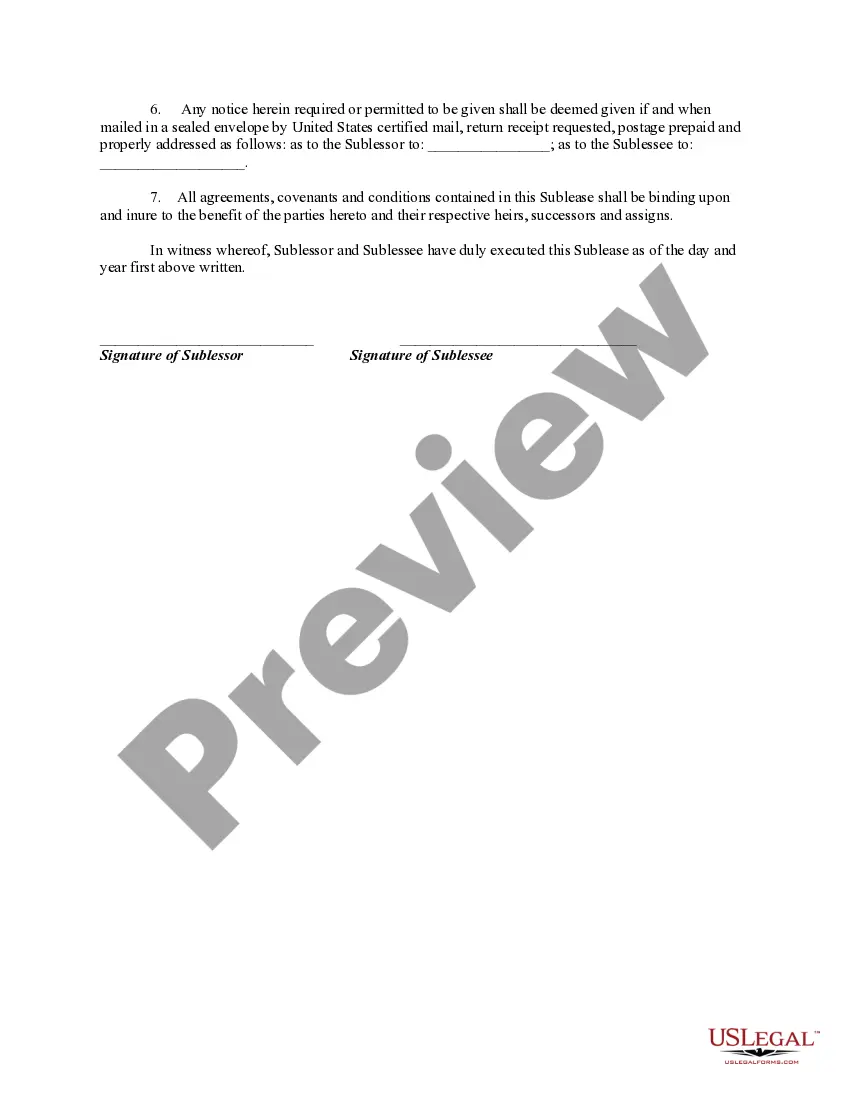
A sublease is a lease by the lessee of an estate to a third person, conveying all or part of the estate for a shorter term than that for which the lessee holds originally. A sublease is a new contract between the lessee and the sublessee. The original lessee turns into a sublessor in this new contract.
