Restrictive Covenants In Land Law In Harris
Description

Get your form ready online
Our built-in tools help you complete, sign, share, and store your documents in one place.
Make edits, fill in missing information, and update formatting in US Legal Forms—just like you would in MS Word.
Download a copy, print it, send it by email, or mail it via USPS—whatever works best for your next step.
Sign and collect signatures with our SignNow integration. Send to multiple recipients, set reminders, and more. Go Premium to unlock E-Sign.
If this form requires notarization, complete it online through a secure video call—no need to meet a notary in person or wait for an appointment.
We protect your documents and personal data by following strict security and privacy standards.
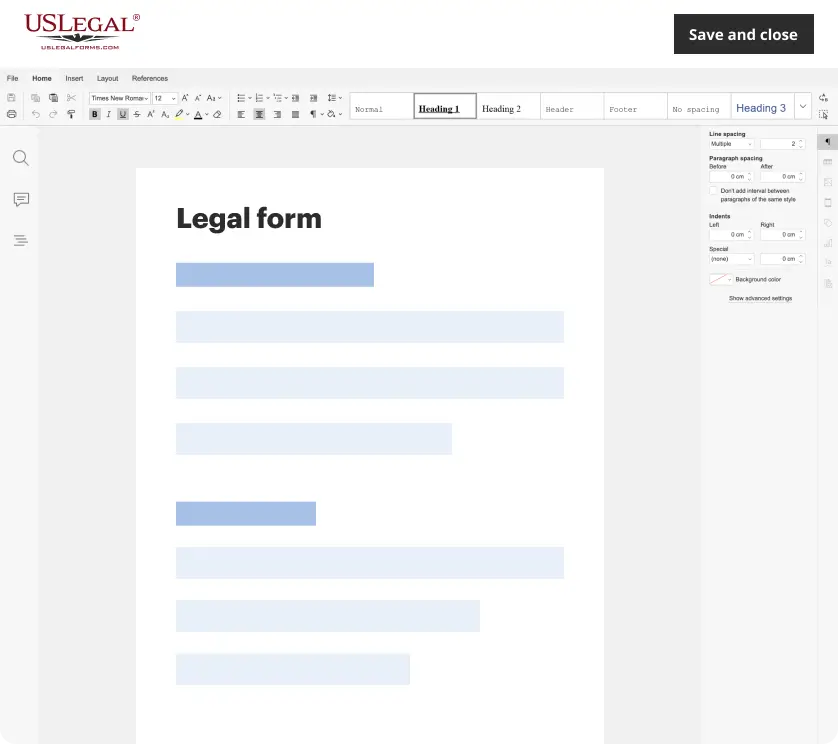
Make edits, fill in missing information, and update formatting in US Legal Forms—just like you would in MS Word.
Download a copy, print it, send it by email, or mail it via USPS—whatever works best for your next step.
Sign and collect signatures with our SignNow integration. Send to multiple recipients, set reminders, and more. Go Premium to unlock E-Sign.

If this form requires notarization, complete it online through a secure video call—no need to meet a notary in person or wait for an appointment.
We protect your documents and personal data by following strict security and privacy standards.
Looking for another form?


Form popularity
FAQ
Justice courts are limited to enforcing residential subdivision deed restrictions, except for restrictions related to structural changes of a dwelling. A justice court cannot order specific performance, unlike a district court. Instead, it can assess civil damages of up to $200 for each day of each violation.
Restrictive covenants) are enforceable in Texas. To be valid under Texas law, a covenant not to compete must be “ancillary to an otherwise enforceable agreement.” Then, the restrictions must be reasonable in scope.
In Texas, a covenant runs with the land when it “touches and concerns” the land; relates to a thing in existence or specifically binds the parties and their assigns; is intended by the original parties to run with the land; and when the successor to the burden has notice.
If it looks like a restrictive covenant is enforceable and is going to be breached by development, seek to obtain a restrictive covenant title indemnity insurance policy to cover any loss from a claim from a beneficiary. You should insure the full gross development value of the property affected.
A covenant must exist in writing, either as a specific instrument or in a deed . Real covenants affect the landowner's property rights and “ run with the land ,” meaning that future owners of the property are bound by the covenant.
What is a Land Use Covenant (LUC)? Under federal and state laws, institutional controls help protect against unsafe exposure to hazardous substances on public or private property. These restrictions are supported by toxicological evaluation or screening.
A bill was introduced in Texas in 2007 to create covenant marriage in the state, but it failed to pass. Biblical teachings are the backbone of covenant marriage, with the belief that marriage is a lifelong promise between both parties to the marriage and God.
Restrictive covenants are most common when your property is part of a homeowners association, inium association, or planned community. Typical limits include restrictions on how many people can occupy the home and the colors you are allowed to paint the exterior.
It is possible to apply to the Lands Chamber of the Upper Tribunal to have a restrictive covenant “discharged or modified”, as the statute puts it, in order to get the covenant removed or changed so that development can take place or the use of the land can be changed.
How long do restrictive covenants last? They have no official expiration date. As long as the legal requirements for a restrictive covenant are otherwise met, a restrictive covenant could be hundreds of years old and could still be enforceable.
