State Specific Employment Laws Within A Company In San Diego
Description
















Get your form ready online
Our built-in tools help you complete, sign, share, and store your documents in one place.
Make edits, fill in missing information, and update formatting in US Legal Forms—just like you would in MS Word.
Download a copy, print it, send it by email, or mail it via USPS—whatever works best for your next step.
Sign and collect signatures with our SignNow integration. Send to multiple recipients, set reminders, and more. Go Premium to unlock E-Sign.
If this form requires notarization, complete it online through a secure video call—no need to meet a notary in person or wait for an appointment.
We protect your documents and personal data by following strict security and privacy standards.
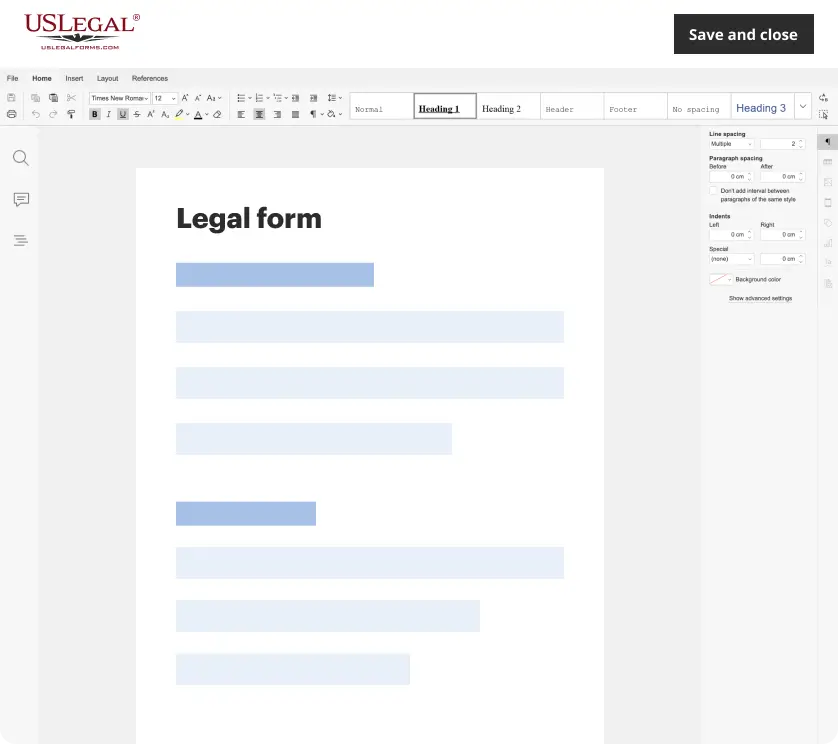
Make edits, fill in missing information, and update formatting in US Legal Forms—just like you would in MS Word.
Download a copy, print it, send it by email, or mail it via USPS—whatever works best for your next step.
Sign and collect signatures with our SignNow integration. Send to multiple recipients, set reminders, and more. Go Premium to unlock E-Sign.
If this form requires notarization, complete it online through a secure video call—no need to meet a notary in person or wait for an appointment.
We protect your documents and personal data by following strict security and privacy standards.
Looking for another form?
Form popularity
FAQ
Most employers are surprised to learn that California does not require companies to have an employee handbook. However, the Fair Employment and Housing Act (FEHA) requires that California employers with at least five employees distribute written harassment, discrimination, and retaliation prevention policies.
The Fair Employment and Housing Act (California Government Code Section 12900-12951 & 12927-12928 & 12955 - 12956.1 & 12960-12976) provides protection from harassment or discrimination in employment because of: age (40 and over), ancestry, color, creed, denial of family and medical care leave, disability (mental and ...
Each state sets laws related to fair employment and workplace safety. In most cases, state laws offer more protections than the federal ones. Contact your state department of labor to learn about the labor laws in your state.
California labor laws are renowned for their comprehensive nature, providing many employee protections. However, they primarily apply to individuals who perform work within the state's borders. This includes individuals who physically work in California, regardless of their residency or the location of their employer.
Usually, these laws primarily apply to employers operating within the geographical boundaries of California. However, there are particular situations where out-of-state employers may find themselves under the jurisdiction of California labor laws.
The Professional Exemption sets out eight specific professions (law, medicine, dentistry, optometry, architecture, engineering, teaching, and accounting) that are exempt from the first 12 sections of the Wage Orders. It also addresses certain other professions, including nurses, pharmacists and software coders.
If you wish to report a widespread violation of labor law by your employer or a violation affecting multiple employees, please contact LETF via phone, online lead referral form or email: Call the LETF Public hotline anytime: 855 297 5322. Complete the Online Form / Spanish Form. Email us at letf@dir.ca.
All workers have rights on the job. In California, workers are protected by labor laws. It does not matter where you were born or what your legal status is. Once you are hired, you have rights.
Minimum Wage and Overtime The FLSA is enforced by the Department's Wage and Hour Division (WHD) and covers more than 143 million workers. The FLSA does not provide an exemption from these requirements specifically for small businesses.