Annual Meeting Shareholders With Manager In Nevada
Description



Get your form ready online
Our built-in tools help you complete, sign, share, and store your documents in one place.
Make edits, fill in missing information, and update formatting in US Legal Forms—just like you would in MS Word.
Download a copy, print it, send it by email, or mail it via USPS—whatever works best for your next step.
Sign and collect signatures with our SignNow integration. Send to multiple recipients, set reminders, and more. Go Premium to unlock E-Sign.
If this form requires notarization, complete it online through a secure video call—no need to meet a notary in person or wait for an appointment.
We protect your documents and personal data by following strict security and privacy standards.

Make edits, fill in missing information, and update formatting in US Legal Forms—just like you would in MS Word.

Download a copy, print it, send it by email, or mail it via USPS—whatever works best for your next step.

Sign and collect signatures with our SignNow integration. Send to multiple recipients, set reminders, and more. Go Premium to unlock E-Sign.

If this form requires notarization, complete it online through a secure video call—no need to meet a notary in person or wait for an appointment.

We protect your documents and personal data by following strict security and privacy standards.
Looking for another form?




Form popularity
FAQ
The Nevada Revised Statutes (NRS) are the current codified laws of the State of Nevada. The Statutes of Nevada are a compilation of all legislation passed by the Nevada Legislature during a particular Legislative Session.
Does Nevada Require Corporate Bylaws? No. NV Rev Stat § 78.046 describes some of the powers bylaws can have, but it doesn't mandate that corporations adopt bylaws. Even so, bylaws are essential legal documents for corporations.
Nevada law contains a provision governing “acquisition of controlling interest.” This law provides generally that any person or entity that acquires 20% or more of the outstanding voting shares of a publicly-held Nevada corporation in the secondary public or private market may be denied voting rights with respect to ...
Chapter 78 - Private Corporations. NRS 78.315 - Directors' meetings: Quorum; consent for actions taken without meeting; alternative means for participating at meeting.
Section 601 - Notice of shareholders' meeting or report (a) Whenever shareholders are required or permitted to take any action at a meeting a written notice of the meeting shall be given not less than 10 (or, if sent by third-class mail, 30) nor more than 60 days before the date of the meeting to each shareholder ...
The corporate opportunity doctrine prohibits a corporate fiduciary from exploiting an opportunity related to the corporation's business unless he or she first offers that opportunity to the corporation.
As the name implies, an annual general meeting (AGM) is a yearly meeting where shareholders and board members converge to discuss business matters, review financial reports, and vote on the election or removal of company directors. AGMs are mandatory for both public and private companies.
If your business is set up and registered as a Corporation, you're required by law to hold an annual shareholder meeting and to document the meeting with minutes.
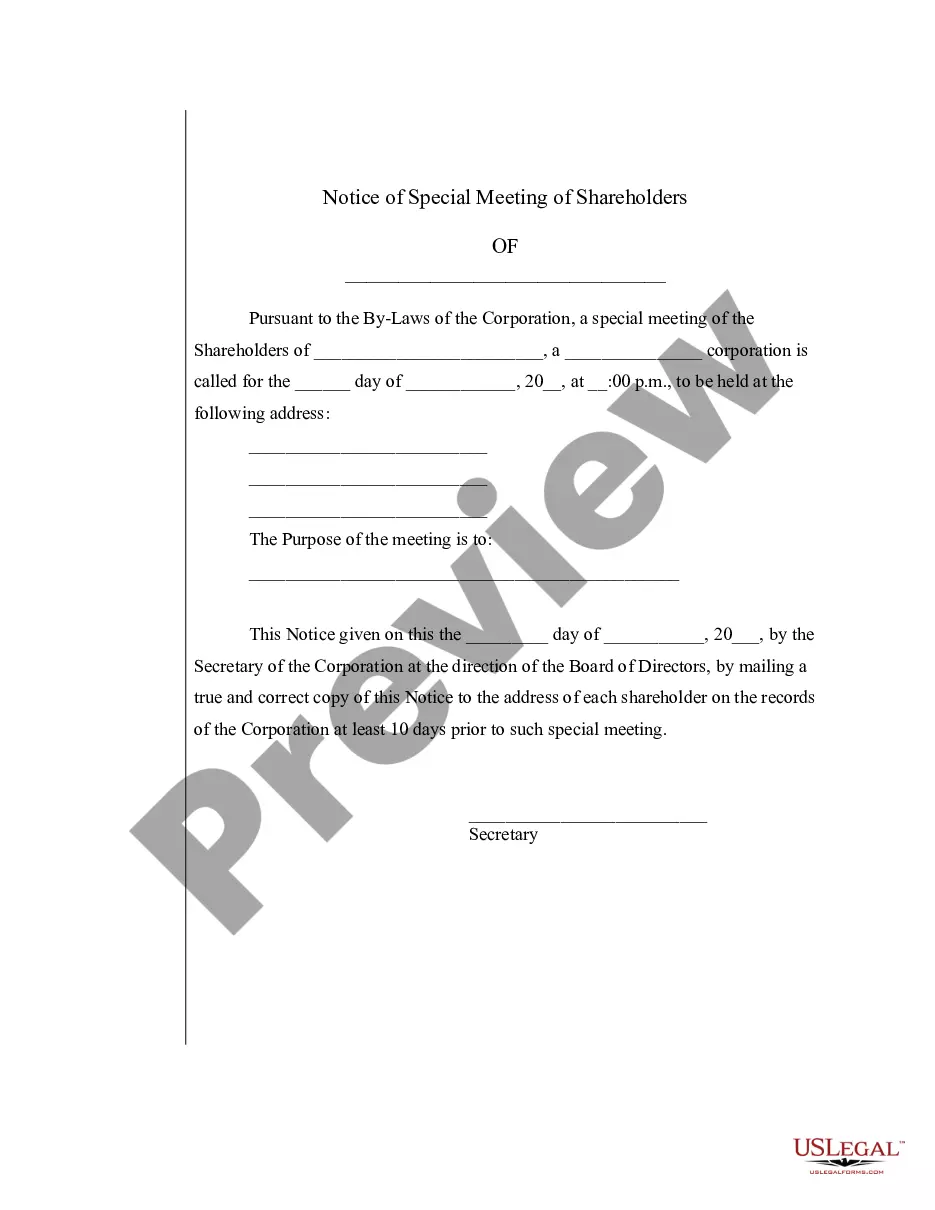
All shareholders must be notified of the format, date, time, and place of the meeting. How far in advance notices should be distributed may depend on your state, but generally, they should be sent out more than 10 days prior to the meeting, but less than 60 days.
A General Meeting is simply a meeting of shareholders and 21 days' notice must be given to shareholders, but this can be reduced to 14 days, or increased to 28 days, in certain situations.

