Special Meeting Notice Requirements In Phoenix
Description


Get your form ready online
Our built-in tools help you complete, sign, share, and store your documents in one place.
Make edits, fill in missing information, and update formatting in US Legal Forms—just like you would in MS Word.
Download a copy, print it, send it by email, or mail it via USPS—whatever works best for your next step.
Sign and collect signatures with our SignNow integration. Send to multiple recipients, set reminders, and more. Go Premium to unlock E-Sign.
If this form requires notarization, complete it online through a secure video call—no need to meet a notary in person or wait for an appointment.
We protect your documents and personal data by following strict security and privacy standards.

Make edits, fill in missing information, and update formatting in US Legal Forms—just like you would in MS Word.

Download a copy, print it, send it by email, or mail it via USPS—whatever works best for your next step.

Sign and collect signatures with our SignNow integration. Send to multiple recipients, set reminders, and more. Go Premium to unlock E-Sign.

If this form requires notarization, complete it online through a secure video call—no need to meet a notary in person or wait for an appointment.

We protect your documents and personal data by following strict security and privacy standards.
Looking for another form?

Form popularity
FAQ
The Ralph M. Brown Act is a “public access law” that ensures the public's right to attend the meetings of public agencies, facilitates public participation in all phases of local government decision-making, and curbs misuse of the democratic process by secret legislation.
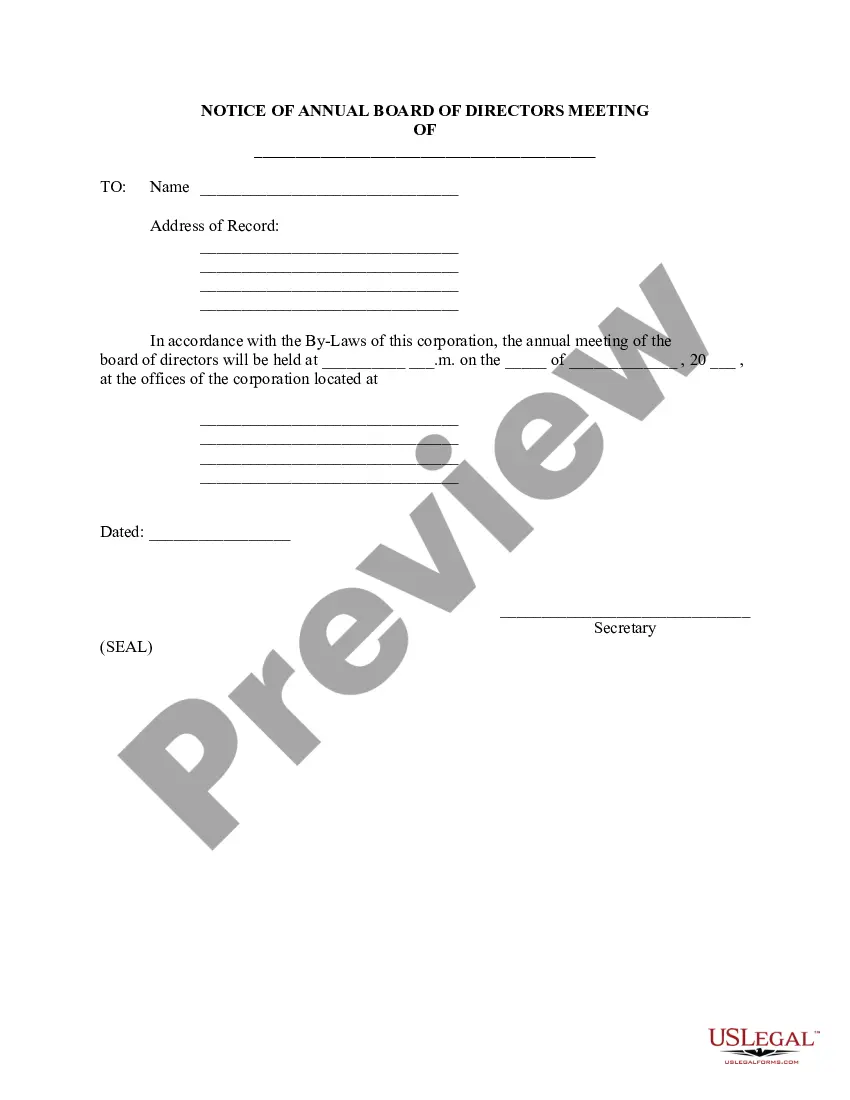
The notice must provide directors with the date, time, and location of the meeting. Although technically, the purpose of the meeting does not have to be provided, it is generally a good idea to include an agenda or similar information so directors know what to expect and why it is important to attend.
The Brown Act applies only to local agencies such as city councils, school boards, and county boards of supervisors. It requires local agencies to adhere to a set of rules so that government officials are not meeting in secret.
Louisiana Open Meeting Law. Maine Open Meeting Law. Maryland Open Meetings Act. Massachusetts Open Meetings Act. Michigan Open Meetings Act. Minnesota Open Meeting Law. Mississippi Open Meetings Act. Missouri Sunshine Law for open meetings.
Open Meeting Law does not apply to homeowner associations.
Arizona's Open Meeting Law. It is the public policy of this state that meetings of public bodies be conducted openly and that notices and agendas be provided for such meetings which contain such information as is reasonably necessary to inform the public of the matters to be discussed or decided.
Since 1967, the Freedom of Information Act (FOIA) has provided the public the right to request access to records from any federal agency. It is often described as the law that keeps citizens in the know about their government.
Open meeting laws, also known as Sunshine Laws, require that public access is provided to government meetings and reports. These laws ensure that government activities are transparent and open to the public, preventing officials from making policies behind closed doors.
Arizona's Open Meeting Law. It is the public policy of this state that meetings of public bodies be conducted openly and that notices and agendas be provided for such meetings which contain such information as is reasonably necessary to inform the public of the matters to be discussed or decided.
An executive session is a meeting conducted without the presence of “outsiders.” In corporate governance, it's usually a meeting that only board members can attend.

