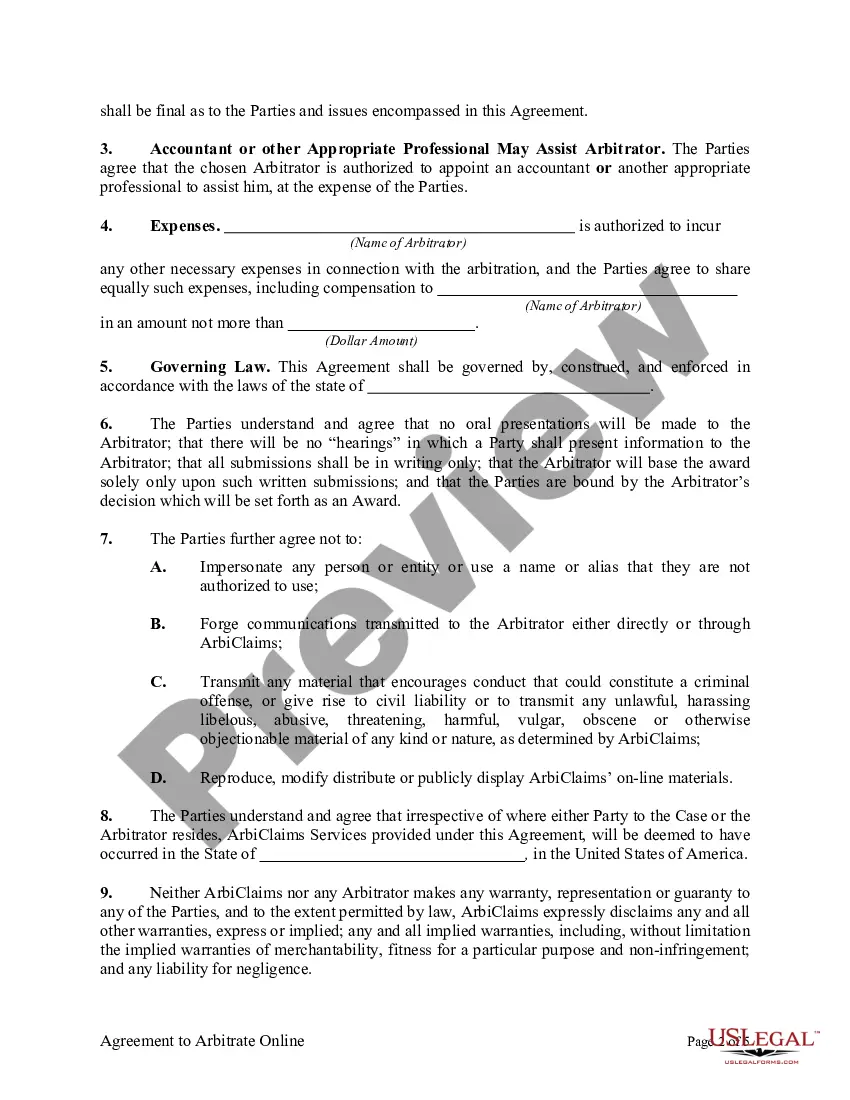
Agreement Arbitrate Sample For Claim In Nassau
Description








Form popularity
FAQ
Arbitration might be the right choice for some cases. Limited discovery rights and costs might be useful when less is at stake. Arbitration might feel less adversarial, which could be an advantage where ongoing relationships are hoped to be preserved. Arbitration lends some confidentiality.
Arbitration is a legal process where a neutral third-party reviews all claim and appeal documentation and issues a final, binding decision. By choosing arbitration, claimants can resolve their disputes outside of court, with a qualified independent arbitrator conducting the hearing and delivering a resolution.
When you raise a specific objection, offer a legal basis for the objection and then avoid further argument or discussion until the arbitrator asks for your further response. If the union advocate has raised a specific objection, avoid responding until asked to do so by the arbitrator.
Arbitration is a private, informal process by which all parties agree, in writing, to submit their disputes to one or more impartial persons authorized to resolve the controversy by rendering a final and binding decision called an Award.
Arbitration agreements require that persons who signed them resolve any disputes by binding arbitration, rather than in court before a judge and/or jury. What is binding arbitration? Binding arbitration involves the submission of a dispute to a neutral party who hears the case and makes a decision.
Arbitration agreements are common in consumer contracts and employment contracts, but they can be proposed additions to any contract negotiation in which one or both parties would like to head off the possibility of a future lawsuit.
Final answer: Yes, parties to an international contract can agree to an arbitration clause, which allows a neutral third party to make a binding decision on a dispute.
Arbitration is a form of alternative dispute resolution. It allows both sides to present their case in an expedited fashion to a panel of three attorneys who render a decision that same day.
The Balance, Oct. 26, 2021) “Litigation is an ancient process that involves determining issues through a court with a judge or jury. Arbitration, on the other hand, involves two parties in a dispute who agree to work with a neutral third party in an attempt to resolve the dispute.
