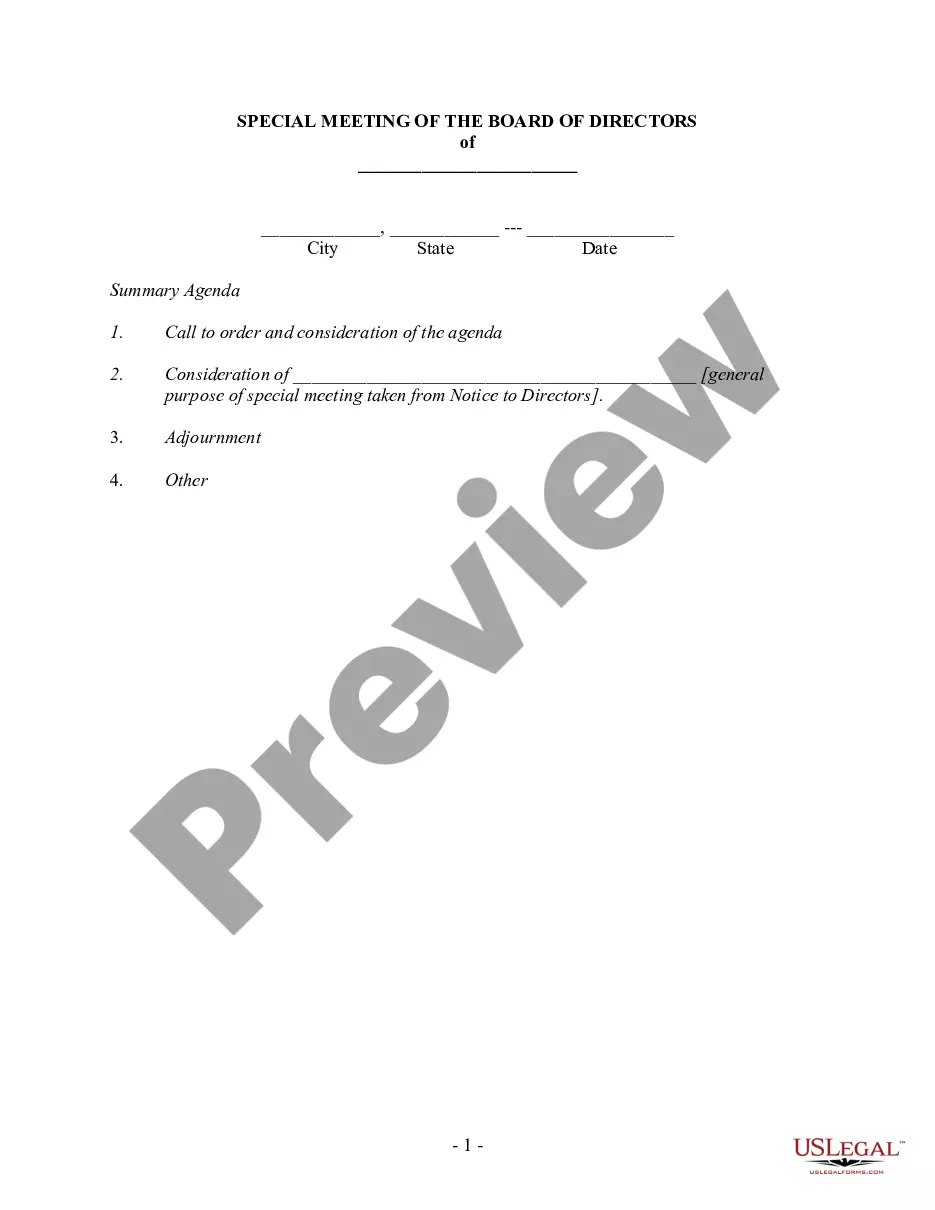
Board Meeting With In California
Description



Get your form ready online
Our built-in tools help you complete, sign, share, and store your documents in one place.
Make edits, fill in missing information, and update formatting in US Legal Forms—just like you would in MS Word.
Download a copy, print it, send it by email, or mail it via USPS—whatever works best for your next step.
Sign and collect signatures with our SignNow integration. Send to multiple recipients, set reminders, and more. Go Premium to unlock E-Sign.
If this form requires notarization, complete it online through a secure video call—no need to meet a notary in person or wait for an appointment.
We protect your documents and personal data by following strict security and privacy standards.

Make edits, fill in missing information, and update formatting in US Legal Forms—just like you would in MS Word.

Download a copy, print it, send it by email, or mail it via USPS—whatever works best for your next step.

Sign and collect signatures with our SignNow integration. Send to multiple recipients, set reminders, and more. Go Premium to unlock E-Sign.

If this form requires notarization, complete it online through a secure video call—no need to meet a notary in person or wait for an appointment.

We protect your documents and personal data by following strict security and privacy standards.
Looking for another form?
Form popularity
FAQ
The Brown Act was enacted in 1953 to guarantee the public's right to attend and participate in meetings of local legislative bodies, and as a response to growing concerns about local government officials' practice of holding secret meetings that were not in compliance with advance public notice requirements.
Brown Act is California's open meetings law. It mandates open and transparent government meetings for local legislative bodies. The Brown Act applies only to local agencies such as city councils, school boards, and county boards of supervisors.
2. What should be excluded in the meeting minutes? Avoid switching tenses in your writing. Avoid recording the debate; just record the outcome. Avoid making personal observations or opinions. Avoid verbatim quotes. Avoid letting the meeting move on if you're confused.
Essentially, the meeting protocol is a template workflow from calling the meeting to signing off the minutes from the previous meeting. The technical details that must be met to ensure the board can make its decisions. This could be the minimum number of members required for a quorum or the type of majority needed.
State Open Meeting Act laws, also known as sunshine laws or open meetings laws, are regulations and laws that require government agencies, boards, commissions, and other public bodies to conduct their meetings and decision-making processes transparently and openly.
Upon finding a violation of the Open Meeting Law, the Attorney General may impose a civil penalty upon a public body of not more than $1,000 for each intentional violation.
Under California law, you must have a quorum of at least two directors or one-fifth of all authorized directors (whichever is larger) to take valid action at a board meeting. Your organization's bylaws may set higher quorum limits, so be sure to take a look through them before proceeding.
Under the Act, all meetings of local legislative bodies are open and public, and all persons are permitted to attend the meetings.
A call to order is the defined start to the meeting agenda and is usually called for by the Chairperson, by declaring that: “The meeting will now come to order”.
"Any Director of a company may, at any time, summon a Meeting of the Board, and the Company Secretary or where there is no Company Secretary, any person authorised by the Board in this behalf, on the requisition of a Director, shall convene a Meeting of the Board, in consultation with the Chairman or in his absence, ...

