Business Meeting Format
Description



Get your form ready online
Our built-in tools help you complete, sign, share, and store your documents in one place.
Make edits, fill in missing information, and update formatting in US Legal Forms—just like you would in MS Word.
Download a copy, print it, send it by email, or mail it via USPS—whatever works best for your next step.
Sign and collect signatures with our SignNow integration. Send to multiple recipients, set reminders, and more. Go Premium to unlock E-Sign.
If this form requires notarization, complete it online through a secure video call—no need to meet a notary in person or wait for an appointment.
We protect your documents and personal data by following strict security and privacy standards.

Make edits, fill in missing information, and update formatting in US Legal Forms—just like you would in MS Word.

Download a copy, print it, send it by email, or mail it via USPS—whatever works best for your next step.

Sign and collect signatures with our SignNow integration. Send to multiple recipients, set reminders, and more. Go Premium to unlock E-Sign.

If this form requires notarization, complete it online through a secure video call—no need to meet a notary in person or wait for an appointment.

We protect your documents and personal data by following strict security and privacy standards.
Looking for another form?


How to fill out Annual Board Of Directors Meeting Minutes - Corporate Resolutions?
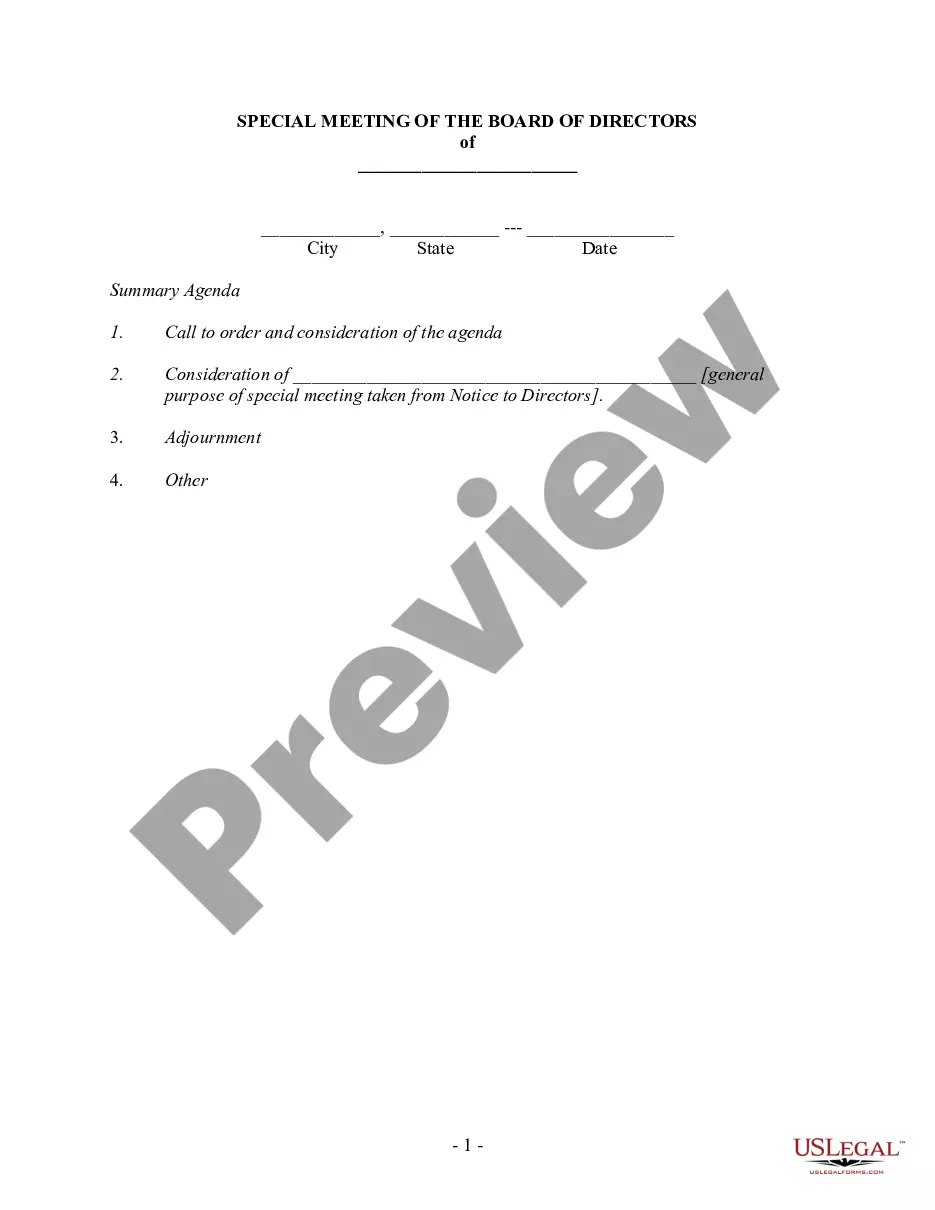
The Business Meeting Format displayed on this page is a versatile formal template created by legal experts in compliance with national and local regulations.
For over 25 years, US Legal Forms has supplied individuals, businesses, and legal practitioners with more than 85,000 validated, state-specific documents for various business and personal events. It is the fastest, simplest, and most reliable method to acquire the necessary paperwork, as the service ensures the utmost level of data protection and anti-malware safeguards.
Select the format you desire for your Business Meeting Format (PDF, DOCX, RTF) and store the document on your device.
- Search for the document you require and review it.
- Browse through the file you searched and preview it or verify the form description to confirm it meets your requirements. If it does not, utilize the search feature to find the correct one. Click Buy Now when you have found the template you need.
- Choose and Log Into your account.
- Select the pricing option that fits you and set up an account. Use PayPal or a credit card to complete a swift payment. If you already have an account, Log In and verify your subscription to continue.
- Obtain the editable template.
Form popularity
FAQ
The 40 20 40 rule for meetings suggests allocating 40% of the time to presentations, 20% to discussions, and 40% to engagement activities. This rule helps maintain participant interest and ensures a balanced flow of information. By structuring your meetings according to this rule, you can keep attendees engaged and make the most of your time together. Implementing this within a well-defined business meeting format can enhance overall effectiveness.
To write a report of a meeting format, create a standard template that includes sections for meeting details, attendees, agenda items, notes, and action items. Use clear headings for each section and keep the language straightforward. This format will help you maintain consistency across all meeting reports, making it easier for participants to follow up on discussions. A well-structured business meeting format can enhance the effectiveness of your reports.
To write a report of a meeting, start by capturing the meeting details, such as date, time, location, and participants. Summarize each agenda item, highlighting key discussions and decisions made. Finally, include any action items and assign responsibilities. By following a structured business meeting format, you can create a comprehensive report that serves as a valuable reference for attendees.
Writing a report format example involves creating a template that includes essential sections such as title, introduction, body, and conclusion. Clearly label each section, and use bullet points or numbered lists for easy readability. Ensure that the format aligns with the business meeting format to maintain consistency and professionalism. This approach will help you craft effective reports that convey information clearly.
To format a meeting, begin with a clear agenda that outlines topics to be covered. Include time slots for each item to keep discussions on track and ensure all points are addressed. Additionally, designate a facilitator to guide the meeting and encourage participation. By adhering to a business meeting format, you can create a structured environment that fosters productivity.
The 5 P's of a meeting include Purpose, People, Process, Product, and Post-meeting. First, clarify the purpose of the meeting to keep discussions focused. Next, identify the people involved, ensuring that everyone understands their roles. Establish a clear process for how the meeting will run, define the expected product or outcome, and plan for follow-up actions after the meeting concludes. Using a well-organized business meeting format can help you effectively implement these principles.
To write a brief summary of a meeting, start by outlining the key points discussed. Focus on decisions made, action items assigned, and any important dates. This summary should be clear and concise, making it easy for attendees to recall the meeting's purpose and outcomes. By following a structured business meeting format, you can ensure that your summary captures all vital information.
