4th Amendment Of Us
Description






Get your form ready online
Our built-in tools help you complete, sign, share, and store your documents in one place.
Make edits, fill in missing information, and update formatting in US Legal Forms—just like you would in MS Word.
Download a copy, print it, send it by email, or mail it via USPS—whatever works best for your next step.
Sign and collect signatures with our SignNow integration. Send to multiple recipients, set reminders, and more. Go Premium to unlock E-Sign.
If this form requires notarization, complete it online through a secure video call—no need to meet a notary in person or wait for an appointment.
We protect your documents and personal data by following strict security and privacy standards.

Make edits, fill in missing information, and update formatting in US Legal Forms—just like you would in MS Word.

Download a copy, print it, send it by email, or mail it via USPS—whatever works best for your next step.

Sign and collect signatures with our SignNow integration. Send to multiple recipients, set reminders, and more. Go Premium to unlock E-Sign.

If this form requires notarization, complete it online through a secure video call—no need to meet a notary in person or wait for an appointment.

We protect your documents and personal data by following strict security and privacy standards.
Looking for another form?
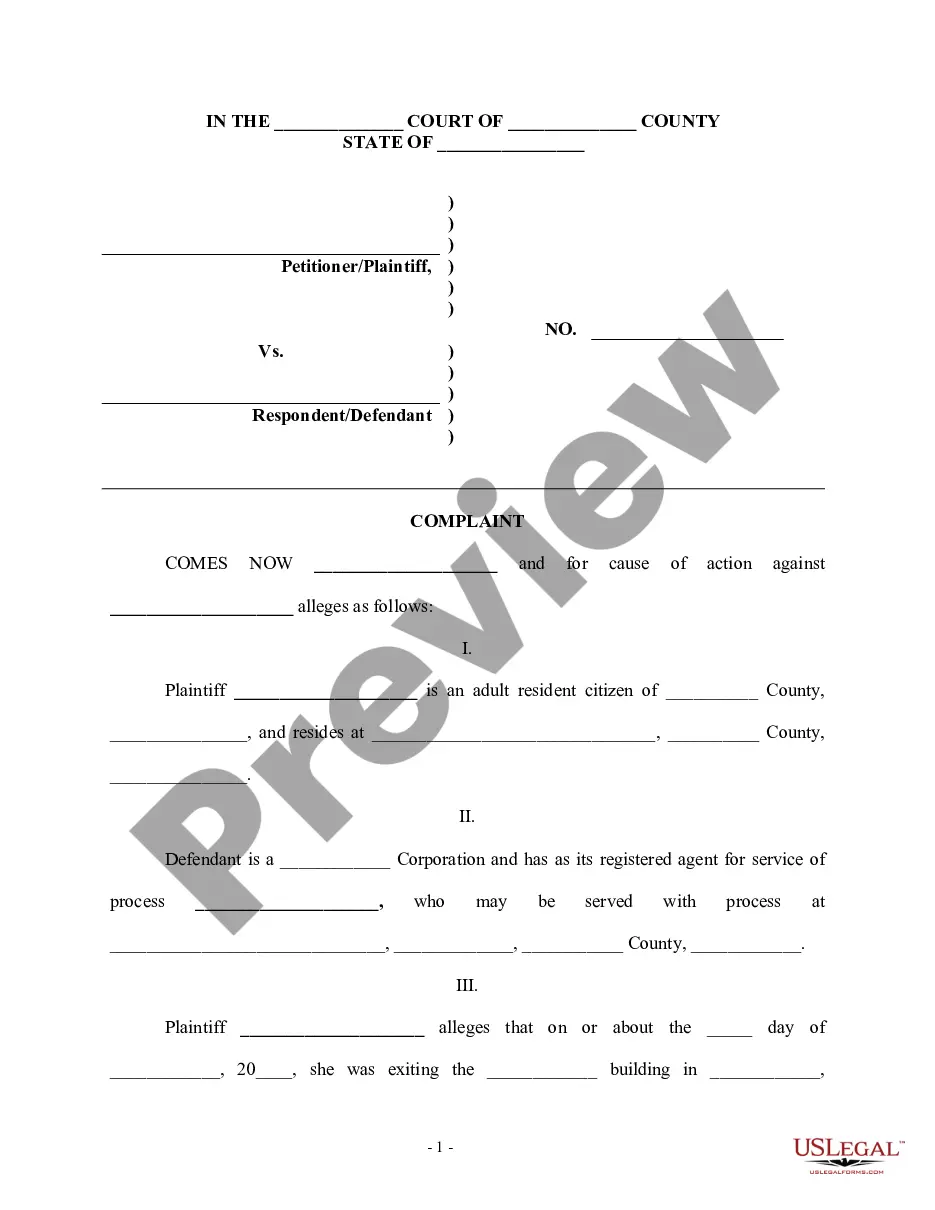

How to fill out Complaint For False Arrest And Imprisonment - 4th And 14th Amendment, US Constitution - Jury Trial Demand?
Regardless of whether it is for commercial reasons or personal issues, everyone must confront legal matters at some point in their life.
Filling out legal documents demands meticulous care, starting with choosing the appropriate form template.
Select your payment method: use a credit card or PayPal account. Choose the desired file format and download the 4th Amendment Of Us. Once saved, you can complete the form using editing software or print it out and finish it manually. With a vast catalog from US Legal Forms available, you do not need to waste time searching for the right sample online. Utilize the library’s intuitive navigation to find the correct form for any situation.
- For instance, if you choose an incorrect version of a 4th Amendment Of Us, it will be declined upon submission.
- Thus, it is crucial to find a reliable provider of legal forms such as US Legal Forms.
- If you need to obtain a 4th Amendment Of Us template, follow these straightforward steps.
- Locate the required template using the search bar or catalog browsing.
- Review the description of the form to ensure it aligns with your situation, jurisdiction, and locality.
- Select the preview of the form to inspect it.
- If it is not the right document, return to the search feature to find the appropriate 4th Amendment Of Us template.
- Acquire the document if it suits your specifications.
- If you possess a US Legal Forms account, click Log in to retrieve previously stored forms in My documents.
- If you have not created an account yet, you can purchase the form by clicking Buy now.
- Select the correct payment option.
- Complete the registration form.
Form popularity
FAQ
Generally speaking, the Fourth Amendment of the US mandates that individuals have a reasonable expectation of privacy. It protects against arbitrary government actions by ensuring that any search or seizure must be justified through a legal process. This principle safeguards personal freedoms and promotes trust in legal systems. Utilizing platforms like US Legal Forms can help you learn more about your rights under the Fourth Amendment and how to address potential violations.
The 4th Amendment of the US protects citizens from unreasonable searches and seizures. It requires law enforcement to have a warrant, supported by probable cause, before searching an individual or their property. This amendment serves as a fundamental right, ensuring that privacy is maintained unless there is a valid reason for intrusion. For anyone looking to understand their rights and navigate legal complexities, US Legal Forms offers resources that clarify these protections.
The 4th Amendment, or the 4 Amendment of the US, focuses on the protection against unreasonable searches and seizures. It requires law enforcement to obtain a warrant, backed by probable cause, before conducting searches. By safeguarding your privacy, this amendment plays a vital role in how law enforcement operates. Knowing your rights under the 4th Amendment of the US is important for protecting your personal freedoms.
The first ten amendments, collectively known as the Bill of Rights, establish key individual freedoms. They cover essential rights like freedom of speech, religion, and the right to assemble peacefully. Among these, the 4th Amendment of the US provides crucial protections regarding searches and seizures. Familiarizing yourself with these amendments empowers you to advocate for your rights.
The U.S. 5th Amendment provides several protections related to legal proceedings. It ensures that no person shall be compelled to testify against themselves, which is a fundamental aspect of due process. Additionally, it addresses issues of double jeopardy and protects against the taking of private property without just compensation. Understanding the 5th Amendment complements your knowledge of the 4th Amendment of the US.
The first ten amendments to the US Constitution, known as the Bill of Rights, include protections such as freedom of speech, religion, and the right to bear arms. Specifically, they include the 1st Amendment through the 10th Amendment, highlighting individual rights and government powers. The 4th Amendment of the US falls within this group and emphasizes privacy and security against arbitrary government action. Learning these amendments can enhance your understanding of American law.
The United States Constitution has a total of 27 amendments, starting with the Bill of Rights, which includes the first ten amendments. These amendments outline the fundamental rights of individuals and the limitations on government power. The order of the amendments addresses various important issues, including freedoms of speech, religion, and protection against unfair legal processes. For specifics regarding the 4th Amendment of the US, consider exploring the Bill of Rights.
The 4th Amendment of the US protects individuals from unreasonable searches and seizures by law enforcement. It ensures that you have the right to privacy in your home and property. This means that any search without a warrant or probable cause is typically considered illegal. Understanding the 4th Amendment of the US is essential for knowing your rights.
To invoke the 4th amendment of us, you can express your right to privacy when law enforcement approaches you for a search. You can clearly state that you do not consent to the search or seizure of your property. If a search occurs without a warrant or probable cause, you may challenge it in court by citing the 4th amendment. Understanding these rights can help protect you in potentially invasive situations.
The 4th amendment of us protects citizens against unreasonable searches and seizures. It requires law enforcement to obtain a warrant based on probable cause, describing the specific places to be searched and the items to be seized. Additionally, citizens must have a reasonable expectation of privacy in the area searched. This amendment plays a crucial role in preserving individual privacy rights.